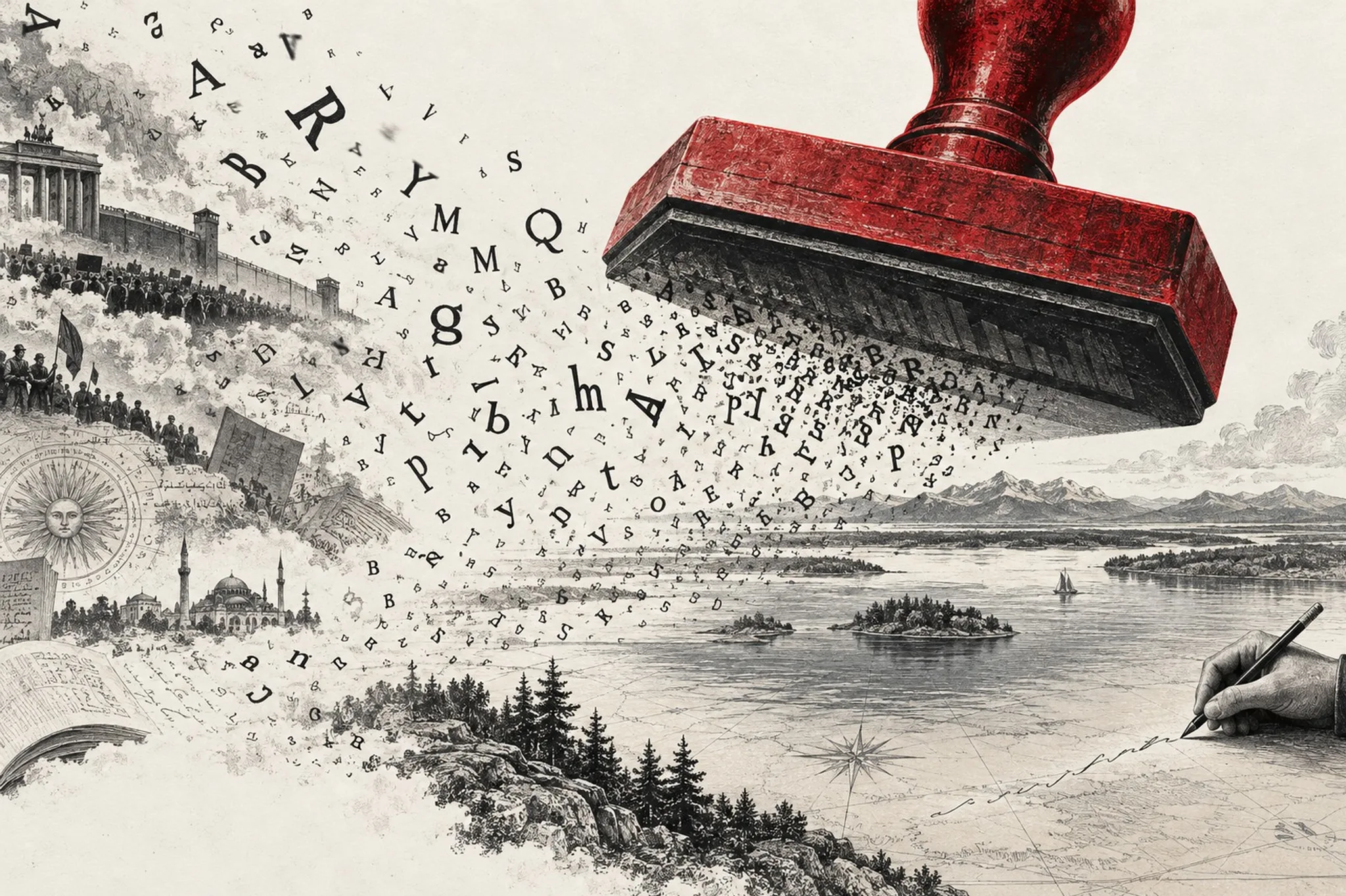
A lake can receive a new official name in a day. A language cannot.
On 27 August 2026, the president of the United States signed an order directing the federal government to call Lake Ontario Lake America. The water did not move. Its shores did not change. The lake still bordered Canada. But an authority with control over American federal naming records had changed what its own institutions were instructed to say.1
Two days later, Google described how it would handle the change. Users in the United States would see Lake America. Canadians would continue to see Lake Ontario. Others would see both. One geographical feature, one technology platform, different names determined by the viewer’s location.2
Earlier, on 20 January 2025, an executive order had directed the US government to use Gulf of America for the portion of the Gulf of Mexico specified in the order. Google subsequently displayed the name differently for American, Mexican and other users.34
Then the campaign arrived at a word closer to the heart of the technology industry. On 29 September 2026, Executive Order 14434 directed the executive branch, to the extent permitted by law, to substitute Super Intelligence and SI for Artificial Intelligence and AI across non-statutory federal materials. The order did something stranger than a casual rebranding: it expressly defined its preferred term to mean the technologies already encompassed by an existing statutory definition of artificial intelligence. It attempted to change the label while holding the referent constant.5 Reuters reported on 6 October that the US Justice Department had instructed staff to follow the change in most contexts—an early indication that the order was moving beyond a symbolic announcement.6
On 8 October, Donald Trump posted that the White House considered anyone who used Artificial Intelligence rather than Super Intelligence “THE ENEMY!” The original post is recorded with its timestamp and identifier; reporting on it followed immediately.7
The president can instruct a federal agency to use a word. He cannot, by that act alone, force a Canadian resident to rename a lake, a scientist to redefine a technical category, or a writer to accept an official term as an editorial truth. The distinction is not semantic trivia. It goes to the relationship between political power and human thought.
And it raises a historical question. When rulers try to name the world for everyone else, what actually happens?
1. Four different powers over a word
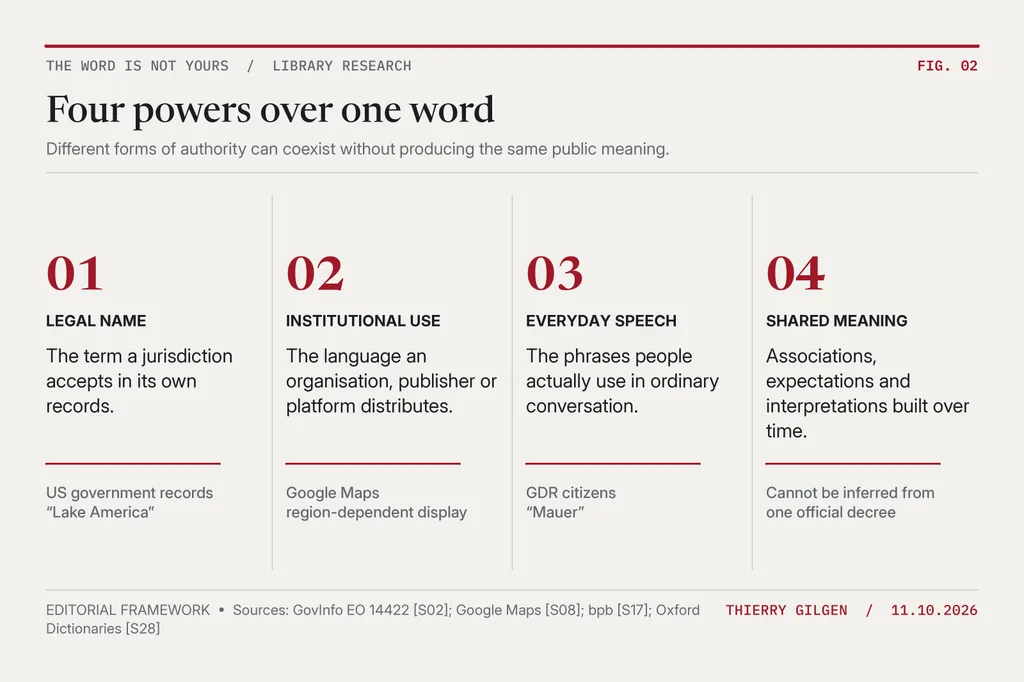
Before drawing historical comparisons, we should separate four things that are often collapsed into one.
A legal name is what a jurisdiction recognises in its own records. An institutional term is what a school, newspaper, laboratory, corporation or government office uses within its organisation. Public usage is what people actually say or write. Shared meaning is how a community understands the term, including its emotional and moral associations.
These layers can overlap. They can also contradict each other. A state may dictate the first, strongly influence the second, put pressure on the third, and try to reshape the fourth. But none is automatically identical to the others.
This distinction explains why the two maps of Lake Ontario matter. A US federal name can be binding within a federal naming system without becoming the accepted international name. A platform can adopt that federal record in one market while preserving another name elsewhere. Millions of people may encounter the new label without ever choosing to say it.12
It also explains why the dispute over superintelligence is more than politics. AI researchers have long used that word for a proposed level of machine intelligence substantially above human capabilities across many domains. The September order gives Super Intelligence a much wider administrative definition. Both uses can exist simultaneously; the scientific meaning does not disappear merely because an executive order assigns a new one for government documents. A 7 October 2026 Nature explainer lays out this definitional gap.58
Language is therefore a domain of overlapping authority, not a single kingdom. Officials, professionals, publishers and ordinary speakers all affect its fate. Some have the power to mandate; others have the power to distribute; others have the power to accept, ignore, subvert or remember.
2. The man who listened to a dictatorship speak
Long before search engines could update a map, Victor Klemperer listened to a country being linguistically remade.
Klemperer was a Jewish German scholar of Romance languages. Stripped of his academic position under the Nazis, he survived the regime and kept notes on how its language entered everyday life. In 1947, he published LTI: Notizbuch eines Philologen—The Language of the Third Reich. The title’s Latin abbreviation was itself a parody of the regime’s bureaucratic affection for grand-sounding initials.910
What makes Klemperer’s work indispensable is that he looked beyond spectacular speeches. A dictatorship also speaks in forms, slogans, school lessons, headlines, euphemisms and the phrases ordinary people repeat almost without thinking. His historical observation was not that a word hypnotises a population, but that repeated linguistic habits can normalise categories and assumptions. The accumulated record is more revealing than any isolated sentence.
The Nazi regime systematically controlled who could publish and what could appear in print. Under Joseph Goebbels, the Ministry of Public Enlightenment and Propaganda supervised major sections of the press, radio, film and culture. The Editors Law of 1933 excluded Jewish journalists and set conditions for professional participation. The ministry issued guidance dictating which stories could be covered and how. Compliance did not depend on winning arguments: loss of employment, imprisonment and other reprisals made the orders consequential.1112
Words served different political functions. Volksgemeinschaft, the supposedly unified national community, was built around an exclusionary racial idea: belonging was defined in ways that excluded Jews and others. Gleichschaltung, literally bringing into line, presented enforced institutional subordination as coordination.13 In the machinery of persecution and murder, Sonderbehandlung (special treatment) and Umsiedlung (resettlement) concealed killings and deportations behind administrative language. The US Holocaust Memorial Museum documents this use of euphemisms as part of a system designed to mislead victims, bystanders and officials.1415
These are not examples of harmless wordplay. They concern a state that orchestrated persecution and genocide. To say that language mattered is not to claim that words caused the Holocaust on their own. Institutions, ideology, armed power, bureaucracy and individual choices were essential. Language helped coordinate, conceal and legitimise what those institutions did.
Then there is a peculiarly revealing episode. Goebbels himself initially disliked propaganda as a ministry title because the public already associated the term with lies. After the ministry was established, he proposed calling it the Ministry of Culture and Public Enlightenment. Hitler vetoed the idea. The regime’s propaganda chief was trying to rebrand propaganda.11
That attempt teaches something different from the Nazi euphemisms: even rulers with extraordinary coercive power recognised that a word’s existing associations could resist their intentions. They could alter what appeared on a ministry door. They could not simply abolish what people understood by the term.
Klemperer’s warning remains useful today, provided we use it with care. Not every manipulative slogan is fascism. Not every effort to standardise terminology is propaganda. The relevant questions are what meanings are being smuggled into language, who is compelled to repeat them, and what happens to those who refuse.
3. The wall that called itself protection
At dawn on 13 August 1961, the East German authorities began closing the border around West Berlin. The separation became the Berlin Wall, a fortified system that restricted movement, divided families and was defended by armed guards. Millions had already left East Germany between 1949 and 1961; preventing further departures was a central function of the new border regime.1617
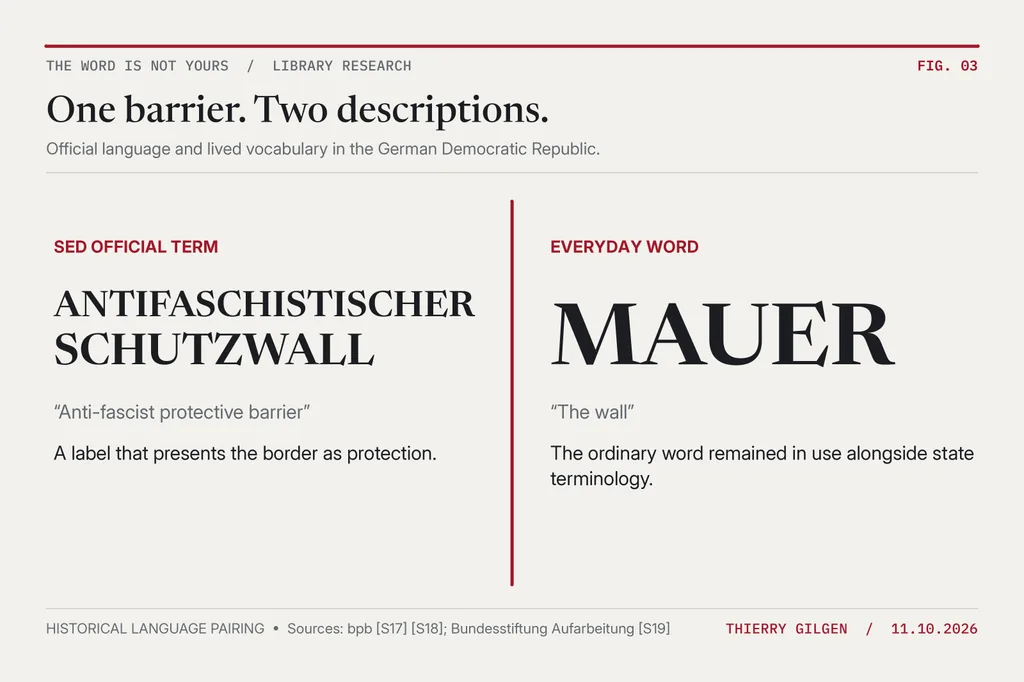
The Socialist Unity Party, the SED, supplied a different description: Antifaschistischer Schutzwall—an anti-fascist protective barrier. In official language, the fortification protected socialism from external enemies. In the lives of residents, it prevented them from crossing to the West.1617
For a writer, this may be the purest historical case in the volume. The state and the citizen could stand before the same concrete structure and attach radically different descriptions to it.
But we should not romanticise the citizen as automatically immune to propaganda. The GDR had schools, television, newspapers, employers and security agencies capable of enforcing its public vocabulary. People could use official phrases because they believed them, because it was professionally useful, because it was safer, or simply because repetition made them familiar. We cannot read private attitudes off public speech.
What we can observe is that the official term never displaced ordinary alternatives completely. Germany’s Federal Agency for Civic Education, in its research on language in the GDR, records precisely the kind of parallel naming that existed beneath the sanctioned vocabulary: Mauer instead of antifaschistischer Schutzwall; Rotlichtbestrahlung rather than party meeting; and a profusion of joking nicknames for the secret police and everyday objects. Some terms were spoken more freely in private than in public.18
This was not a heroic revolution every time someone said Mauer. Often it was just ordinary speech. But that is the point. Language generated from everyday experience continued to coexist with language issued from above.
When the border opened on 9 November 1989, the official formula had no great popular future to reclaim. The Berlin Wall remained the name around which memories, museums, photographs and arguments accumulated. The GDR’s state vocabulary had achieved official circulation; it had not secured permanent social adoption.16
4. When a label becomes a verdict
The Soviet experience reveals a more dangerous use of language: a category that changes how a person may be treated.
During Stalin’s rule, enemy of the people became a political accusation capable of destroying reputations and lives. It was not merely an insult; in the conditions of the purges it was a marker used to justify repression. One of the clearest historical interpretations came from inside the Soviet leadership itself. In his speech to the Communist Party’s Twentieth Congress in February 1956, Nikita Khrushchev condemned Stalin’s use of the expression, arguing that it eliminated the need to prove an opponent’s alleged errors and helped enable severe repression.19
A word cannot arrest someone. Police and institutions do that. But a political classification can make persecution appear deserved before evidence is presented. It can collapse the distinction between an adversary, a dissenter, a suspect and an enemy.
We should be precise about the historical parallel. Trump’s October 2026 post applies an enemy label to people who use a disfavoured technological term. That is a documented rhetorical act. Stalin’s campaigns involved mass imprisonment and killing. The phrases can be compared as mechanisms of delegitimisation without equating the political systems or their consequences. Historical comparisons become irresponsible when they treat resemblance in vocabulary as proof of equivalence in violence.719
The narrower, defensible concern is serious enough: when leaders describe disagreement over terminology as hostility to the state, they try to move a dispute from the arena of reasons to the arena of allegiance.
5. Mao’s revolution and the battle over acceptable words
During China’s Cultural Revolution, launched in 1966, accusations such as capitalist roader and counterrevolutionary helped classify people as political threats. Revolutionary language was reproduced through publications, meetings, wall posters and campaigns. The classifications did not merely describe political debates; they could be entangled with humiliation, persecution and severe violence.
The most credible document for assessing the campaign’s institutional legacy is strikingly self-critical. In 1981, the Chinese Communist Party’s Central Committee adopted a resolution calling the Cultural Revolution the gravest setback and losses the country had experienced since 1949 and stating that Mao initiated and led it. The resolution explicitly criticised the way the campaign had confused right and wrong—and the people with their alleged enemies.20
This does not mean the Chinese state ceased trying to guide public expression. It means that a political establishment can later repudiate language and doctrines it had itself propagated. The life of an official term is not guaranteed by the system’s continuity.
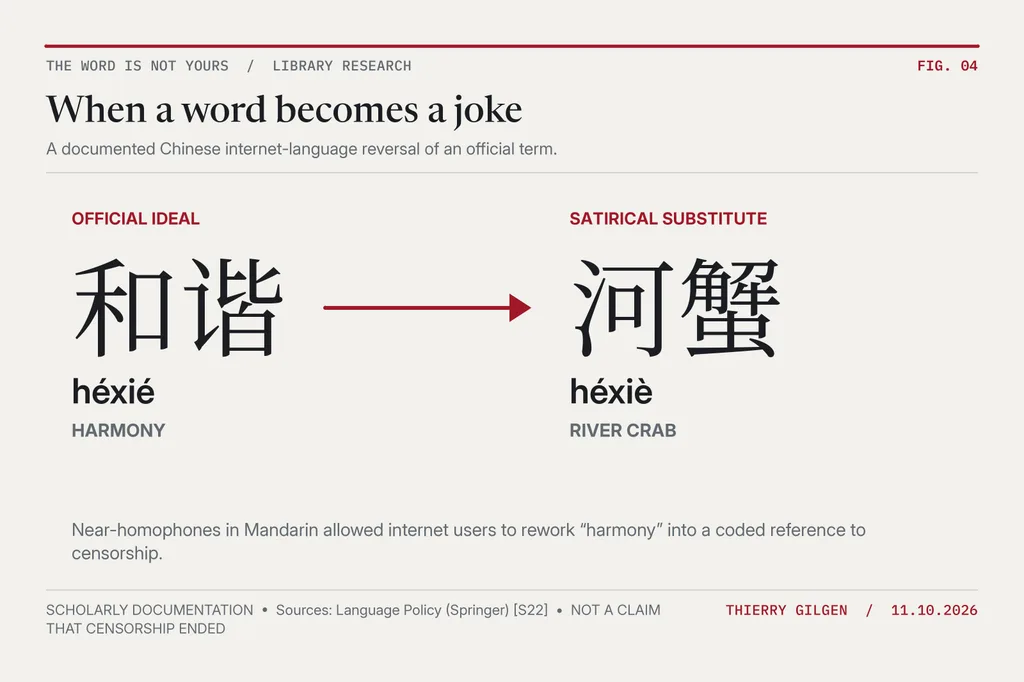
China also provides a case of linguistic resistance which would have delighted the GDR’s creators of dark humour. As internet censorship expanded, Chinese users began turning political language against itself. The official ideal of harmony—héxié—became associated online with censorship. People substituted the near-homophone river crab—héxiè—and circulated imagery of a fictitious grass-mud horse, with a name resembling an obscene phrase, as an absurdist character of resistance. Linguistic scholarship documents how these puns moved between online and offline discussion.21
This is not evidence that humour defeated censorship. Governments can block jokes, punish speakers and adapt their filters. Researchers Gary King, Jennifer Pan and Margaret E. Roberts analysed the selective removal of Chinese social-media posts and found, for the sites and period they studied, that messages associated with collective action faced distinctive censorship risks even when ordinary criticism sometimes remained. It is a crucial warning against assuming that any surviving joke demonstrates freedom of speech.22
What the puns do show is that language is inventive under pressure. The intended meaning of a word can be reversed by the very people expected to repeat it.
6. Why simply saying “language cannot be dictated” is wrong
There is a temptation now to conclude that authoritarian naming always collapses and everyday speech always wins. History does not permit that comforting conclusion.
Governments can change writing systems, calendars, legal terminology and administrative place names. States possess schools, tax systems, publishers, archives and bureaucracies. Children can grow up knowing only a term that was politically new to their grandparents. A policy can become habit, and habit can become culture.
The most useful test is to compare two quite different state-led reforms, both of which began with an unmistakable decision from above.
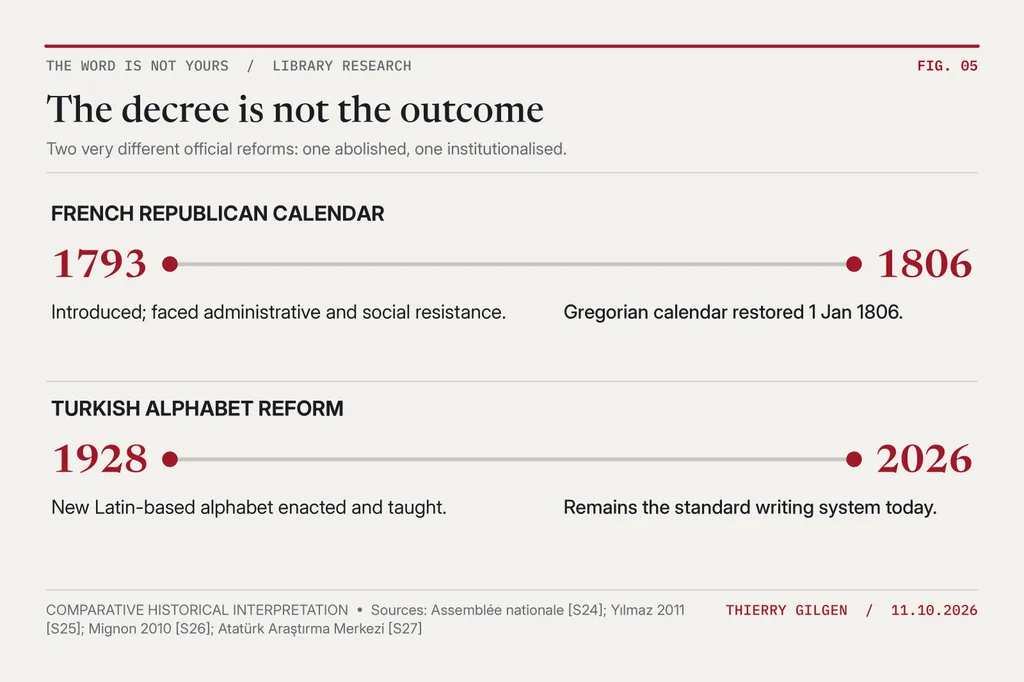
In France, revolutionaries introduced a republican calendar in 1793. Months received names such as Vendémiaire, Brumaire and Thermidor; weeks were organised into ten-day cycles. The reform was intended in part to break with the religious and monarchical order and shape a secular republican society. Yet it met administrative difficulties and resistance, particularly in rural areas. Napoleon abolished it in September 1805 and the Gregorian calendar returned on 1 January 1806. A handful of its words survived as historical vocabulary. France had successfully established an official calendar for a period. It had not made that calendar permanent.23
In Turkey, the government under Mustafa Kemal Atatürk changed the national script in 1928, moving from the Ottoman Arabic-based writing system to a Latin-based alphabet. Unlike the French calendar, the new script became enduringly normal in education, administration and public life. Yet scholarship warns against treating its adoption as painless or instantaneous: lived experiences varied, older reading practices survived and officials sometimes confronted active or silent resistance.242526
These are not politically or morally equivalent projects to Nazi or Stalinist terror. They are useful because they isolate a different question: under what conditions does an imposed linguistic reform become ordinary practice?
The contrast suggests—not proves—that a reform may endure when institutions sustain it across generations, when it reorganises practical necessities and when new speakers learn it as their default. It may fail when its demands conflict persistently with entrenched routines, religious life or practical convenience. Every case requires its own evidence.23242526
7. Maps have become publishers
The twenty-first century adds a new institution to the story: the platform that quietly decides which term a user encounters.
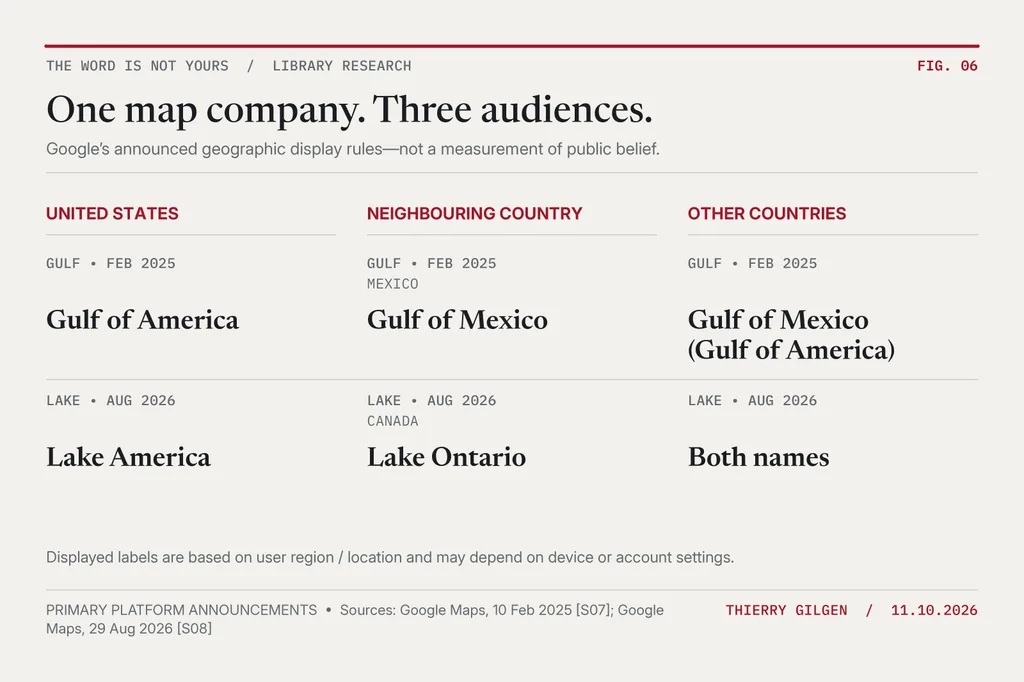
In February 2025, Google said it would show Gulf of America to users in the United States, Gulf of Mexico to those in Mexico, and both terms elsewhere. In August 2026, Google announced a comparable regional arrangement for Lake America and Lake Ontario. These were published product policies, not an independent survey of what people called the waters.42
The implications are substantial. Maps are no longer only printed documents that people knowingly choose. Their labels appear in searches, navigation systems, everyday directions and embedded software. A naming decision can be incorporated into a product before a public consensus exists. The visibility of a word can therefore increase through infrastructure as well as persuasion.
That makes the old distinction between an official name and a popular name harder to observe. Seeing a term a thousand times is not the same as believing it, but it can make the term familiar. The exposure comes through a product interface that often feels more like neutral geography than editorial choice.
The pressure is not always confined to software. In February 2025, Trump said he would continue restricting Associated Press access until the news agency adopted Gulf of America in its reporting. AP continued using Gulf of Mexico while acknowledging the US government’s preferred designation. Litigation followed, with competing legal interpretations of presidential press access and viewpoint discrimination. The documented event is the attempt to condition access on a newsroom’s terminology—not a final judicial conclusion that all such disputes have been resolved.2728
The modern struggle is therefore conducted across executive orders, newsrooms, search indexes and product interfaces. It asks who gets to set the default term when billions of people encounter the world through privately operated systems.
The platform that could not retire its old name
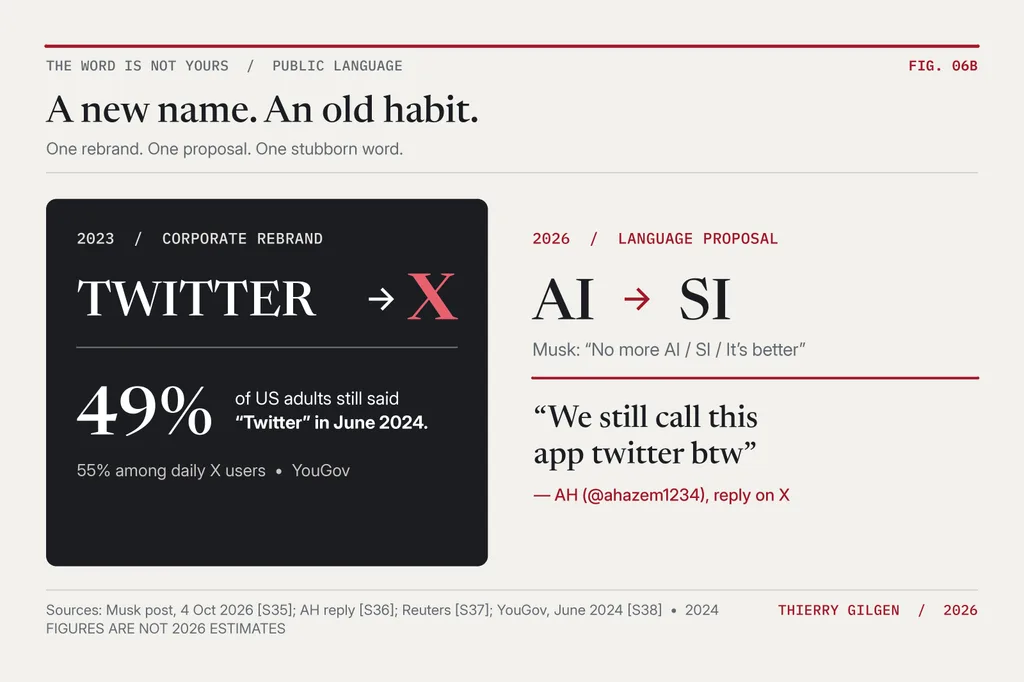
Elon Musk has experienced the same tension between official naming and public habit in his own business. In July 2023, he began rebranding Twitter as X. He could change the company’s signs, logo, app branding and official accounts. Whether users would adopt the new name was a different question.29
On 4 October 2026, Musk proposed another substitution, posting three short lines on X:
No more AI
SI
It’s better
The post is preserved under its original X status identifier. Reuters separately reported that Musk said he intended to rename SpaceX’s AI unit from SpaceXAI to SpaceXSI, but did not give an implementation timetable.3031 By 10 October, the unit’s X account had changed its handle from @SpaceXAI to @SpaceXSI; whether the company’s legal name, website and products would follow had not been announced.32
One reply, from an account using the display name AH (@ahazem1234), made a wonderfully economical counterargument:
We still call this app twitter btw
The exchange is traceable to the original posts. A reader-supplied screenshot captures the juxtaposition, although—as with any social-media image—the screenshot alone is not adequate proof of the posts’ authenticity.3033
The joke has support beyond a single comment. In a nationally representative US YouGov survey conducted 25–26 June 2024, 49% of adults said they generally called the platform Twitter; among daily users of X, the figure was 55%. That is a dated measurement, not evidence that those exact proportions persisted into October 2026. It nevertheless shows that the old term remained socially useful a year after the official rebrand.29
A corporate owner changing a product’s name is not equivalent to a government compelling speech, let alone to dictatorship-era repression. The mechanisms and consequences are different. What the cases share is the gap between controlling an official label and obtaining voluntary adoption.
Musk could rename the platform. He could not make everyone stop calling it Twitter.
8. What words can—and cannot—do to thought
The question now becomes philosophical and empirical. Does controlling language control what people think?
The strong version of that claim is unsupportable. Human beings can recognise lies, maintain private disagreements and invent new descriptions. They can even use a mandated word sarcastically. Yet it would be equally mistaken to claim that vocabulary is nothing more than a replaceable label. Language supplies recurring categories, metaphors, assumptions and frames through which people interpret events.
In a well-known 2011 set of experiments, Paul Thibodeau and Lera Boroditsky found that describing crime metaphorically as a beast rather than a virus affected the policy solutions participants proposed. A later peer-reviewed follow-up by Gerard Steen, Gudrun Reijnierse and Christian Burgers challenged methodological features of that research, introduced neutral comparisons and did not find the same metaphorical framing effect in four experiments. The studies do not establish that wording never matters; they demonstrate why findings about its influence must be tested rather than assumed.3435
Political scientist Timur Kuran provides another missing piece. In research on the unexpected revolutions of 1989, he argued that the divergence between private preferences and public declarations could make regimes appear more secure than they were. If people are afraid to contradict official orthodoxy, what they say in public ceases to be a transparent measure of what they believe.36
The lexicographer adds a useful reality check. Oxford’s description of how it evaluates new words points to evidence of usage across sources, not decrees from an author, dictionary or politician. Even a fast-spreading expression needs uptake beyond its originator to become an established word in common language. Dictionaries increasingly document practice rather than pre-authorise it.3738
And philosophers of language have long cautioned against treating meaning as an object controlled by a single speaker. Wittgenstein’s use-oriented account is sometimes reduced to a slogan—meaning is use—but scholarly interpretations emphasise that his claim concerned a large class of cases, not every possible word and naming convention. The qualification is worth keeping.39
Taken together, these literatures support neither naïve optimism nor linguistic fatalism. Words can alter what people notice and how they frame choices. Institutions can make particular expressions difficult to avoid. And yet public repetition, personal understanding and genuine social acceptance remain distinguishable.
9. The diagnostic test: four questions whenever someone renames reality
The historical record suggests a practical framework for reading official language.
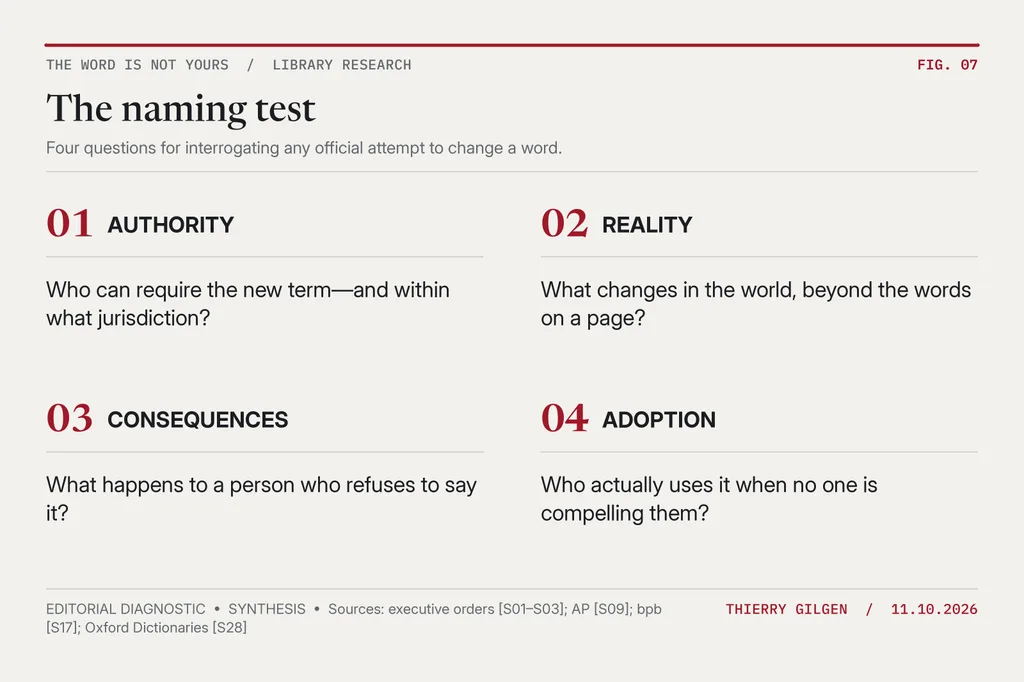
First: who has the authority to require the term? A national government may control its own records. A professional body may control its technical vocabulary. A platform may control a product’s labels. These are different jurisdictions of language, and their boundaries matter.
Second: what changes when the term changes? In the Lake Ontario example, water and borders remain the same. In the AI example, the executive order expressly reuses an existing statutory definition. Sometimes a new term accompanies genuine reform; at other times it simply redescribes an unchanged thing.15
Third: what happens to someone who refuses? The distance between an official style guide and a threat of reprisal is politically enormous. Compare a dictionary adding a word, a ministry ordering an employee to use it, a newsroom losing access for rejecting it, and a state persecuting people under an enemy classification. All concern language, but the consequences are not comparable in severity.271119
Fourth: did the word actually spread? A new name appearing on a map is evidence of display policy. A newspaper adopting it is evidence of editorial usage. Public acceptance requires stronger data: independent corpora, longitudinal surveys, conversations, and evidence from different communities. The correct answer to the fate of the 2026 renamings is still we do not know.4237
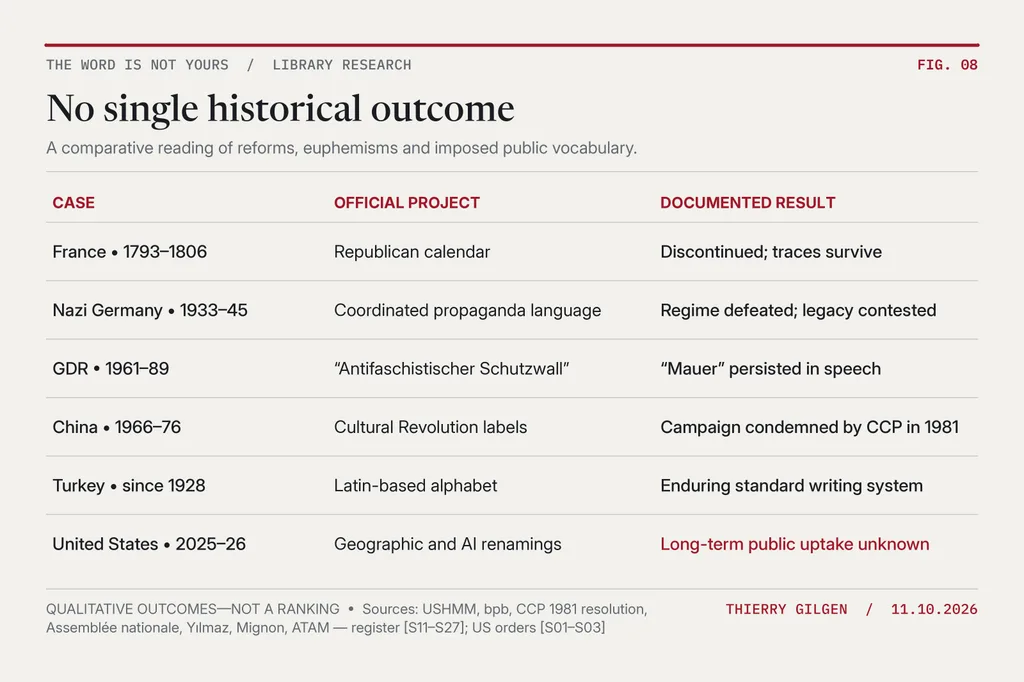
10. A language is a commons, not a throne
When a regime falls, some of its words vanish from public life, others survive as warnings, and still others linger almost unnoticed. Sometimes a political project succeeds so thoroughly that its original political authorship becomes invisible. Sometimes people keep using the older name for decades. Sometimes the new term survives, but only as a joke.
That variability is the heart of the story.
A lake is not changed by its label. But a label can change what an official map shows, what a newsroom is pressured to print and what a child encounters on a screen. An enemy classification cannot by itself imprison a person; in the hands of a repressive state, it can assist a system that does. A word cannot compel belief; repeated words embedded in institutions can shape the conditions under which beliefs are expressed and contested.
Donald Trump’s renaming campaign is not equivalent to the terror of Hitler, Stalin or Mao. That claim would distort history. What makes the comparison worth making is a narrower mechanism visible across very different systems: the attempt to convert political authority into authority over meaning. The means differ. So do the stakes. The temptation is recognisable.
The most remarkable people in this history are therefore not the leaders who coined or prohibited expressions. They are Klemperer, documenting words while endangered by them; East Germans quietly saying Mauer; Chinese internet users bending harmony into ridicule; the readers, speakers and writers who resisted the idea that a word printed by power was necessarily the whole truth.
One can command the form of an official sentence. One can even make enormous numbers of people repeat it.
But a command, a repetition and a belief are not the same thing.
The word is not yours.
Method and limits
This volume is a comparative historical essay, not a claim that its cases are politically or morally equivalent. It prioritises original executive orders, archived statements, institutional histories, scholarly studies and named historical source texts.
The contemporary situation is assessed as of 11 October 2026. The article does not claim to have measured population-wide adoption of Trump’s preferred names. It reports announced platform policies, official instructions and selected public reactions, not a representative corpus study. The Chinese censorship research pertains to the sites and periods studied, not a universal description of all censorship in China today. The June 2024 Twitter/X usage poll is a historical snapshot rather than an October 2026 measure. Some historical works are available online only as abstracts or publisher summaries; the Sources list marks those limits.
The article also distinguishes: (1) mandated administrative vocabulary, (2) institutionally distributed vocabulary, (3) public usage, and (4) individual or collective belief. No simple causal inference from a label to behaviour is asserted. Original figures are interpretive graphics, not quantitative estimates, except where they reproduce documented dates and policies.
Sources
Footnotes
-
Executive Order 14422, 27 August 2026, via GovInfo. Honoring the American History of the Great Lakes and Renaming Lake Ontario as Lake America. Published in the Federal Register on 2 September 2026. Directs US federal records (GNIS); says nothing about Canadian usage. ↩ ↩2 ↩3
-
Google, The Keyword, 29 August 2026. How the GNIS Lake Ontario/Lake America name change in the U.S. will appear in Maps. Announced display policy, not a field study. ↩ ↩2 ↩3 ↩4
-
The White House, Executive Order 14172, 20 January 2025. Restoring Names That Honor American Greatness. Section 4, Gulf of America. Applies to federal naming; not an international renaming. ↩
-
Google, The Keyword, 10 February 2025. Gulf of America name change in the U.S. — what you’ll see in Maps. Announced display policy, not a measure of what people say. ↩ ↩2 ↩3
-
Executive Order 14434, 29 September 2026, Federal Register, 2 October 2026. Inaugurating the Era of Super Intelligence; White House version. Non-statutory executive-branch materials, to the extent permitted by law; the definition refers to 15 U.S.C. 9401(3). ↩ ↩2 ↩3
-
Reuters, 6 October 2026. US Justice Dept tells staff to call AI 'super intelligence' under Trump order. Reported internal directive; the memo was not obtained for this volume. ↩
-
Donald J. Trump, Truth Social, 8 October 2026, 12:14 EDT. Original post; archived copy with timestamp and status ID; Axios report, 8 October 2026. A rhetorical statement; the executive order sets no penalty. ↩ ↩2
-
Jenna Ahart, Nature, 7 October 2026 (updated 8 October). The science of superintelligence and why AI is still a useful word. News explainer on the research meaning of superintelligence. ↩
-
Reclam. Die Sprache des Dritten Reiches. Beobachtungen und Reflexionen aus LTI. Publisher’s page for a selection from Victor Klemperer’s LTI, first published in 1947. In German. ↩
-
Zeithistorische Forschungen, issue 2/2023. Sprachkritik und Autobiographie. Über Victor Klemperers „LTI“. Scholarly appraisal of LTI, including the abbreviation as satire. In German. ↩
-
United States Holocaust Memorial Museum, Holocaust Encyclopedia. Ministry of Propaganda and Public Enlightenment. Goebbels’s proposed renaming and Hitler’s veto; the Editors Law, daily directives and sanctions. ↩ ↩2 ↩3
-
United States Holocaust Memorial Museum, Holocaust Encyclopedia. Nazi Propaganda and Censorship. Overview of the regime’s press, school and media controls. ↩
-
United States Holocaust Memorial Museum, Holocaust Encyclopedia. Gleichschaltung: Coordinating the Nazi State. The regime’s term for forcing institutions into line. ↩
-
United States Holocaust Memorial Museum, Holocaust Encyclopedia. Glossary. Definitions of Volksgemeinschaft and Sonderbehandlung. ↩
-
United States Holocaust Memorial Museum, Holocaust Encyclopedia. Combating Holocaust Denial: Origins of Holocaust Denial. Euphemisms such as “special treatment” and “resettlement”. ↩
-
Bundeszentrale für politische Bildung (bpb), Kontraste. Glossar. Entries on the building of the Wall, the “antifaschistischer Schutzwall” and 9 November 1989. In German. ↩ ↩2 ↩3
-
Bundesstiftung zur Aufarbeitung der SED-Diktatur. Der Ost-West-Konflikt: Tod an der Mauer. Educational resource on the SED’s “antifaschistischer Schutzwall” narrative. In German. ↩ ↩2
-
Bundeszentrale für politische Bildung (bpb), 15 October 2010. Sprache und Sprachgebrauch in der DDR. Lists Mauer instead of antifaschistischer Schutzwall and Rotlichtbestrahlung instead of Parteiversammlung as parallel names. Examples, not frequencies. In German. ↩
-
Nikita Khrushchev, speech to the Twentieth Party Congress, 25 February 1956, in English translation. Secret Speech (excerpts), Internet Modern History Sourcebook; fuller transcript. A successor’s retrospective condemnation, not a neutral history. ↩ ↩2 ↩3
-
Central Committee of the Chinese Communist Party, 27 June 1981, English translation hosted by the USC US-China Institute. Resolution on Certain Questions in the History of Our Party since the Founding of the People’s Republic of China. The Party’s own retrospective assessment, not a neutral consensus. ↩
-
Xuan Wang, Kasper Juffermans and Caixia Du, Language Policy, published online 24 July 2015. Harmony as language policy in China: an Internet perspective. Open access. Source for 和谐 héxié, 河蟹 héxiè and the grass-mud horse (căonímă). ↩
-
Gary King, Jennifer Pan and Margaret E. Roberts, American Political Science Review 107(2), 2013, 326–343. How Censorship in China Allows Government Criticism but Silences Collective Expression; author page. Findings apply to the sites and period studied. ↩
-
Assemblée nationale, history and heritage pages. Convention nationale et calendrier républicain. Introduction in 1793, abolition on 9 September 1805, Gregorian calendar again from 1 January 1806. In French. ↩ ↩2
-
Hale Yılmaz, International Journal of Middle East Studies, 2011. Learning to Read (Again): The Social Experiences of Turkey’s 1928 Alphabet Reform. Abstract consulted; the full text may require access. ↩ ↩2
-
Laurent Mignon, Journal of the Royal Asiatic Society, 2010. The Literati and the Letters: A Few Words on the Turkish Alphabet Reform. Abstract consulted. ↩ ↩2
-
Atatürk Araştırma Merkezi, 27 June 2023. Harf ve Dil Devrimi. Institutional, commemorative account with contemporary statements. In Turkish. ↩ ↩2
-
Associated Press, 18 February 2025. Trump says AP will be curtailed at the White House until it changes its style to Gulf of America. Reporting by a party to the dispute, with Trump’s on-the-record statement. ↩ ↩2
-
Associated Press, 2025. Appeals court hands AP an incremental loss in its attempt to regain its access to Trump events; AP and Trump administration argue access case before federal appeals court, no ruling yet. Litigation coverage; preliminary decisions, not a final judgment. ↩
-
YouGov, 8 July 2024. A year after Twitter was rebranded to X, how has the brand progressed in the US?. Online survey of 1,190 US adults, 25–26 June 2024, weighted to be nationally representative. Not a 2026 measure. ↩ ↩2
-
Elon Musk, X, 4 October 2026. No more AI / SI / It’s better. Text and time checked against the original post on 11 October 2026. ↩ ↩2
-
Reuters, 4 October 2026. Musk says he will rename SpaceXAI to SpaceXSI. An announced intention; no timetable at the time of reporting. ↩
-
SpaceX Super Intelligence (@SpaceXSI), X account, checked 11 October 2026. @SpaceXSI on X; TeslaNorth report, 10 October 2026. Handle and display name checked on 11 October 2026; @SpaceXAI no longer resolves. No announcement found on the legal name, website or products. ↩
-
AH (@ahazem1234), X, 4 October 2026, reply to Elon Musk. We still call this app twitter btw. Checked against the original post on 11 October 2026. One reply, not a survey. ↩
-
Paul H. Thibodeau and Lera Boroditsky, PLOS ONE 6(2), 2011, e16782. Metaphors We Think With: The Role of Metaphor in Reasoning. Read together with the follow-up study below. ↩
-
Gerard J. Steen, W. Gudrun Reijnierse and Christian Burgers, PLOS ONE, 2014. When Do Natural Language Metaphors Influence Reasoning? A Follow-Up Study to Thibodeau and Boroditsky (2013). Four experiments with neutral comparison conditions. ↩
-
Timur Kuran, World Politics 44(1), 1991, 7–48. Now Out of Never: The Element of Surprise in the East European Revolution of 1989. Abstract consulted. A theory of preference falsification, not a survey. ↩
-
Oxford Dictionaries. How do you decide if new words should enter the dictionary?. One publisher’s method: evidence of use from more than one source. ↩ ↩2
-
Oxford Dictionaries. How have dictionaries changed over the years?. Corpus-based description of usage. ↩
-
Paul Horwich, Wittgenstein’s Metaphilosophy, Oxford University Press, 2012, chapter 4, “Meaning”. Chapter abstract; further scholarly discussion. Publisher abstracts consulted; the chapter was not reviewed in full. ↩