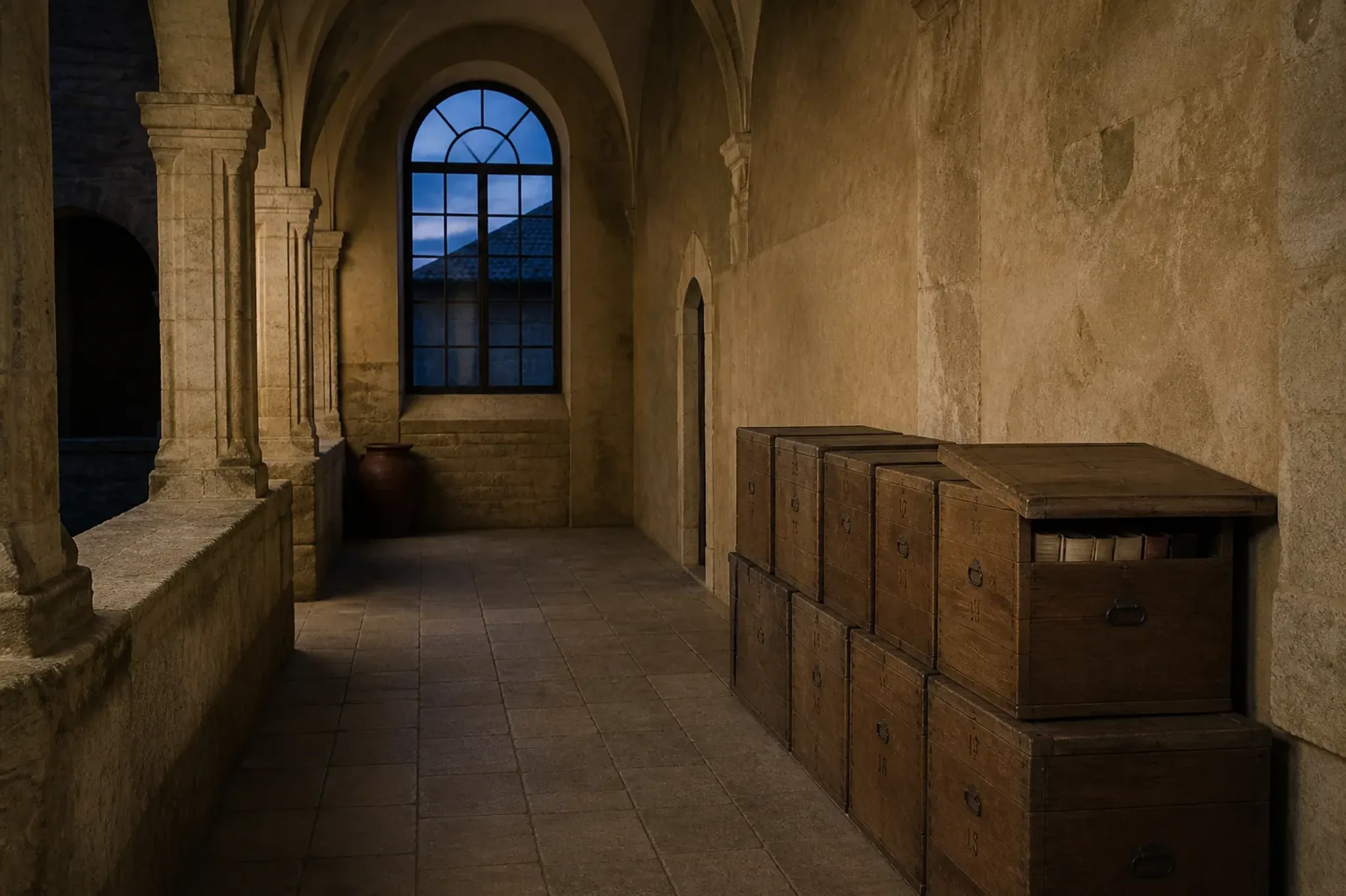
On the evening of 26 August 2026, I sat in the Universitätsbibliothek Basel listening to Noah Regenass speak about the library during the Second World War.
The title of the lecture came from the archive itself:
«(…) wir dürfen noch nicht an die Heimholung unseres Fluchtgutes denken.»
We cannot yet think of bringing our evacuated holdings home.
It is a remarkably quiet sentence for a time of war.
No drama. No grand declaration.
Just an institution that had moved part of its memory somewhere safer and a librarian who knew that it was still too early to bring it back.
What stayed with me most that evening was not a spectacular historical revelation. It was the manner in which the history was approached.
Regenass did not stand in 2026 and arrange the people of the 1930s and 1940s into comfortable moral categories. He reconstructed decisions, correspondence, circumstances and contradictions.
Some actions appear extraordinarily farsighted.
Others are uncomfortable from today's perspective.
Some questions remain unanswered because the surviving evidence does not allow a conclusion.
That restraint made the history stronger rather than weaker.
Understanding came before judgement.
And perhaps that is one of the first things a serious library protects.
Not innocence.
Complexity.
The plan was ready before the bombs fell
Basel was neutral during the Second World War.
It was not invulnerable.
A border city close to Germany and France could not assume that neutrality would protect every building, every collection or every person inside it. Bombs did fall on Basel during the war. On the night of 16 to 17 December 1940, a Royal Air Force attack intended for railway infrastructure hit the city and killed four people.
For the Universitätsbibliothek, the danger had been considered before then.
Karl Schwarber had worked at the library since 1920 and had been its Oberbibliothekar — effectively its chief librarian — since 1935. During the 1930s he was already asking what would happen to the collections if war reached Basel.
The questions were practical.
How do you protect valuable books from bombing?
What happens if collections are plundered?
Which material would be endangered by National Socialist ideology?
Where can manuscripts be moved?
How does a university library continue functioning if much of its staff is called into military service?
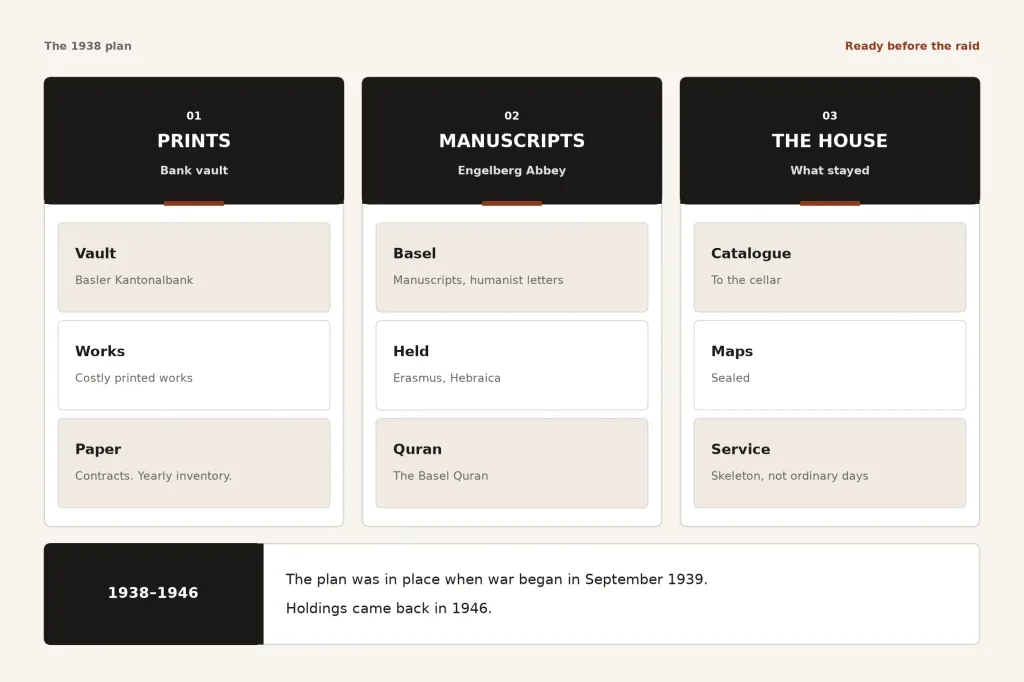
After Nazi Germany's annexation of the Sudetenland in 1938, Schwarber worked with Basel Regierungsrat Fritz Hauser, who headed the cantonal education department, on a concrete crisis plan.
The most valuable printed works were to be placed in the vault of the Basler Kantonalbank, then located beside the Hotel Drei Könige.
Manuscripts would be sent to the Benedictine monastery at Engelberg.
The Basel government approved the measures. Agreements existed with the bank and the monastery. Inventories were to be checked regularly. Individual objects could even be returned temporarily if research required them.
When war began in September 1939, the plan was not an idea waiting for implementation.
It was ready.
The Universitätsbibliothek's own anniversary publication contains a wonderfully unheroic piece of evidence. On 1 September 1939, a librarian named Scherrer informed Schwarber that the crates were packed and arranged according to number.
That may be the most convincing image of preparedness there is.
No speech.
No strategy paper.
Numbered crates.
The danger had not yet materialised.
The books were already packed.
I have previously argued that preparedness is one of the highest forms of sovereignty: the ability to detect, decide and move before pressure removes your choices.
In Basel in 1939, that principle existed physically.
It had box numbers.
What went into the crates
The material selected for protection was not random.
Among the manuscripts were Basiliensia: works with a particular connection to Basel and its intellectual history.
There were writings by Thomas Platter.
Collections of humanist correspondence.
Manuscripts connected with Erasmus of Rotterdam.
There were Hebraica — printed works and manuscripts in Hebrew.
There was also the Basel Quran, the famous Bibliander edition printed by Johannes Oporinus.
According to Regenass's account of the archival material, Schwarber understood that Jewish and Hebrew holdings would have been at particular risk had they fallen into National Socialist hands.
The library's own catalogue system also became an object requiring protection.
The card catalogue — the Zettelkästen that represented the library's memory of what it actually possessed — was moved into the cellar after the outbreak of war.
The map collection was sealed.
A map is not merely scholarship when armies are moving.
Geographical information can become military information very quickly.
The protected holdings remained away for years.
They returned in 1946.
A library at war is still a library
The Universitätsbibliothek did not continue normal operations throughout the war.
Regenass describes a Minimalbetrieb — skeleton service.
Many employees were serving in active military duty. The shortage of staff became a persistent problem. At one point the library had to close for ten days because there were simply not enough people.
At the same time, Schwarber argued that the institution had to remain available to teaching and research.
This matters.
A library's wartime responsibility is not only to put valuable objects in boxes.
It is also to remain a library for as long as it reasonably can.
Protection and access exist in tension.
Close everything and the collection may be safer, but the institution ceases to perform its public function.
Keep everything open as though nothing has changed and you may lose both the institution and the collection.
Stewardship is the work of managing that tension.
It is rarely elegant.
The archive refuses a clean story
It would be easy to turn the Basel story into a heroic narrative.
A wise librarian sees the danger.
The treasures are evacuated.
Civilisation is saved.
The archive does not permit such simplicity.
A letter survives concerning the possibility of employing women as temporary staff during the wartime shortage.
Schwarber wrote that further developments would show whether it would become necessary to bring in female Aushilfskräfte. For the moment, he did not consider it necessary.
This was written while the institution was struggling badly enough with personnel shortages that it would temporarily close.
The contradiction is uncomfortable.
It should remain uncomfortable.
There are other unresolved questions.
Regenass found documentation showing that the Universitätsbibliothek purchased books from a Jewish seller in Frankfurt. The precise circumstances of that transaction have not yet been reconstructed.
There were also plans to purchase antiquarian material that had entered the market as a consequence of the pogroms in Germany. From the currently published evidence, it is not clear whether that particular purchase was completed.
That distinction matters.
A receipt is evidence of a transaction.
It is not automatically evidence of looted property.
Provenance research exists precisely because the circumstances between those two statements have to be established rather than imagined.
The ideological picture is similarly complex.
Regenass describes correspondence with German libraries in which the Basel institution deliberately retained the closing formula Mit kollegialem Gruss rather than adopting National Socialist forms of greeting.
The library also continued acquiring communist literature because research, in Schwarber's conception of the institution, should not end at ideological borders.
None of these facts cancels the others.
An individual can recognise one danger clearly and remain blind to another.
An institution can act courageously in one domain and conservatively in another.
That is not a defect in the historical record.
It is the historical record.
The temptation to simplify the dead according to the moral vocabulary of the living is understandable.
But if history becomes useful only after we have cleaned away all contradiction, we are no longer studying history.
We are manufacturing a lesson.
A serious archive does something harder.
It keeps the evidence.
Globi becomes evidence
One of the most memorable slides that evening concerned a rather different kind of cultural object.
Globi wird Soldat.
The children's book was first published in Zürich in 1940. Ignatius Karl Schiele was responsible for planning and editing, Robert Lips for the drawings, and Alfred Bruggmann for the verses.
Globi's transformation into a soldier belonged unmistakably to the cultural atmosphere of wartime Switzerland. The book was public, contemporary, patriotic and approved by General Henri Guisan.
It was not a forbidden book.
It was not hidden underground.
It was part of the culture.
What made the slide so memorable was the judgement placed beside it.
The lecture presented a note condemning the use of the army as the subject of a children's joke book and describing the work as evidence of remarkably poor taste during the fifth year of the war.
I am deliberately careful here.
The note was shown during the lecture. I have not found a public catalogue record that independently establishes a 1944 Universitätsbibliothek Basel Militaria accession of this particular copy. I therefore treat it as evidence presented in the lecture, not as a provenance claim that can presently be reconstructed from a public catalogue.
But the intellectual point remains.
A library does not have to admire an object in order to preserve it.
In fact, sometimes disapproval is itself a reason to keep something.
A children's book can tell us what patriotism looked like.
What humour looked like.
How the army was presented to children.
What adults considered appropriate.
What another adult considered tasteless.
The judgement itself becomes historical evidence.
There is something almost beautiful about that.
The implicit archival decision is:
I think this is terrible. Keep it.
And because institutions make decisions like that, later generations gain the ability to disagree.
Perhaps we will agree that the book was tasteless.
Perhaps we will find it charming.
Perhaps we will read it as propaganda.
Perhaps as social history.
Perhaps as graphic design.
Perhaps someone eighty years from now will ask an entirely different question that none of us would think to ask today.
The library preserves that possibility.
It keeps the evidence required for us to disagree even with the people who kept the evidence.
That is institutional confidence of a very high order.
The questions that have not been asked yet
A library is often described as a place that preserves knowledge.
I think that definition is incomplete.
A library is not a warehouse of answers.
It is a bet that someone who does not yet exist will need evidence for a question we cannot yet specify.
Parish records are created for administrative purposes.
Centuries later they become genealogical evidence.
A newspaper records yesterday.
Later it becomes political history.
A children's book is entertainment.
Later it becomes evidence of wartime culture.
A handwritten annotation that appears insignificant today may become decisive to a researcher whose discipline does not yet exist.
This is what I mean by cultural optionality.
A society preserves enough of its past that future people retain meaningful choices about how to understand it.
Not every object can be saved.
Not every question can be anticipated.
But enough evidence must survive that the present does not acquire a monopoly over what the future is allowed to know.
This is why obscure material matters.
The regional newspaper.
The unpopular pamphlet.
The technical manual nobody checks out anymore.
The political argument that lost.
The edition with handwritten notes.
The binding.
The paper.
The ownership marks.
The children's book someone once thought ridiculous.
The point is not that everything deserves eternal preservation.
The point is that preservation decisions should recognise our ignorance about future relevance.
Libraries institutionalise humility about what will matter later.
The scan is not the book
I encountered a small version of this problem personally only weeks before Regenass's lecture.
The Universitätsbibliothek Basel had digitised my family history, Die Gilgen von Rüeggisberg.
That experience became the basis of an earlier volume: The Scan Is Not the Book.
Digitisation is extraordinary.
A scanned book can become searchable.
It can be transcribed.
It can be translated.
It can be read simultaneously on several continents.
It can become accessible to people who could never travel to the library that holds it.
A machine can compare it with thousands of other texts.
All of this is valuable.
But the scan is a layer.
The physical object remains evidence.
Its paper can tell us something.
Its binding can tell us something.
A handwritten note can tell us something.
Wear can tell us something.
Ownership marks can tell us where a particular copy travelled.
Digitisation preserves some properties of an object remarkably well.
It does not preserve all of them.
This distinction has become much more important because another kind of reader has entered the library.
The machine.
When a book becomes raw material
Artificial-intelligence systems need enormous quantities of human-created language.
Books are unusually valuable for that purpose.
This should not surprise librarians.
The technology industry has rediscovered something libraries have known for centuries: a book is an extraordinarily dense package of edited human thought.
The interesting question is what happens once the text becomes more valuable to a machine than the object is to the organisation extracting it.
The American copyright case Bartz v. Anthropic makes that tension unusually visible.
In June 2025, Judge William Alsup separated three different uses of books by Anthropic.
They should not be collapsed into one.
First, copies used to train the model were held to be fair use. The court regarded the use as transformative rather than a substitute for reading the books themselves.
Second, Anthropic had purchased physical books, converted them into digital copies on a one-for-one basis, destroyed the print copies and did not redistribute the resulting files. The court held that conversion to be fair use for a different reason: the company had lawfully acquired the copies and converted the format for its own internal library.
Third, copies obtained from pirate libraries including LibGen and PiLiMi were not fair use.
That distinction remained important when the litigation moved toward settlement.
On 20 July 2026 the court gave final approval to a settlement of $1.5 billion concerning the pirated class.
The settlement applies to works obtained through the pirate libraries.
It does not turn the settlement into a licence.
It does not cover the purchased-and-scanned books in the same way.
And while copies originating from the pirate sources are to be destroyed under the settlement terms, copies derived from Anthropic's own scans are not.
The law has therefore drawn distinctions that any serious discussion of the case must preserve.
But there is a second question that copyright law does not answer.
What cultural assumption is revealed by the physical process?
Purchase the book.
Remove the binding.
Cut the pages.
Scan the text.
Keep the data.
Discard the object.
Legally, the relevant question may be whether the use is permitted.
Culturally, another question appears:
What did we decide the book was for?
This is not book burning
The analogy to book burning is tempting.
It should be handled carefully.
Industrial scanning by an AI company is not Nazi book burning.
A company acquiring books because their contents have value as training material is not morally equivalent to a political regime destroying books because it wants to erase the people, ideas or cultures they represent.
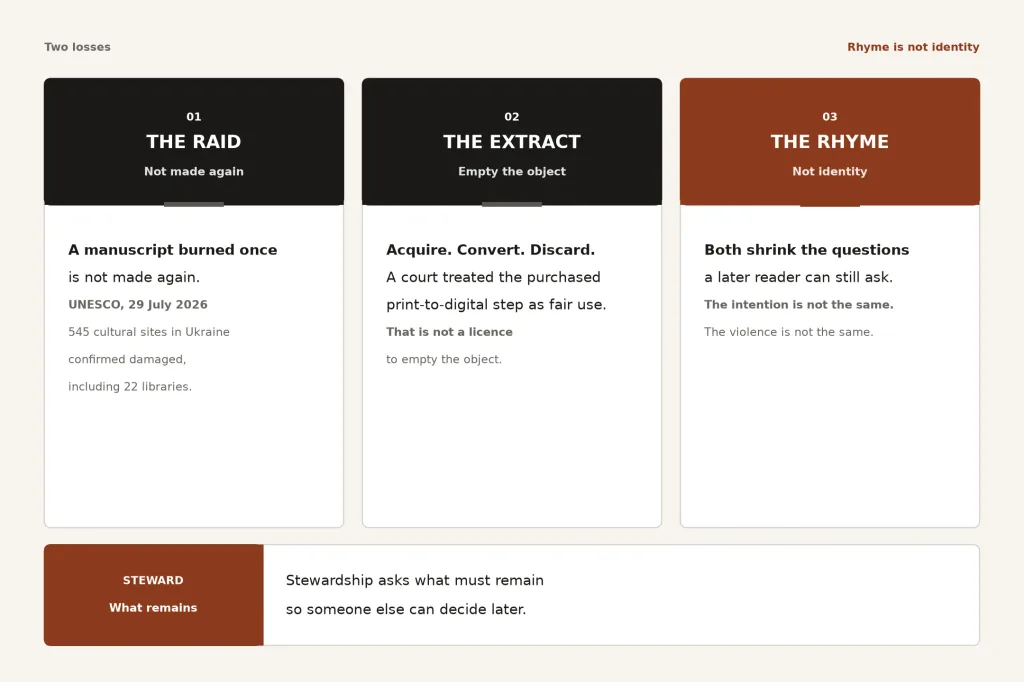
The intention is different.
The violence is different.
The historical circumstances are different.
To collapse these things into a single category would be exactly the kind of careless historical judgement that impressed me by its absence in Regenass's lecture.
But refusing a false equivalence does not mean that comparison itself becomes forbidden.
Different systems can reveal similar structural questions without becoming morally identical.
A regime engaged in cultural destruction may ask:
What must disappear?
An extraction economy asks:
What can be taken from this?
Stewardship asks something else:
What must remain so that someone else can decide later?
That is the distinction that interests me.
A raid destroys what is unwanted.
Extraction preserves what is useful and may discard what is not.
The first is an attack on memory.
The second can become an optimisation against the object.
They are not the same act.
But both can reduce cultural optionality if the evidence that disappears cannot be recovered.
Destructive digitisation is not new
There is an important historical complication.
Libraries themselves have practised destructive conversion.
The large-scale microfilming of newspapers in the twentieth century is an obvious example.
Newspapers printed on acidic wood-pulp paper deteriorate badly. Preservation programmes therefore transferred their contents to microfilm, and physical preparation could include removing issues from bindings and, where originals were not to be retained, cutting them for efficient filming.
Nicholson Baker's Double Fold made that controversy famous in 2001.
So the question is not as simple as libraries preserve while technology destroys.
Libraries also make choices.
Sometimes an object's informational content is judged more valuable than its continued physical survival.
Sometimes there are duplicates.
Sometimes the paper is already disintegrating.
Sometimes preservation resources are finite.
But modern preservation standards for rare and significant material have moved strongly toward non-destructive digitisation.
Google Books developed scanning equipment intended to photograph bound volumes without cutting them apart.
The Internet Archive describes its digitisation process as non-destructive and explicitly states that it does not cut bindings from books.
IFLA's guidelines for rare books and manuscript collections state that unbinding material for reproduction is no longer considered best practice and that original collections should not be discarded after digitisation.
The Swiss National Library operates from an even clearer preservation mandate: documents within its responsibility are to be preserved in their original form. Its digitisation procedures include examining the physical condition of objects before and after scanning.
That is a fundamentally different philosophy from treating the book as disposable packaging around a useful text.
The old threat has not disappeared
The discussion about AI and digitisation should not make us forget that the older threat remains completely real.
In Ukraine, libraries are once again being damaged by war.
UNESCO's official monitoring, as of 29 July 2026, had verified damage to 545 cultural sites in the country, including 22 libraries.
Those figures are preliminary and describe damaged cultural sites, not a complete inventory of destroyed collections.
But the principle is not ambiguous.
International organisations representing archives, libraries, museums and monuments have explicitly described the destruction of cultural collections as an attack on identity and memory.
International law recognised this long before the current war.
The 1954 Hague Convention for the Protection of Cultural Property in the Event of Armed Conflict explicitly includes manuscripts, books, important collections of books, archives, large libraries and archive repositories within the concept of cultural property.
And Article 3 contains a principle that connects directly back to Basel in 1938.
States are expected to prepare for the safeguarding of cultural property in time of peace.
That is a remarkable sentence.
Prepare in peacetime.
Do not begin thinking about the crates when the aircraft are already overhead.
Schwarber's plan was not merely good administration.
It expressed a principle that international cultural-heritage law would later formalise.
Move before pressure removes the possibility of moving.
The quieter threat
Today's European library is unlikely to begin its morning by seeing an enemy army at the city boundary.
The pressures are quieter.
Budgets tighten.
Storage becomes expensive.
Digitisation promises efficiency.
Global platforms become the default route through which people find information.
AI systems increasingly become the interface through which people ask questions.
Local publishing contracts.
Collections are evaluated according to usage figures.
Machine-readable text acquires new commercial value.
Each individual decision may be perfectly reasonable.
That is precisely why the development deserves attention.
Sovereignty is rarely lost through one theatrical decision.
It can disappear one optimisation at a time.
A shelf removed here.
A local collection no longer acquired there.
An original discarded because a digital representation exists.
A licence signed without a meaningful exit.
A corpus transferred while its provenance metadata becomes detached.
A minority language underrepresented because the market for it is small.
A researcher who stops entering the archive because the machine's summary appears sufficient.
Nothing burns.
Nothing is prohibited.
Nobody declares war on culture.
Nothing looks like a crisis.
And yet the range of questions available to the future can still become narrower.
That is a different kind of loss.
But it is still a loss.
Libraries should use AI
The answer is not technological retreat.
Libraries should digitise.
They should make difficult collections searchable.
They should use machine learning to transcribe handwriting.
They should use AI to connect documents separated by languages, cataloguing conventions and centuries.
They should make knowledge available to people who will never physically enter their reading rooms.
They should make responsible computational research possible.
They should experiment.
They should expose machine-readable interfaces.
They should collaborate with researchers and technology companies where the terms make sense.
A strong library is not one that refuses the future.
It is one that enters the future without surrendering the past.
That requires more than scanners.
It requires policy.
Keep originals where the object still carries evidential value.
Preserve provenance.
Know what has been licensed and under which terms.
Maintain copies of machine-readable collections under institutional control.
Avoid irreversible dependency on a single platform.
Ensure that a new interface does not quietly become the only interface.
Continue collecting local and minority material whose importance cannot be justified by today's usage statistics alone.
And retain the people who understand why all of this matters.
What the library really keeps
A strong library keeps more than text.
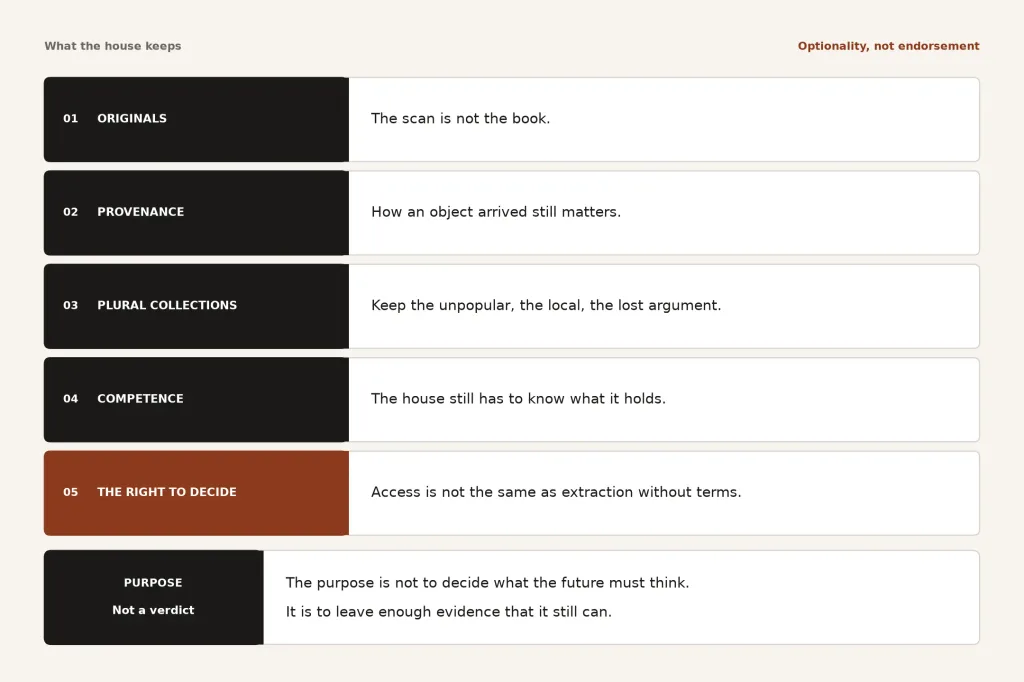
It keeps originals.
The paper.
The binding.
The copy that travelled.
The annotation whose significance has not yet been recognised.
It keeps provenance.
How an object arrived.
Who owned it.
What is known.
What remains uncertain.
It keeps plural collections.
Humanist correspondence beside Hebraica.
A Quran beside Christian manuscripts.
Political literature from opposing ideological camps.
A children's book that someone considered an offence against good taste.
The library does not need everything inside it to agree.
That is almost the point.
It keeps competence.
People who can read a receipt and know that it is evidence but not yet a verdict.
People who can distinguish an object from its representation.
People who understand a catalogue well enough to know what is missing from it.
People who know how to pack a manuscript before the crisis arrives.
And it keeps the right to decide how the collection is used.
Who may read.
Who may borrow.
Who may scan.
Who may extract at scale.
Under what conditions.
For which purpose.
With which obligations afterward.
That is cultural sovereignty in institutional form.
Five hundred and fifty-five years
The Universitätsbibliothek Basel is first attested in 1471 through a purchase note in an early printed book.
The university itself had been founded in 1460 and almost certainly collected books from its beginning, but the written evidence for the library comes later.
The UB describes itself as the oldest secular library in Switzerland.
In 2026, it can therefore look back on approximately 555 years of institutional memory.
That number is difficult to comprehend in the technology sector.
A startup may plan eighteen months ahead.
A software platform can feel ancient after ten years.
A file format becomes legacy.
An API disappears.
A company is acquired.
A service is shut down.
A 555-year-old library operates on another scale.
That scale does not exist because the building remained unchanged.
It exists because generations of people repeatedly accepted the obligation to keep something for people they would never meet.
Someone bought the book.
Someone catalogued it.
Someone repaired it.
Someone questioned its provenance.
Someone packed it into a numbered crate.
Someone brought it back.
Someone digitised it.
Someone researched the decisions of the people who came before.
And someone will eventually ask a question about it that none of those people anticipated.
Institutions survive through that chain of custody.
Not through permanence.
Through stewardship.
The people behind the institution
This may have been the part of the evening that affected me most.
We often speak about institutions as though they were buildings, statutes or logos.
They are not.
Institutions exist because people repeatedly perform the work that makes them real.
In 1938, someone had to recognise that the collections might be threatened.
Someone had to decide what should move.
Someone negotiated with the bank.
Someone contacted Engelberg.
Someone wrote the inventories.
Someone found the crates.
Someone numbered them.
Someone checked them.
Someone kept the library functioning while colleagues were in military service.
Someone kept material that might have appeared unimportant.
And today other people catalogue, research, conserve, digitise and explain those same collections.
That deserves recognition.
Not because librarians should be romanticised as guardians in some theatrical sense.
But because stewardship is a form of work whose success is often invisible.
The manuscript that was not destroyed does not announce the disaster it avoided.
The provenance record that prevents a false conclusion rarely attracts attention.
The original that remains on the shelf beside its digital copy looks inefficient until the day somebody needs the property that the scan did not capture.
Preparedness often looks unnecessary right up to the moment when it becomes indispensable.
Preserve the right to ask again
When war approached Basel, the Universitätsbibliothek could not know exactly what would happen.
That uncertainty was not an argument for waiting.
It was an argument for preserving options.
When a children's book appeared to embody the dubious taste of wartime culture, the correct archival response was not necessarily to admire it.
It was to keep the evidence.
When historians today encounter contradictions in the wartime record, their responsibility is not to force those contradictions into a clean morality play.
It is to preserve enough context that we can understand them.
And when artificial intelligence discovers that centuries of books constitute one of the richest bodies of human-created data ever assembled, our task should not be to keep machines away from libraries.
It should be to make sure that access does not become extraction without stewardship.
A library does not exist to tell the future what to think.
It exists so that the future still has something from which to think.
That is why originals matter.
That is why provenance matters.
That is why strange books matter.
That is why minority collections matter.
That is why librarians matter.
That is why a box packed in Basel in 1939 matters.
A library preserves the questions that have not been asked yet.
And in an age in which a machine can consume more text in an afternoon than a human being could read in several lifetimes, preserving our ability to ask those questions for ourselves may become one of the most important forms of sovereignty we have.
Preserve the right to ask again.
Sources
The lecture and the Universitätsbibliothek Basel during the Second World War
- Universitätsbibliothek Basel, Die UB im Zweiten Weltkrieg, event page, 26 August 2026. https://ub.unibas.ch/de/event/details/die-ub-im-zweiten-weltkrieg/
- Noëmi Kern, Universität Basel, Die UB im Zweiten Weltkrieg: Wie schützt man Bücher vor Bomben?, interview with Noah Regenass, 20 August 2026. https://www.unibas.ch/de/Aktuell/News/Uni-Agenda/UB-im-Zweiten-Weltkrieg-Noah-Regenass-Vorsichtsmassnahmen-Bestaende-schuetzen-Krisenplan-Kulturgueter-bewahren-Bedrohungslage-Karl-Schwarber.html
- Universitätsbibliothek Basel, Bookmark 26 — UB 555. https://ub.unibas.ch/de/jahresberichte/bookmark-26/ub-555/
- Historical Dictionary of Switzerland, Ueli Dill, Karl Schwarber, 14 March 2011. https://hls-dhs-dss.ch/de/articles/046164/2011-03-14/
- Staatsarchiv Basel-Stadt, Hauser, Fritz (1884–1941), Regierungsrat. https://dls.staatsarchiv.bs.ch/records/428138
- Universitätsbibliothek Basel, 555 Jahre UB Basel and institutional history pages. https://ub.unibas.ch/de/555/ · About us
Globi wird Soldat
- SwissCollections, Der Globi, Heft 5, 1940, contemporary announcement of Globi wird Soldat. https://swisscollections.ub.k8s-001.unibas.ch/Record/991170730682205501
- Swissinfo, Die Globi-Chronologie von 1931 bis 2003. https://www.swissinfo.ch/ger/kultur/die-globi-chronologie-von-1931-bis-2003/3482660
- Marc Tribelhorn, Neue Zürcher Zeitung, Globi, der Landesverteidiger. https://www.nzz.ch/zuerich/landi-39/globi-der-landesverteidiger-ld.851959
- The slide and accompanying note discussed in this volume were photographed during Noah Regenass's lecture on 26 August 2026. Where no independent public catalogue evidence is available, the text treats them explicitly as lecture evidence rather than as independently reconstructed provenance.
AI, digitisation and Bartz v. Anthropic
- Bartz v. Anthropic PBC, United States District Court, Northern District of California, C 24-05417 WHA, Judge William Alsup, Order on Fair Use, 23 June 2025. https://storage.courtlistener.com/recap/gov.uscourts.cand.434709/gov.uscourts.cand.434709.231.0_3.pdf
- Bartz v. Anthropic PBC, Class Action Settlement Agreement, including provisions concerning pirated and scanned copies. https://storage.courtlistener.com/recap/gov.uscourts.cand.434709/gov.uscourts.cand.434709.362.3.pdf
- Authors Guild, Court Grants Final Approval to Anthropic Copyright Settlement, 21 July 2026. https://authorsguild.org/news/court-grants-final-approval-anthropic-copyright-settlement/
- Library of Congress, United States Newspaper Program, Physical Preparation. https://guides.loc.gov/directory-of-us-newspapers/physical-preparation
- Nicholson Baker, Double Fold: Libraries and the Assault on Paper, Random House, 2001.
- Internet Archive, Digitization Services. https://digitization.archive.org/digitization/
- IFLA, Guidelines for Planning the Digitization of Rare Book and Manuscript Collections, 2015. https://www.ifla.org/wp-content/uploads/2019/05/assets/rare-books-and-manuscripts/rbms-guidelines/guidelines-for-planning-digitization.pdf
- Swiss National Library, Principles of Digitisation and Basics. https://www.nb.admin.ch/en/principles-of-digitisation · https://www.nb.admin.ch/en/basics
Cultural property and armed conflict
- UNESCO, Damaged Cultural Sites in Ukraine, status 29 July 2026. https://www.unesco.org/en/ukraine-war/damaged-cultural-sites
- UNESCO, Convention for the Protection of Cultural Property in the Event of Armed Conflict, The Hague, 14 May 1954. https://www.unesco.org/en/legal-affairs/convention-protection-cultural-property-event-armed-conflict-regulations-execution-convention
- ICA / ICOM / ICOMOS / IFLA, Declaration on the Protection of Archives, Libraries, Museums and Heritage Places during Armed Conflicts and Political Instability, 30 May 2024. https://icom.museum/en/news/declaration-on-the-protection-of-archives-libraries-museums-and-heritage-places-during-armed-conflicts-and-political-instability/
Related volumes
This volume discusses a United States copyright case for its implications for stewardship and preservation. It is not legal advice.