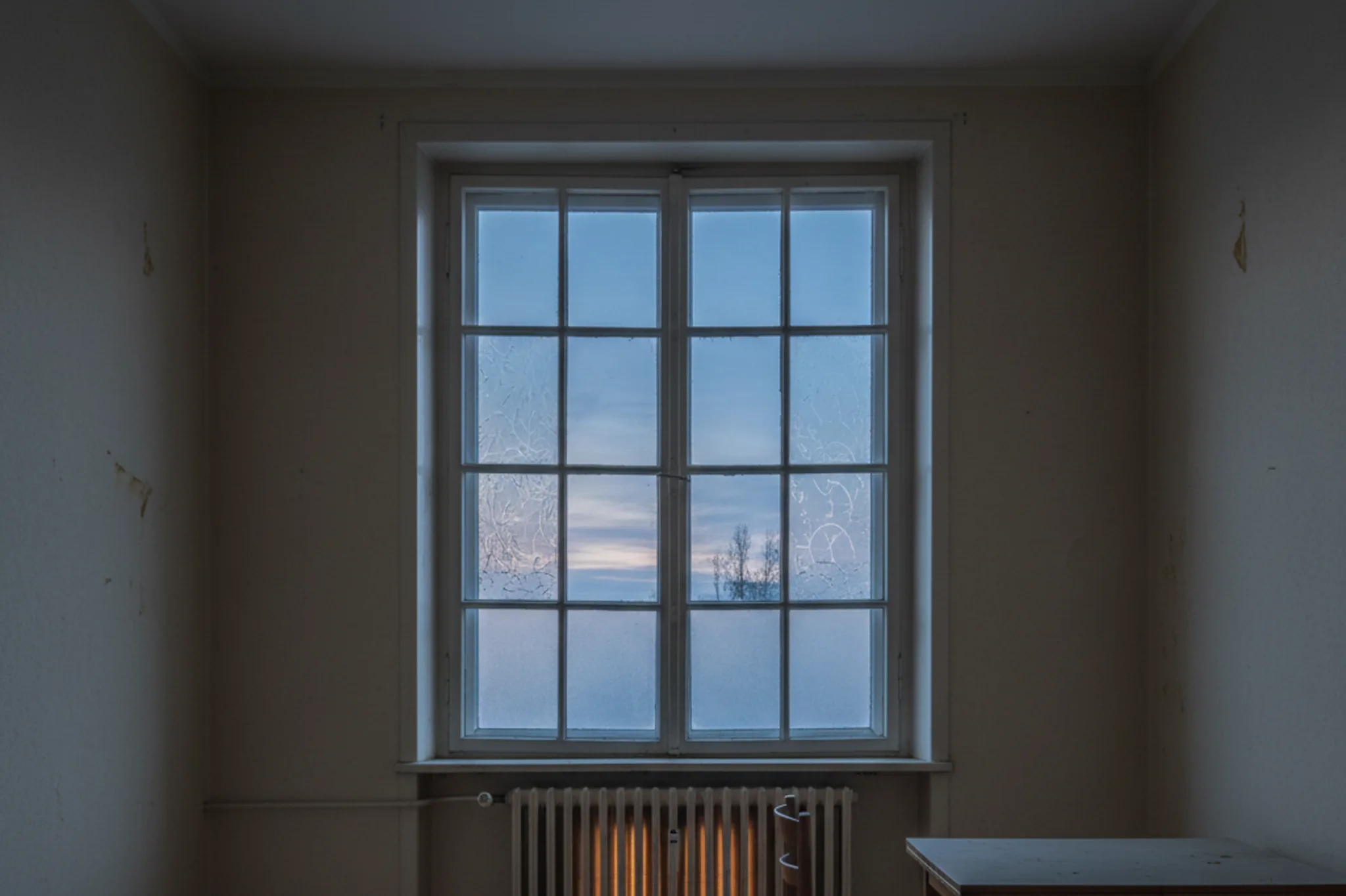
The radiator is warm.
That is where this starts. Not with a chip. Not with a hall of servers. With the metal in the room.
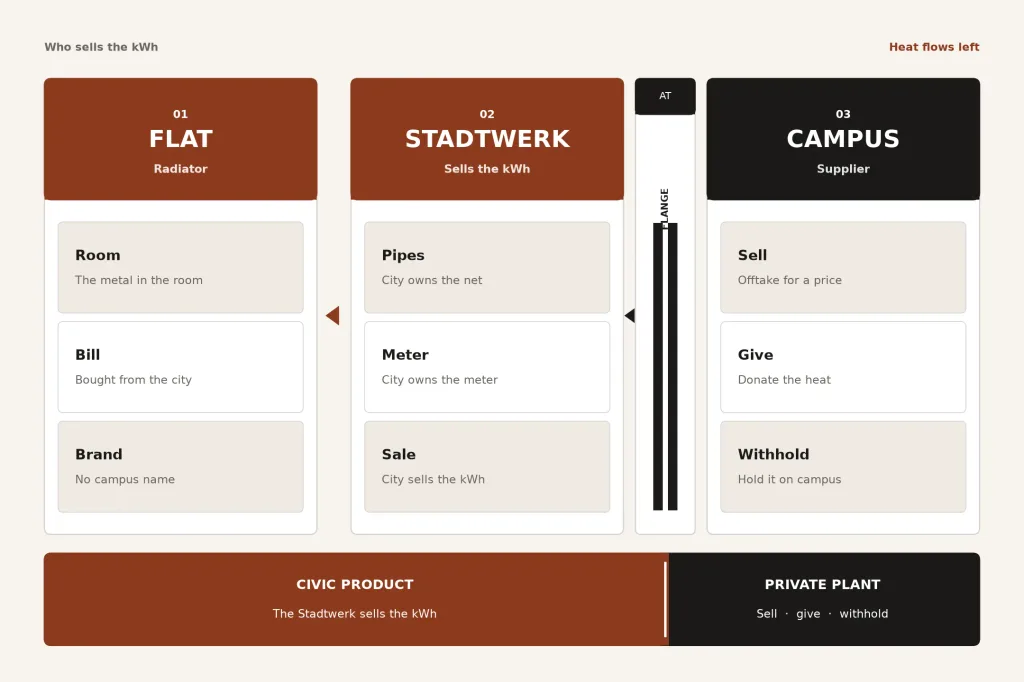
Someone sold that warmth. In most European cities that someone is the Stadtwerk. The city utility. The same body that owns the pipes under the street and the meter on the wall.
After a flange, the heat is district heating.
The IT stays on campus.
The campus can sell the heat. It can give it away. It can hold it back.
If you cannot say which of those three it is doing tonight, you do not yet know who owns the warmth.
The civic product
Warmth in the flat is a civic product.
The tenant does not buy it from a campus. The tenant buys it from the utility. The bill says kilowatt-hours, or a share of a building's heat. The name on the bill is the Stadtwerk.
A Swiss tariff makes the split plain. IWB 772.600, in force 1 April 2024, says the Stadtwerk owns the pipes and the house connection as far as the handover point. The building owns the house station. The Stadtwerk owns the meter. It sells the kilowatt-hour. Heat crosses an exchanger. It does not carry a brand from the hall that made it.
The data centre is a supplier. It is not the network owner. It is not the seller to flats.
That is the ordinary case.
Lucerne is the exception that shows the split. ewl owns the Stollen data centre, opened 21 June 2022, and it owns the lake-energy network. Same Stadtwerk. Same books. Most cities are not Lucerne.
Sovereignty Is Not Self-Sufficiency already said the flat depends on a governed feed. It does not depend on owning a plant. The radiator is that case in steel and water.
What the meters have said
Headlines run ahead of meters.
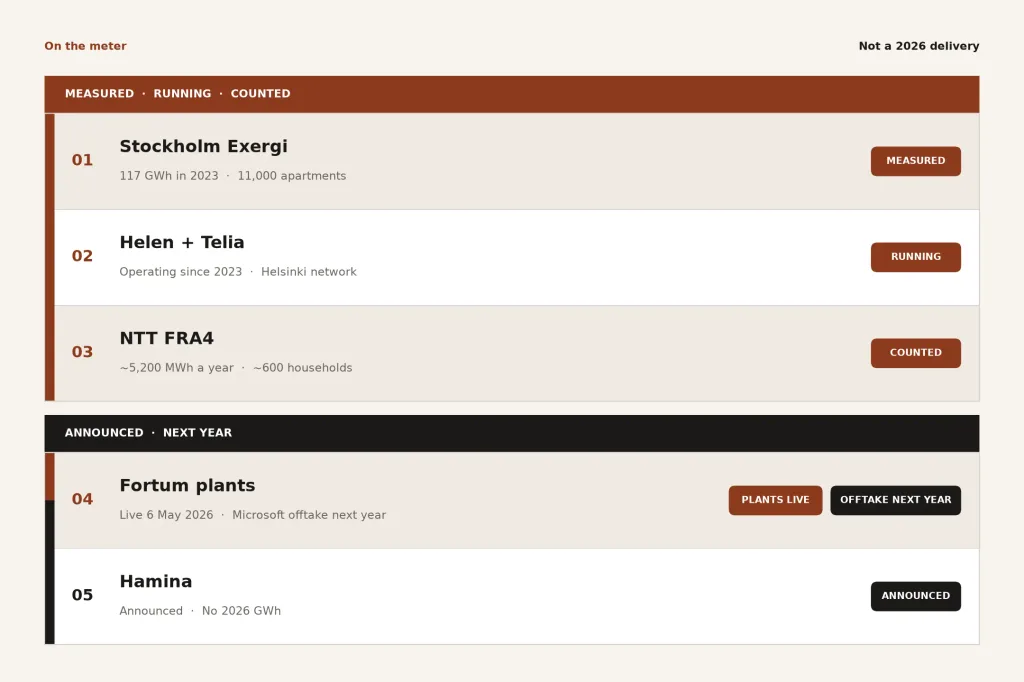
Stockholm Exergi is the one that published a year. Data Parks and Open District Heating put 117 GWh into the network in 2023. The live recovery page names 11,000 apartments. Rosersberg added 64 GWh in 2025, on the Green Bond report. Those are measured numbers. They are not a slogan about two hundred thousand homes, and they are not a capture rate of ninety-seven per cent. The viral line fails against the year Exergi printed.
Helen and Telia have been operating since early 2023. The heat is on the Helsinki network. That is a running plant, not a press date.
Fortum started heat production at two large Finnish sites on 6 May 2026. The plants sit on air-source heat pumps, 200 MW of electric boilers, and an 800 MWh store. Microsoft offtake comes "step by step next year." The plants are live. The campus heat is not yet the winter story. A line that Microsoft already supplies forty per cent of Espoo is design speech. It is not a 2026 delivery.
NTT's FRA4 hall in Hattersheim is smaller and already counted. NTT's neighbourhood page gives 2.5 MW and about 5,200 MWh a year. Mainova says about five gigawatt-hours, enough for about 600 households. Mainova builds and runs the energy centre. NTT supplies the waste heat.
Meta's surplus heat is in Odense, in Tietgenbyen. It is not in Esbjerg.
Google's Hamina project is announced. The utility's design figure is 40 GWh a year. There is no published 2026 delivery figure. The plant rating is contested on the utility's own pages: 5 MW on one, 7.5 MW on another. Announced is not delivered. A line that Hamina already supplies eighty per cent of a city is a forecast.
A measurement is a year and a meter. Design is a forecast. Announced is not delivered.
Who may cut
Only one published product says who may cut.
Stockholm Exergi's Open District Heating splits the heat into three.
Call — Avropsvärme. The supplier must hold the contracted megawatts. Exergi always calls when the outdoor temperature is 10 °C or below.
Spot. The supplier chooses. There is no delivery duty.
Combined, since 2023. The supplier must deliver up to the contracted megawatts. Exergi may limit.
Prices, temperatures, and capacity go out after 16:00 the day before.
That is a contract you can read. It says who holds the heat on a cold night. It says who may leave it on campus. Call is a duty. Spot is a choice. Combined is a duty with a limit in the utility's hand.
Helen has two models. Helen builds the lift and takes the heat. Or the data centre builds the lift and Helen buys at about 85 °C. The published pages do not say who may curtail.
Fortum now owns the lift plants. They run independent of Microsoft's IT. The published pages do not say who may interrupt.
Fjernvarme Fyn can turn its heat pumps down when power is expensive. It has a buffer tank. It says this can be done without operating trouble at Facebook (META). The published pages do not say what happens if the campus trips.
At Hamina the utility owns the lift. Google donates the heat for €1 plus VAT a year. The published pages do not say who may cut.
Mainova builds and runs the energy centre. NTT supplies the waste heat. The published pages do not say who may cut. A fifteen-year term sometimes attached to FRA4 belongs to another project.
So: one city published the cut. The others have not. A missing clause is not a promise that the heat will come. It is not a promise that it will stop. It is a gap.
If the product sheet does not say who may withhold, you are guessing on a January night.
Other plants still stand
Utilities do not describe a January night as a single flange.
Fortum kept 200 MW of electric boilers and a 20,000 cubic-metre store of 800 MWh. Gas and bio sit there "to secure heat supply in the coldest periods."
Mainova kept the existing gas combined-heat-and-power plant for the 600 households as redundancy and at peak load.
Fjernvarme Fyn still has Havnegade for most of the load, about twenty peak centrals, gas for five to ten per cent of the year and 500 to 1,000 hours, and electric boilers for about 1,000 hours.
Exergi runs about thirty plants. District-heating SAIDI in 2023 was 70 minutes. Fossil oil is used mainly during severe cold.
Helen and Hamina have not published a boiler labelled "when the campus trips."
Sovereignty Is Measured in Response Time is the physical clock. A January night. A SAIDI number. A peak plant that can still fire. The clock is not a press release about waste heat. It is whether the water in the pipe is still hot when this campus is not.
No published utility annual report or incident notice says a campus trip left homes cold. No published report says a campus going dark left radiators cold.
What the flat sees if the campus trips is other sources. That is what the utilities describe. They do not publish "the radiator goes cold."
The gap is a gap.
The stop that was a price
There is one sourced offtake stop.
It is not a trip.
On 5 February 2024 Kim Winther at Fjernvarme Fyn said the Danish surplus-heat price ceiling had blocked Meta heat that could have reached 11,000 households. The utility would burn more gas. Four hundred million kroner of surplus-heat plant stood to become worthless.
That is the utility not sending heat. It is not a statement that those flats went cold.
The cap was abolished on 1 July 2025. The energy agency recorded the date. Fjernvarme Fyn had already published a joy note on 17 January 2025.
The offtake failed on a price. The backup was gas. The radiators, on the published record, stayed a civic product with another plant behind them.
A city can have a surplus-heat works and still choose not to take the heat. The campus did not fail that February. The tariff did. The pipe was still the utility's pipe.
Switzerland, as built
Three operating feeds are on the record.
Geneva. Infomaniak's D4 hall sends heat to SIG's CAD Chapelle-Les-Sciers from 11 November 2024. The inauguration was 27 January 2025. Full load is 1.7 MW and 14.9 GWh a year. About a quarter at inauguration. Full by 2028. The heat is sold to SIG at cost.
Lucerne. ewl's Stollen opened 21 June 2022. ewl owns both the data centre and the lake-energy network. That is the exception. When the same Stadtwerk owns the hall and the net, the cut and the sale sit in one pair of hands.
Zurich. Swisscom Herdern has fed ewz's Energieverbund Aargauerstrasse since 2013. Swisscom's Binz Technikzentrale has fed Energieverbund Binz since 2006. A Technikzentrale is not a hyperscale colo.
The planned list is longer than the measured one. Green and Energie 360 at Dielsdorf carry a design of 160 GWh a year, a rollout from 2024 to 2026, and no later measured gigawatt-hour. Green Lupfig DC4 is meant for IBB Eigenamt. The hall itself is dated 2027. Eigenamt's first heat in May 2026 is biomass. Vantage Winterthur Neuhegi was before the city council on 29 October 2024: about 24 °C lifted towards 70 °C, full build about 2029. Digital Realty at Airport City, heat from 2029. Vantage Volketswil sits in a federal case.
Green and Energie 360 give the heat free. The utility pays the lift.
IWB Fernwärme is not fed by a large data centre. The 2025 mix is Kehricht, gas, wood, biogas, and sludge. Rubbish, wood, and gas. The only IWB data-centre heat on the public record is the 2020 Serverheizung in one apartment house where Fernwärme is not available. That is a building loop. It is not a district case.
Basel is still in that position. IWB runs the Fernwärme. The mix is rubbish, wood, and gas. There is no large data centre on the network.
Swisscom and BFE claim Wankdorf heat into Bern's Fernheiz-Netz. ewb's 2026 mix page lists Forsthaus, wood, and gas. It does not list the data centre. Those are two claims. They are not the same record.
Hagenholz and Forsthaus are waste-to-energy plants, not data centres. Equinix "heat recovery" and NTT office heat pumps are not Fernwärme.
The federal numbers 2.02 to 2.62 TWh a year are extractable potential. They are not heat already in Swiss district networks. The published pages do not give a national measured injected gigawatt-hour.
Zurich law is narrower than a slogan. Cantonal energy law BBV I § 30a says unused waste heat above 2 GWh must be offered at cost. The 2025 model cantonal provisions, article 1.18(2), are model law. They are not automatic.
The Stadtwerk still owns the pipes. The Stadtwerk still sells the kilowatt-hour. The campus is still a supplier.
Offer is not offtake. Potential is not a pipe.
What the law does not do
The law is staggered. It is not one switch.
The Energy Efficiency Directive, (EU) 2023/1791, entered into force on 10 October 2023. Member States had until 11 October 2025 to transpose it. Until they do, it binds the States, not a named campus.
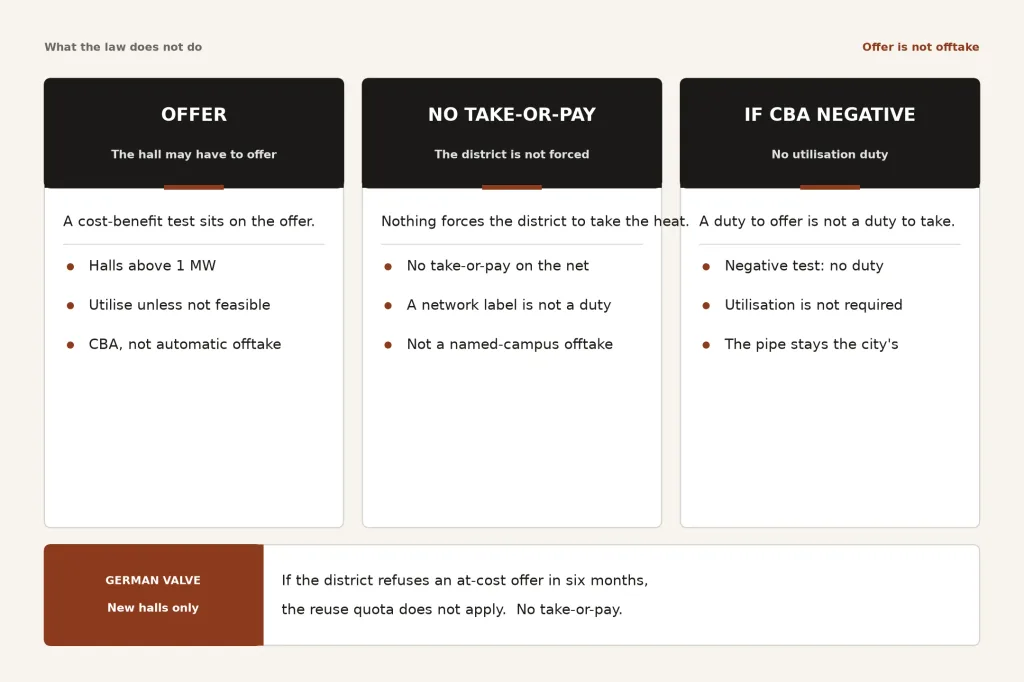
Article 26(6) says States must ensure that data centres with a total rated energy input above 1 MW utilise waste heat, unless that is not technically or economically feasible.
Article 26(7) is a cost-benefit analysis. It is not automatic offtake. If the analysis is negative, utilisation is not required.
Article 26(1) defines "efficient district heating." That is a qualification of the network. It is not a duty to accept a named campus.
Nothing in the Directive forces a district-heating company to take data-centre heat.
Reporting is already live. Article 12 and Delegated Regulation (EU) 2024/1364, in force 6 June 2024, apply directly. Data centres with IT power of 500 kW or more report to the European database. First date 15 September 2024, then 15 May each year. The public sees aggregates. The energy-reuse factor is recovered heat over energy at the data-centre boundary, after the European standard EN 50600-4-6. A rating scheme was announced as a 2026 draft. It is not in force.
Germany's Energy Efficiency Act has been in force since 18 November 2023. Section 11 sets energy-reuse-factor quotas for new data centres only. Ten per cent from commissioning on 1 July 2026. Fifteen per cent from 1 July 2027. Twenty per cent from 1 July 2028. Hit the number within two years. Existing stock has a power-usage rule. It has no reuse quota.
Section 11(3) is the valve. If a nearby district operator does not accept an at-cost offer within six months, the quota does not apply. The district must inform capacity. There is no take-or-pay.
Finland's utilise-or-analysis rule for halls above 1 MW has been in force since 1 January 2026. Existing unused heat needs a cost-benefit analysis by 31 December 2027. No district take duty.
Sweden's reporting for 500 kW and above has been in force since 1 July 2025. An offtake duty sits in a government referral of 20 August 2026, proposed for 1 January 2027. That is not law. The district-heating act from 2008 has no data-centre offtake clause.
Denmark abolished the surplus-heat price ceiling on 1 July 2025. A cost-benefit order has been in force since 11 October 2025 for new and refurbished halls above 1 MW. If the analysis is positive, the heat must be utilised at once. Still no district take-or-pay.
The Directive did not switch on a duty for the city to take chip heat. A duty to offer is not a duty to take.
The chip does not make radiator water
About one kilowatt-hour of heat leaves the chip for each kilowatt-hour of electricity that arrives.
NVIDIA's own thermal line is "the maximum amount of heat generated … that the cooling system can dissipate." The chip exports no mechanical work. The GPU does not have a COP above one. It is not a heat pump.
Facility heat can exceed IT kilowatt-hours. Backup power, fans, pumps. Capture is not one hundred per cent. The recovered-heat count includes only the heat handed off outside the data-centre boundary. The reuse factor is not the efficiency of the lift.
ASHRAE's technical committee on this still recommends 18 to 27 °C air at the inlet. Liquid classes run from W17 to W45. W45 and the class above it are listed against "District heating system" at 45 °C and above.
Helen will not buy below about 85 °C.
That is why a heat pump sits on the pipe.
Mainova's official lift is about 30 °C to 70–75 °C. Telia's loop is about 30 °C, then about 80–85 °C into Helen, and about 20 °C back. The GPU does not make radiator water. The lift consumes electricity. Mainova says rooftop photovoltaics cover about a tenth of the heat-pump power. None of these projects publish a heat-pump COP.
The seasons do not match. Cloud&Heat at the Eurotheum already dumped about a third of the heat in summer. Fortum built 800 MWh of storage because heat and power are not coincident.
When the Water Tower Runs Low treated a civic appliance, a right that is not a capability, and a summer mismatch. Warmth is the same class of object. The right to a warm flat is not the same as a campus that can hold the offtake.
The pipe still needs a plant the city can start.
One misread
A headline said a company would hang a data centre on the wall and heat the house.
The object in the story is SPAN XFRA. It is outdoor. It is a United States test. The heat is dumped outside.
It does not heat the house. It is not a European radiator. It is not safer than a campus because it is small. No agency paper says that.
Who can leave the campus
What Strauss promised in 1954 was electrical energy in the home, not a plant in the basement. The Stadtwerk still sells the warmth. The data centre is a supplier.
If you cannot say who sells the kilowatt-hour, and who may withhold the offtake, you do not know who owns the warmth.
The city can leave this campus only if other plants still stand. That is one beat of The Exit Test. Then the question stays on the pipe.
The campus is an operator the radiator did not appoint. That is the sentence in The Unappointed Operator.
Sources
Nordic and German heat
- Stockholm Exergi, Annual Report 2023. https://www.stockholmexergi.se/wp-content/uploads/2024/03/Arsredovisning-2023_ENG_240326_spreads.pdf
- Stockholm Exergi, heat recovery. https://www.stockholmexergi.se/en/heat-recovery/
- Stockholm Exergi, Open District Heating product sheet. https://www.stockholmexergi.se/wp-content/uploads/2023/05/Produktblad_tjanster_Oppen-Fjarrvarme.pdf
- Stockholm Exergi, Open District Heating FAQ. https://www.stockholmexergi.se/en/heat-recovery/frequently-asked-questions-about-open-district-heating/
- Helen, heat recovery service for data centres. https://www.helen.fi/en/companies/cooling-for-companies/heat-recovery-service-for-data-centers
- Fortum, 6 May 2026, heat production started at two large data-centre sites. https://www.fortum.com/en/media/2026/05/fortum-has-started-heat-production-two-large-data-centre-sites-finland
- Fjernvarme Fyn, 5 February 2024, surplus-heat plant and the price ceiling. https://www.fjernvarmefyn.dk/nyheder/vi-har-brugt-400-millioner-paa-overskudsvarmeanlaeg-den-investering-staar-nu-til-at-blive-vaerdiloes/
- Mainova, Hattersheim, about 600 households. https://www.mainova.de/de/ihre-mainova/presse/pressemitteilungen/2024/klimafreundliche-abwaerme-aus-rechenzentrum-heizt-kuenftig-ueber-600-haushalte-in-hattersheim-139356
- NTT, Frankfurt 4 neighbourhood page. https://www.gdc-im-dialog.de/frankfurt-4/frankfurt-4-/default.aspx
- Google, Hamina off-site heat recovery announcement. https://blog.google/company-news/inside-google/around-the-globe/google-europe/our-first-offsite-heat-recovery-project-lands-in-finland/
Switzerland
- SIG, Infomaniak D4 inauguration. https://ww2.sig-ge.ch/actualites/infomaniak-sig-et-letat-de-geneve-inaugurent-un-data-center-revalorisant-100-de-son
- ewl Luzern, Stollen opening. https://www.ewl-luzern.ch/medien/medienmitteilungen/ewl-eroeffnet-oekologisches-rechenzentrum-in-luzern
- City of Zurich, Swisscom Herdern / ewz, 2013. https://www.stadt-zuerich.ch/misc/de/mitteilungsarchiv/medienmitteilungen/2013/03/130319a.html
- IWB, heat transformation. https://www.iwb.ch/ueber-uns/newsroom/dossiers/waermetransformation
- IWB tariff 772.600 (lexfind). https://www.lexfind.ch/tolv/238825/de
Law
- Directive (EU) 2023/1791 (Energy Efficiency Directive). https://eur-lex.europa.eu/eli/dir/2023/1791/oj
- Commission Recommendation (EU) 2024/2395, quoting Article 26. https://eur-lex.europa.eu/legal-content/EN/TXT/HTML/?uri=OJ:L_202402395
- Delegated Regulation (EU) 2024/1364 (data-centre reporting). https://eur-lex.europa.eu/eli/reg_del/2024/1364/oj/eng
- Commission, energy performance of data centres. https://energy.ec.europa.eu/topics/energy-efficiency/energy-efficiency-targets-directive-and-rules/energy-efficiency-directive/energy-performance-data-centres_en
- Germany, Energy Efficiency Act, section 11. https://www.gesetze-im-internet.de/enefg/__11.html
- Germany, Energy Efficiency Act (full act). https://www.gesetze-im-internet.de/enefg/BJNR1350B0023.html
- Finland, Energy Authority, data centres. https://energiavirasto.fi/datakeskukset
- Sweden, SFS 2025:570 (reporting). https://www.riksdagen.se/sv/dokument-och-lagar/dokument/svensk-forfattningssamling/lag-2025570-om-offentliggorande-av-information_sfs-2025-570/
- Denmark, Danish Energy Agency, surplus heat and cost-benefit analyses. https://ens.dk/forsyning-og-forbrug/overskudsvarme-og-cost-benefit-analyser
Physics
- NVIDIA, Power Primer (TDP as heat the cooling system can dissipate). https://www.nvidia.com/content/dam/en-zz/Solutions/GeForce/technologies/frameview/Power_Primer.pdf
- ASHRAE TC 9.9, thermal guidelines reference card. https://www.ashrae.org/File%20Library/Technical%20Resources/Bookstore/Supplemental%20Files/Therm-Gdlns-5th-R-E-RefCard.pdf
Library
- The Exit Test
- Sovereignty Is Not Self-Sufficiency
- When the Water Tower Runs Low
- Sovereignty Is Measured in Response Time
- The Unappointed Operator
Contested, and therefore unused as fact: the viral "Sweden 200,000 homes / 97% capture"; Microsoft already supplying 40% of Espoo heat; Google Hamina already delivering 80% or 40 GWh in 2026; Meta in Esbjerg; a fifteen-year term on NTT FRA4; Hamina plant rating 5 MW versus 7.5 MW as a settled figure; official project heat-pump COP; a Swedish offtake duty as if it were law; the claim that the Energy Efficiency Directive switched on and district heating must take chip heat; the claim that distributing home boxes is safer than a campus; WCCFTech / NVIDIA wall-mounted household box as a heater (the object is SPAN XFRA, outdoor, United States test, heat rejected outside); any story in which a campus trip left a radiator cold.
This volume is not legal advice.