
There is a comfortable way to talk about traffic congestion.
We can blame commuters.
We can blame population growth.
We can blame trucks, immigration, urban planning, construction sites, climate policy, public transport, federalism or the refusal of other people to behave exactly as we would prefer.
Each explanation contains a fragment of truth.
None of them captures the system.
The more interesting question is not why Switzerland has traffic jams.
It is this:
How can a country recognise a predictable infrastructure problem years in advance, allocate billions of francs to its road network, and still arrive at a point where congestion grows vastly faster than either population or economic output?
That is not primarily a traffic question.
It is a question of state capability.
And therefore, it is a question of sovereignty.
The numbers are not subtle
Between 2010 and 2024, Switzerland’s permanent resident population increased by approximately 15 percent.
Real GDP per capita increased by approximately 12 percent.
The transport performance of heavy goods vehicles, measured in tonne-kilometres, remained broadly flat and ended slightly below its 2010 level.
Recorded congestion hours on the national road network increased by approximately 249 percent.
In 2024, the Federal Roads Office recorded 55,569 congestion hours on the national road network. Switzerland’s national roads represent only a small share of the country’s total road network, yet they carried more than 40 percent of all vehicle kilometres—approximately 29.8 billion kilometres that year.
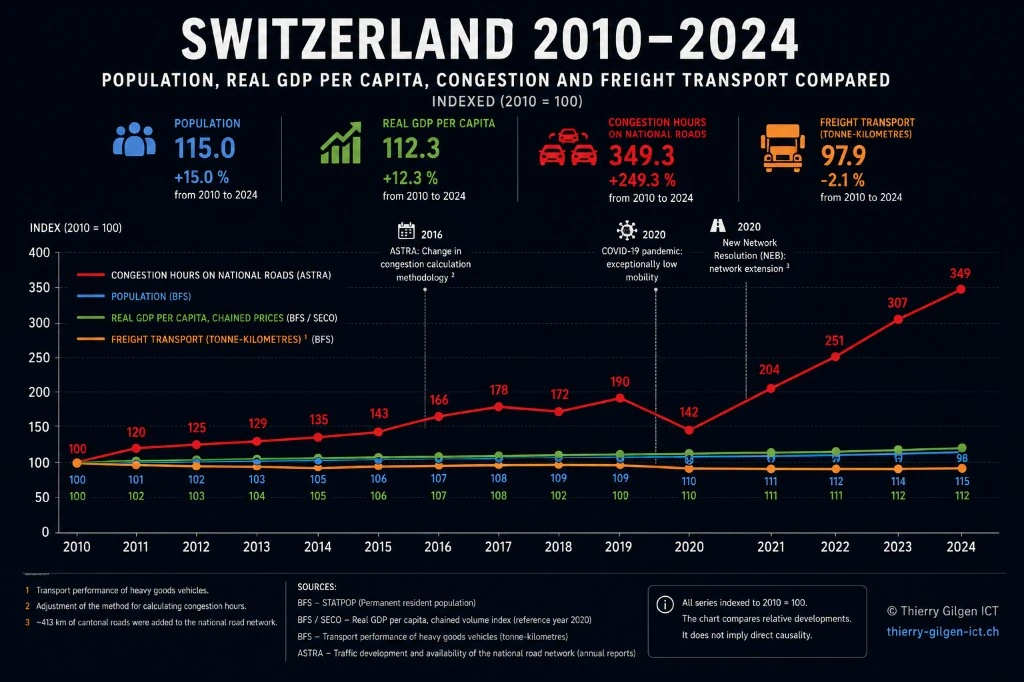
The chart does not tell us that traffic volumes tripled.
They did not.
It tells us something more important:
The system lost its remaining tolerance.
Congestion is not linear
Infrastructure systems rarely fail in a neat, proportional manner.
A road that can process 5,000 vehicles per hour may function acceptably at 4,800.
At 4,950, it becomes fragile.
At 5,050, the result is not merely two percent more inconvenience. A queue begins to accumulate. Vehicles entering the system faster than they can leave create a backlog that persists long after the original peak has passed.
Add a minor accident, a lane change, a delivery vehicle, poor weather or a braking wave, and a previously manageable flow becomes unstable.
This is why a small increase in traffic can produce a very large increase in congestion.
In 2023, vehicle kilometres on Swiss national roads increased by approximately 1.5 percent compared with the previous year, while recorded congestion hours increased by 22.4 percent. ASTRA itself described this divergence as evidence that the network was reaching its capacity limits.
That relationship continued.
The network did not suddenly carry three times as much traffic.
It crossed thresholds.
And thresholds change the behaviour of systems.
Covid did not cause the crisis
The visible acceleration after 2020 makes Covid appear like a turning point.
It was—but not in the way people often assume.
Covid temporarily suppressed mobility and created an abnormal low point. When normal activity returned, traffic returned to infrastructure that was already operating with very limited capacity reserves.
The national road network also underwent a statistical and administrative change in 2020 when additional roads were incorporated under the New Network Resolution. Comparisons across that boundary therefore require care.
But the pandemic cannot explain the subsequent record levels.
By 2024, recorded congestion hours were far beyond their pre-Covid level.
The correct interpretation is not that Covid created congestion.
It revealed how little resilience remained.
For a brief period, pressure was removed.
When it returned, the underlying system had not materially changed.
The congestion is mainly caused by congestion
That sentence sounds circular, but the distinction matters.
Of the 55,569 congestion hours recorded in 2024, the overwhelming majority resulted from ordinary traffic overload—not from construction sites or accidents.
ASTRA attributes approximately 87 percent of the recorded congestion hours to traffic overload.
This matters because it rules out one of the easiest explanations.
The problem is not primarily that Switzerland happened to have an unusually bad year for roadworks.
Nor did accidents suddenly multiply enough to explain the curve.
The system is regularly receiving more demand at critical locations and times than those locations can reliably process.
This is a capacity problem.
More precisely, it is a capacity-at-the-wrong-place-and-time problem.
Switzerland did invest
It would be dishonest to claim that the state simply abandoned the national road network.
Switzerland spent billions on roads.
It maintained tunnels, bridges, surfaces, safety systems, noise protection, drainage, operating technology and existing infrastructure. It completed missing network sections, financed major projects and created programmes specifically intended to remove bottlenecks.
Official ASTRA budget reporting distinguishes between network completion, maintenance, major projects, capacity expansion and explicit bottleneck removal. In the years around 2019–2022, total annual withdrawals and expenditure through the relevant road and agglomeration infrastructure structures amounted to several billion francs, while the amount explicitly allocated to bottleneck elimination represented only one part of that total.
Switzerland had also identified the problem long before Covid.
A federal programme worth CHF 5.5 billion for removing bottlenecks from the national road network existed more than a decade ago.
So the failure was not ignorance.
The state knew.
The money was not zero.
The engineering competence existed.
The forecasts existed.
The bottlenecks had names.
That makes the outcome more interesting—not less.
The difference between spending and creating capacity
Infrastructure expenditure is not synonymous with additional system capacity.
A country may spend enormous sums simply to prevent existing assets from deteriorating.
That spending is necessary.
A tunnel must remain safe.
A bridge must remain structurally sound.
A road surface must be replaced.
Drainage, lighting, ventilation, control systems, retaining walls and environmental protections must function.
None of that automatically allows an overloaded corridor to process materially more vehicles during the morning peak.
This distinction is politically inconvenient because both activities are commonly described as “investment in infrastructure.”
But operationally, they are different.
One preserves the system.
The other changes its throughput.
A state can therefore spend heavily while its capacity problem continues to worsen.
That does not mean maintenance money was wasted.
It means the metric “how many francs were spent?” is insufficient.
The more relevant questions are:
- How much new capacity became operational?
- At which bottlenecks?
- In which year?
- How long after the problem was identified?
- Did implementation occur before or after the corridor crossed its critical threshold?
Sovereignty is not measured in approved budgets.
It is measured in completed capabilities.
The real bottleneck may be the decision cycle
Consider the A1 between Luterbach and Härkingen.
The heavily used 22-kilometre section is now being widened to six lanes, with completion expected by 2032.
The project did not emerge from nowhere in 2025.
The corridor had been discussed, analysed and politically processed for years before major construction began.
That produces a striking asymmetry:
Traffic demand changes continuously.
Capacity projects arrive in large increments after planning cycles that may last well over a decade.
For years, nothing appears catastrophic.
The road becomes gradually busier.
Peak periods extend.
Small disruptions become harder to absorb.
Then the system reaches a threshold, and congestion begins to rise non-linearly.
By the time construction starts, the project is no longer preventing the crisis.
It is attempting to catch up with one that has already arrived.
This is where a transport problem becomes a sovereignty problem.
When the state’s response time exceeds the system’s deterioration time, decline becomes structurally embedded.
Proof that targeted capacity can matter
There is a popular argument that expanding a road can never improve congestion because every additional lane will immediately fill with induced demand.
The real world is less absolute.
Demand responses exist. Land-use effects exist. Behaviour changes. No serious infrastructure planner should ignore them.
But neither should we pretend that targeted bottleneck removal is inherently meaningless.
The third Gubrist tunnel tube opened to traffic in 2023. ASTRA reports that congestion hours in the affected direction declined substantially after the additional capacity became available.
This does not prove that every proposed motorway project is justified.
It proves something simpler:
Physical bottlenecks are real, and removing the correct bottleneck can improve system performance.
The difficult work lies in identifying which interventions create durable value and delivering them before congestion consumes the benefit.
That requires planning.
It also requires speed.
Sovereignty has a clock
We usually describe sovereignty in static terms.
Territory.
Law.
Borders.
Currency.
Data.
Energy.
Defence.
But sovereignty also has a temporal dimension.
A sovereign system must be able to respond within the time available.
A hospital that receives funding after its waiting lists have become unmanageable was not operationally sovereign when it mattered.
An energy system that starts approving generation capacity only after shortages appear was not operationally sovereign when it mattered.
A country that discusses domestic compute infrastructure until its companies and institutions are irreversibly dependent on foreign platforms was not operationally sovereign when it mattered.
A defence programme that delivers equipment after the threat environment has fundamentally changed was not operationally sovereign when it mattered.
The same logic applies to roads.
It is possible to possess all formal decision-making authority and still lack the ability to act at the required speed.
That is sovereignty on paper.
Not sovereignty in operation.
The four stages of operational sovereignty
A functioning state must be able to complete four steps:
1. Observe
Measure the system honestly.
Know where capacity is disappearing.
Distinguish between political narratives and physical constraints.
2. Anticipate
Model what happens when population, economic activity, mobility patterns and infrastructure age change over time.
Do not wait for the queue to become visible from space.
3. Decide
Choose between maintenance, expansion, demand management, pricing, public transport, digital alternatives and spatial planning.
Make trade-offs explicit.
Accept that refusing to decide is also a decision.
4. Execute
Build.
Deploy.
Commission.
Measure the result.
A state that performs the first three stages but repeatedly fails at the fourth has not solved the problem.
It has documented it.
Democracy is not an excuse for institutional paralysis
Switzerland is deliberately slow in some respects.
That is often a strength.
Federalism distributes power.
Consultation improves legitimacy.
Legal remedies protect citizens.
Referendums allow major decisions to be challenged.
Environmental review forces projects to account for impacts that engineers and politicians might otherwise ignore.
These are not defects to be casually discarded.
But every governance mechanism has operating costs.
When layers of review, fragmentation and political hesitation extend implementation beyond the useful decision horizon, the system begins to consume itself.
The answer is not authoritarian speed.
It is better democratic execution.
Clearer responsibilities.
Earlier participation.
Transparent trade-offs.
Standardised procedures.
Fewer sequential approval loops.
More parallel work.
Smaller projects where smaller projects are sufficient.
And much stronger accountability for the time between identifying a need and delivering an operational result.
Democracy should improve decisions.
It should not make execution temporally irrelevant.
The road expansion vote does not explain the past
In November 2024, Swiss voters rejected a package of six national-road expansion projects intended to remove bottlenecks and improve traffic flow and safety.
That decision will influence the future.
It does not explain why congestion had already climbed to record levels before the vote.
The pre-existing curve was created across many years, governments, parliamentary decisions, planning processes, legal procedures and local conflicts.
Reducing the entire story to one referendum would be intellectually lazy.
The more uncomfortable conclusion is that Switzerland’s institutional response had already been too slow long before voters were presented with that particular package.
And the rejection itself may contain an additional warning.
When government allows a problem to deteriorate for long enough, the eventual solution becomes larger, more expensive and more politically controversial.
Earlier action often allows smaller interventions.
Delayed action produces megaprojects.
Megaprojects produce resistance.
Resistance produces further delay.
Delay produces a larger problem.
That is a feedback loop.
Not every congestion problem requires concrete
Operational sovereignty does not mean building every proposed road.
It means retaining the ability to select and execute the right mix of measures.
That mix may include:
- targeted capacity expansion at proven bottlenecks;
- hard-shoulder running and dynamic lane management;
- better incident detection and clearance;
- variable speed limits;
- congestion-sensitive pricing;
- improved rail and public transport capacity;
- freight scheduling and logistics coordination;
- remote work and decentralised service delivery;
- better integration between land-use planning and transport;
- and more reliable data about where delay actually occurs.
The ideology is less important than the outcome.
The system must move people and goods reliably enough to support economic and social life.
A country that refuses every expansion is not sovereign.
A country that responds to every problem with additional concrete is not sovereign either.
Both positions substitute doctrine for engineering.
Sovereignty requires choices grounded in measurable system performance.
The freight result matters
One of the most interesting findings in the data is what did not happen.
Heavy-goods transport performance did not increase by anything resembling the rise in congestion.
Measured in tonne-kilometres, the 2024 value was slightly below the 2010 level.
This metric does not tell us how many trucks occupied a specific motorway segment at a specific hour. Vehicle kilometres would be more directly connected to road usage, and network-definition changes complicate a clean 2010–2024 comparison.
Still, the result is valuable.
It prevents an easy but unsupported narrative:
The congestion explosion cannot simply be explained by saying that freight traffic increased by 249 percent—or even by 58 percent.
It did not.
The numbers again point toward network saturation, concentration around specific corridors and times, and declining operational reserves.
The system became fragile faster than its underlying demand indicators grew.
Reliability is economic infrastructure
Congestion is often discussed as an annoyance.
That understates the issue.
A logistics company cannot productively use a driver who is stationary.
A construction site cannot install materials that have not arrived.
A service technician cannot repair a system while trapped in traffic.
A parent cannot recover the hour lost between work and childcare.
A bus caught in the same congestion does not become efficient because it is public transport.
Unreliable travel times force companies and individuals to build buffers into their schedules.
Those buffers are hidden inventory.
Hidden labour cost.
Hidden stress.
Hidden lost capacity.
The damage is not represented only by the number of congestion hours.
It appears as uncertainty throughout the economy.
Reliable infrastructure is therefore not a lifestyle preference.
It is part of a country’s productive base.
Switzerland’s advantage was never speed alone
Switzerland is not known for reckless execution.
Its advantage has traditionally been something better:
Precision combined with reliability.
Careful engineering.
Long-term maintenance.
Institutional trust.
Decisions that may take time—but produce systems that work.
The danger begins when careful becomes inert.
When long-term becomes late.
When participation becomes diffusion of responsibility.
When planning becomes a substitute for delivery.
When a country remains highly competent at maintaining yesterday’s system but loses the ability to build tomorrow’s.
That is how operational sovereignty erodes.
Not through one dramatic surrender.
Through thousands of rational delays.
The lesson reaches far beyond roads
The same pattern is visible across modern infrastructure.
We identify energy constraints years in advance and debate generation projects until scarcity becomes politically unavoidable.
We speak about digital sovereignty while public institutions deepen their dependence on foreign hyperscalers.
We announce AI strategies without securing compute, data, deployment capability or operational ownership.
We recognise healthcare capacity problems while administrative complexity consumes clinical resources.
We discuss defence readiness through procurement cycles that exceed the pace of technological change.
In each case, the language is different.
The system problem is the same.
Reality moves continuously.
Institutions respond in batches.
If the response arrives after the threshold has been crossed, the cost is no longer proportional.
A more useful definition of sovereignty
Sovereignty is not merely the right to decide.
It is the demonstrated ability to make a decision effective in the physical world.
That requires authority.
But it also requires competence, resources, coordination and time.
A country may own the road.
It may finance the road.
It may regulate the road.
It may publish excellent reports about the road.
But if it cannot resolve a known bottleneck before the bottleneck becomes a national productivity problem, its formal ownership is not enough.
The same applies to data centres, power grids, hospitals, defence systems and public digital services.
Control without execution is ceremonial sovereignty.
Operational sovereignty is different.
It is visible in outcomes.
The queue is the receipt
Traffic congestion is unusually honest.
It cannot be solved through messaging.
A press release does not increase throughput.
A strategy document does not remove a bottleneck.
A budget allocation does not open a tunnel.
An approved project does not carry a single vehicle.
The queue remains until the underlying system changes.
That makes congestion a receipt.
It shows the accumulated difference between what institutions knew and what they completed.
Switzerland did not ignore its national roads.
It studied them, financed them, maintained them and planned their development.
But the data suggest that on critical parts of the network, implementation arrived more slowly than pressure accumulated.
That is the real Field Note.
Not that Switzerland needs to build roads everywhere.
Not that population growth alone caused congestion.
Not that one political party possesses a simple answer.
The lesson is harder:
A sovereign country must be able to modify essential systems before those systems lose their operating margin.
When it cannot, decline first appears as friction.
A delay.
A queue.
A workaround.
A temporary exception.
Then the exceptions become normal.
And eventually, the country starts calling its inability to act “complexity.”
Sovereignty is measured in response time
Switzerland’s congestion curve is not merely a chart about roads.
It is a warning about the relationship between decision speed and physical reality.
A system close to its limit does not grant institutions another fifteen years simply because the planning process is not finished.
Physics does not attend consultations.
Capacity does not wait for political consensus.
Thresholds do not negotiate.
The country that can observe, anticipate, decide and execute before those thresholds are crossed retains operational sovereignty.
The country that acts afterwards manages consequences.
Switzerland’s competitive advantage has never been cheap labour, abundant resources or administrative aggression.
It has been engineering.
Precision.
Trust.
And the belief that systems should work.
That advantage is worth defending.
But defending it requires more than funding.
More than plans.
More than authority.
It requires delivery before reality moves on.
Sovereignty is not measured by how many decisions a country is entitled to make.
It is measured by whether those decisions still arrive in time.
Data and methodology
The chart compares four official annual series, indexed to 2010 = 100:
- permanent resident population;
- real GDP per capita;
- recorded congestion hours on the national road network;
- transport performance of heavy goods vehicles in tonne-kilometres.
The chart compares relative developments. It does not claim that any single series directly caused the development of another.
Recorded congestion hours are influenced by traffic conditions as well as the quality and methodology of detection. ASTRA notes that improved detection and documentation have contributed to a more complete recording of congestion events. The 2020 expansion of the national road network under the New Network Resolution also affects direct comparisons across the period.
Heavy-goods transport performance in tonne-kilometres measures transported weight multiplied by distance. It is not equivalent to truck counts or vehicle kilometres on a specific road segment.