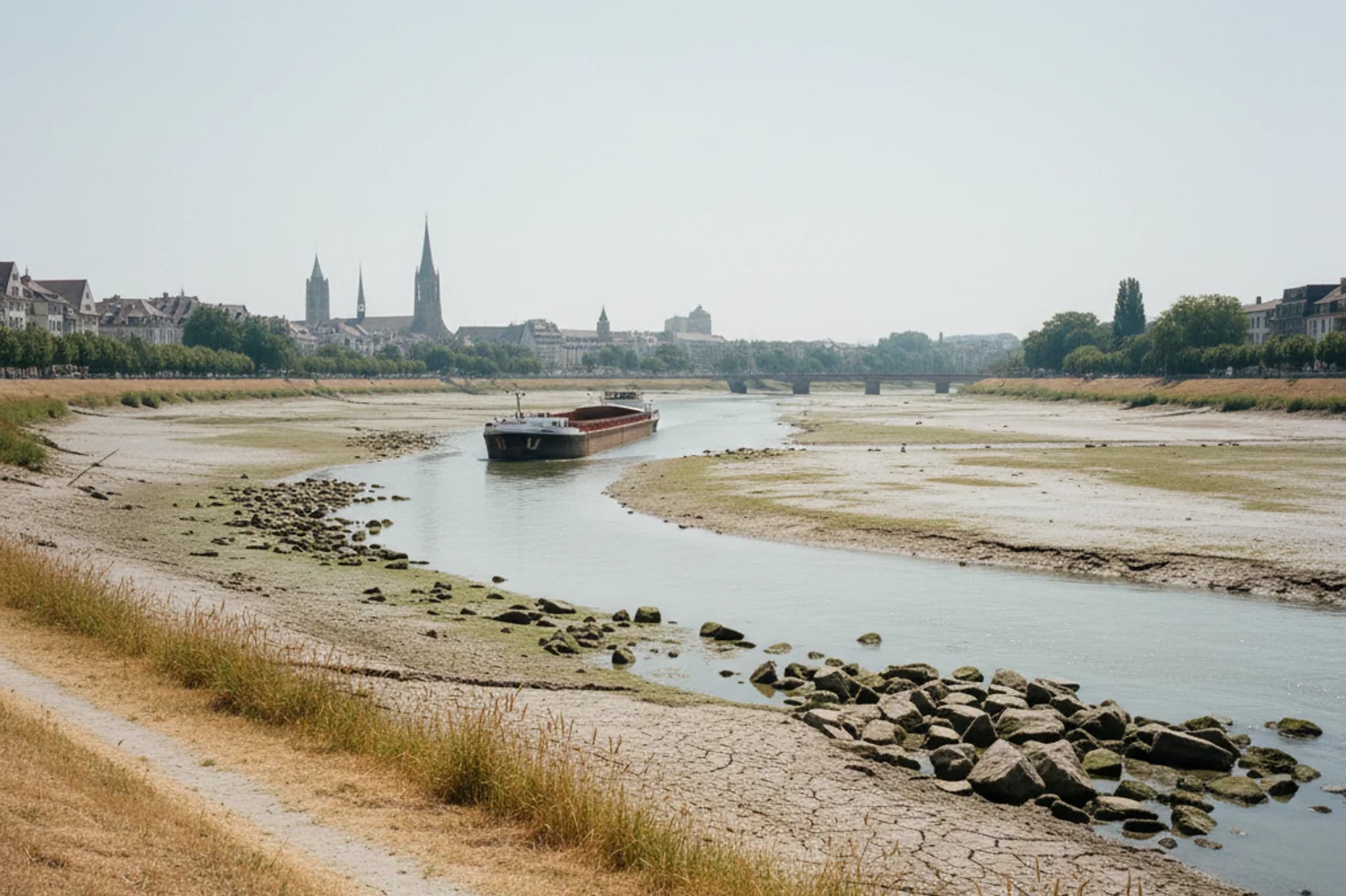
I grew up with the Rhine.
In Basel, it is difficult not to. It divides the city and connects it at the same time. We cross it on bridges. We swim in it. The small ferries move quietly from one bank to the other. On summer evenings, thousands of people sit beside it. And behind all of that, almost unnoticed, ships carry goods north and south.
For most of my life, the Rhine was simply there. So was something else: green Switzerland. Even in summer, the landscape around Basel and across much of the country was green enough that I never consciously thought about it. Water was not something Switzerland seemed to lack. We are, after all, the Wasserschloss Europas — the water tower of Europe. Mountains, glaciers, snow, lakes and rivers made water appear to belong to the category of things that could be taken for granted.
Then came the summer of 2026. Fields turned brown. Streams shrank. The Rhine fell. Something I had unconsciously classified as permanent suddenly looked conditional — not simply because there is less water, but because a constant stopped behaving like a constant.
The infrastructure we do not notice
Good infrastructure has a strange property. When it works reliably enough, we stop seeing it. We notice the train when it is late, electricity when the lights go out, a network when the connection disappears. A river, perhaps, in the same way.
For Basel, the Rhine is not merely landscape. It is infrastructure. Switzerland is a landlocked country, but economically it is not entirely cut off from the sea. Through the Rhine, Basel is connected to Rotterdam and Antwerp and therefore to the world's maritime trade routes.
Around ten per cent of Swiss foreign trade moves through this corridor. A substantial share of petroleum products reaches Switzerland this way. Fuel, food, animal feed, fertiliser, raw materials and industrial goods move through the Rhine ports around Basel. The river helped make a landlocked country less landlocked.
Switzerland did something with this geographic dependency that is easy to underestimate. It turned it into a governed one. Through international agreements and the Central Commission for the Navigation of the Rhine, Switzerland has rights of navigation and participates directly in determining the rules governing the river. For a small inland country, this is an unusual political achievement. Switzerland cannot move Rotterdam onto Swiss territory. It cannot nationalise the North Sea. Instead, it has spent generations building institutions that make an unavoidable dependency predictable, governed and reliable.
That is how small countries often succeed: not by eliminating dependence, but by making dependence governable.
A right is not a depth
Then the water falls.
In August 2026, the gauge at Kaub in Germany — one of the most important shallow sections of the Middle Rhine — reached record lows. At one point it measured just a few centimetres. This does not mean that only a few centimetres of water remained in the navigation channel. Gauge readings are reference measurements, not literal river depth. Economically, the distinction becomes almost academic.
As water levels fall, ships must reduce their loads to avoid touching the riverbed. A vessel that can normally carry a full cargo may carry half, then a third, then much less. At some point, the ship may still technically be capable of moving while the journey no longer makes economic sense.
The Rhine remains open. The treaties remain valid. Switzerland retains its internationally guaranteed route towards the sea. No border has closed. No government has imposed a blockade. No political agreement has been broken. And yet the usable transport capacity of the corridor can collapse.
A corridor can remain legally available after it has ceased to be operationally available.
The agreement can guarantee passage. It cannot guarantee water beneath the ship. Germany can be negotiated with. France can be negotiated with. The Netherlands can be negotiated with. Discharge cannot.
The water tower has a calendar
The old metaphor of Switzerland as Europe's water tower is not necessarily wrong. But perhaps we understood it too literally. A water tower sounds like a reservoir: something filled with water, stable, available when required. The Swiss hydrological system is more complicated.
Snow, in particular, has always performed an enormous storage function. Water falls during winter but does not immediately enter the rivers. It remains in the mountains. Then spring and summer release it gradually. The Alps are therefore not merely a source of water. They are part of its timing mechanism.
Climate change changes that mechanism. Warmer winters mean more precipitation falls as rain rather than snow. Snow melts earlier. Glaciers retreat. Hotter summers increase evaporation. Summer soils become drier. Swiss climate scenarios expect hotter and generally drier summers, longer drought periods and significantly lower summer runoff as warming continues. At the same time, intense rainfall events are expected to become more frequent.
That combination may sound contradictory — more drought, more extreme rainfall — but climate change is not simply a story about having less water. It is also about having water at different times, in different places and in more extreme forms. Too much today, too little six weeks later. The problem is increasingly not only the quantity of water. It is its distribution through time.
Perhaps Switzerland remains a water tower. But we are discovering that:
The water tower has a calendar.
Changing the boundary conditions
This matters beyond hydrology. Engineers design systems around assumptions. A bridge has expected loads. A data centre has expected temperatures. A railway has operating tolerances. A logistics network has expected transport capacity. A business has expected delivery times. Some assumptions are explicit. Others slowly disappear into the background because experience keeps confirming them.
A navigable Rhine is one of those assumptions. So is sufficient snow storage. So are agricultural seasons, certain temperature ranges, the availability of cooling water, and the expectation that extreme events remain exceptional.
Climate change is unusual because it does not merely damage infrastructure. It changes some of the boundary conditions under which the infrastructure was designed. That is a different kind of problem. A failed machine can be repaired. The environment in which the machine operates can move. Something that worked reliably for a century was partly reliable because the physical world around it remained within a relatively familiar range. We are beginning to find out what happens when that range shifts.
The alternatives reveal the system
Low water does not mean Switzerland suddenly stops functioning. Goods can move by rail. They can move by road. Some fuels can travel through pipelines. Companies maintain inventories. Switzerland maintains compulsory stocks of essential goods. Different suppliers can sometimes be used. Different routes can sometimes be activated. This is why the current Rhine disruption has not turned into a general Swiss supply crisis. The system has buffers.
Disruption reveals how those buffers actually work. Replacing river freight is not as easy as drawing another arrow on a logistics diagram. A single large barge can represent the cargo of scores — in some cases well over a hundred — trucks. Those trucks require vehicles, drivers, road capacity, fuel, loading infrastructure, border capacity, and places to unload. Rail requires available train paths, locomotives, wagons and terminals. And Switzerland is not the only country that suddenly wants them. If the Rhine is restricted through Germany, German industry is looking for exactly the same alternative capacity.
Redundancy is therefore not the existence of another mode of transport. It is the existence of available capacity in that mode when everybody needs it at the same time. Saying we could move it by rail is not the same as knowing we can move this many tonnes per day by rail, starting within this many hours, for this many weeks. One is an alternative in theory. The other is operational resilience.
Formal rights and operational freedom
I did not begin thinking about this drought as a sovereignty question. I began with the Rhine, with Basel, with brown fields, with the strange experience of seeing a Switzerland that did not look like the Switzerland I remembered. The further I followed the river, the more familiar the structure became. Sovereignty is ultimately about freedom of action: not absolute independence, not producing everything yourself, not eliminating relationships with other countries. A small country cannot operate that way.
Switzerland's prosperity has always depended on exchange: on trade, cooperation, access, and infrastructure that crosses borders. The question is not whether dependencies exist. The question is whether they can be governed, whether alternatives exist, whether there is enough time to activate them, and whether decisions remain possible when conditions change.
The Rhine makes this unusually tangible. Switzerland can possess sovereignty in the formal political sense while temporarily losing part of its operational freedom because a critical transport corridor no longer has sufficient physical capacity. The treaty remains. The river changes.
Formal sovereignty is the right to decide. Operational sovereignty is the practical ability to execute that decision. The two are not always the same thing.
Rights × capability × alternatives × time
The Rhine suggests a useful way of thinking about effective sovereignty. Not as a scientific equation, but as a systems model:
Effective sovereignty = rights × physical capability × alternatives × time
A right without physical capability may be unusable. Physical capability without legal access may be inaccessible. A single functioning corridor without alternatives is fragile. Alternatives that take longer to activate than the crisis allows are theoretical.
This is where strategic reserves become more interesting than they first appear. A stockpile does not make Switzerland independent. It converts dependency into time. If fuel deliveries are interrupted today but reserves exist for weeks or months, the country does not need to solve the entire problem today. It can wait for water levels to recover, redirect shipments, activate rail capacity, use another supplier, adjust demand, negotiate, respond.
Stored goods are therefore also stored decision time. And decision time is one of the most valuable forms of resilience a country can possess.
Cooperation is not the opposite of sovereignty
Climate stress will not make international cooperation less important for Switzerland. It will make it more important. The Rhine passes through multiple countries. Its navigation infrastructure is international. Its water management is international. Its industrial users are international. Its environmental system does not recognise national borders. No credible Swiss strategy can treat that reality as optional.
The choice is not between sovereignty and interdependence. The real choice is between different forms of interdependence.
There is unmanaged dependence: we need this system and hope it continues to work.
And there is governed interdependence: we understand the dependency, participate in its institutions, know its limits, maintain alternatives, hold reserves, measure deterioration, and know what to do when the normal path stops working.
For a country like Switzerland, cooperation can therefore increase sovereignty rather than diminish it. The opposite of sovereignty is not dependence.
It is dependence that cannot be governed, substituted, buffered or escaped.
Efficiency and unused options
Modern infrastructure tends to become efficient. Warehouses become smaller. Inventories shrink. Transport becomes just-in-time. Assets run closer to capacity. Unused resources look expensive. Redundancy looks inefficient. Under stable conditions, this works extraordinarily well.
Optimisation has a hidden cost. Every piece of unused capacity that disappears may also remove an option: a spare rail path, an additional storage tank, a warehouse holding another month of supplies, a second supplier, a vessel designed for unusually shallow water, a logistics contract that appears unnecessary during normal years.
Efficiency asks: What capacity do we need most of the time?
Resilience asks: What capability must still exist when most of the time stops looking like most of the time?
The summer of 2026 does not answer where the correct balance lies. It does make the trade-off visible.
We should be careful about what the drought proves
One extreme summer is not a climate model. It would be too simple to say that every dry field or every low river level exists because of climate change. Weather remains variable. Wet years will return. The Rhine will rise again. There will be floods as well as droughts.
The broader direction still matters. Swiss climate science does not predict the disappearance of the Rhine. It does not predict a permanently brown Switzerland. It does tell us that hotter conditions, drier summers, changing snow storage and more severe drought episodes are becoming a more important part of Switzerland's future operating environment.
The useful question is not: Will the Rhine disappear? It is: What happens when conditions once treated as exceptional become common enough that our systems must be designed around them? That is a much harder question. And a much more practical one.
The new map of Swiss resilience
If this change continues, Swiss resilience will increasingly depend on systems that once appeared secondary: low-water vessels, better river forecasts, rail capacity that can actually be activated during disruption, multimodal ports, pipelines, inventories, water management, agricultural adaptation, electricity systems designed for changing seasonal hydrology, international agreements, and shared infrastructure projects outside Switzerland.
And perhaps most importantly: the ability to identify assumptions before reality invalidates them. The Rhine is unlikely to be the only one.
What else have we mistaken for permanent because it remained reliable throughout our own lives? Snow, water, cool nights, stable forests, predictable harvests, cheap insurance, reliable cooling, certain river levels, certain temperature ranges, certain places remaining comfortably habitable.
Infrastructure is usually built on yesterday's environment. The uncomfortable task ahead is deciding which parts of yesterday remain reasonable assumptions for tomorrow.
Back to Basel
The Rhine is still beautiful. People still swim in it. The ferries will keep crossing it. Ships will return when the water permits. Basel will remain Basel. Switzerland will remain Switzerland. This is not a story about the Rhine disappearing. Something subtler disappeared. An assumption.
For most of my life, I never had to think about whether there would be enough Rhine. This summer, I did. And perhaps that is how large changes first enter our lives: not when everything collapses, but when something that used to belong to the background suddenly demands attention.
We usually discover infrastructure when it fails. Climate change may force us to discover nature in much the same way. That leaves a broader question than the Rhine itself:
Which parts of our freedom of action depend on physical conditions we have quietly assumed will remain unchanged?
Sovereignty was never control of the river. It was never control of the weather. It was never independence from geography. It is something more achievable — and more demanding.
The ability to keep choosing when the conditions around us change.
And the first test may simply be noticing which things we had mistaken for permanent.
Sources & further reading
The factual background for this volume draws primarily on Swiss federal climate, hydrological, transport and economic-supply sources, together with the institutions governing Rhine navigation and contemporary reporting on the 2026 low-water event.
Swiss climate and hydrology
- National Centre for Climate Services — Climate CH2025 — Switzerland's current national climate scenarios, including projections for hotter conditions, drier summers, more extreme heat, heavier precipitation and less snow.
- NCCS / Hydro-CH2018 — Water shortages in summer — hydrological scenarios for declining summer runoff, longer drought periods and changing low flows.
- Federal Office for the Environment — Drought: monitoring, forecasting and warning — Switzerland's national drought-monitoring and warning architecture, including the implications for agriculture, energy, ecosystems and Rhine freight.
- National Drought Platform — Drought bulletin — current observations and official assessments of drought conditions across Switzerland.
- Swiss Federal Institute WSL — Drought in the Swiss water tower — research on drought, snow, forests, water deficits and the changing Swiss hydrological system.
The Rhine and Switzerland's access to the sea
- Federal Department of Foreign Affairs — “Switzerland can directly co-determine the rules of Rhine navigation” — the strategic importance of the Rhine to Swiss foreign trade, petroleum supply and Switzerland's role in governing navigation.
- Central Commission for the Navigation of the Rhine — Information on the waterway Rhine — institutional and technical background on navigation, infrastructure, water levels and the international governance of the Rhine.
- Federal Statistical Office — Goods transport by air, water and pipeline — official Swiss statistics on goods transported through the Rhine ports and other transport modes.
Security of supply
- Federal Office for National Economic Supply — Current supply situation — official information on Rhine transport restrictions, alternative transport modes and Swiss compulsory stocks during the 2026 drought.
The 2026 Rhine low-water event
- Reuters, 15 August 2026 — Rhine water sinks to another record low and transport shifts to land — reporting on record-low levels at Kaub and the shift of freight from river transport to road and rail.
- Reuters, 11 August 2026 — Low Rhine levels disrupting German industry — reporting on industrial disruption, higher freight costs, capacity constraints and the scale required to substitute barge transport with trucks and trains.
- Reuters, 9 August 2026 — German shippers warn Rhine could be 'split in two' by low water — reporting on the operational consequences of extremely low water at the Kaub bottleneck.
Sources accessed August 2026. The equation “effective sovereignty = rights × physical capability × alternatives × time” is a conceptual model developed in this volume, not an established scientific formula.