Most people still think of sovereignty as a matter of borders, flags, armies, and formal independence.
That definition is outdated.
In the real world, sovereignty reveals itself under pressure. It shows up in the speed with which a country can detect a problem, understand it, coordinate a response, move resources, and restore stability. It is not measured by how loudly a state speaks, but by how reliably it acts.
That is why preparedness is the highest form of sovereignty.
It is easy to talk about control. It is much harder to build the systems, institutions, redundancies, and operational discipline that allow a society to respond before a crisis becomes a catastrophe. Yet that is precisely where real sovereignty lives: not in slogans, but in readiness.
The latest Ebola outbreak in the Democratic Republic of Congo offers a powerful case study. At first glance, it may look like a distant humanitarian event. In reality, it reveals a structural truth that applies far beyond public health. It tells us something about crisis management, about political priorities, and about the difference between states that merely exist and states that are truly capable.
Ebola is not “somebody else’s problem”
A dangerous mistake in modern policymaking is to treat foreign outbreaks, infrastructure failures, cyber incidents, or supply shocks as local issues until they are no longer local.
That is not how interconnected systems behave.
A virus does not care about passports. A malware campaign does not care about neutrality. A supply chain rupture does not ask whether a country thought itself insulated. Complex systems are brutally indifferent to political comfort. They move across networks — physical, digital, financial, human.
This means that preparedness abroad and resilience at home are not separate topics. They are parts of the same strategic equation.
If an outbreak is not contained early, the cost of response escalates. If early warning systems are weak, every later intervention becomes more expensive. If funding arrives too slowly, the burden compounds. The same pattern appears everywhere: in public health, in cybersecurity, in infrastructure, in cloud dependency, in AI governance, and in national defense.
The crisis changes. The underlying logic does not.
The numbers tell a brutal story
The most striking fact in the Ebola response is not that the world lacks money. It is that the world still struggles to move relatively small sums quickly enough.
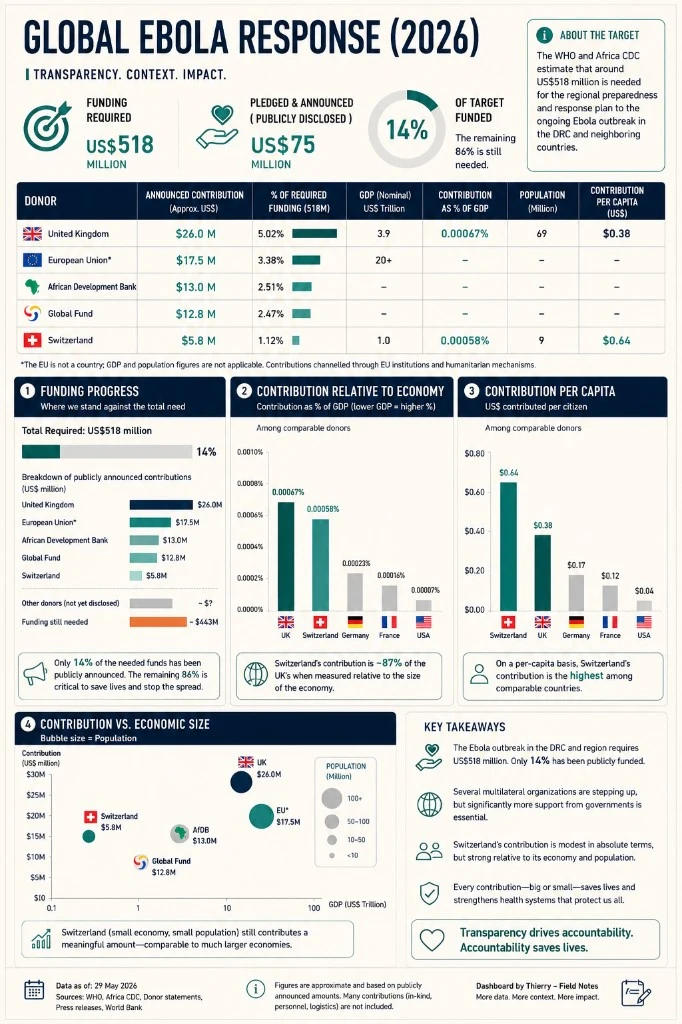
The total estimated requirement for the regional Ebola response and preparedness effort was around US$518 million.
At the time of writing, only about US$75 million in publicly announced major contributions had been clearly disclosed.
That means roughly 14% of the requirement had been visibly covered.
That gap matters.
Not simply because money is missing — but because the delay in moving money translates directly into delay in moving action.
Among the publicly announced contributions, several stood out:
- United Kingdom: approximately US$26 million
- European Union: approximately US$17.5 million
- African Development Bank: approximately US$13 million
- Global Fund: approximately US$12.8 million
- Switzerland: approximately US$5.8 million (roughly CHF 4.6 million)
In absolute terms, Switzerland’s number appears small beside larger actors. But that is exactly why normalized comparisons matter.
Once the numbers are viewed relative to economic size and population, the picture changes. Switzerland’s contribution is strong for a country of its scale. Per capita, it compares very favorably. Relative to GDP, it is not far behind the much larger United Kingdom.
This is not a sentimental argument. It is a practical one.
Scale is not destiny.
Small countries do not need to dominate in absolute volume in order to matter. They need to be capable, focused, and operationally serious.
That is a sovereignty lesson.
The world does not have a money problem
This is the uncomfortable part.
When a crisis response needs US$518 million, many people instinctively talk as if the world simply cannot afford it.
That is nonsense.
The combined annual spending of governments worldwide is measured in the tens of trillions of dollars. In that context, US$518 million is tiny. The issue is not resource existence. The issue is resource mobilization.
This distinction matters enormously.
If we misdiagnose the problem as scarcity, we will keep arguing over who should pay.
If we correctly diagnose the problem as coordination latency, then we are forced to confront the real weaknesses:
- fragmented responsibility
- slow approval chains
- weak operational visibility
- lack of pre-committed response mechanisms
- insufficient strategic prioritization
- public institutions that are reactive rather than ready
The cost of that latency is not theoretical. It is paid in lost time, lost control, and eventually lost lives.
This is true for Ebola.
It is equally true for:
- ransomware incidents
- electricity shortages
- floods
- transport breakdowns
- cloud outages
- AI governance failures
- supply chain shocks
In other words: the world is often not poor. It is slow.
Prevention is politically invisible
Why does this happen again and again?
Because prevention is hard to sell.
When prevention works, nothing dramatic happens. There is no spectacle. No politician cuts a ribbon on the disaster that never occurred. No one receives applause for a system that absorbed a shock quietly and competently. The public usually notices failure, not preparedness.
That creates a political bias toward visible spending and away from resilient design.
We repeatedly underinvest in:
- early warning
- reserve capacity
- training
- maintenance
- contingency planning
- stockpiles
- drills
- interoperable systems
- institutional memory
Then, when crisis arrives, we spend far more in emergency mode than we would ever have spent on readiness.
This is one of the defining pathologies of modern governance.
The same mistake appears in road networks, hospitals, digital infrastructure, energy policy, cybersecurity, and AI systems. Preventive work is treated as boring overhead — until its absence becomes a headline.
Preparedness is not glamorous. It is not theatrical. It does not trend well. But it is the difference between disruption and breakdown.
Public health is national security
A mature state understands that public health is not a soft issue.
It is part of national security.
An outbreak far away can trigger:
- cross-border transmission risks
- trade disruption
- pressure on humanitarian and diplomatic capacity
- stress on regional security conditions
- indirect migration effects
- financial strain on already weak systems
- reputational and political consequences if response is inadequate
This is why health preparedness belongs in the same strategic discussion as cyber defense, energy security, food resilience, and digital sovereignty.
All of these domains share the same fundamental question:
Can the system absorb shock and continue to function?
That is what sovereignty means in practice.
Not the fantasy of perfect control.
Not the theatre of symbolic politics.
But the real capacity to detect, decide, respond, and recover.
Small states can have outsized influence
One of the most interesting takeaways from the Ebola funding picture is how misleading absolute numbers can be.
If public discussion focuses only on the largest top-line amounts, smaller states disappear from the story. But when normalized by GDP or contribution per citizen, a more useful reality appears.
Switzerland’s contribution is modest in absolute terms. Yet relative to the size of its economy and population, it is meaningful. That matters because it reinforces an important principle:
Capability is not only a function of scale. It is also a function of discipline.
That same lesson appears again and again in engineering, logistics, and public administration. High-functioning systems are rarely the product of rhetoric. They are the product of standards, routines, prioritization, and a willingness to invest in reliability before disaster strikes.
Small states cannot compete with major powers by pretending to be large powers.
They compete by being sharper, faster, and better organized.
This is why preparedness matters so much for countries like Switzerland. It is one of the clearest ways to turn competence into influence.
Transparency creates accountability
Another problem becomes obvious the moment one tries to understand the funding landscape: the information is surprisingly fragmented.
That alone is revealing.
If preparedness is strategically important, then visibility should be treated as a core capability. We should be able to see, in near real time:
- what is required
- what has been pledged
- what has been disbursed
- what is still missing
- how the response is evolving
- where bottlenecks remain
Dashboards matter.
Operational visibility matters.
Shared situational awareness matters.
People act differently when reality is made legible.
A good dashboard does not solve a crisis by itself. But it reduces ambiguity, increases accountability, and improves decision quality. It shortens the gap between signal and action.
This is true in epidemic response.
It is true in cybersecurity operations centers.
It is true in supply chain control towers.
It is true in any serious system.
Opacity is friction.
Clarity is capacity.
Coordination latency is the hidden tax on resilience
There is a phrase that belongs at the center of modern governance: coordination latency.
This is the time lost between:
- detecting a threat
- agreeing that it matters
- deciding who is responsible
- approving the next step
- releasing resources
- executing the response
Most people underestimate how destructive this delay can be.
In complex systems, time is not neutral. Delay changes the shape of the problem. What could have been contained becomes amplified. What could have been solved cheaply becomes expensive. What could have been local becomes systemic.
This is why crises so often look bigger in hindsight than they needed to be.
We tend to talk about outcomes as if they were inevitable. In reality, many bad outcomes are simply the accumulated result of slow movement through institutions that were never designed for speed under uncertainty.
Preparedness is the discipline of reducing that latency before the crisis arrives.
Not during.
Before.
Preparedness is a design choice
Preparedness does not appear by accident.
It is designed.
It is budgeted.
It is trained.
It is rehearsed.
It is maintained.
A prepared system usually has several characteristics:
- clear ownership
- fast decision paths
- predefined escalation models
- situational visibility
- redundancy where needed
- local competence with central coordination
- regular testing and drills
- realistic assumptions instead of optimistic theatre
- enough slack to absorb shocks without immediate collapse
This is true whether the system in question is a national public health network, a railway operator, a cloud platform, or an AI deployment inside a company.
The organizations and states that perform well under pressure tend to have something in common: they prepared while others were still talking.
A sovereignty doctrine for the real world
If we take the lesson seriously, then sovereignty needs to be redefined for the twenty-first century.
A practical doctrine of sovereignty would ask:
- Can we detect emerging threats early?
- Can we understand system dependencies clearly?
- Can we mobilize people, money, and infrastructure quickly?
- Can we continue operating under pressure?
- Can we recover without prolonged chaos?
- Can we assist others before their crisis becomes ours?
- Can we act based on reality rather than institutional fantasy?
That is a far more demanding definition than the symbolic one.
But it is also more useful.
It applies equally to:
- epidemic preparedness
- digital infrastructure
- energy security
- transport systems
- AI governance
- disaster response
- defense logistics
- economic resilience
Preparedness is the connective tissue between all of these.
The measure is response time
In the end, sovereignty is not proven by speeches, branding, or ideology.
It is proven by response time.
How fast can a system notice?
How fast can it decide?
How fast can it move?
How fast can it recover?
The Ebola case makes this brutally clear. The world did not need to invent new wealth in order to respond. It needed to move existing capacity faster, with more discipline and more visibility.
That is why this story matters far beyond public health.
It exposes a wider civilizational weakness: we still prefer the appearance of control to the hard work of readiness.
But the future will not reward appearances.
It will reward preparedness.
And that is why preparedness is the highest form of sovereignty.
Figures referenced in this article are approximate and based on publicly announced major contributions at the time of writing. The purpose of the comparison is not to claim perfect completeness, but to illustrate a structural point: the gap between available global resources and the speed at which they are mobilized.