
A sentence with a hidden theory of the world
In July 2024, a sentence attributed to Joseph Browning began circulating online:
“The underlying purpose of AI is to allow wealth to access skill while removing from skill the ability to access wealth.”1
Some later versions say “from the skilled” rather than “from skill.” The wording above matches an indexed post on Browning’s own X account. The date and an earlier Facebook origin are attested by secondary references, but the original Facebook post was not independently accessible during this review. The wording matters less than the allegation it contains.
It is a brutal thing to say. And “purpose” is precisely the word that should make us suspicious. A claim about the intentions behind an entire technology cannot be established by observing what some companies do with it. AI research spans medicine, accessibility, scientific discovery, education, consumer tools, military applications and commercial automation. There is no singular intention to be uncovered.
But perhaps the sentence is powerful because it mistakes an economic possibility for a motive.
Strip away the implied conspiracy and a question remains: What happens when the ability to perform skilled work becomes easier to acquire, but the property rights and commercial relationships needed to profit from that work do not become equally accessible?
I asked a related question in The Compounding Class: what happens when people with resources can convert them into deployable intelligence, retain the gains, and reinvest those gains into more capability?2 Here I want to examine the other side of that arrangement. Not the accumulating owner, but the person whose education and expertise once promised a livelihood.
For generations, we told people that education was the reliable route from dependency toward independence. Study, practise, become useful, and the market will make room for you. That was never a universal promise, never equally available and never fulfilled for everybody. But it was sufficiently credible to shape entire lives.
What if the market still wants what you know, but increasingly stops needing to obtain it from you?
The difference between knowing and being paid
An engineer knows how to solve problems. A translator understands language. A lawyer recognises distinctions that matter. A researcher can tell a promising result from a misleading one. Those are real capabilities, accumulated through effort and experience.
Yet the price of an occupation is not a direct moral reward for that effort. Markets pay for scarce contributions under specific conditions. The relevant question is not merely whether your work is useful, but how many alternatives a buyer has, how easily your output can be verified, how much demand exists, and how strongly you can negotiate.
A skilled person can be indispensable to a task without having much power over the contract. A business owner can know less about the technical work and still control the relationship with the customer, the legal rights to the output and the decision about who is hired.
Automation changes this relationship when it gives the buyer another credible way to obtain an outcome. Sometimes it replaces a task outright. Sometimes it helps a colleague carry out the task. Sometimes it improves the expert’s own work so much that the expert becomes more valuable. These are different arrangements, and their distributional effects need not be the same.3
The mistake is to imagine that a machine must become as good as the very best expert at everything before the price of any expert’s labour can change. In real markets, a cheaper substitute that is good enough for a particular use can change bargaining power long before it can replace an entire profession. Conversely, when mistakes are costly, context matters and someone must assume responsibility, human expertise may remain valuable even when routine output becomes abundant.
The market value of an expert’s service and the social value of expertise are not identical.
Where the wage premium goes
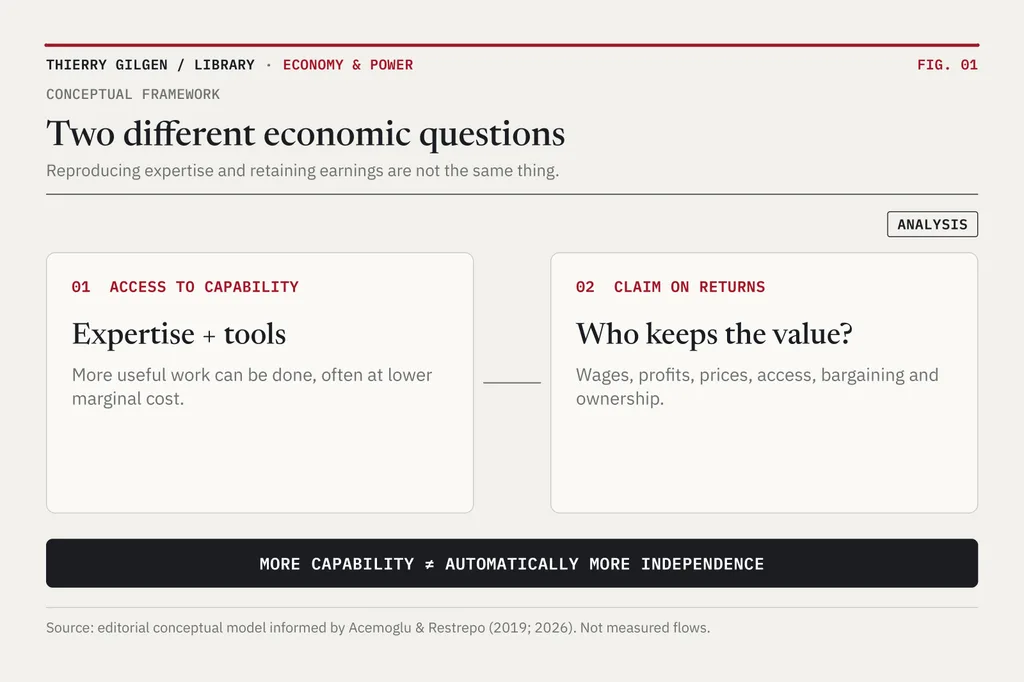
Economists Daron Acemoglu and Pascual Restrepo offer a useful vocabulary for this mechanism: rent dissipation. In this context, a rent is not an accusation of greed. It means an earnings premium above a worker’s outside option. Some tasks, firms and institutional arrangements give workers the leverage to earn such premiums.
Their 2026 Quarterly Journal of Economics study models how automation can target such tasks and erode those premiums. Using US data from 1980 to 2016, the authors estimate that automation accounted for 52% of the increase in between-group wage inequality over that historical period, with rent dissipation explaining about one-fifth of automation’s contribution. They also estimate that rent dissipation offset a large share of the gross productivity gains associated with automation under their model.4
Those estimates are important, but they are not estimates of the effect of generative AI since 2022. They illuminate a mechanism from previous technological change. The mechanism deserves scrutiny because AI is expanding the range of tasks software can perform, including tasks traditionally associated with education and professional status.
Suppose a small consultancy needs specialist analysis. Previously, it might have paid an external professional for two days. An AI-assisted internal employee can now prepare a strong first draft in an afternoon. The consultant may still be the best person to review it. That last hour could become more valuable. Or the buyer may decide that a good-enough draft meets the need and pay no consultant at all. The outcome depends on the stakes, the quality standard, and the market for the remaining human contribution.
The knowledge has not vanished. Its purchasing conditions have changed.
This distinction also helps us avoid an easy analytical error. If customers get lower prices, society may benefit even where some established professionals lose a scarcity premium. We should not defend expensive access to knowledge merely because it protects a profession. But if the productivity dividend accrues overwhelmingly to a few owners while pathways to well-paid work deteriorate, the gains are distributed differently from the benefits the technology makes possible.
What the numbers do — and do not — say
The strongest available evidence does not describe one seamless global story. It describes several local stories with different data and different outcomes.
Switzerland: the professions under pressure
A KOF Swiss Economic Institute study by Jeremias Kläui and Michael Siegenthaler compares the evolution of registered jobseekers and online vacancies across Swiss occupations with different exposure to large language models. After late 2022, jobseeker numbers in highly exposed occupations rose up to 27% more strongly than in less exposed occupations, while vacancies in exposed occupations also evolved more negatively. The comparison covers relative occupational changes, using Swiss administrative and job-posting data through August 2025.5 In 2026, Siegenthaler put the gap at up to 30% and said generative AI explained at most a fifth of the rise in Swiss unemployment since 2023.67
This is not a 27% increase in Switzerland’s overall unemployment rate. Nor is it a clean experimental estimate proving that AI caused the entire occupational divergence. The researchers focus on relative patterns and note that benefits through productivity, complementary jobs and lower prices are not captured by that comparison.
The distinction is essential. Switzerland’s total number of jobs in the second quarter of 2026 was 2.0% higher than a year earlier, according to the Federal Statistical Office’s employer-based job statistics. A separate population survey found employed persons up 0.8% and ILO unemployment at 4.9% in that quarter. Different concepts and denominators are involved; neither should be silently substituted for the KOF occupational measure.89
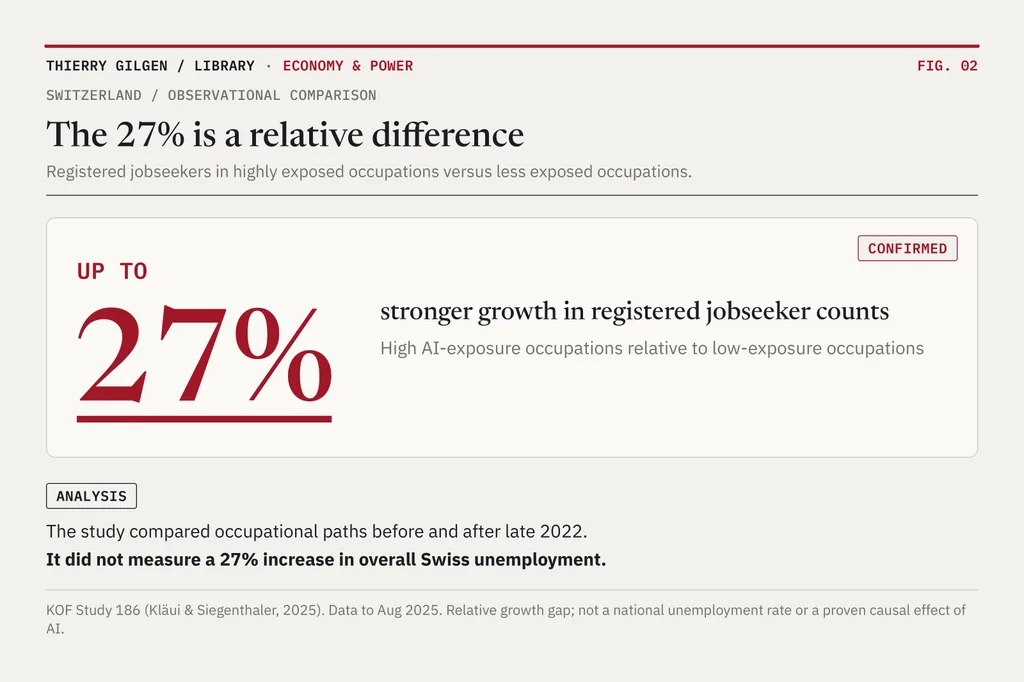
The Swiss signal is that the distribution of opportunity may be shifting inside an economy where employment can still grow.
United States: a narrower doorway
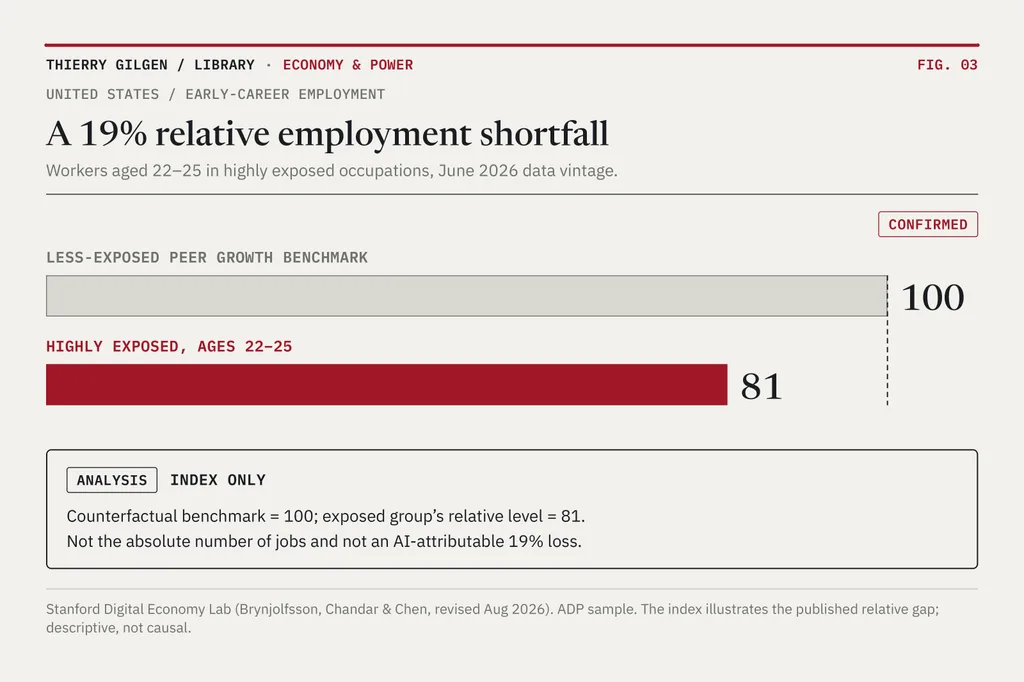
In an August 2026 revision, Erik Brynjolfsson, Bharat Chandar and Ruyu Chen analysed ADP payroll data covering millions of US workers through June 2026. Employment for workers aged 22–25 in highly AI-exposed occupations stood about 19% below a counterfactual in which it had grown in line with the same-age group in less-exposed occupations. The divergence was concentrated more in reduced hiring than in layoffs; the study found no widespread economy-wide displacement.10
That 19% is a relative employment gap, not a measured AI-caused unemployment rate, not the share of jobs eliminated by a model, and not a forecast. The authors explicitly describe their evidence as suggestive rather than definitive; education controls and sample selection temper causal claims.10
The study also contains an important distinction: workers with accumulated tacit experience appear different from young workers relying more heavily on codified, textbook knowledge. That sounds plausible, but it must not become a lazy promise that every senior professional is safe. It is a hypothesis about the composition of tasks and experience, not an immunity certificate.
Denmark: disruption without an average wage shock
Research by Anders Humlum and Emilie Vestergaard links representative chatbot-adoption surveys with Danish administrative earnings and employment records. Their March 2026 revision, Still Waters, Rapid Currents, finds widespread task change, but no detectable average effects of adoption on earnings or recorded hours at the worker or workplace level two years after ChatGPT, ruling out effects larger than 2% under their design.11
This result is not a refutation of the Swiss or American evidence: it asks different questions, in a different labour market, using a different empirical design. But it is a valuable warning against pronouncing a general wage collapse before one is measurable.
Productivity without a single answer to distribution
In a field study involving 5,172 customer-support agents, Erik Brynjolfsson, Danielle Li and Lindsey Raymond found access to a generative AI assistant increased resolved issues per hour by 15% on average, with larger gains among less-experienced and less-skilled agents.12
This is one of AI’s most compelling possibilities: capability that once took a long time to acquire can be made more widely available. People can become better at useful work. It does not tell us, by itself, whether the subsequent value was realised as higher wages, lower prices, company profits, or some mixture.
And in the commercial freelance market there are early signs that the price of some outputs may fall even as demand increases. Upwork’s July 2026 platform report says contracts for generative-AI and creative-production work grew 90% year on year while per-contract earnings fell 13%. It separately reports that more complex AI-augmented professional services grew 72% in volume with earnings rising 22%. These are figures from one commercial platform, reported by that platform, and the categories and composition can change. They should not be projected onto all workers.13
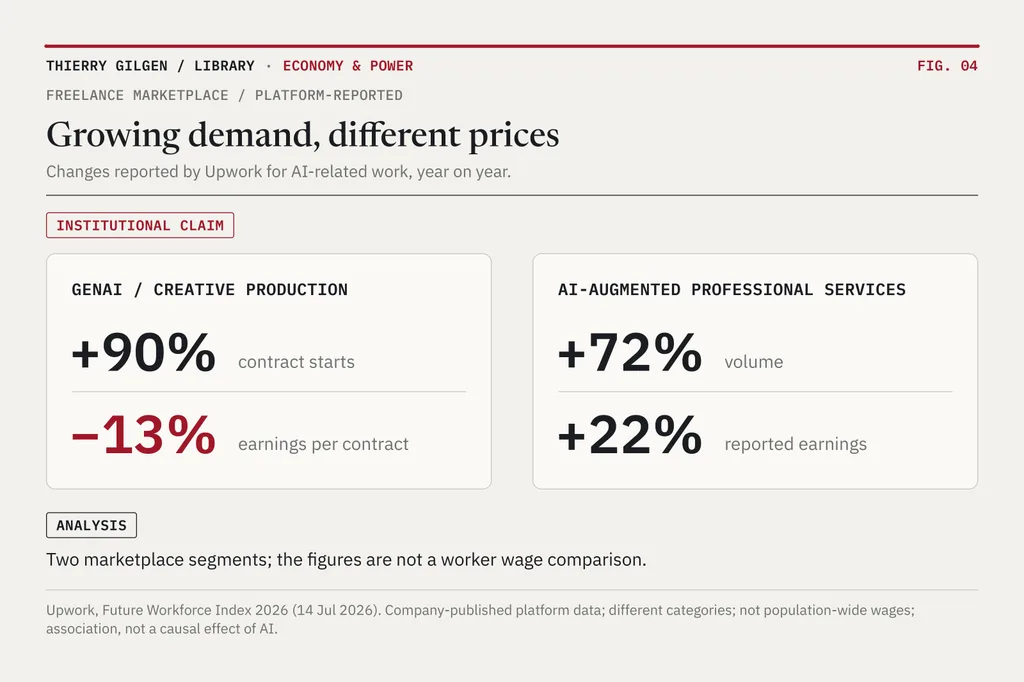
The underlying observation is credible without pretending every study measures the same variable: the economic consequences depend not only on whether work is assisted by AI, but on the type of work, the organisation around it, and who has alternatives.
The ladder we may be removing
There is a less visible problem than today’s wage premium: the path through which tomorrow’s professionals become competent.
We do not ordinarily hire a graduate to exercise twenty years of judgment. We hire them to do bounded work: preliminary research, documentation, initial analysis, routine coding, first drafts, quality checks. Along the way, they encounter awkward exceptions, learn why apparently simple rules fail, and see how an experienced colleague decides what matters.
What happens if the entry-level tasks are exactly the ones an employer finds easiest to automate?
A company may become more productive in the short term by replacing parts of junior work with AI. If every company in an industry responds similarly, the pool of people acquiring experience can narrow. Ten years later, the same industry may discover that it needs experienced specialists it has not trained.
This is not yet an empirically established ten-year collapse. It is a foreseeable coordination problem. The firm making today’s hiring decision may not bear the full future cost of losing the industry-wide training pipeline.
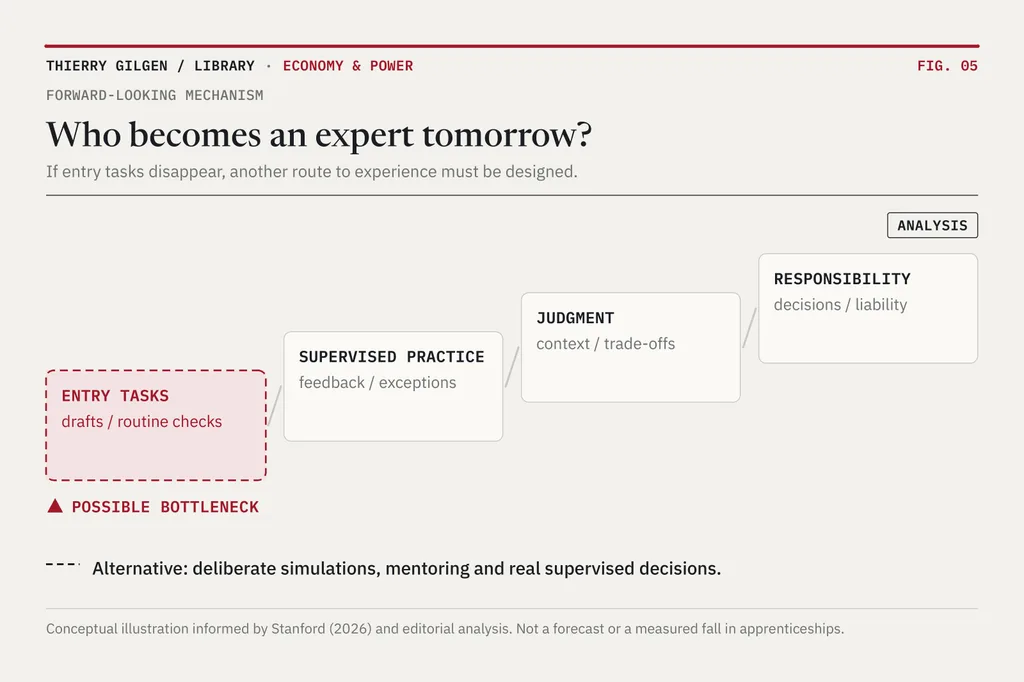
The answer cannot be to preserve repetitive tasks forever simply as a form of compulsory apprenticeship. Many such tasks were boring, exclusionary or badly paid. A better question is whether we can design new routes to judgment: supervised simulation, deliberately structured rotations, meaningful responsibility, annotated AI decisions, apprenticeships that include oversight of real systems, and clear progression criteria.
The better the technology becomes at providing answers, the more deliberately institutions may have to teach people how to ask consequential questions, verify outcomes and take responsibility for decisions.
When capability is common, what remains scarce?
Some scarcity will disappear, and that can be progress. A small business able to obtain competent translation, accounting assistance, design or software prototyping at a fraction of the historical cost may do things it otherwise could not afford. People previously excluded by tuition costs, geography, disability or professional gatekeeping may gain tools that improve their prospects.1214
Other scarcity will become more important. Accurate data, customer trust, distribution, licences, legal liability, proprietary workflow access, capital for experimentation, physical infrastructure and the ability to deliver a result all matter. A person who can generate a proposal is not necessarily a person who can win and execute the contract. A company that produces many promising outputs still has to verify them and answer for failures.
Here is where the original sentence acquires its force without proving its allegation.
An owner can pay for machine capacity and obtain useful cognitive work without paying the old price for each unit of human time. A worker may learn to use the same technology yet lack the customer access, assets or bargaining position to retain much of the result. Or the worker may use it to become an independent supplier, undercut a gatekeeper and keep more than before. Both stories fit the technology. Their relative prevalence is an empirical and institutional question.
The IMF’s July 2026 analysis of observed AI usage finds that its estimated productivity-equivalent gains are concentrated toward higher-wage occupations, particularly in developing economies, while this occupational concentration appears to be declining as adoption spreads. Crucially, the authors cannot infer from use-patterns alone whether firms or workers ultimately capture the resulting value. Their headline labour-cost-equivalent estimate is a modelled valuation of time saved, not realised GDP, income or profit.15
We should be careful with the difference between a technology producing an advantage and someone possessing a legal claim on that advantage.
The question of ownership
The Compounding Class examined the accumulation loop: resources fund deployable capability, retained returns finance additional capability, and advantage compounds.2
The present question starts one level lower, at the transaction between a person and the institution purchasing their work.
A wage is a claim on a share of the value created under an employment agreement. Equity is a claim on residual returns under an ownership agreement. Customers benefit when prices decline or quality improves. Governments can redistribute part of the gains through taxation and public services. Suppliers of models, compute and distribution can take their own shares. We cannot know the final distribution by measuring token usage, hours saved or even output per employee alone.
Nor should we assume that every company adopting AI will become rich. Competition may pass savings to customers. Verification costs may eat up the productivity gain. New entrants may erode incumbent margins. Businesses can fail while using excellent tools. A powerful model can remain a costly dependency rather than a productive asset.
There is, however, an asymmetry worth watching: the person who performs a task and the person who can repeatedly deploy the means of performing that task occupy different economic positions.
One can have knowledge. The other can reproduce part of its output at scale and decide where the resulting earnings go.
The question is not whether ownership should disappear or expertise should become artificially scarce. It is whether greater productive capacity will be paired with broader opportunities to own, negotiate, compete and participate in the returns.
A better test than whether everyone has an AI subscription
Public debates often ask the wrong question: can everybody use AI? Access matters, but access to a chat interface is not the same as a claim on the value created with it.
For the next few years, I would watch five things.
The entry channel. Are employers hiring and training enough beginners to create the experienced workforce they will need later? The strongest warning signs may appear first in applications, vacancies and apprenticeships rather than headline unemployment.
The quality of work. Do AI gains make jobs more autonomous and skilled, or do workers become supervisors of automated output with less control over time, pace and professional standards? The ILO’s June 2026 review urges attention to job quality and autonomy alongside employment counts.16
The wage response. When verified productivity increases, do earnings improve, stay flat, or decline after accounting for inflation and workforce composition? Task-level productivity is not a wage statistic.
Contestability. Can a skilled individual or small enterprise credibly serve customers with available tools? Can they switch providers, use portable data, finance reasonable verification costs and retain a durable relationship with customers?
Participation in returns. Do employees gain bargaining power, profit-sharing, equity, mobility or lower living costs when output becomes cheaper? Does the consumer surplus offset or compound changes to income? These are related but not interchangeable measures.
No single chart settles these questions. Nor will one grand policy solve them. Different institutions can support different forms of access, bargaining and shared gain.
The other possibility
There is a temptation, after reading Browning’s sentence, to picture a future in which every talented person is reduced to a spectator and a handful of owners operate all the machines.
That is possible to imagine. It is not a forecast we have earned the right to state as fact.
A student with a modest laptop can learn and make things that once required a well-funded institution. A translator can serve more clients. A scientist can explore more hypotheses. A small company can create a product without first raising enough money to hire a large department. A disabled worker may obtain assistance that makes employment possible. A professional whose repetitive workload is reduced may finally have time for the human part of the job.121416
The economic question is whether such empowerment becomes a stable basis for independence, or merely the capacity to do more work under terms set elsewhere.
I do not think the answer lies in pretending that knowledge should remain expensive. Nor do I think we should treat all productivity gains captured by companies as theft. Ownership, investment and risk-taking have legitimate roles. A society that makes useful knowledge cheaper has accomplished something valuable.
But an economy can become more capable while some of its capable people become less secure. An education system can produce talent without producing bargaining power. A generation can be told to learn the new tools and discover that what it lacked was not a better tool but a viable claim on the value it helped create.
This is why the old promise deserves reconsideration.
We asked people to invest years in becoming skilled because skill offered a path to independence. If AI makes more of that skill reproducible, it is not enough to ask those people to become more productive again and again.
We have to ask whether the institutions around productivity still provide a path to independence.
The question is not whether intelligence will become abundant. It is whether the ability to earn a life from intelligence will remain broadly available.
Method and limitations
This essay is an editorial synthesis of academic studies, official statistical releases, an institutional review, company-published platform data, and a quotation traced through indexed social posts. It is not a new causal study. Country-level, occupational, company-platform and experimental findings measure different outcomes and should not be combined into an aggregate AI impact estimate. The quantitative graphics therefore retain each study’s own unit and denominator. No fictional data points, forecasting curves or fitted trendlines have been added.
The passage about lost early-career training pipelines is a forward-looking mechanism, not an observed long-term effect. The Compounding Class is an existing companion essay, not independent empirical support. The original Browning Facebook attribution remains less firmly verified than the indexed posting on his own X account; see the Sources. All source checks and editorial claims are current to 13 October 2026.
Sources
Footnotes
-
Joseph Browning, X, July 2024. Indexed post on Browning’s X account; attributed Facebook original, dated 10 July 2024 by a secondary repost; secondary repost; The Register, 21 October 2024, Gary Marcus suggests GenAI boycott to rein in big tech, independently reports the Facebook post with the “from skill” wording. The X text was read from a search-index excerpt (direct fetch blocked); the Facebook original was not independently inspected. A remark attributed to Browning, not a statement of industry intent. ↩
-
Thierry Gilgen, Library, edition 7, 26 September 2026. The Compounding Class. The author’s earlier essay; a framework, not independent evidence. ↩ ↩2
-
Daron Acemoglu and Pascual Restrepo, NBER Working Paper 25684, March 2019. Automation and New Tasks: How Technology Displaces and Reinstates Labor. Framework; not a measurement of generative AI. ↩
-
Daron Acemoglu and Pascual Restrepo, Quarterly Journal of Economics 141(2), May 2026, pp. 1521–1579, DOI 10.1093/qje/qjag006. Automation and Rent Dissipation; journal page. US data 1980–2016; not an estimate of generative AI since 2022. ↩
-
Jeremias Kläui and Michael Siegenthaler, KOF Studies No. 186, October 2025. KI und der Schweizer Arbeitsmarkt (author version); KOF press release; ETH Research Collection. SECO jobseeker and x28 job-ad data to August 2025. Relative comparison between occupational groups; causal attribution limited. ↩
-
KOF Swiss Economic Institute, 9 March 2026. Wie Demografie und KI den Schweizer Arbeitsmarkt verändern. KOF’s report of Michael Siegenthaler’s talk at the KOF economic forum: unemployment in exposed occupations up 20–30% more strongly since 2023; generative AI “at most” a fifth of the rise. In German. ↩
-
Michael Siegenthaler, Netzwoche, 22 July 2026. Die Arbeitslosigkeit steigt – und KI dürfte ein Grund sein. Article by the study’s co-author: unemployment in highly exposed occupations up to 30% more strongly since autumn 2022. In German. ↩
-
Swiss Federal Statistical Office (FSO), 27 August 2026. Employment barometer, second quarter 2026. Job statistics (JOBSTAT): counts jobs, not people; no attribution to AI. ↩
-
Swiss Federal Statistical Office (FSO), 18 August 2026. Swiss Labour Force Survey, second quarter 2026. Household survey of people; not interchangeable with job counts or registered jobseekers. ↩
-
Erik Brynjolfsson, Bharat Chandar and Ruyu Chen, Stanford Digital Economy Lab, revised 12 August 2026. Canaries in the Coal Mine? Six Facts about the Recent Employment Effects of Artificial Intelligence; summary of the revision. ADP payroll data to June 2026. Working paper; the authors call the results descriptive, not causal. ↩ ↩2
-
Anders Humlum and Emilie Vestergaard, NBER Working Paper 33777, May 2025, revised March 2026. Still Waters, Rapid Currents (previously Large Language Models, Small Labor Market Effects); author page. Danish administrative data; no detectable average effect is not proof of no effect for every group. ↩
-
Erik Brynjolfsson, Danielle Li and Lindsey Raymond, Quarterly Journal of Economics 140(2), May 2025, pp. 889–942, DOI 10.1093/qje/qjae044. Generative AI at Work. One customer-support organisation; a productivity measure, not a wage measure. ↩ ↩2 ↩3
-
Upwork (Jennifer Brett and Teng Liu), 14 July 2026. The Future Workforce Index 2026: AI, Freelancing, and the New Value of Work. Company-published platform data; categories defined by the platform; per-contract earnings, not hourly wages. ↩
-
International Labour Organization, 20 May 2025. Generative AI and Jobs: A 2025 Update. Occupational exposure, not measured job losses. ↩ ↩2
-
Rachel Yuting Fan and Ha Minh Nguyen, IMF Working Paper 26/147, 10 July 2026. Aggregate Gains from AI and Their Distribution: Global Evidence from Usage Data; full text. Based on consumer chatbot usage samples; a modelled labour-cost equivalent, not realised GDP or profit; working-paper views are not necessarily the IMF’s. ↩
-
Rossana Merola, Ekkehard Ernst, Daniel Samaan, Maria del Rio-Chanona and Ole Teutloff, International Labour Organization, 1 June 2026, DOI 10.54394/00034628. The impact of GenAI on jobs, productivity and work organization: a review of empirical evidence. Evidence review; not an independent estimate of jobs lost. ↩ ↩2