
AI may distribute useful intelligence widely while concentrating the power to act. The deeper divide is not simply between free and expensive subscriptions. It is between people who receive assistance, people who organise machine work, and people who own the infrastructure and retain its returns. Add unequal access to healthy years, and advantages can reinforce one another across both working time and a lifetime.
This essay examines that possibility without mistaking a workshop for a controlled experiment, a prototype for a functioning business, or longevity research for proof of an emerging biological species.
Ten minutes in Basel
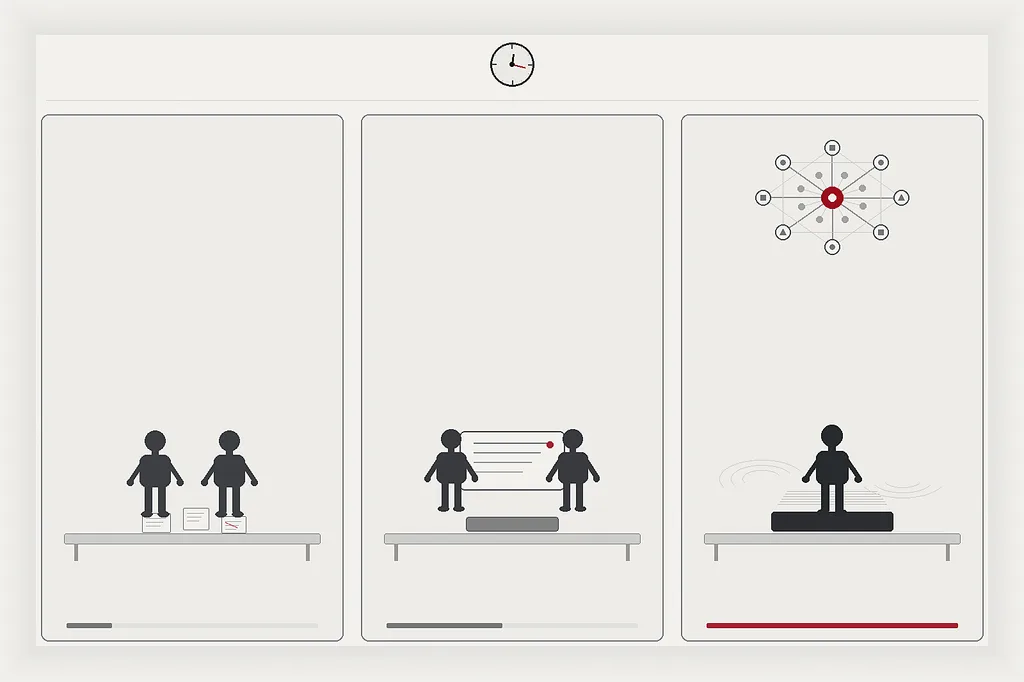
On 25 September, I attended the AI Open House in Basel. In one workshop, we worked in randomly assembled teams. We prepared an idea, handed it to another group, received somebody else's idea, and had roughly ten minutes to turn it into something we could present.12
The room was not a random sample of society. These were people working in the industry or sufficiently interested in AI to spend their time at an event about it.
Even there, the difference was striking.
Some groups were still discussing their ideas or writing on paper. Their result was a few sentences. My group photographed the handwritten brief and handed it to my existing group of AI agents. While they researched the question, I asked them to build an agent specifically for the case.
The question was what humans should still do when AI does most of the work. We arrived at four words: judgment, liability, taste, and trust. The proposed agent would take information about a human project and identify decisions and responsibilities that should remain under human control.
Within those ten minutes, we had research to discuss and a first version of that agent.2
Not a production system. Not evidence that its recommendations were correct. Certainly not a business whose value had been demonstrated. A prototype is a beginning, not an outcome certificate.
But it was a different kind of beginning.
I did not conduct a subscription survey. My impression was that free tools and ordinary paid subscriptions accounted for most of the room, with only a small minority using expensive tiers or several services extensively. I cannot establish how much of the difference came from spending, experience, preparation, team composition, or interpretation of the exercise.
Nor do I think a handwritten answer is necessarily a worse answer. Sometimes the most valuable work is deciding that nothing should be built.
What unsettled me was something else: we shared a deadline, but we did not arrive with the same capacity to act.
My agents were already configured. My familiarity with them already existed. The money, experimentation, mistakes, and preparation had happened before the workshop clock started. What looked like ten minutes of work was ten minutes spent using accumulated capability.
I was inside the advantage I was observing.
That is where the larger question begins. What happens when this is not a workshop? What happens when it is a contract, a company, a scientific programme, or a country's ability to negotiate its future?
Access is not one thing
"Everyone has access to AI" is becoming an increasingly inadequate description of the situation.
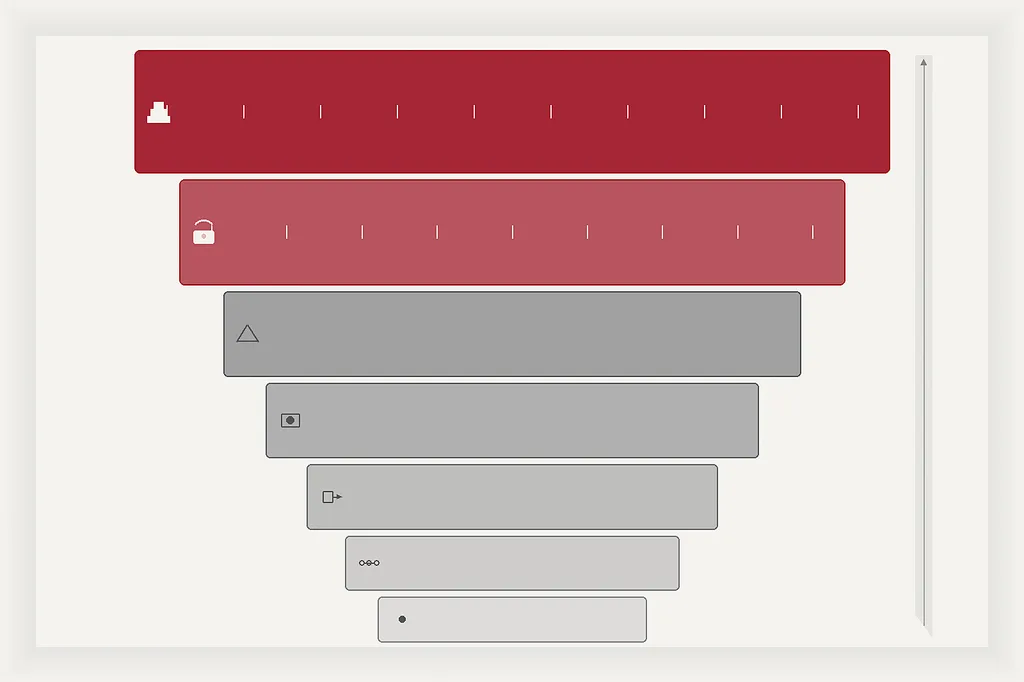
There is access to an answer. There is access to a sustained workflow. There is access to tools that can act across systems, examine alternatives, write and test software, and return work for review. And there is control over the infrastructure on which all of that depends.
Those are different economic positions.
Higher-priced subscriptions already sell greater usage capacity and priority, not merely a different badge. But free products also offer substantial capabilities. The price of a plan is neither a measure of a person's intelligence nor a reliable multiplier of their productivity.3
Effective access also requires context, usable data, integration, permission, and the ability to evaluate what comes back. For a parent working two jobs, the scarce resource may be uninterrupted learning time. For an employee, it may be permission to connect company systems. For a small organisation, it may be the capacity to absorb a failed experiment.
My initial formula was simple: creativity, compute, and skills.
It remains a useful description of how to build. It is not a complete explanation of who wins.
A wealthy owner can hire creativity and skills. A highly skilled employee may create enormous value and retain very little of it. A founder can build something excellent that nobody buys. A government can acquire machines and still lack the institutions that make them useful.
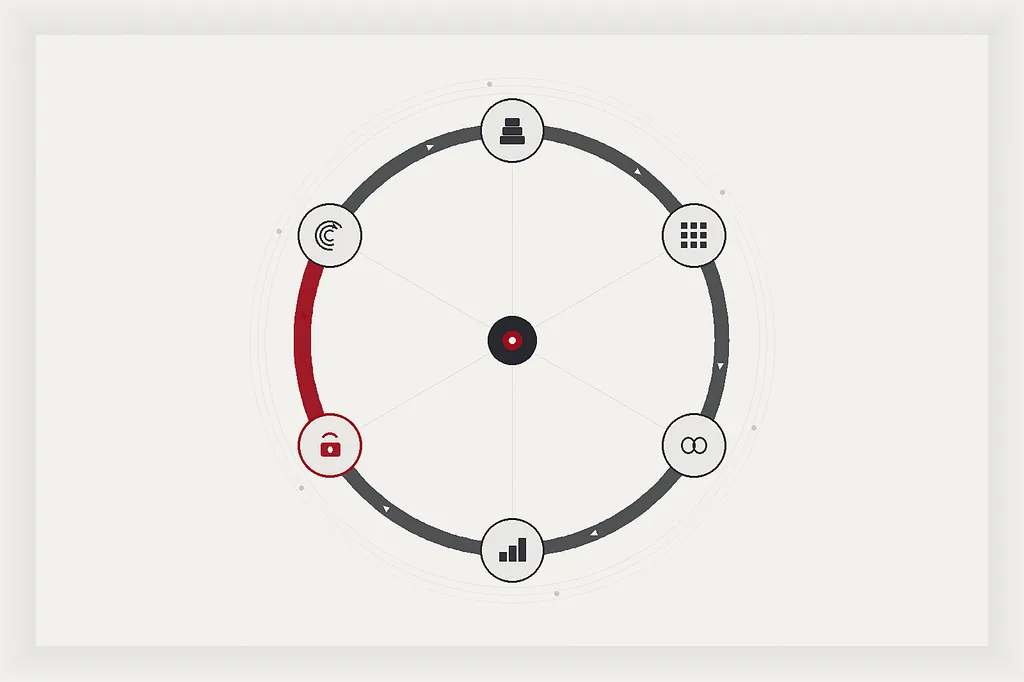
For the question of power, we must add two things: the authority to deploy capability, and the ability to keep the gains.
Otherwise, we risk confusing the person operating the machine with the person whose position the machine strengthens.
AI can close one gap and widen another
The evidence does not support a simple story in which AI only makes the already capable more capable.
A field study of 5,172 customer-support agents found an average productivity improvement of about 15%, with the largest gains among less experienced and lower-skilled workers. In that setting, AI helped people catch up.4
That is a serious counterargument to the idea that the technology necessarily creates a professional aristocracy.
It is not, however, a counterargument to concentrated ownership.
Two employees can become more equal in their ability to resolve a customer's problem while the owner of the system captures a larger share of the value. Skill inequality inside a workflow and economic inequality across society are not the same variable.
There is another distinction we should preserve: a more impressive output is not necessarily a more reliable outcome.
In a large experiment with consultants, AI helped participants complete suitable tasks faster and better. On a task outside the system's capabilities, AI users were less likely to reach the correct answer. The study described an uneven technological frontier, not a universal productivity multiplier.5
Even the measurement changes as the technology changes. METR's early-2025 experiment found that experienced open-source developers took longer on their own repositories when allowed to use the tested AI tools. Its February 2026 follow-up warned that selection effects and changing working practices made a current estimate much harder to establish. Freezing either result into a permanent slogan would miss the point.67
The relevant advantage is not the ability to generate more material. It is the ability to turn machine work into verified results at a cost somebody can sustain.
And task-level gains do not instantly become economy-wide gains. Research linking Danish adoption surveys to administrative records found substantial changes in work without detectable effects on earnings or recorded hours during the early period studied.8
The workshop made a divergence visible. It did not measure the size of that divergence in the economy.
The compounding class
Here is the mechanism I find more consequential than the subscription gap.
Someone with resources can fund useful AI capacity, integration, and experimentation. Where that creates genuine value, and where they retain enough of the return, they can reinvest it in more capacity, better systems, proprietary context, distribution, or ownership of other productive assets.
Their advantage does not merely repeat. It can finance its own expansion.
That is what I mean by the compounding class: people and institutions able to convert accumulated resources into deployable intelligence, convert that intelligence into retained gains, and use those gains to strengthen the original advantage.
This is an analytical description, not a measured demographic category.
The mechanism is not new in every respect. Owners have long bought other people's time and used capital to scale production. What AI may change is the cost and breadth of organising certain kinds of cognitive work, including work that helps improve the organisation itself.
If an agent can perform a bounded task reliably, buying several instances creates a different possibility from asking one person to work harder. That possibility remains constrained by coordination, verification, compute costs, demand, and everything the system cannot do. It is not infinite labour. It is a potentially different relationship between an individual's time and the amount of work they can commission.
The ownership starting point is already unequal. The World Inequality Report 2026 estimates that the wealthiest tenth owns about three-quarters of global wealth, while the bottom half holds about 2%.9
AI enters that distribution. It does not start a new game with equal balances.
Economic research gives us a reason not to assume productivity settles the distributional question. Acemoglu and Restrepo distinguish automation that displaces labour from the creation of new tasks that restores demand for it. Higher productivity, by itself, does not determine which force prevails.10
A society could therefore become more productive without distributing either the income or the independence proportionately.
There is an uncomfortable implication for people like me. Being a highly capable user does not put me at the top of this structure. If my business depends on someone else's models, access policies, and pricing, I may be a successful tenant in somebody else's industrial system.
A subscription is not sovereignty.
The organisation that does not need to unlearn itself
Consider two companies trying to serve the same customer.
One begins with departments, inherited software, approval chains, and work divided around the assumption that humans must execute most steps. The other begins by asking which responsibilities require people, then organises reliable machine work around those responsibilities.
The second company may need fewer handovers, fewer internal translations, and less effort spent reconciling systems that were never designed to cooperate.
That is a plausible structural advantage. It is not a guarantee that the smaller company wins.
The incumbent may possess relationships, specialist knowledge, licences, distribution, physical assets, and data that the newcomer cannot reproduce. Much of what appears to be organisational friction may also be doing necessary work: protecting patients, preventing fraud, or ensuring that someone is accountable.
An instructive experiment took place inside Procter & Gamble, not a newly created AI-native startup. In the published study, individuals using AI matched teams without AI on product-innovation tasks, and AI helped bridge differences between technical and commercial perspectives.11
The lesson is not that established organisations are incapable of changing. It is that the unit of useful work may change inside them.
The strategic divide may therefore be between organisations that redesign work and organisations that merely add a chatbot to the existing diagram.
Our workshop's four words belong here, with a qualification. Judgment, liability, taste, and trust are not a scientific list of things machines can never influence. They describe places where people should think carefully about retained authority and responsibility.
A human signature is not meaningful control if the signatory has neither the time nor the information to challenge the system.
Could an AI company swallow a pharmaceutical giant?
The thought of Anthropic one day acquiring Novartis is deliberately provocative. It reverses an assumption: that technology suppliers remain suppliers, while the established industries remain in charge.
I would not present that particular acquisition as a forecast. Compute is not a clinical trial, a manufacturing system, or a complete pharmaceutical organisation.
The more useful question is whether control over increasingly important research capabilities could shift bargaining power between industries.
There is already a concrete example of a different arrangement. Isomorphic Labs and Novartis expanded their research collaboration in February 2025. That is evidence of partnership between AI capability and pharmaceutical expertise, not evidence that either side is destined to absorb the other.12
Several futures remain possible: supplier, partner, licensing platform, new competitor, or acquirer. The distribution of power depends on which capabilities become scarce and difficult to substitute.
That brings us back to infrastructure. Stanford's 2026 AI Index reports that industry produced more than 90% of notable frontier models in 2025. The FTC's study of major cloud and AI partnerships identified potential competition concerns involving input access, switching costs, and privileged information.1314
Neither finding establishes an inevitable monopoly. Together, they make the ownership question difficult to dismiss.
A country can win while its citizens lose
The phrase "whoever wins AI wins" expresses the geopolitical version of this argument. Donald Trump has used it explicitly.15
But who is the subject of "wins"?
A country may increase its strategic capabilities while most of the gains accrue to a small group of companies. A national champion can be powerful without making its citizens economically independent. A sovereign system can still concentrate authority domestically.
Meanwhile, the world is not beginning from universal connectivity. ITU estimated that 2.2 billion people remained offline in 2025. The World Bank reports that high-income countries held 77% of global data-centre capacity as of June 2025, while low-income countries held less than 0.1%.1617
Data-centre capacity is not a direct measure of frontier AI capability. Countries can also access services across borders. Nevertheless, these figures describe unequal starting conditions before we discuss agent orchestration or premium subscriptions.
The World Bank frames the foundations more broadly: connectivity, compute, context, and competency. It also points to the usefulness of smaller, locally relevant AI applications.18
Useful locally relevant applications still count. A country does not have to build everything itself to benefit, and importing useful technology is not automatically surrender.
The practical questions are whether it can develop local expertise, negotiate acceptable terms, sustain important services, and change suppliers when necessary. National power without domestic participation is an incomplete answer. So is access without bargaining power.
The relevant divide is not simply between countries with AI and countries without it. It is between those able to shape their dependence and those required to accept it.
Now add unequal time
Until this point, the argument concerns how much someone can accomplish in an hour.
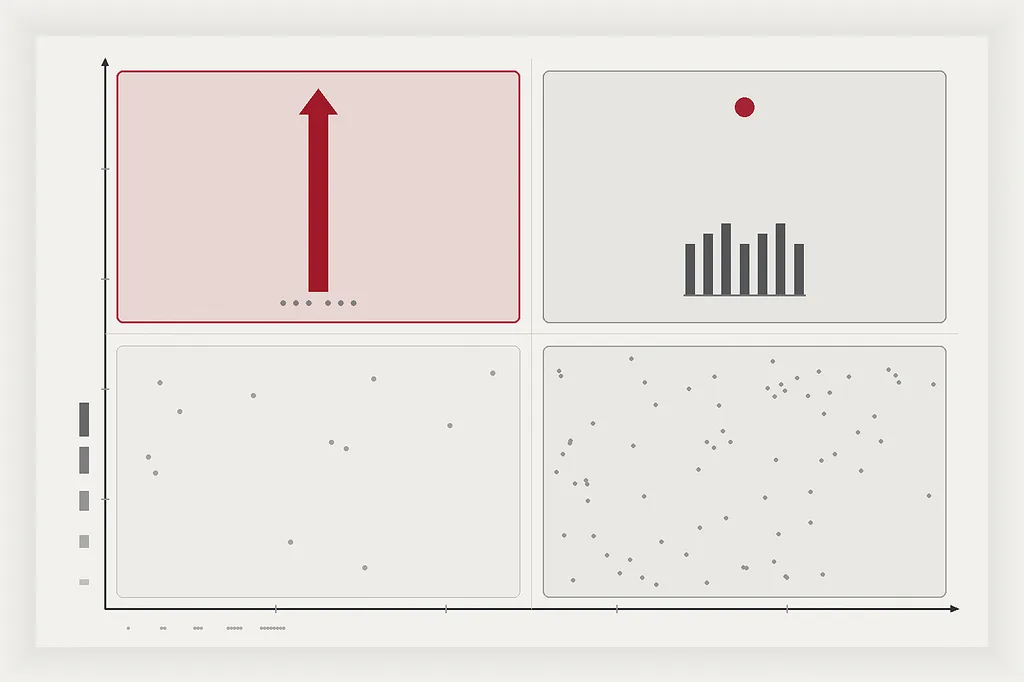
Longevity adds a second dimension: how many healthy years they have in which to act.
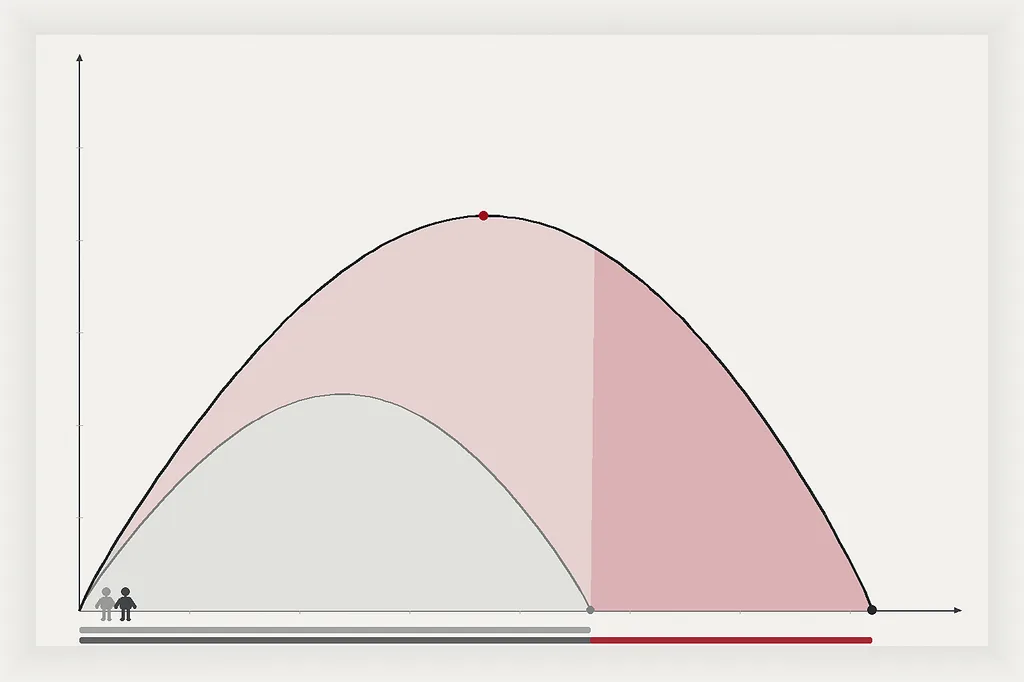
This is not waiting for an anti-ageing breakthrough. Raj Chetty and colleagues, analysing US data from 2001 to 2014, found that life expectancy at age 40 differed between the top and bottom 1% of the income distribution by 14.6 years for men and 10.1 years for women.19
These are historical, observational estimates. They do not mean that a particular amount of money purchases a specified number of years. Nor should a US result be treated as a universal global figure.
But the direction of the concern is not speculative.
A separate study of older adults in England and the United States found that, at age 50, those in the poorest wealth group could expect seven to nine fewer years without disability than those in the richest group.20
That is not merely a difference in the date on a death certificate. It is a difference in the conditions under which people can participate in their own lives.
WHO's work on health inequity emphasises the importance of housing, education, working conditions, income, and other social circumstances. The ordinary foundations of health matter before we reach experimental treatments or elite longevity clinics.21
Now consider the possible interaction.
If one person can deploy more productive capacity during each working year and remain healthy and active for longer, those advantages can reinforce each other. They may have more opportunities to learn, recover from failure, build relationships, and exercise control over assets.
There is an important correction to the simple compounding story: wealth does not stop compounding when its owner dies. Companies, estates, and inherited portfolios can continue. Death was never a reliable redistribution policy.
What longer healthy lives could change is the duration of personal control. The same owners and decision-makers might remain active for longer. Succession could be delayed. Established networks could endure. That is a plausible institutional consequence, not a demonstrated result of AI or a reason to oppose longer lives.
The humane goal is more healthy time for everyone. The concern is whether access to it becomes another advantage that wealth can reinforce.
Longevity is not immortality with an expensive waiting list
We should resist importing marketing claims into this argument.
Longer average life expectancy, more years in good health, slowing biological ageing, and radically extending the maximum human lifespan are different propositions.
A 2024 demographic study found that improvements in life expectancy had generally slowed in the long-lived populations it examined. Its conclusion was conditional: radical extension was implausible this century unless biological ageing could be substantially slowed.22
That is not proof that such a breakthrough cannot happen. It is a warning against treating one as an accomplished fact.
Even encouraging human research requires care. An analysis of the CALERIE randomised trial found a small change in one measure of the pace of biological ageing, but not significant changes in several other biological-age measures. The authors explicitly called for long-term evidence on disease and mortality.23
A favourable biomarker is not twenty additional years of life.
The stronger argument does not require anyone to live to 150. Existing differences in health and survival already deserve attention. If future therapies produce substantial additional benefits and access is selective, they could intensify the pattern. If those benefits diffuse widely through effective health systems, they could weaken it.
Both possibilities should remain visible.
Give the intelligence a body
Robotics extends the same question into the physical world.
The International Federation of Robotics reported in September 2026 that the global operational stock of industrial robots reached about five million in 2025.24
Those are industrial robots, not five million general-purpose humanoid workers. A machine operating in a structured factory is not evidence that every activity in a home, hospital, or construction site can be automated economically.
Still, the potential convergence is important. AI can help organise information and decisions. Robotics can execute some physical tasks. Medical technology can support or restore some human functions. It is reasonable to examine what might happen as these capabilities improve together, without pretending they already form a seamless system.
In the strongest version of the scenario, an individual or small institution could direct much more research, administration, production, and physical activity than its human headcount suggests.
But the power would not reside only in that person's body or brain. It would also reside in ownership, infrastructure, contracts, energy, maintenance, and the institutions that protect control over those resources.
The first "superhuman" may be an ownership structure.
There is a harder political possibility underneath the science-fiction imagery. If owners become less dependent on employing large numbers of people to produce value, a source of ordinary people's bargaining power could weaken. New tasks and forms of participation could counteract that. They should not simply be assumed to appear in the right places at the right time.10
This would not make everyone else unnecessary. It would make the distribution of dependence more important.
We do not need a new species to create a new ruling class
It is tempting to call this the emergence of a super-species: longer-lived people, partially augmented bodies, and armies of intelligent machines.
As a description of a possible social distance, the image has force. As a biological conclusion, it goes beyond the evidence examined here. Buying compute or receiving a medical implant does not establish that a new human species has emerged.
We do not need that claim.
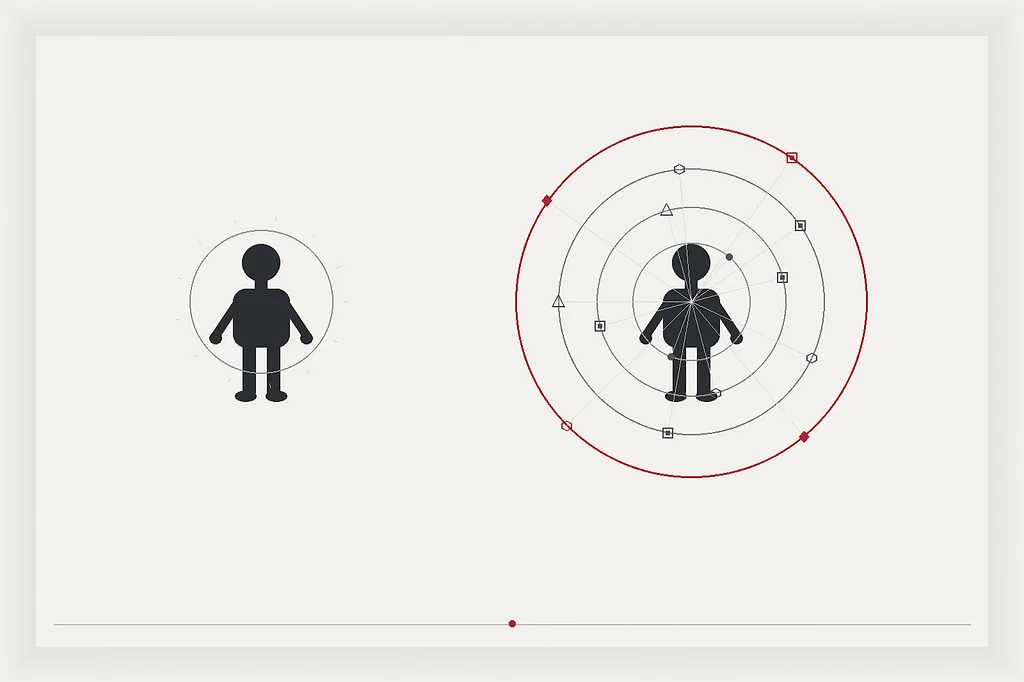
Two people can remain biologically ordinary humans while living at radically different distances from power. One may have the capacity to initiate, investigate, contest, purchase, and organise. The other may mostly encounter decisions that have already been made.
The danger is not a superior form of human life. It is an arrangement that makes some people's intentions vastly more executable than others'.
Nor does greater capability establish greater wisdom, legitimacy, or moral worth. An actor who can coordinate a thousand systems has not thereby earned the right to govern a thousand people.
And a person who produces less is not less deserving of healthcare, security, dignity, or a political voice.
Keeping those claims apart will matter more, not less, if human productive capacities diverge.
This is a direction, not a law of the universe
There is a strong counterforce to the concentration story: useful AI can become dramatically cheaper.
Stanford's 2025 AI Index reported that the inference cost of reaching roughly GPT-3.5-level performance fell more than 280-fold between November 2022 and October 2024. That is a comparison at a specified capability level, not a claim that every current frontier workflow is cheap.25
But it is real evidence against assuming that today's access gap must remain permanent.
Smaller models, competitive suppliers, open-weight systems, public infrastructure, and better education could spread useful capacity. A small organisation does not need the most expensive model for every task. A capable entrant can undermine an incumbent's advantage.
The question is whether diffusion outruns the concentration of the complementary assets: data, distribution, ownership, integration, and the right to make consequential decisions.
Three futures are worth distinguishing.
In one, useful capability becomes broadly available, new work develops, and gains are shared through wages, lower prices, services, and wider ownership.
In another, many people become substantially more capable, but a few platforms capture disproportionate returns and remain difficult to leave. An augmented middle class coexists with concentrated infrastructure.
In a third, ownership, institutional access, and unequal healthy lifetimes reinforce each other strongly enough to produce a durable compounding class. Entry remains technically possible but increasingly difficult in practice.
These are scenarios, not forecasts with defensible probabilities.
Calling the third inevitable would remove the decisions that make it more or less likely. Competition, public investment, labour institutions, taxation, healthcare, and the design of ownership are not outside the system. They are part of it.91021
The choices that actually matter
A response limited to "teach everyone prompting" is too small for this problem.
I would begin with a meaningful capability floor: access to useful tools, the connectivity to use them, practical education, and support for schools, small businesses, and public institutions. A free login is not equivalent to the ability to complete valuable work safely.
Then I would ask who owns the resulting productive capacity. Wider employee ownership, participation in gains, competitive markets, and carefully governed public investment are different possible mechanisms. None is a magic solution. Each has costs and design problems. But participation cannot be reduced to receiving permission to use someone else's tools.
I would also treat portability and contestability as economic infrastructure. People and organisations need credible ways to move their data and workflows, replace suppliers, challenge consequential decisions, and recover when systems fail. Formal choice means little when exercising it would destroy the business.
Healthcare belongs in the same discussion. Better prevention and fair access to proven treatment are not secondary social policies to be considered after the technology strategy. They help determine who gets the time and capacity to participate in it.
Finally, there must remain a right to an ordinary human life. People should not have to become exceptional AI operators, purchase bodily augmentation, or maximise every hour merely to deserve a secure place in society.
How would we know whether the darker thesis is becoming true?
We should watch verified productivity rather than subscription counts; who retains the gains rather than how much content is generated; whether new firms can compete and switch providers; whether earnings and bargaining power improve alongside output; and whether differences in healthy adult lifetimes narrow or widen.
Evidence of broad participation and durable gains outside the existing ownership class would weaken the argument. Persistent dependence alongside concentrated returns would strengthen it.
A warning that cannot be challenged by evidence is not analysis. It is a belief system.
Back to the room
The people with paper in that workshop were not a lesser class of human being. They were people who arrived with different tools, habits, experience, and opportunities.
I do not want a future in which that difference determines whose ideas are allowed to become real.
What I saw in Basel was not proof of an emerging super-species. It was a small, imperfect view of something more immediate: the distance between having an intention and possessing the means to execute it.
AI could shorten that distance for extraordinary numbers of people. It could also help a much smaller group extend its reach while everyone else becomes more dependent on systems they do not control.
We do not have to choose between believing in the technology and questioning the distribution of its power.
The danger is not that a few people become gods. It is that the rest of us lose the practical ability to say no.
Sources
The workshop account is the author's recollection and has not been independently audited; its subscription mix is an impression, not a representative survey. The prototype was not evaluated for this essay. "Compounding class" is an analytical label used here, not a measured demographic category or scientific classification. The AI–pharma acquisition thought, selective radical longevity, and strongly augmented future actors are scenarios, not forecasts of inevitability. Quantitative findings retain their original population, task, and time boundaries. Corporate statements establish what was announced, not that promised outcomes were achieved. Evidence cutoff: 26 September 2026. The accompanying source register documents verification limits and excluded claims.
Footnotes
-
AI Open House, official event page, 25 September 2026. Event. Confirms the event, date, and venue, not the author's workshop outcomes. ↩
-
Thierry Gilgen, first-person workshop account supplied for this draft on 26 September 2026. Private source; no public URL. See the source register for the unverified subscription estimates and timing qualifications. ↩ ↩2
-
Anthropic, Claude pricing, accessed 26 September 2026. Illustrates tiered usage capacity, not measured performance differences between users. ↩
-
Erik Brynjolfsson, Danielle Li, and Lindsey R. Raymond, "Generative AI at Work," The Quarterly Journal of Economics 140(2), 2025, pp. 889–942. Journal; author manuscript. ↩
-
Fabrizio Dell'Acqua et al., "Navigating the Jagged Technological Frontier," Organization Science 37(2), 2026. HBS PDF; DOI. Earlier working paper circulated in 2023; do not mistake publication year for the model vintage tested. ↩
-
METR, "Measuring the Impact of Early-2025 AI on Experienced Open-Source Developer Productivity", 10 July 2025. ↩
-
METR, "We are Changing our Developer Productivity Experiment Design", 24 February 2026. ↩
-
Anders Humlum and Emilie Vestergaard, "Still Waters, Rapid Currents: Early Labor Market Transformation under Generative AI," revised working paper, 2026. Author-institution summary; NBER working-paper record. ↩
-
World Inequality Lab, World Inequality Report 2026, executive summary. ↩ ↩2
-
Daron Acemoglu and Pascual Restrepo, "Automation and New Tasks: How Technology Displaces and Reinstates Labor," Journal of Economic Perspectives 33(2), 2019, pp. 3–30. Article. ↩ ↩2 ↩3
-
Fabrizio Dell'Acqua et al., "The Cybernetic Teammate: A Field Experiment on Generative AI and Teamwork," Organization Science 37(4), 2026, pp. 1217–1242. Article. ↩
-
Isomorphic Labs, "Isomorphic Labs announces Novartis collaboration expansion", 18 February 2025. ↩
-
Stanford HAI, AI Index Report 2026. ↩
-
US Federal Trade Commission, "FTC Issues Staff Report on AI Partnerships & Investments Study", 17 January 2025. Potential competition implications, not a finding that every partnership is unlawful. ↩
-
PBS NewsHour, "Trump pushes back as AI leaders fuel calls to rein in rapidly advancing technology", 14 September 2026. Indexed transcript records the phrase; full-page retrieval was unsuccessful during source review. ↩
-
International Telecommunication Union, Facts and Figures 2025. ↩
-
World Bank, "Inequalities in Use of and Exposure to Artificial Intelligence," Atlas of Global Development. Data-centre capacity shares are dated June 2025. ↩
-
World Bank, Digital Progress and Trends Report 2025: Strengthening AI Foundations. ↩
-
Raj Chetty et al., "The Association Between Income and Life Expectancy in the United States, 2001–2014," JAMA 315(16), 2016, pp. 1750–1766. PubMed; full text. ↩
-
Paola Zaninotto et al., "Socioeconomic Inequalities in Disability-free Life Expectancy in Older People from England and the United States," The Journals of Gerontology: Series A 75(5), 2020, pp. 906–913. PubMed; full text. ↩
-
World Health Organization, "Health inequities are shortening lives by decades", 6 May 2025; accompanying World Report on Social Determinants of Health Equity. ↩ ↩2
-
S. Jay Olshansky et al., "Implausibility of radical life extension in humans in the twenty-first century," Nature Aging 4, 2024, pp. 1635–1642. PubMed; DOI. ↩
-
R. Waziry et al., "Effect of long-term caloric restriction on DNA methylation measures of biological aging in healthy adults from the CALERIE trial," Nature Aging 3, 2023, pp. 248–257. PubMed; DOI. An author correction is linked from the PubMed record. ↩
-
International Federation of Robotics, "Five Million Robots now Operate in Factories Globally", 24 September 2026, reporting the operational stock in 2025. ↩
-
Stanford HAI, AI Index Report 2025, takeaway 7. The cost comparison concerns GPT-3.5-level performance from November 2022 to October 2024, not the cost of every frontier system. ↩