Pendant longtemps, on a tenu le logiciel pour l’actif qui comptait.
Aujourd’hui, beaucoup croient que c’est le modèle.
Je pense que l’un et l’autre passent au second rang.
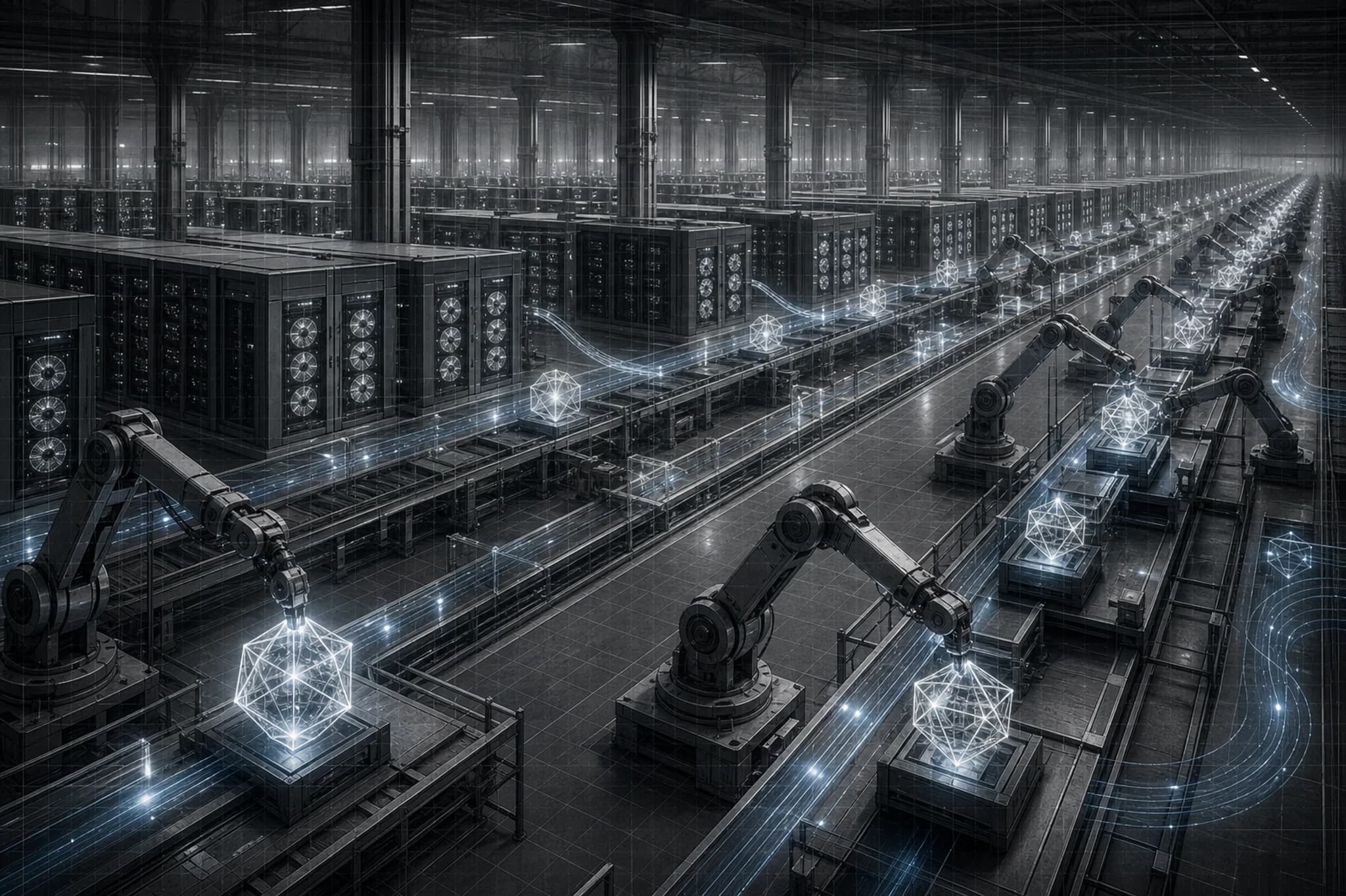
Ce qui pèse vraiment, c’est l’usine : celle qui, jour après jour, fabrique de l’intelligence.
Plus d’acier, plus de tapis roulants, plus de chaînes d’assemblage.
Des grappes de GPU.
Des plateformes d’inférence.
Des bancs d’évaluation.
Des chaînes de données synthétiques.
Un entraînement qui ne s’arrête pas.
Une ingénierie de sûreté.
Les retours du terrain.
La télémétrie une fois le système en service.
Le modèle est un produit.
L’usine, c’est le métier.
L’industrie a déjà vécu ça.
Les maisons qui ont changé le monde ne se réduisent presque jamais à un objet.
On les reconnaît à leur système de production.
Toyota n’a jamais été seulement une voiture.
TSMC n’est pas un semi-conducteur.
Amazon n’est pas un magasin.
Leur avantage tient à ce qui, sans relâche, produit de la valeur.
L’intelligence artificielle entre dans cette phase-là.
Une requête d’inférence ne se limite pas à une réponse.
Elle laisse des traces.
Des schémas d’usage.
Des données d’évaluation.
Des retours d’exploitation.
Parfois un corpus d’entraînement qu’on n’avait pas.
Prise une à une, ces traces n’impressionnent personne.
Rassemblées, elles font un savoir d’usine.
L’atelier s’améliore en tournant.
Cela déplace la propriété intellectuelle.
On a d’abord protégé le code source.
Puis les modèles déjà entraînés.
Ce qui mérite désormais d’être défendu n’est ni l’un ni l’autre.
C’est le système qui crée l’intelligence et la affine, en continu.
La valeur n’habite plus seulement le modèle.
Elle habite le fonctionnement.
Pour la souveraineté numérique, la conséquence n’est pas petite.
Souverain n’a jamais voulu dire posséder chaque objet.
Cela a voulu dire tenir les moyens de production.
Dans les révolutions industrielles précédentes : les chemins de fer.
Les aciéries.
Les centrales.
Les usines de semi-conducteurs.
Aujourd’hui, de plus en plus : le calcul.
Les plateformes d’inférence.
Les systèmes d’évaluation.
La gouvernance des données.
La maîtrise de l’exploitation.
Un pays qui s’en remet entièrement à des usines d’intelligence étrangères se place en dépendance stratégique — peu importe où le logiciel a été écrit.
La leçon ne s’arrête pas aux États.
Toute organisation qui met de l’IA en service devrait changer de question.
Pas :
« Quel modèle acheter ? »
Plutôt :
« Quelles capacités construisons-nous, et lesquelles restent à nous ? »
Les modèles progresseront encore.
Les classements bougeront encore.
Les fournisseurs se feront encore concurrence.
La capacité d’exploitation, elle, s’accumule.
Ceux qui laisseront une valeur durable n’auront pas forcément les plus gros modèles.
Ils auront, autour d’eux, les systèmes de production les plus solides.
Les usines d’autrefois transformaient la matière en produits.
Les usines d’IA transforment le calcul en connaissance.
Saisir cette différence pourrait être, dans cette décennie, une question stratégique décisive.
On répète souvent que l’IA est la nouvelle électricité.
Le parallèle, à mon sens, rate l’essentiel.
L’électricité alimente les usines.
L’intelligence artificielle est en train de devenir l’usine.
Et, d’un siècle à l’autre, les sociétés qui savaient bâtir, faire tourner et défendre leurs ateliers ont rarement vécu à la merci de celles qui ne savaient pas.