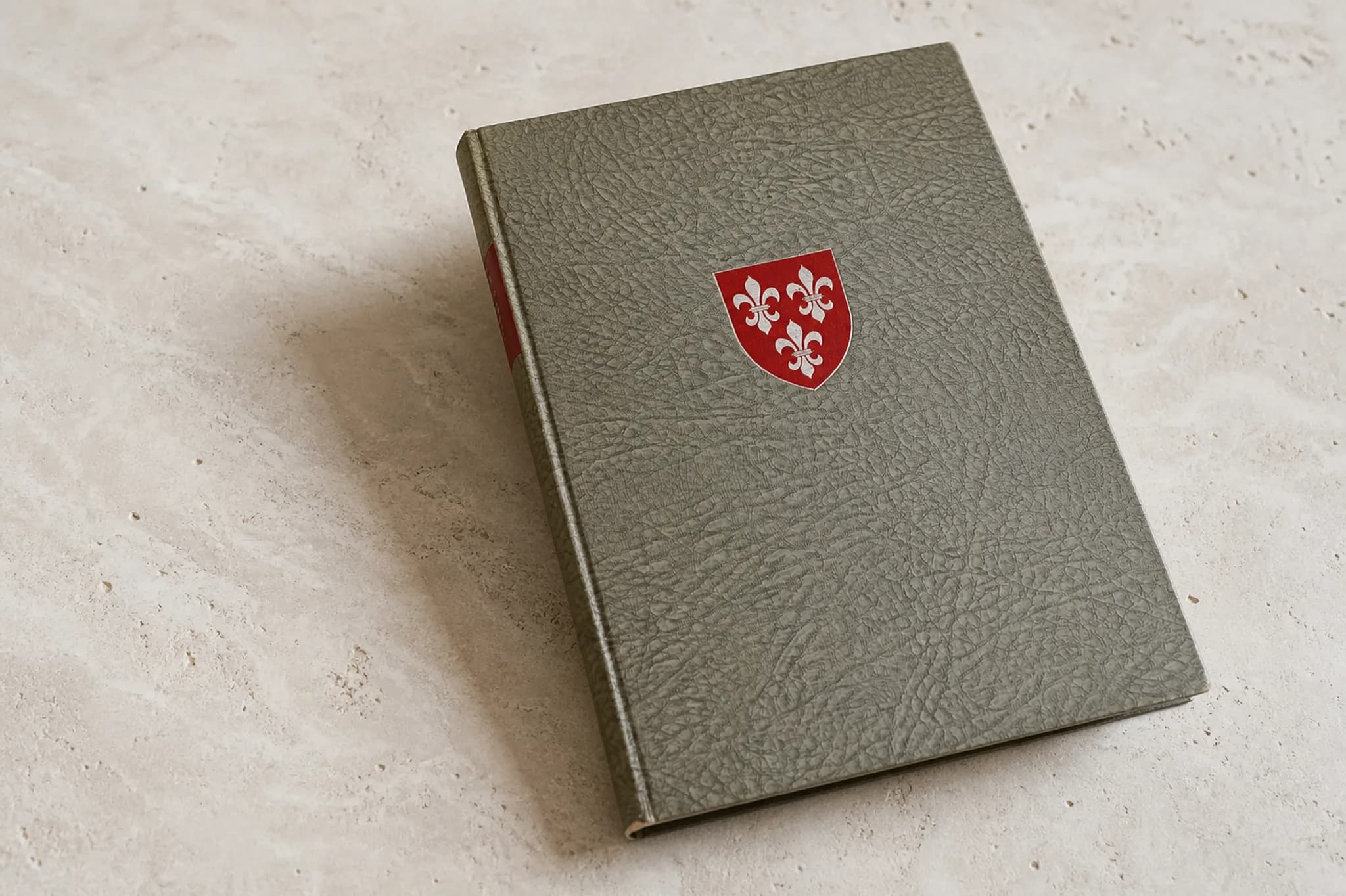
Last Friday, I carried almost five hundred years of my family's history into the Universitätsbibliothek Basel. The object weighs a few kilograms. It has a grey textured cover, a red coat of arms with three white lilies, yellowing pages, black-and-white photographs, and hundreds upon hundreds of names. Its title is Die Gilgen von Rüeggisberg. It is one of the most valuable things I own — not because it would fetch a high market price, but because it cannot be replaced.
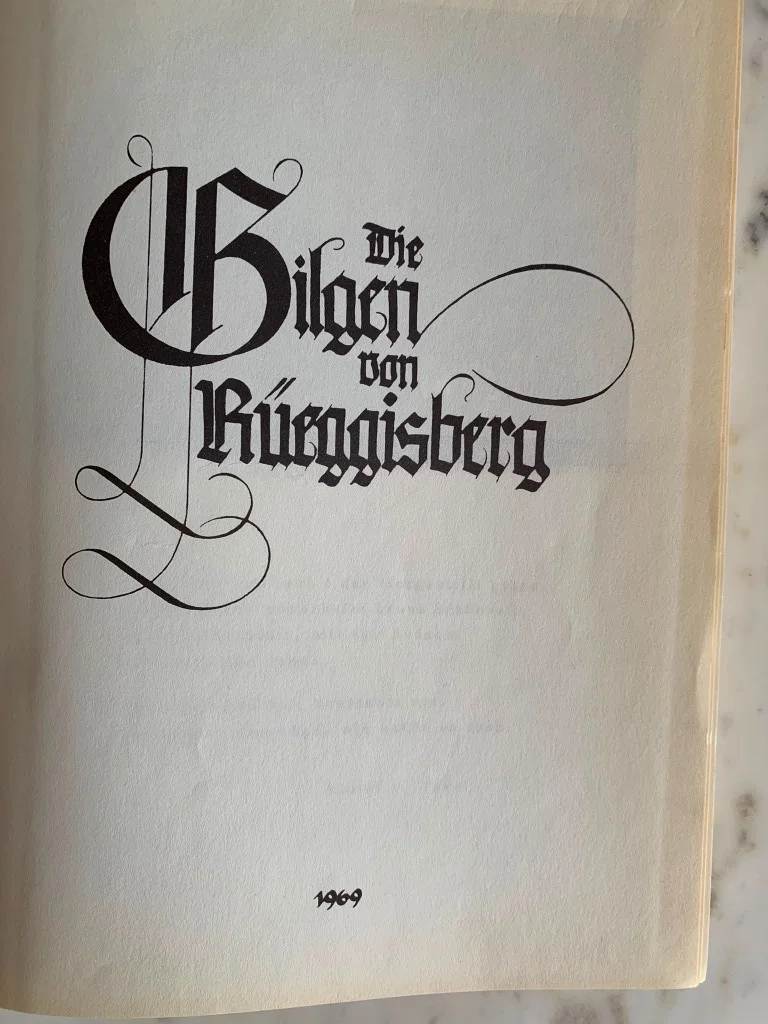
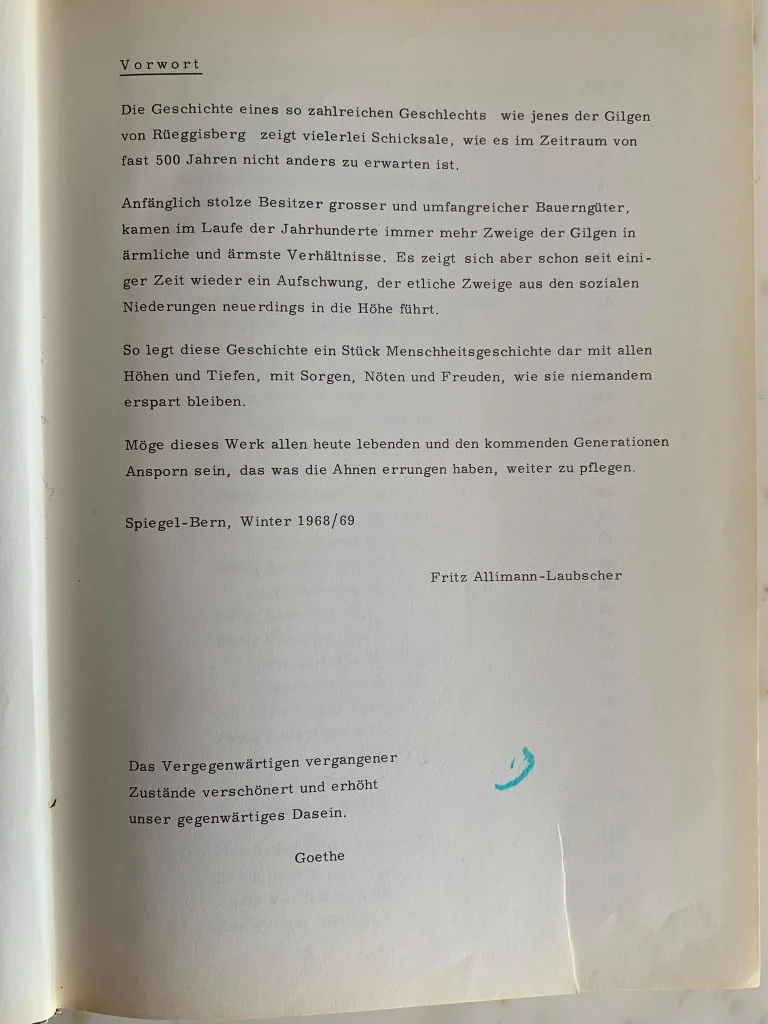
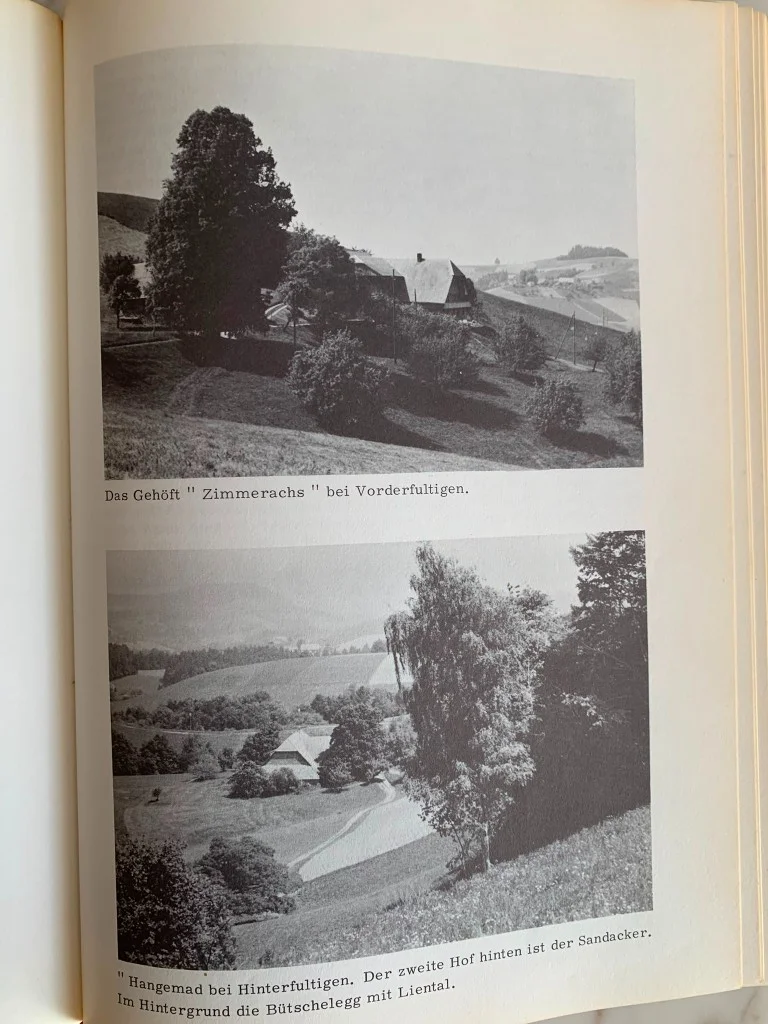
The book was produced as a private printing in 1969. It traces generations of the Gilgen family from Rüeggisberg through almost five centuries of Swiss life: people are born, marry, become farmers, bakers, teachers and merchants, move from one village to another, prosper or fall into poverty, lose children, found new branches, or disappear from the record. The book is genealogy. It is also something else. Its foreword calls it ein Stück Menschheitsgeschichte — a piece of human history. And now it has reached my generation.
Preserve It. Update It. Pass It On.
Near the beginning of the book is a short text by Joh. F. Gilgen-Berger of Bern, who published the work as a private printing. He explains what he hopes will happen to the copies entrusted to members of the family. Each owner, he writes, should care for the book as an inheritance from their ancestors and pass it on to their descendants unversehrt und nachgetragen — intact and updated.
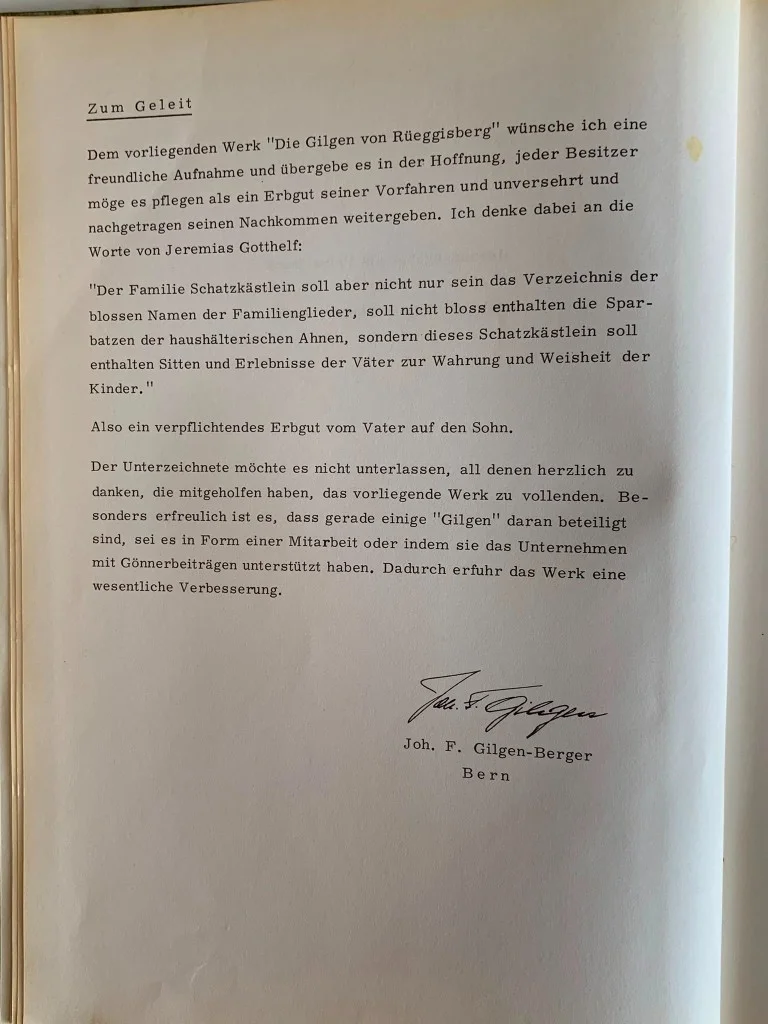
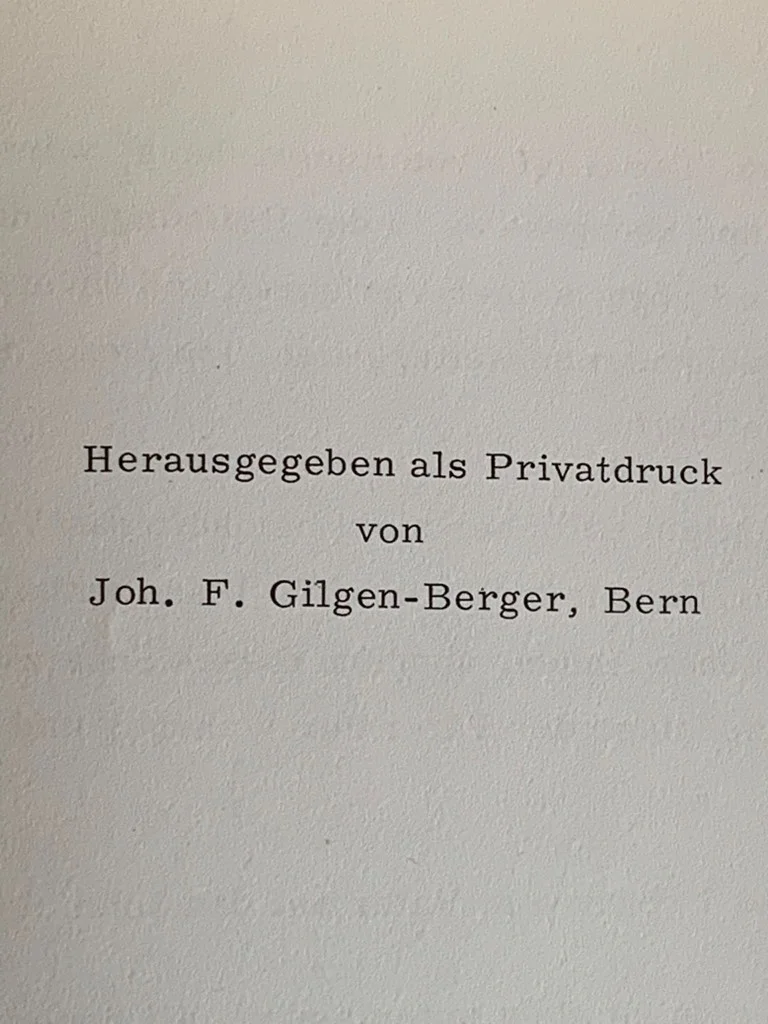
Those two words matter: unversehrt and nachgetragen. Preserve it. But do not merely preserve it. Continue it. The book was never intended as a monument to a finished past. It was designed as a living inheritance. More than half a century later, that instruction has arrived at my door.
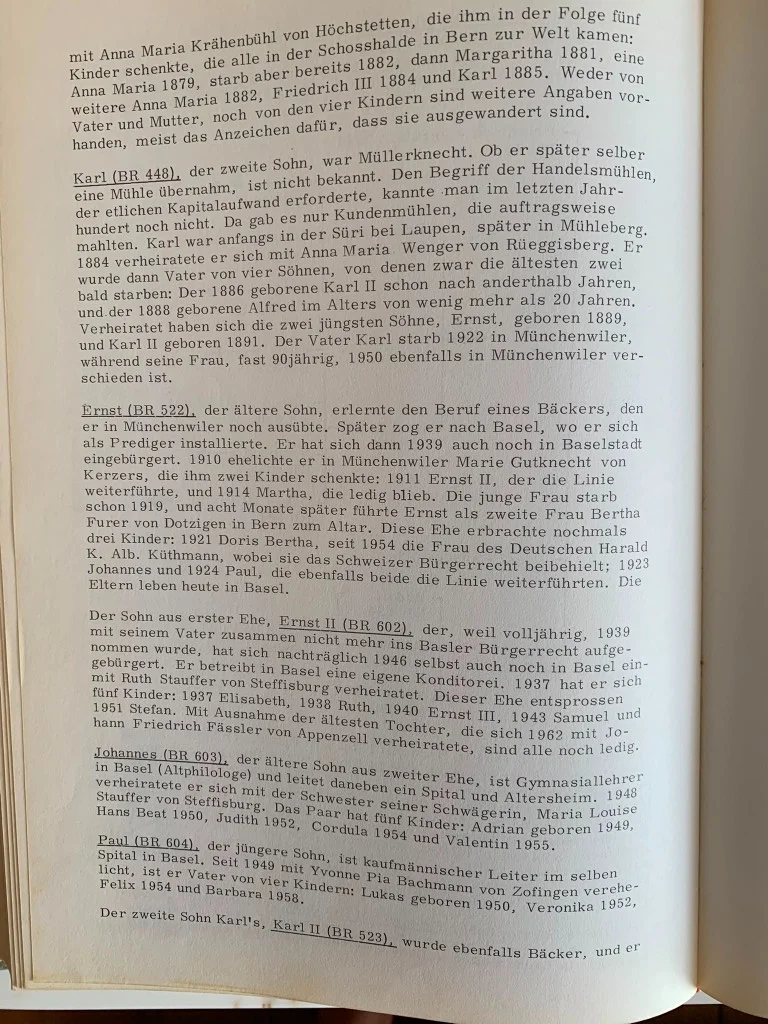
My line runs through my great-grandfather Ernst Gilgen to my grandfather Johannes Gilgen, his wife Maria Louise Stauffer, and their five children: Adrian (born 1949), Hans Beat (1950), Judith (1952), Cordula (1954) and Valentin (1955). Johannes's brother was Paul Gilgen. Adrian was my father. I am now the oldest in the generation that follows. I do not regard that simply as a position in a family tree. I regard it as an obligation.
There are roughly forty years missing from the documentation. Those years belong to my generation to reconstruct. Something else has changed since 1969 as well: the technologies with which we preserve knowledge have changed almost beyond recognition. That raises a question the people who created this book could never have anticipated. What does it mean to inherit a family archive in the age of artificial intelligence?
One Book Enters a Library
That is why I brought the book to the Universitätsbibliothek Basel. There, with the support of Noah Regenass from the Historical Collections and Annemarie Simon from the Digitisation Centre, the physical book is being professionally digitised. The objective is not to replace the book. It is to create another way into it.
A high-quality digital representation can become the foundation for something larger: transcription, structured names, relationships, places, dates, photographs, historical records, and eventually the missing decades. From that, we can build a digital Familie Gilgen Family Archive. Eventually, artificial intelligence can provide an interface to it.
A member of the family should one day be able to ask who the Gilgens living around Rüeggisberg were in the eighteenth century; where different branches moved; what professions they had; how they are related to a given person; what was happening in Switzerland during an ancestor's lifetime; which source supports a claim; how certain we are; and to be shown the original page. A child should be able to explore the same archive as a historian, while asking completely different questions. That possibility is real. It also comes with a trap.
The Scan Is Not the Book
Once the pages have been digitised, it becomes tempting to think that the physical object has completed its job. The words remain. The photographs remain. The names remain. We can search them faster than anyone in 1969 could have imagined. So what exactly are we preserving when we preserve the book?
More than its text. There is the binding, the paper, the typography, the coat of arms, the photographs, the arrangement of information, the signatures, and the marks left by previous owners — the physical evidence of how the object was made and how it travelled through time. There is provenance, custody and context. Some of those things can be digitised. Some can be described as metadata. Some cannot be reproduced completely.
A scan can preserve an extraordinary amount of information about a book. But the scan is not the book. That distinction sounds obvious. In the age of AI, it is becoming surprisingly important.
When a Book Becomes Raw Material
At almost exactly the moment my family book entered a university digitisation centre, another story about books and artificial intelligence was unfolding. Court filings in the United States revealed an Anthropic programme known internally as Project Panama. Its objective was enormous: acquire physical books at industrial scale and convert their contents into data for training artificial intelligence.
The method was efficient. Books were purchased in huge quantities. Their bindings were removed. Their spines were cut. The loose pages were fed through high-speed scanners. The resulting material could then be used in the development of language models. The physical remains were recycled.
There are important nuances here. Destructive scanning is not inherently an act of cultural vandalism. Libraries, archives and digitisation projects may sometimes determine that destructive methods are appropriate for particular materials, duplicates, or objects that would otherwise disappear. Nor does the available evidence establish that Anthropic deliberately destroyed unique manuscripts or irreplaceable antiquarian treasures. There is also a legitimate technological argument behind what the company was doing. Books contain extraordinarily valuable information. In fact, the AI industry has rediscovered something libraries have known for centuries: books are excellent knowledge infrastructure.
But Project Panama exposes a difference in how we can understand a book. If a book is principally a container for text, then destroying one copy after extracting that text can be perfectly rational. The information has been captured. The container has served its purpose. Archives teach another way of thinking. The object can itself be information.
Subsequent reporting has now connected destructive book scanning not only with Anthropic's Project Panama but also with an Amazon operation acquiring physical books through commercial markets (404 Media, 17 August 2026; also Forbes). That does not settle whether any given copy should be destroyed. A scanner optimising for corpus extraction and a custodian optimising for historical preservation assign different value to the same physical object.
Extraction and Stewardship
There are therefore at least two ways to turn a book into data. One is extraction. The other is stewardship.
Extraction asks: what information can I obtain from this object? Stewardship asks: what must I preserve so that somebody in the future can ask a question I have not thought of yet?
That difference matters because every generation asks different questions of the past. The historical records behind Die Gilgen von Rüeggisberg survived because somebody preserved them before anyone knew that a future researcher would use them to reconstruct a family history — parish records, municipal registers, births, deaths, marriages, property, occupations. People maintained these records for purposes that belonged to their own time. Later generations found new purposes for them. Eventually they contributed to this book. Now the book itself has become a historical source. And we are about to ask something new of it again.
The Archive Is a Chain
This is what I have started to think of as a chain of custody across generations. A clerk records a birth. An archive preserves the register. A researcher finds the record. A family history connects it to other records. A book preserves that research. A library digitises the book. Software structures its contents. Artificial intelligence makes the structure explorable. A descendant asks a question.
Every link adds something. But each link also depends on what survived before it. That suggests a principle for digitisation in the AI age: add a layer; do not unnecessarily destroy the one you inherited. Preserve the object. Digitise it. Transcribe it. Structure it. Connect it. Make it searchable and machine-readable. Build new interfaces. But keep the evidence underneath. One day somebody will ask a question that today's interface cannot answer.
Then the AI Got My Own Family History Wrong
While researching this essay, something happened that made the argument considerably less theoretical. I was working with an AI assistant to reconstruct the history of the Gilgen book before I had received photographs of its introductory pages from my uncle Hans Beat. We had fragments. We knew about Die Gilgen von Rüeggisberg. We knew extensive historical research lay behind it. We knew my grandfather Johannes had been involved with the family and its history. We had public historical records about him.
The AI connected those facts. It confidently described my grandfather as the person who had travelled through municipal archives conducting the research behind the book. There was only one problem. It was not true. The story was plausible. The people existed. The book existed. The archival research existed. The family relationships existed. The resulting sentence fitted the essay. And it was wrong.
Then the primary evidence arrived. My uncle photographed the relevant pages from his copy of the book and sent them to me. Suddenly we had the names, the roles, the foreword, the publisher, and the actual words written in 1969. The source corrected the machine. I could hardly have designed a better experiment for the archive we are about to build.
AI Is Not the Archive
An AI system can make an archive dramatically more accessible. But it must never become the authority for the archive. If the future Familie Gilgen Family Archive tells one of my descendants that an ancestor lived somewhere in 1742, the important question is not whether the answer sounds convincing. The important question is: why do we believe this?
Show the record. Show the page. Show the transcription. Show which person made the connection. Distinguish documented fact from inference. Distinguish family recollection from archival evidence. Show contradictory sources when they exist. Preserve uncertainty where certainty does not exist.
That means provenance cannot be something we add later. It has to be part of the architecture. Every fact should ideally be able to travel backwards through the system: AI answer → structured claim → source → page → document → physical object or archival record. The interface may change. The evidence should remain.
A Small Human Corpus
There is another reason this matters. A family history can look insignificant beside national archives, research libraries and the enormous datasets used to train artificial intelligence. It is not. The history of humanity is not composed only of famous people. It is mostly made from people whose names never entered history books — farmers, craftsmen, teachers, shopkeepers, mothers, children; people who moved twenty kilometres and changed the trajectory of a family; people who became wealthy or lost everything; people who lived ordinary lives through extraordinary historical periods.
Taken individually, these are tiny records. Taken together, they are the texture of human history. This is one reason historical collections may become increasingly important in the age of generative AI. They contain something machines cannot manufacture retrospectively: provenance-backed traces of lives that actually happened.
The Family Schatzkästlein
Joh. F. Gilgen-Berger included another idea in the opening pages of the book. Quoting Jeremias Gotthelf, he describes the family archive as a Schatzkästlein — a small treasure chest. But the treasure chest, Gotthelf argued, should contain more than a directory of names. It should preserve the customs and experiences of previous generations for the benefit and wisdom of their children.
That idea feels remarkably modern. A family archive consisting only of names and dates is a database. A living archive contains context: stories, documents, places, images, relationships, contradictions, memory and evidence. That is what I want the digital archive to become. Not a chatbot trained on my family. Not a genealogical novelty. And not a replacement for the book. A new layer over the inheritance we already have.
The Missing Forty Years
The first job is much less glamorous than artificial intelligence. We need to finish the record. The roughly forty years since the documented history ends contain births, deaths, marriages, photographs, careers, moves and stories that have not yet entered the family archive. Some exist in official records. Some exist in photo albums. Some live on hard drives. Some are probably sitting in drawers. And some exist only in the memories of people who can still tell us what happened.
That last category has an expiration date. So the next stage of the project is not primarily technical. It is human. Talk to people. Collect. Verify. Scan. Describe. Record where something came from. Ask who is in the photograph before nobody remembers. Separate recollection from documented fact. Preserve both. Then technology can help us connect it.
The Next Custodian
In 1969, Joh. F. Gilgen-Berger asked the owners of this book to preserve it intact, update it and pass it on. He could not have imagined the tools available to us today. I cannot imagine the tools available to the person who will inherit it from me. That is precisely why the physical book matters — and why open, structured, well-documented digital data matters, and why provenance matters.
The objective is not to predict the interface that future generations will use. It is to give them the best possible evidence from which to build their own. My responsibility is therefore not to finish the Gilgen archive. I do not think such an archive can ever really be finished. My responsibility is to carry it through my generation: to close the missing decades, preserve the original, create its digital counterpart, make its knowledge accessible with the tools of our time, and eventually hand both to somebody else.
In 1969, that obligation was expressed in three simple ideas. More than half a century later, they still describe the job.
Preserve it. Update it. Pass it on.