
Before we enter
This is an essay built from the public record: court rulings, executive orders, financial disclosures, regulatory filings, government statements and attributed reporting. It is not a finding of crime. No court, regulator or prosecutor has found that any decision described here was bought, and every person and company named who has responded denies wrongdoing. Where a claim rests on a single outlet or on anonymous sources, it is attributed as such. Where we could not verify a claim, it is left out.123
The title asks a question that the evidence can carry: what does access to a head of state cost, who sells it, and who pays? Whether the pattern amounts to an abuse of power is argued in section 7, as a thesis, with the strongest defence set beside it. Readers can disagree with the conclusion and still use the record.
The research cut-off is 25 November 2026. On that day the United States published the result of its trade investigation into "structural excess capacity", including proposed tariffs on Swiss goods. Section 5 reports it as what it is: a proposal, with no new duty yet in force.
Prologue — Two delegations
On 31 July 2025, the President of the Swiss Confederation spoke to the President of the United States by telephone for about half an hour. Karin Keller-Sutter had reason to be hopeful. On 4 July her government had approved a draft trade arrangement that Swiss negotiators believed had the support of senior US officials. The call did not go well. According to Bloomberg's account, Donald Trump pressed the point that Switzerland was taking about $40 billion a year from the United States through its goods surplus, and Keller-Sutter would not accept that framing.45
That same day an executive order set the tariff on Swiss goods at 39%, the highest rate imposed on any developed economy.6
"I have listened," Keller-Sutter said afterwards in Bern. "But I didn't agree that Switzerland is responsible for a loss of $40 billion."5
Three months later a second Swiss group entered the Oval Office. It was not a government delegation. It was six business leaders, or rather five in the room and one who had helped arrange the meeting: the heads or founders of Rolex, the precious-metals group MKS, Richemont, the trader Mercuria, Partners Group and the shipping company MSC. They brought two objects. One was a Rolex desk clock. The other was a one-kilogram gold bar, stamped with the numbers 45 and 47 for Trump's two presidencies.78
Ten days later the United States announced a framework that capped tariffs on Swiss goods at 15%.910
The two scenes are easy to turn into a fable about flattery. The record does not support anything so simple. The Swiss government had negotiated for months, the framework included a pledge of $200 billion in Swiss investment, and the participants say the gifts were lawful and were given to the presidential library. But the two scenes do raise a question that runs far beyond Switzerland. When the decisive channel to a government is one person, what is the currency in which that channel is paid? And when that person's family runs businesses whose value depends on his decisions, how would anyone outside know which payment bought what?
This volume follows that question through three places: a widely watched video that tried to map the Trump family's business, the Gulf states where money and policy met, and the Swiss tariff file, which we know best.
1 — What a YouTube video put in one place
On 12 November 2026, the investigator known as Coffeezilla published a 51-minute video called "Investigating The President". He had built his reputation on influencer scams and collapsed crypto projects. This time he said he was breaking his two rules, no politicians and no billionaires. The mapping was done with Molly White, a researcher who has spent years cataloguing the crypto industry; the video credits her with helping to map everything in it.1
The video's argument is cumulative. Since January 2025, it says, the President and his family have taken positions in meme coins, a stablecoin, bitcoin mining, a social network that sells data feeds, prediction markets, a fusion company, venture capital and defence-adjacent start-ups. Many of these industries depend on decisions the President signs, regulators he appoints or contracts his government awards. Benefits appear to flow in both directions. Most retail investors, meanwhile, lost money.
It is also careful in a way that the clips circulating afterwards were not. Early on, Coffeezilla tells viewers to "assume that every single person in this video denies everything in it and nothing is an accusation of criminal behavior". He says he asked Donald Trump, Melania Trump, Donald Trump Jr. and Eric Trump for comment and received no reply. He reads out written responses from World Liberty Financial, the family's crypto company, and from the trading firm Cumberland DRW.1
We checked the video's material claims against primary sources and established reporting. Most hold. Some do not, and they are worth naming because a volume that relies on the video should correct it where it is wrong.
Donald Trump Jr. was described as being "on the board" of the two largest prediction-market companies. He was an adviser to both, not a director, and Kalshi ended his role on the day the video appeared, after his venture firm made a large investment in its rival Polymarket.11 A robotics start-up advised by Eric Trump was presented, in a television clip the video quotes, as having "just secured a $24 million contract with the Pentagon". WIRED found that public records show roughly $3 million of older awards inherited from an acquired company, and Coffeezilla himself notes that the contracts were "old news".12 The $6 million that Melania Trump reported came from licensing NFTs and collectibles, not from her meme coin.13 And the $TRUMP coin launched three days before the inauguration, not two.14
A few claims could not be verified for this volume: the precise payouts reported from a $1.5 billion token deal with the listed company ALT5 Sigma, the returns attributed to Donald Trump Jr.'s venture firm, and a reported further $5 billion in arms approvals for Qatar. They are not used.
The rest of the video's spine is documented elsewhere. The chapters that follow use those documents, not the video's commentary. The video's own language, a "web of corruption", "the most corrupt" presidency, is its author's judgement. It is quoted here as his.
2 — The ledger
The most useful document in the story is also the longest. On 30 June 2026 the President filed his annual financial disclosure with the Office of Government Ethics. It ran to 927 pages. Barack Obama's last form had eight.214
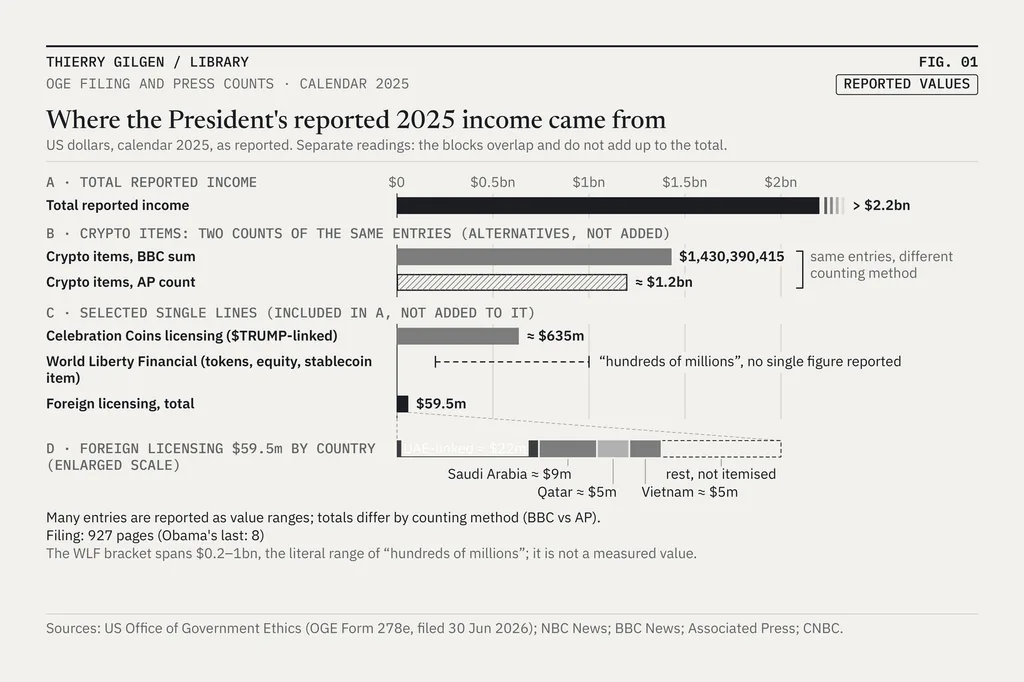
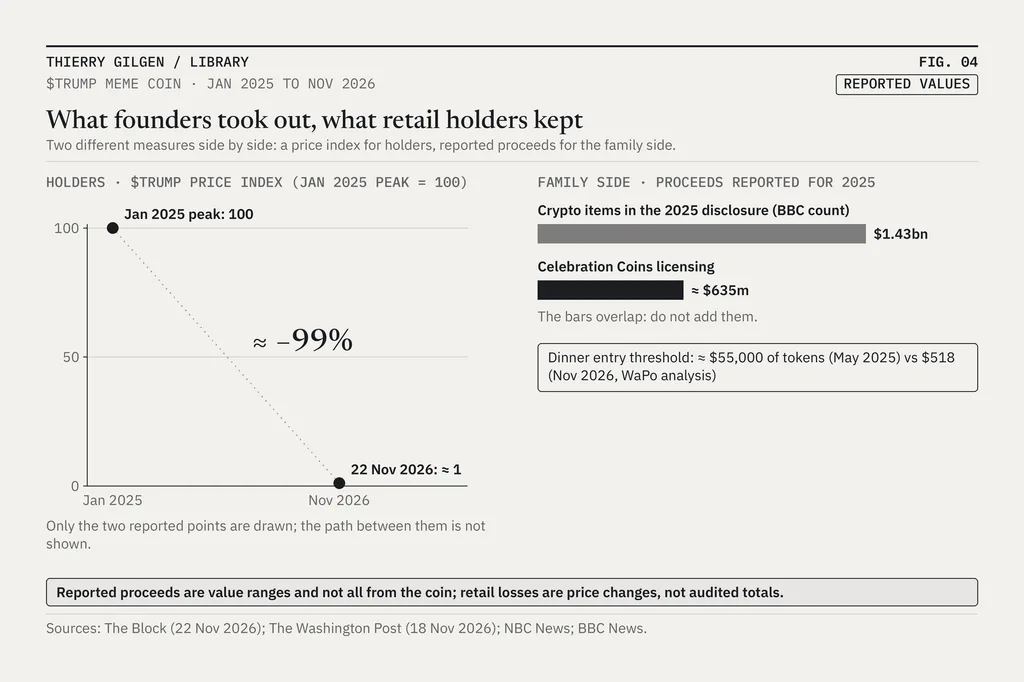
The filing reports income for 2025, the first year of the second term, of more than $2.2 billion. More than $1.4 billion of it came from crypto. The BBC added the crypto items to $1,430,390,415. The Associated Press, counting differently, put the crypto take at about $1.2 billion. Because many entries are reported in value ranges rather than exact amounts, no one can state the true figure precisely.315
The largest single line was about $635 million in royalties from an entity called Celebration Coins, linked to the $TRUMP meme coin. World Liberty Financial produced hundreds of millions more through token sales, equity sales and a stablecoin-related item. Trump's foreign licensing business, which lends his name to towers and golf courses abroad, earned $59.5 million in 2025, including about $22 million from projects linked to the United Arab Emirates, about $9 million from Saudi Arabia, and about $5 million each from Qatar and Vietnam.1416
The family's fortunes moved with it. Forbes estimated that Eric Trump's net worth had risen tenfold since the 2024 election, to about $400 million, and Donald Trump Jr.'s sixfold, to about $300 million, mostly through crypto holdings.1718
The buyers fared differently. By 22 November 2026, the $TRUMP token traded about 99% below its January 2025 peak. That evening the President hosted a second dinner for the coin's largest holders. According to a Washington Post analysis, one guest qualified with tokens worth $518. For the first dinner, in May 2025, it had taken about $55,000.1920
The White House has answered every version of this story in the same terms. "Neither the President nor his family has ever engaged, or will ever engage, in conflicts of interest," a spokesperson said when the disclosure was released. Asked about his wealth the next day, Trump said: "I don't get involved in my personal [finances], we have funds that run my money." His crypto policy, he has said, is about national position: "We have to be at the top. Otherwise China is going to take it over."31
3 — The Gulf triangle
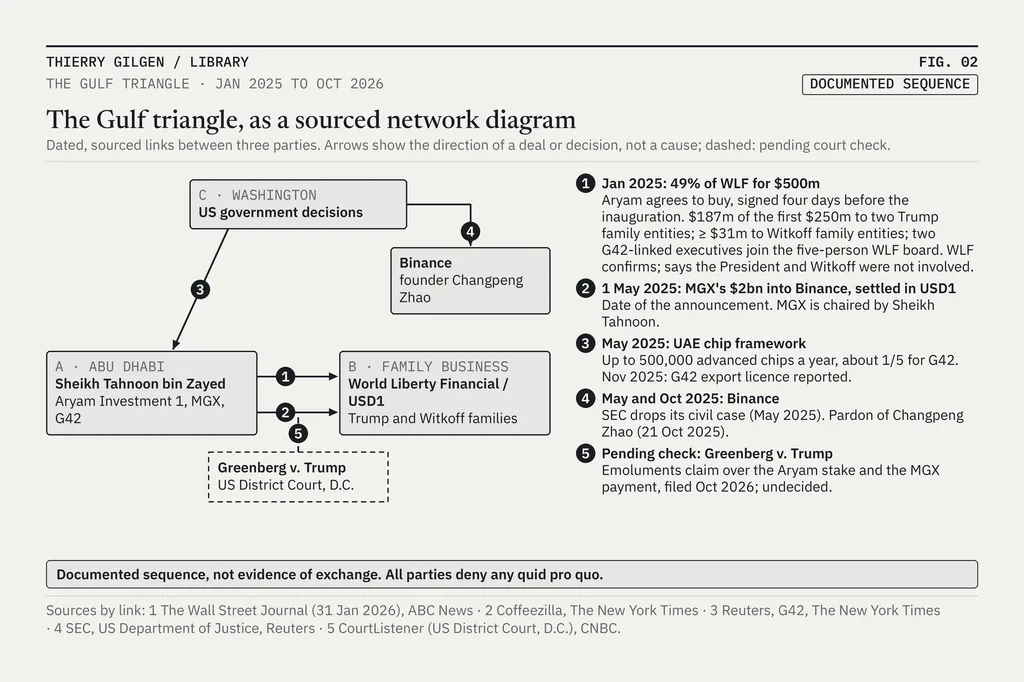
On 31 January 2026, The Wall Street Journal published an investigation built on company documents. Four days before the January 2025 inauguration, it reported, representatives of an Abu Dhabi royal had signed an agreement to buy 49% of World Liberty Financial for $500 million. The buyer was a company called Aryam Investment 1. The investor behind it was Sheikh Tahnoon bin Zayed Al Nahyan, brother of the UAE's president, the country's national security adviser and the chairman of its largest pools of state and private capital.21
According to the Journal, the deal was signed by Eric Trump. Of the first $250 million, $187 million was directed to two Trump family entities. At least $31 million was slated for entities affiliated with the family of Steve Witkoff, a World Liberty co-founder who had weeks earlier been named US envoy to the Middle East. Two executives connected to Tahnoon's AI company G42 joined World Liberty's five-person board. The Journal called it the only known case of a foreign government official buying a major stake in a Trump company after his election.21
World Liberty acknowledged the transaction. Its spokesperson said that "neither President Trump nor Steve Witkoff had any involvement whatsoever" in it.22
The second side of the triangle had been public all along, though its meaning was not. On 1 May 2025, Zach Witkoff, Steve Witkoff's son and a World Liberty co-founder, announced that USD1, the company's new dollar stablecoin, had been "selected as the official stablecoin to close MGX's $2 billion investment in Binance". MGX is an Abu Dhabi investment company chaired by Tahnoon. A stablecoin earns its issuer income from the reserves that back it. Two billion dollars parked in USD1 is a large, steady source of interest for its owner.123
Asked by Coffeezilla why this had not been disclosed, World Liberty said it was "unfair to hold a private company to arbitrary standards when raising money", and that MGX chose USD1 on its merits.1
The third side was policy. The UAE had long wanted access to the most advanced American AI processors and had long been refused, because of concerns about diversion to China. In May 2025 the administration agreed a framework allowing the UAE to import up to 500,000 advanced chips a year, with about a fifth going to G42. In November 2025, G42 announced that it had received US export approval. The New York Times reported the sequence in September 2025 under the headline "In Giant Deals, U.A.E. Got Chips, and Trump Team Got Crypto Riches".242523
Binance supplies a fourth line. In May 2025 the Securities and Exchange Commission dismissed its civil case against the exchange and its founder, Changpeng Zhao. In October 2025 Trump pardoned Zhao for the anti-money-laundering offence to which he had pleaded guilty. Asked about it on television, the President said: "I don't know who he is." Zhao has said he "didn't do anything" to obtain the pardon, while adding that without one it was "quite hard for Binance to enter the US in a proper way".2627281
Nothing in the public record shows that any of these decisions was a payment for another. World Liberty calls any suggestion of a political quid pro quo "completely false" and says it has no influence over policy. Senator Elizabeth Warren has asked the Commerce Secretary to explain the chip decision. A shareholder lawsuit filed in October 2026, Greenberg v. Trump, argues that the Aryam stake and the MGX payment are emoluments from a foreign state. It has not been decided.1293031
In April 2026, as the war with Iran strained dollar funding in the Gulf, the President was asked whether the United States might offer the UAE a currency swap line. "It is," he said, "but it's been a good country, it's been a good ally of ours." The UAE said it did not need support, and no swap was announced.32
Qatar offers a smaller version of the same geometry. In May 2025 it offered a Boeing 747-8 worth about $400 million for use as Air Force One, accepted through the Defense Department. The United States approved a possible $1.96 billion sale of MQ-9B drones to Qatar. The Trump Organization signed a licensing agreement for a golf and villa project in Qatar's Simaisma development, part of a project its partners value at $5.5 billion. Each of these has an explanation that stands on its own. Together they describe a relationship in which state business and family business share a table.333435
The same is true of the envoys. Jared Kushner, the President's son-in-law, negotiates in the Middle East while his investment firm, according to The New York Times, seeks at least $5 billion from Gulf sovereign funds. Steve Witkoff said in 2025 that he was divesting from World Liberty. ABC News reported that his 2026 disclosure shows he earned close to $107 million from the venture and still lists World Liberty entities under his holding company. The White House says he has fully divested.363738
4 — When the regulator is also the market
In most countries a regulated company tries to keep a respectful distance from the person who appoints its regulator. The pattern in this chapter runs the other way.
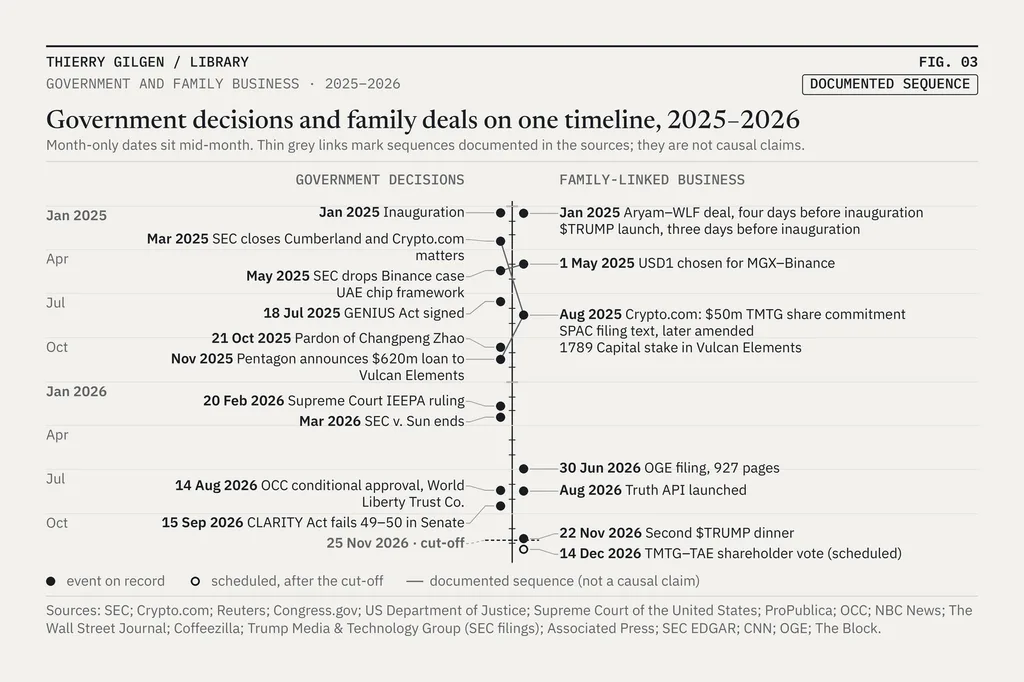
On 18 July 2025 the President signed the GENIUS Act, the first federal law for dollar stablecoins. He had lobbied for it personally, including, by his own account, calls to Republican holdouts late at night. His family's company issues one of the stablecoins the law governs. A broader market-structure bill, the CLARITY Act, passed the House but failed a Senate cloture vote, 49 to 50, on 15 September 2026.39401
On 14 August 2026, the Office of the Comptroller of the Currency, whose head the President appoints, granted preliminary conditional approval for World Liberty Trust Company, a national trust bank to issue USD1 and hold digital assets. World Liberty says the approval was handled by career staff on the merits.411
In 2025 the SEC dropped or closed its cases against most major crypto exchanges, Binance among them. Molly White points out that several of the firms involved also paid, one way or another, into the President's orbit. The case against Cumberland DRW was dismissed with prejudice in March 2025. According to the video, its founder, Don Wilson, was among the investors in Trump Media's bitcoin treasury weeks later; Cumberland told Coffeezilla there was no quid pro quo and no connection. The SEC closed its investigation of Crypto.com without action in March 2025. In August 2025 Crypto.com agreed to buy $50 million of Trump Media shares as part of a strategic partnership. The SEC's fraud case against Justin Sun, World Liberty's largest early public investor, ended in March 2026 with the claims against him dismissed with prejudice and a $10 million settlement by an affiliate. Sun has since fallen out with World Liberty; each side has sued or accused the other.2642143444546
Trump Media itself turned the President's attention into a product. In August 2026 it began selling what it calls the Truth API, a fast machine-readable feed of posts from top Truth Social accounts, including the President's, for up to $100,000 a month. "Markets already move on Truth Social posts," its interim chief executive, Kevin McGurn, said.1 The company reported a 2025 net loss of $712.3 million, largely from unrealised losses on digital assets, and is seeking shareholder approval on 14 December 2026 for a roughly $6 billion all-stock merger with the fusion company TAE Technologies.474849
The President's own portfolio raises the same question from a different side. A CNN analysis of his disclosure found at least 44 purchases in 21 companies within a week before he posted favourably about them. A later periodic report showed purchases of Palantir, SpaceX and NVIDIA shares in September 2026, around federal contract decisions and the NVIDIA leadership crisis. The White House says the accounts are managed by independent third parties and that he does not direct trades.5051
The sons' ventures add the procurement state. A special-purpose acquisition company with Eric Trump and Donald Trump Jr. as advisers told the SEC in August 2025 that it would look for targets "well positioned to benefit from federal or state level incentives, such as government contracts or preferential procurement programs". After the Associated Press asked about it, the company filed an amendment removing the passage and called it a scrivener's error.5253 ProPublica reported that a senior White House adviser initiated a $620 million Pentagon loan to Vulcan Elements, a rare-earth magnet company, about three months after Donald Trump Jr.'s firm 1789 Capital invested in it. "The call came from the White House," one person told ProPublica. 1789 Capital says it stays "totally out of" government dealings and holds only minority stakes.54155
On prediction markets, Donald Trump Jr. advised both Kalshi and Polymarket while the Commodity Futures Trading Commission, under a chairman appointed by his father, set the industry's rules. The New York Times reported that he told Republican state attorneys general not to fight prediction markets; he described it as a passing comment. The CFTC chairman, Michael Selig, told Congress: "We do not pick winners and losers or engage in favoritism." On 24 November 2026, the senior Democrat on the House Judiciary Committee, Jamie Raskin, demanded records from four companies backed by 1789 Capital, citing "suspiciously well-timed government favors".56157
Each item has an innocent account, and several have been given one. The question is what a citizen, an investor or a foreign government is supposed to conclude when the same pattern repeats across industries.
5 — A tariff with a telephone attached
Switzerland's tariff file shows the same logic from the receiving end. It is worth telling in order.
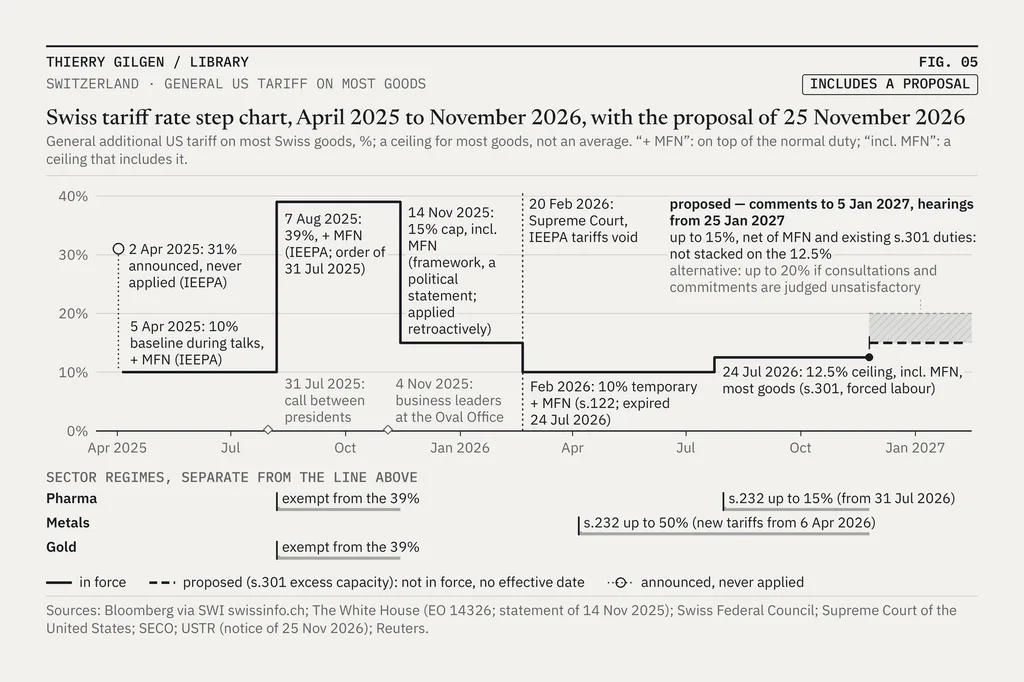
On 2 April 2025, "Liberation Day", the President announced reciprocal tariffs on almost every trading partner under the International Emergency Economic Powers Act, a 1977 law for national emergencies. Switzerland was listed at 31%, then, like others, placed at a 10% baseline while talks ran. Bern believed it was well placed. It had abolished its own industrial tariffs. On 24 April, after meeting the Treasury Secretary, Keller-Sutter spoke of "somewhat preferential treatment". In May and June the US Trade Representative's office held more than 20 rounds of talks with Swiss officials. The Swiss offered agricultural concessions, easier approval of US medical devices and the investment plans of Roche and Novartis. They hoped for 10%.4
Then came the call of 31 July and the 39% order. Why the rate was so high is still disputed. Swiss Sunday papers, citing unnamed sources, reported that Trump found Keller-Sutter moralising, and that after half an hour the head of SECO received a message from Trump's side suggesting the call be ended before it escalated. A person close to Keller-Sutter said it did not escalate. Bloomberg also reported that Switzerland had "put little on the table". The executive order itself gives the trade deficit as its reason.58546
In early August Keller-Sutter and Guy Parmelin flew to Washington. They did not meet the President. The tariff took effect on 7 August. Pharmaceuticals, gold and some other goods remained exempt.459
On 4 November 2025 the business delegation sat down in the Oval Office: Jean-Frédéric Dufour of Rolex, Marwan Shakarchi of MKS, Johann Rupert of Richemont, Daniel Jaeggi of Mercuria and Alfred Gantner of Partners Group, with Diego Aponte of MSC having helped arrange the meeting. In a joint statement they called it "highly constructive" and said they "did not engage in any negotiations". MKS, whose chief executive presented the gold bar, said in a statement that the gifts "were presented to the Presidential Library on behalf of the group who attended the meeting, in full compliance with both US and Swiss law, and were cleared with the White House ethics counsel." White House officials said Trump accepted them for his library. Gantner later said the gifts were not for Trump but "for the American public".7860
On 14 November the United States, Switzerland and Liechtenstein issued a joint statement on a framework. The United States would cap its tariffs on Swiss goods at 15%. Switzerland and Liechtenstein pledged at least $200 billion of private investment in the United States over five years, including $67 billion in 2026, lower tariffs on US fish and farm products, and easier recognition of US standards. Future Section 232 tariffs on Swiss pharmaceuticals and semiconductors would not exceed 15%. The framework was a political statement, not a treaty. The 15% cap applied retroactively from 14 November.91059
Parmelin later explained the business channel plainly: "When we heard from business representatives that some of them might have direct access to the Oval Office, we saw an opportunity to put the issue at the top of the list." He also insisted: "It's still the Federal Council that negotiated."60
On 20 February 2026 the Supreme Court decided Learning Resources v. Trump. "IEEPA does not authorize the President to impose tariffs," the Court held. Writing for the Court, Chief Justice Roberts recalled that the Constitution gives Congress the power to lay duties and that "the Framers did not vest any part of the taxing power in the Executive Branch". The 39% rate, the 15% framework rate and every other reciprocal tariff lost their legal basis at a stroke. Justice Brett Kavanaugh, dissenting, observed that "the Court's decision is not likely to greatly restrict Presidential tariff authority going forward", because other statutes remain.61
He was right about the rebuild. A temporary 10% surcharge followed under Section 122 of the Trade Act, which is limited to 150 days. In March 2026 the Trade Representative opened two new investigations under Section 301, one into enforcement against goods made with forced labour, covering some 60 economies, and one into "structural excess capacity" in 16 economies. Switzerland was named in both. The Federal Council rejected the allegations and submitted written comments. From 24 July 2026 the forced-labour action set a ceiling of 12.5% on most Swiss goods, counting existing duties. New Section 232 tariffs reached up to 50% on metals and up to 15% on pharmaceuticals.62
On 29 June 2026, still without a binding agreement, the Federal Council published a unilateral declaration on implementing parts of the November statement: simpler recognition of US conformity bodies, medical devices and cars, and changes in public procurement. It said it expected the United States to keep its side.63 In October the US ambassador to Switzerland, Newt Gingrich, called the framework "a significant achievement" and said the two governments were "working toward a legally binding agreement".64
On 25 November 2026 the decision came. The Trade Representative, Jamieson Greer, determined that the practices of 14 of the 16 investigated economies, Switzerland among them, were "unreasonable and burden or restrict U.S. commerce", and were therefore actionable under Section 301. He made no determination on Mexico or Norway.65
The notice on Switzerland names four practices: a history of intervening in currency markets to keep the franc from appreciating, together with low and sometimes negative interest rates over the past ten years; "extensive public investment and fiscal incentives" for pharmaceuticals; financial support that lowers the cost of electricity for Swiss steel producers; and a failure to restrict imports from, or to monitor and address investment from, non-market economies, China above all. The sectors it names are pharmaceuticals, chemicals, watches, precision instruments and machinery. Consultations held on 13 May 2026, it says, "did not resolve U.S. concerns".66
What it proposes is a rate, not yet a duty. USTR proposes tariffs on all Swiss goods "of up to 15 percent, net of MFN rates and existing Section 301 tariffs", a figure it says accounts for existing Section 301 and 232 duties, the continuing consultations and the commitments in the November 2025 joint statement. Should it find those consultations and commitments "unsatisfactory", it proposes up to 20% instead. Goods under Section 232 tariffs, including steel, aluminium, copper, vehicles, wood, patented pharmaceuticals and semiconductors, are exempt, as are informational materials, donations and accompanied baggage, and hundreds of tariff lines listed in an annex. Comments are due by 5 January 2027, and public hearings begin on 25 January 2027. Nothing is yet in force.66
Greer said on CNBC that the new duties would not stack on the existing forced-labour duties of 10% or 12.5%: "Those are not really additive." A senior official told reporters that final action could come as early as January.67 The Neue Zürcher Zeitung reads the proposal as keeping Switzerland, for now, at the all-in 15% ceiling of the joint statement, with the 20% option held in reserve as a threat.68 Bern said little at first. At the Federal Council's press conference that afternoon, before the notice had been published, its spokeswoman, Nicole Lamon, said in German that Switzerland had "not yet received any official information from the United States" and that "the results are not yet known". Switzerland has rejected the allegations since the investigation began.6962 Later that afternoon, once the notice was out, the economics department said through SECO that it had taken note of USTR's findings and would examine the report before deciding on next steps. It nevertheless assumes, Keystone-ATS reported in Blick's French edition, that the recommendation respects the joint declaration of intent of 14 November 2025, the one that capped US tariffs at 15% instead of the 39% first announced.70
The first Swiss reality check came that evening. Blick put the four charges to the economist Klaus Wellershoff (quotes in our translation). On the franc, he said the charge might be true "historically" but was "wrong" today: the National Bank "has hardly intervened" lately. The SNB's own figures give each side something. It bought foreign currency worth CHF 3.9 billion in the first quarter of 2026 and CHF 1.4 billion in the second, as the war with Iran pushed the franc up; in 2020 it had spent about CHF 110 billion. Its policy rate has been zero since June 2025.7172 On pharmaceuticals, Wellershoff saw state support but "no preferential treatment compared with other sectors". On steel, he could not imagine American producers feeling threatened by Swiss ones.71 The fourth charge, which USTR's summary calls a "failure to address global excess capacity", left him asking: "What could Switzerland do here?" The notice is more specific: Switzerland does not screen investment from non-market economies. Parliament adopted a screening law in December 2025, limited to takeovers by foreign state-controlled investors; it is due to take effect in 2027.71656673 Economiesuisse rejected the charges outright, and Wellershoff called the exercise domestic politics whose cost Americans would bear. The measures USTR names exist. Whether they add up to structural excess capacity is what the hearings are for.
The shape of the year is now plain. A small country negotiated by the book and received the developed world's highest tariff. A private channel opened a door, and what came through it was a statement without legal force. The legal basis for both the punishment and the relief was then struck down, and replaced by instruments the Swiss could influence even less. Fifteen per cent is back on the table, now resting on a trade-law finding that Switzerland disputes, with 20% held in reserve.
6 — The Swiss side of the mirror
Switzerland is not only a victim in this story. It is also a test of its own institutions.
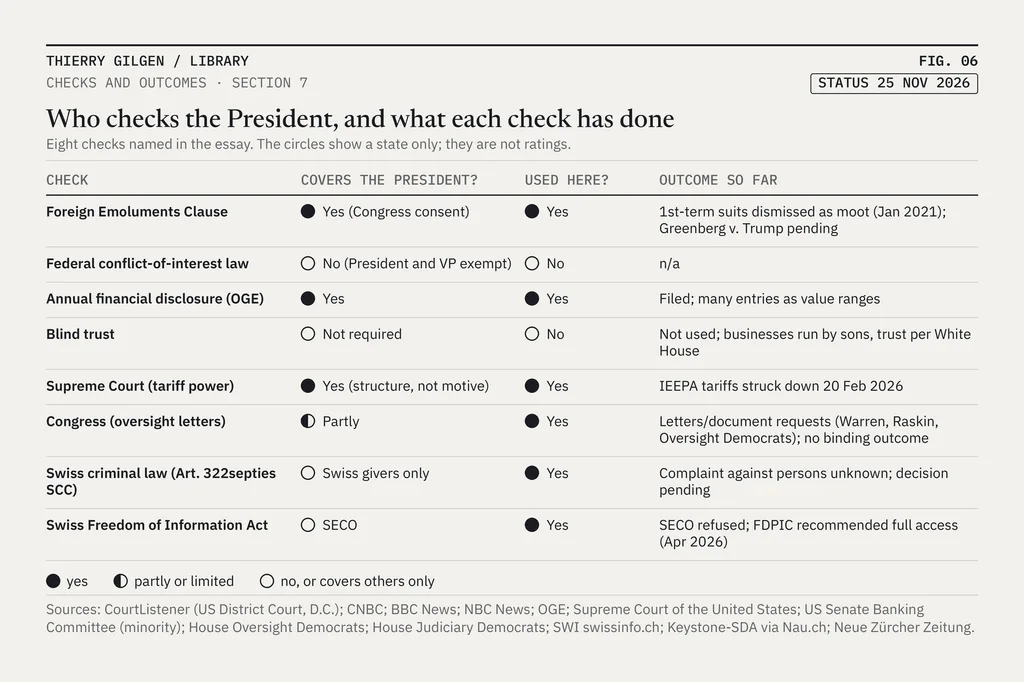
By 27 November 2025, two Green members of the National Council, Greta Gysin and Raphaël Mahaim, had asked the Office of the Attorney General of Switzerland to examine whether the gifts breached article 322septies of the Swiss Criminal Code, which forbids offering an undue advantage to a foreign official in connection with an act within the official's discretion. The complaint was filed against persons unknown. The Office of the Attorney General confirmed it had received three complaints and was examining them "as usual". No decision had been published by the cut-off of this volume. No one has been charged, and the attendees maintain that the gifts were lawful.7460
Experts quoted by swissinfo described the questions a prosecutor would ask. Swiss federal employees may keep gifts worth up to CHF 200. A US official may accept foreign-government gifts of minimal value, currently $480. Whether a gift is "undue" depends on context and on whether it is socially acceptable. Whether a quid pro quo can be inferred depends on what was within the official's discretion. A tariff set by executive order, one lecturer noted, arguably is. A former ethics counsel to George W. Bush pointed out that a presidential library is a private foundation, so a gift to it is not obviously a gift to the American people.60
The second test is transparency. In December 2025 a journalist used the federal Freedom of Information Act to ask SECO for its correspondence with the business leaders. SECO refused, citing ongoing negotiations, economic and foreign-policy interests and customary international law. In April 2026 the Federal Data Protection and Information Commissioner recommended full access and said SECO had prevented him from examining the documents. Gantner has said the meeting was coordinated "one to one" with SECO. SECO describes the execution as a private initiative.75
These are uncomfortable facts for a country that sells itself on rules. The Federal Council chose to let private actors carry the national interest into a room it could not enter, and then declined to show the public how that was arranged. The likeliest explanation is not corruption on the Swiss side but improvisation under pressure. It was still a choice to work the counterparty's way.
7 — Is it abuse of power? The case and the defence
There is no statute called "abuse of power". The phrase names a judgement: that public authority has been used for private ends, or that the people who hold it have arranged things so that no one can tell. To weigh it, start with the rules that exist.
The Constitution's Foreign Emoluments Clause says that no person holding an office of profit or trust shall, without the consent of Congress, accept "any present, Emolument, Office, or Title, of any kind whatever, from any King, Prince, or foreign State". A Domestic Emoluments Clause limits the President's compensation from the federal government and the states. During the first term, lawsuits under both clauses ended without a ruling on the merits; in January 2021 the Supreme Court sent them back as moot. The new test is Greenberg v. Trump, filed in Washington in October 2026 by a shareholder of the stablecoin company Circle, on the theory that the Aryam stake and the MGX payment are foreign emoluments. It is pending.3031
The federal conflict-of-interest statute, which bars officials from acting on matters in which they have a financial interest, exempts the President and Vice-President. The President has pointed this out himself. He must still file annual disclosures, but these report many values only in broad ranges. He has not placed his assets in a blind trust. The Trump Organization says its business is run by his sons and that his investments are managed by third parties.314
The tariff power has now been tested in court. The Supreme Court's decision is a structural ruling about who may tax, not a finding about motive. It does not say any tariff was set for private reasons. It does say that the instrument used against Switzerland, and against almost every other trading partner, was never the President's to use in that way.61
A similar question hangs over a different deal. In August 2025 the administration allowed NVIDIA and AMD to resume certain chip sales to China in exchange for 15% of the revenue. Legal scholars writing in Lawfare and elsewhere argued that this resembles an export tax, which the Constitution forbids, and a licence fee, which export-control law bars. That money goes to the Treasury, not to anyone's family. It shows the same habit: a public permission converted into a negotiated price.76
The critics' case, as made by ethics lawyers, senators and investigators, runs as follows. A president who retains businesses that foreign governments, regulated firms and contractors can invest in, buy from or partner with has created a market for access. The disclosures show the money arrived. The decisions that followed the money are documented. Even if no single decision was bought, the arrangement makes it impossible to prove that any decision was not. "Of course it's a conflict of interest," said Richard Painter, chief ethics lawyer to George W. Bush, of the crypto income.3
The public has moved with the critics. In Gallup's 2026 survey, a record 89% of Americans said corruption was widespread in government.77
The defence deserves to be stated in its own words. The White House says that neither the President nor his family has ever engaged in conflicts of interest, that his businesses are held in a trust managed by his sons, and that the President has made the United States "the crypto capital of the world" through policy that benefits all Americans. Trump says rising markets have made "everybody" richer and that he does not talk to the people who invest his money. World Liberty says it has no influence on policy and that regulators acted through career staff. Investors in the family's ventures say they bought access to capital markets and to a story, not to the government. Defenders of the tariffs say they forced trading partners, Switzerland included, to make concessions that years of diplomacy had not; the US ambassador in Bern calls the Swiss framework "a significant achievement".3164
The record supports some of the defence. Many crypto cases were dropped across the industry, not only for family partners. Several of the contracts flagged in the video predate the family's involvement. And a president who rejects the conflict rules is not, by that fact, breaking them.
But the defence answers a narrower charge than the one the evidence raises. The question is not only whether a decision was sold. It is whether a government has been arranged so that its decisions can no longer be read. When the same person sets a tariff by phone, accepts gifts for a private library, profits from a token held by foreign buyers, appoints the regulator of his family's bank and personally arranges the return of a chief executive whose shares he owns, the public is asked to trust motives it cannot inspect. Our thesis is that this arrangement, more than any single transaction, is the abuse. It is an argued conclusion. A court has not reached it.
8 — The second chair, again
Our previous volume, The Human Chokepoint, ended with an empty chair at NVIDIA. For eleven days in November 2026 the company ran without Jensen Huang. The board then reinstated him, citing his candour and "input from senior levels" of the US government.78
The President described his role directly. "I made the deal," he told CNBC on 23 November, in a telephone interview shortly after NVIDIA announced Huang's return. "And we gave them assurances, at least with everything we know."79 Reuters quoted him as saying, "I believe my intervention was very important to get Jensen Huang back," and reported from his disclosures that he owns between $11 million and $55 million of NVIDIA shares. A White House spokesperson said his portfolio is managed independently.80
That volume concluded that the chokepoint was never in the processor but in the layer where decisions about the processor are made, and that a second chokepoint had appeared in Washington. This volume widens the picture. The same layer decides a Swiss tariff, a Gulf chip licence, a bank charter, a pardon and a company's leadership. In each case, the decisive input is the judgement of one office, and in several cases that office has a private interest in the outcome.
For the people affected, the practical problem is not moral. It is that a decision made this way can be unmade the same way. A rate set by telephone can be reset by telephone. A framework that rests on goodwill lasts as long as the goodwill. Institutions exist so that a country's obligations survive a bad call and a changed mood.
9 — What a small country can still control
Switzerland cannot choose its counterparties. It can choose how it deals with them.
The first lesson of 2025 is that commitments from Washington are only as durable as their legal basis. The 15% framework was valuable, but it was a statement. The Supreme Court then removed the law beneath it. A Swiss exporter planning investment should treat any US tariff level that is not written into statute or a ratified agreement as revocable. The Federal Council's aim of a legally binding agreement is the right one. The same caution applies to European partners whose caps are written into "finalised" deals: finalised by whom, and enforceable how?
The second lesson is about channels. Access to the Oval Office through private wealth appears to have helped. It also exposed the country to a criminal complaint, a transparency dispute and the reputational cost of being seen to pay tribute. If business leaders are to carry the national interest, the arrangement should be decided by the Federal Council, documented and disclosed afterwards. Gifts above what Swiss officials could accept should not be part of it.
The third lesson is for boards. Companies that depend on US approvals, US chips or US markets carry a key-person risk that sits in Washington, not in their own organisation. The questions from The Human Chokepoint apply here too. If the person who carries this relationship were gone tomorrow, who would decide? On what record? And how long would the decision last?
The fourth is for Swiss finance. Banks, exchanges and asset managers that hold or distribute USD1, or deal with World Liberty, Binance or their partners, should assess more than credit risk. A stablecoin whose issuer is tied to a head of state, whose largest outside shareholder is a foreign security official and whose regulator is appointed by that head of state carries political and reputational risk of a kind Swiss supervisors will recognise.
The excess-capacity proposal makes the first lesson concrete. The 15% that Switzerland negotiated in November 2025 survives, for now, as the lower of two rates in an American trade-law notice, and whether the higher one of 20% applies depends on whether Washington finds Swiss commitments satisfactory. For exporters, two dates matter: 5 January 2027 for comments and 25 January for the hearings. For Bern, the open question is whether a framework that can be honoured can also be made binding.
Epilogue — The price of access
Return to the two objects on the Oval Office desk: a gold clock and a kilogram of gold.
Neither has been shown to have bought anything. They were given, their givers say, lawfully and to a library. The tariff fell because of a negotiation that included a $200 billion pledge, and then the law under it fell because a court said the President never had the power he used. All of that may be true at once.
What the objects show is where the price of access is now quoted. It is no longer quoted only in treaties, hearings and published rules. It is also quoted in tokens, licences, board seats, data feeds and gifts to private foundations, in a market whose terms are visible only after the fact, and sometimes only because a newspaper obtained the documents.
Switzerland paid in investment pledges and concessions, and in something harder to count: the habit of treating its own institutions as optional when the counterparty prefers a different door. Others paid more. Retail buyers of a meme coin paid in savings. Citizens pay in the confidence that their government's decisions mean what they say.
A country that wants its agreements to last should insist on the slower door.
The deal that can be bought by phone can be cancelled by phone.
Research and revision note
This edition is based on publicly accessible court rulings, executive orders, Federal Register notices, financial disclosures filed with the US Office of Government Ethics, SEC and OCC records, statements by the Swiss Federal Council and SECO, congressional letters, company statements and attributed reporting, reviewed on 25 November 2026. It began as a check of the claims in Coffeezilla's video of 12 November 2026. It is a desk-research synthesis, not an original investigation. No parties were contacted for this volume. Public responses are quoted where available. The US excess-capacity notice on Switzerland was read in its pre-publication Federal Register version of 25 November 2026; the rates it contains are proposals.
Claims that could not be verified were removed: the specific payouts reported from the ALT5 Sigma transaction, the returns attributed to 1789 Capital, a reported further $5 billion in arms approvals for Qatar, and the characterisation of a prediction-market product as a failure. Where the video was wrong, the text says so. Figures from financial disclosures are reported as the filings and named outlets present them; many are value ranges. The account of the 31 July 2025 call rests on press reports citing anonymous sources and is attributed accordingly.
No claim is made that any person named committed a crime, that any decision was bought, or that the Swiss business leaders acted unlawfully. "Abuse of power" in section 7 is the author's argued conclusion, not a legal finding.
The German and French versions preserve the same facts, uncertainty, attributions and sources.
AI disclosure
We used AI tools to help gather and check sources, compare claims against primary records and draft and edit this text in three languages. The argument, the selection of evidence and the final wording were reviewed and approved by the author. Errors remain ours, and corrections are welcome.
What would change this edition
A final US decision on the excess-capacity tariffs for Switzerland, a binding US–Swiss agreement, a decision by the Office of the Attorney General, a ruling in Greenberg v. Trump, or a correction to a load-bearing source would justify a revision with a dated change note.
Related reading in the Library
- The Human Chokepoint: the NVIDIA affair and the second chokepoint in Washington.
- The Sovereignty Gap: where Swiss politics actually runs.
- The Cost of Closing the World: AI investment and the economic limits of political power.
- Too Strategic to Fail: when private AI becomes a public obligation.
- Inherited Trust Is Not a Product: Swiss banking and the price of confusing a moat with a strategy.
- Bitcoin Between Cash and Collateral: what crypto was for, and what it became.
Sources
Sources were checked on 25 November 2026. Each numbered note carries its source ID (S01–S80). Primary sources (S01–S36) come first in the ID sequence.
Notes and sources
-
[S36] Coffeezilla (YouTube) (2026-11-12): Investigating The President. www.youtube.com ↩ ↩2 ↩3 ↩4 ↩5 ↩6 ↩7 ↩8 ↩9 ↩10 ↩11 ↩12 ↩13 ↩14 ↩15
-
[S13] US Office of Government Ethics (2026-06-30): Donald J. Trump, OGE Form 278e, 2025 Annual Report. extapps2.oge.gov ↩ ↩2
-
[S45] BBC News (2026-07-01): Trump made more than $1bn from crypto in first year back in office. www.bbc.com ↩ ↩2 ↩3 ↩4 ↩5 ↩6
-
[S68] Bloomberg via SWI swissinfo.ch (2025-08-09): How Switzerland's Tariff Drama Swung From Hope to Despair. www.swissinfo.ch ↩ ↩2 ↩3 ↩4
-
[S69] Bloomberg via SWI swissinfo.ch (2025-08): Tenacious Swiss Leader Stood Up to Trump — It Backfired on Her. www.swissinfo.ch ↩ ↩2 ↩3
-
[S02] The White House (2025-07-31): Executive Order 14326: Further Modifying the Reciprocal Tariff Rates. www.whitehouse.gov ↩ ↩2
-
[S65] Reuters (2025-11-05): Executives from Mercuria, Rolex, other Swiss firms meet Trump. www.reuters.com ↩ ↩2
-
[S66] Axios (2025-11-14): How to lobby Trump with Swiss precision: gifts, gold and gab. www.axios.com ↩ ↩2
-
[S03] The White House (2025-11-14): Fact Sheet: The United States, Switzerland, and Liechtenstein Reach a Historic Trade Deal. www.whitehouse.gov ↩ ↩2
-
[S04] The White House (2025-11-14): Joint Statement on a Framework for a United States–Switzerland–Liechtenstein Agreement on Fair, Balanced, and Reciprocal Trade. www.whitehouse.gov ↩ ↩2
-
[S60] The Washington Post (2026-11-12): Kalshi parts ways with Trump Jr. after his firm deepens its Polymarket bet. www.washingtonpost.com ↩
-
[S63] WIRED (2026): A Humanoid Company Backed by Eric Trump Is Preparing Its Robots for War. www.wired.com ↩
-
[S48] Fortune (2026-07-01): Melania Trump NFT earnings surge in 2025, filing shows. fortune.com ↩
-
[S46] NBC News (2026-06-30): Trump's financial disclosure lists $1.4 billion in crypto earnings, powered largely by meme coins. www.nbcnews.com ↩ ↩2 ↩3 ↩4
-
[S47] Associated Press (2026-06-30): Trump filing shows he took in about $1.2 billion from crypto businesses last year. apnews.com ↩
-
[S49] CNBC (2026-08-10): Trump foreign licensing income surged to $59.5 million. www.cnbc.com ↩
-
[S50] Forbes (2025-12-04): Eric Trump has gotten 10 times richer since his father's election. www.forbes.com ↩
-
[S51] Forbes (2025-12-08): How Donald Trump Jr.'s fortune jumped six-fold in a year. www.forbes.com ↩
-
[S52] The Block (2026-11-22): Trump to host second memecoin dinner tonight with TRUMP down 99% from peak. www.theblock.co ↩
-
[S78] The Washington Post (2026-11-18): Almost nobody's vying for an invite to Trump's second meme coin dinner. www.washingtonpost.com ↩
-
[S38] The Wall Street Journal (2026-01-31): 'Spy Sheikh' Bought Secret Stake in Trump Company. www.wsj.com ↩ ↩2
-
[S39] ABC News (2026-02): White House faces questions over UAE royal's investment in Trump family's crypto firm. abcnews.com ↩
-
[S40] The New York Times (2025-09-15): In Giant Deals, U.A.E. Got Chips, and Trump Team Got Crypto Riches. www.nytimes.com ↩ ↩2
-
[S41] Reuters (2025-05-14): US close to letting UAE import millions of Nvidia's AI chips, sources say. www.reuters.com ↩
-
[S33] G42 (2025-11): G42 receives US approval for advanced AI chip exports. www.g42.ai ↩
-
[S16] US Securities and Exchange Commission (2025-05): Litigation release: Binance Holdings Limited et al.; Changpeng Zhao. www.sec.gov ↩ ↩2
-
[S19] US Department of Justice, Office of the Pardon Attorney (2025-10-21): Executive grant of clemency: Changpeng Zhao. www.justice.gov ↩
-
[S54] Reuters (2025-10-23): Trump pardons convicted Binance founder 'CZ' Zhao. www.reuters.com ↩
-
[S28] US Senate Banking Committee, minority (2026): Warren presses Lutnick over decision to grant UAE access to sensitive US tech following investment in Trump family crypto company. www.banking.senate.gov ↩
-
[S27] US District Court for the District of Columbia / CourtListener (2026-10): Greenberg v. Trump, No. 1:26-cv-03686 (docket). www.courtlistener.com ↩ ↩2
-
[S55] CNBC (2026-10-22): Lawsuit accuses Trump of illegally profiting off foreign crypto deals. www.cnbc.com ↩ ↩2
-
[S42] Reuters (2026-04-21): Trump says currency swap with UAE is under consideration. www.reuters.com ↩
-
[S64] Associated Press (2026): $400M Qatari jet gifted to US nearly ready to be Trump's Air Force One. apnews.com ↩
-
[S26] Defense Security Cooperation Agency (2025): Major Arms Sales (Qatar, MQ-9B). www.dsca.mil ↩
-
[S34] The Trump Organization (2025): Qatari Diar and Dar Global: Trump International Golf Club and Trump Villas, Simaisma. www.trump.com ↩
-
[S43] The New York Times (2026-03-13): Jared Kushner Solicits Funds for His Firm While Working as Mideast Envoy. www.nytimes.com ↩
-
[S44] ABC News (2026): Steve Witkoff earned nearly $107M from Trump-affiliated crypto venture, disclosures show. abcnews.com ↩
-
[S14] The White House (2026-09): Steven Witkoff, OGE Form 278e, 2026 Annual Report. www.whitehouse.gov ↩
-
[S24] Congress.gov (2025-07-18): S.1582, GENIUS Act: actions (Public Law 119-27). www.congress.gov ↩
-
[S25] Congress.gov (2026): H.R.3633, Digital Asset Market Clarity Act. www.congress.gov ↩
-
[S15] Office of the Comptroller of the Currency (2026-08-14): Conditional approval: World Liberty Trust Company, National Association. www.occ.gov ↩
-
[S18] US Securities and Exchange Commission (2025-03): Litigation release: Cumberland DRW LLC. www.sec.gov ↩
-
[S32] Crypto.com (2025-03): SEC closes Crypto.com investigation with no action. crypto.com ↩
-
[S20] Trump Media & Technology Group / SEC (2025-08-26): Form 425 (Crypto.com transaction). www.sec.gov ↩
-
[S17] US Securities and Exchange Commission (2026-03): Litigation release: Justin Sun, Tron Foundation Limited, BitTorrent Foundation Ltd., Rainberry, Inc. www.sec.gov ↩
-
[S53] Reuters (2026-05-04): Trump family crypto project countersues billionaire backer Sun for 'smear campaign'. www.reuters.com ↩
-
[S58] CNBC (2026-08-24): Trump Media CEO defends faster access to Truth Social posts. www.cnbc.com ↩
-
[S21] Trump Media & Technology Group / SEC (2026-02): Exhibit 99.1: fiscal 2025 results. www.sec.gov ↩
-
[S22] Trump Media & Technology Group / SEC (2026-11-04): Prospectus (424B3) for the proposed merger with TAE Technologies. www.sec.gov ↩
-
[S56] CNN (2026-07-16): Trump promoted companies on Truth Social days after buying their stocks. www.cnn.com ↩
-
[S57] CNBC (2026-11-19): Trump bought Nvidia, Palantir, SpaceX amid federal contracts. www.cnbc.com ↩
-
[S62] Associated Press (2025-08): Company advised by Trump sons said it hoped to benefit from fed money, then took it back. apnews.com ↩
-
[S23] New America Acquisition I Corp. / SEC EDGAR (2025-08): Form S-1 and amendment (filing index). www.sec.gov ↩
-
[S59] ProPublica (2026): Company Tied to Donald Trump Jr. Got a Deal After White House Intervened. www.propublica.org ↩
-
[S29] US House Committee on Oversight, Democrats (2026): Garcia and Huffman demand documents from Vulcan Elements. oversightdemocrats.house.gov ↩
-
[S61] CNBC (2026-08-27): Trump Jr. told GOP state attorneys general don't fight prediction markets, NYT reports. www.cnbc.com ↩
-
[S30] US House Judiciary Committee, Democrats (2026-11-24): Raskin demands records from four companies linked to 1789 Capital. democrats-judiciary.house.gov ↩
-
[S37] La Liberté (citing SonntagsZeitung and SonntagsBlick) (2025-08-03): Entre Keller-Sutter et Trump, ça aurait dégénéré. www.laliberte.ch ↩
-
[S05] Swiss Federal Council / Federal Office for Agriculture (2025-12-10): Reduction in US additional tariffs to enter into force retroactively. www.blw.admin.ch ↩ ↩2
-
[S67] SWI swissinfo.ch (2025-12): Is offering a Rolex to a foreign official considered bribery under Swiss law?. www.swissinfo.ch ↩ ↩2 ↩3 ↩4
-
[S01] Supreme Court of the United States (2026-02-20): Learning Resources, Inc. v. Trump, No. 24-1287 (consolidated with Trump v. V.O.S. Selections, No. 25-250), opinion. www.supremecourt.gov ↩ ↩2
-
[S06] State Secretariat for Economic Affairs (SECO) (2026-11-25): Swiss-US trade relations (status page, retrieved 25 November 2026). www.seco.admin.ch ↩ ↩2
-
[S11] Swiss Federal Council (2026-06-29): US-Zölle: Bundesrat bekräftigt Absichtserklärung Schweiz - USA. www.admin.ch ↩
-
[S12] US Embassy in Switzerland and Liechtenstein (2026-10-19): Ambassador Gingrich's Interview with Le Temps. ch.usembassy.gov ↩ ↩2
-
[S07] Office of the United States Trade Representative (2026-11-25): USTR Makes Determinations and Proposes Actions in 14 Section 301 Investigations Relating to Structural Excess Capacity and Production in Manufacturing Sectors. ustr.gov ↩ ↩2
-
[S08] Office of the United States Trade Representative (2026-11-25): Notice of Determination and Request for Comments Concerning Proposed Action in the Section 301 Investigation of Acts, Policies, and Practices of Switzerland Relating to Structural Excess Capacity and Production in Manufacturing Sectors (pre-publication Federal Register notice; dockets USTR-2026-0737, USTR-2026-0741). ustr.gov ↩ ↩2 ↩3
-
[S74] Bloomberg via SWI swissinfo.ch (2026-11-25): US Targets China, EU With New Tariffs Citing Overcapacity. www.swissinfo.ch ↩
-
[S75] Neue Zürcher Zeitung (2026-11-25): Trump will die Zölle erneut erhöhen – was bedeutet das für die Schweiz?. www.nzz.ch ↩
-
[S76] Keystone-SDA via SWI swissinfo.ch (2026-11-25): Zollandrohung aus den USA war Thema im Bundesrat. www.swissinfo.ch ↩
-
[S80] Keystone-ATS via Blick (French edition) (2026-11-25): Berne rejette les accusations de Washington. www.blick.ch ↩
-
[S79] Blick / Milena Kälin, Michael Hotz (2026-11-25): Neue US-Zölle gegen Schweiz: die 4 Gründe im Realitätscheck. www.blick.ch ↩ ↩2 ↩3
-
[S09] Swiss National Bank (2026-09-30): Data portal: foreign exchange transactions (cube snbfxtr, quarterly) and SNB policy rate (cube snbgwdzid), retrieved 25 November 2026. data.snb.ch ↩
-
[S10] State Secretariat for Economic Affairs (SECO) (2026-11-25): Investitionsprüfung (Investment Screening Act, status page, retrieved 25 November 2026). www.seco.admin.ch ↩
-
[S71] Keystone-SDA via Nau.ch (2025-11-27): Bundesanwaltschaft erhält Strafanzeige gegen Team Switzerland. www.nau.ch ↩
-
[S70] Neue Zürcher Zeitung (2026-05-02): Zollstreit: Seco verweigert Herausgabe der Korrespondenz mit «Team Switzerland». www.nzz.ch ↩
-
[S72] Lawfare (2025): Trump's Illegal AI Chip Export Controls, and Who Can Challenge Them. www.lawfaremedia.org ↩
-
[S31] Gallup (2026): Record-high 89% in US say government corruption widespread. news.gallup.com ↩
-
[S35] NVIDIA (2026-11-23): NVIDIA Board Reinstates Jensen Huang as President, CEO and Board Director. nvidianews.nvidia.com ↩
-
[S77] CNBC / Seema Mody, Dan Mangan (2026-11-23): Trump sealed deal for Nvidia to rehire Jensen Huang as CEO. www.cnbc.com ↩
-
[S73] Reuters (2026-11-23): Huang returns as Nvidia CEO after Trump intervention in abrupt board reversal. www.reuters.com ↩