
A working adult develops a sharp pain in one side of the chest.
It arrives without a meeting in the diary.
British Thoracic Society guidance describes the common pattern without romance: a primary spontaneous pneumothorax can occur, for no apparent reason, in an otherwise healthy person. Most such events happen in healthy young adults who do not have lung disease. The pain is sudden. Breathlessness often follows. Recurrence, if it comes, is a design assumption of the treatment, not a surprise. The NHS patient leaflet sets out the same pattern.
I have been in that bed.
I am not in it now.
A personal record already exists. What actually matters. was written from the ward — the second pneumothorax, the other side, the form about future dreams, the filter of time, health, and people. That letter is context. This volume is the argument the letter could not carry.
That distinction matters. This is not a dispatch from the ward. It is written after the tubes came out, after the work started again, after it became easy to treat the whole episode as an interruption rather than a property of the system.
The interruption was the property.
For a stretch of days I could not operate the firm I own. I could not sign. I could not keep the small promises that look like a company when you add them up. Friends and doctors did what they do. The legal form did not grow a second person because I was horizontal.
The Library has spent thirty volumes asking how humans retain the capacity to understand, govern, contest, repair, and leave the systems on which they depend. Human Sovereignty in the Age of Machine Intelligence set the working definition.
It has not asked what happens when the human is the system that fails first.
The question The Exit Test did not ask
The Exit Test is the right instrument pointed at the wrong object.
It asks whether an organisation could remove an important dependency and still perform its essential functions in time. Data, technology, operations, competence, time, authority. You are not sovereign because you own the contract. You are sovereign when you can leave.
Apply the same six layers to the operator.
Can anyone retrieve what exists only in that person's head?
Can anyone else perform the functions that person performs?
Can the essential processes continue — invoices, wages, clients, filings — while that person cannot?
Does the competence survive the body that held it?
Can a deputy be activated in the time actually available — days, not a succession programme?
Does anyone else have the authority to act?
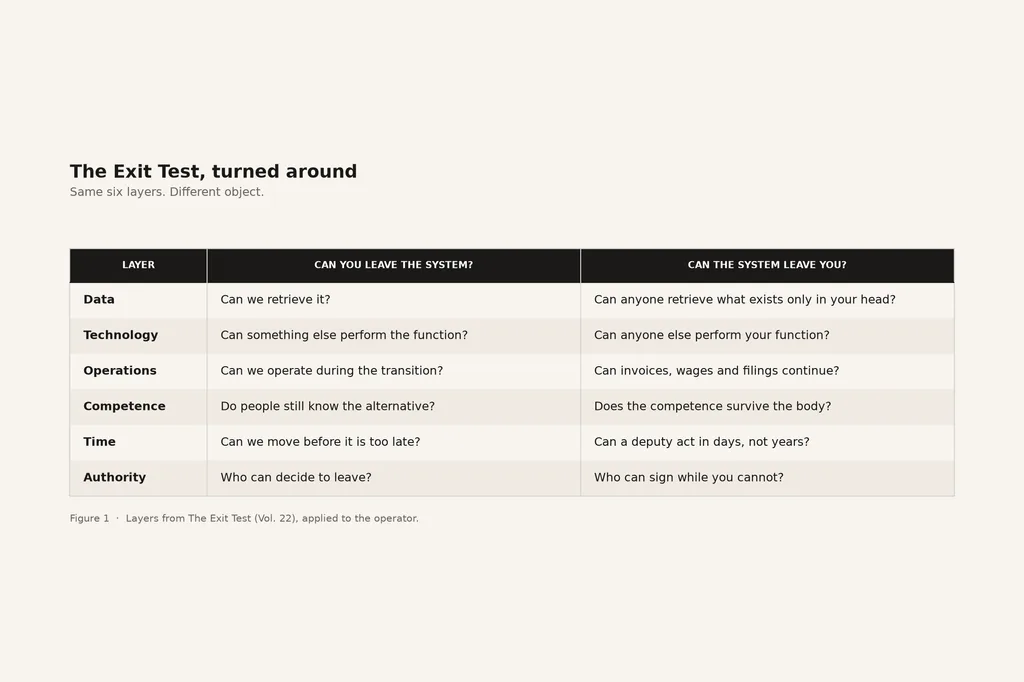
If several answers are no, the organisation may still own the shares, the domain, the mandate, the brand.
It may still be efficient.
It may still look, from the outside, like a going concern.
It has transferred something important.
The ability to continue.
That is the inverse Exit Test.
Not: can I leave the system?
But: can the system leave me?
Human Sovereignty already said the final unit of sovereignty is the person. This volume starts after that sentence. The person is also a body. Bodies fail. They fail suddenly. They fail temporarily. They fail in ways that look, from a calendar, like a short absence and, from a Handelsregister, like a missing organ.
Formal responsibility can outlive effective control. We have said that about vendors. It is also true of a founder in a bed.
The firm that ends with the person
Swiss federal SME guidance is unusually blunt.
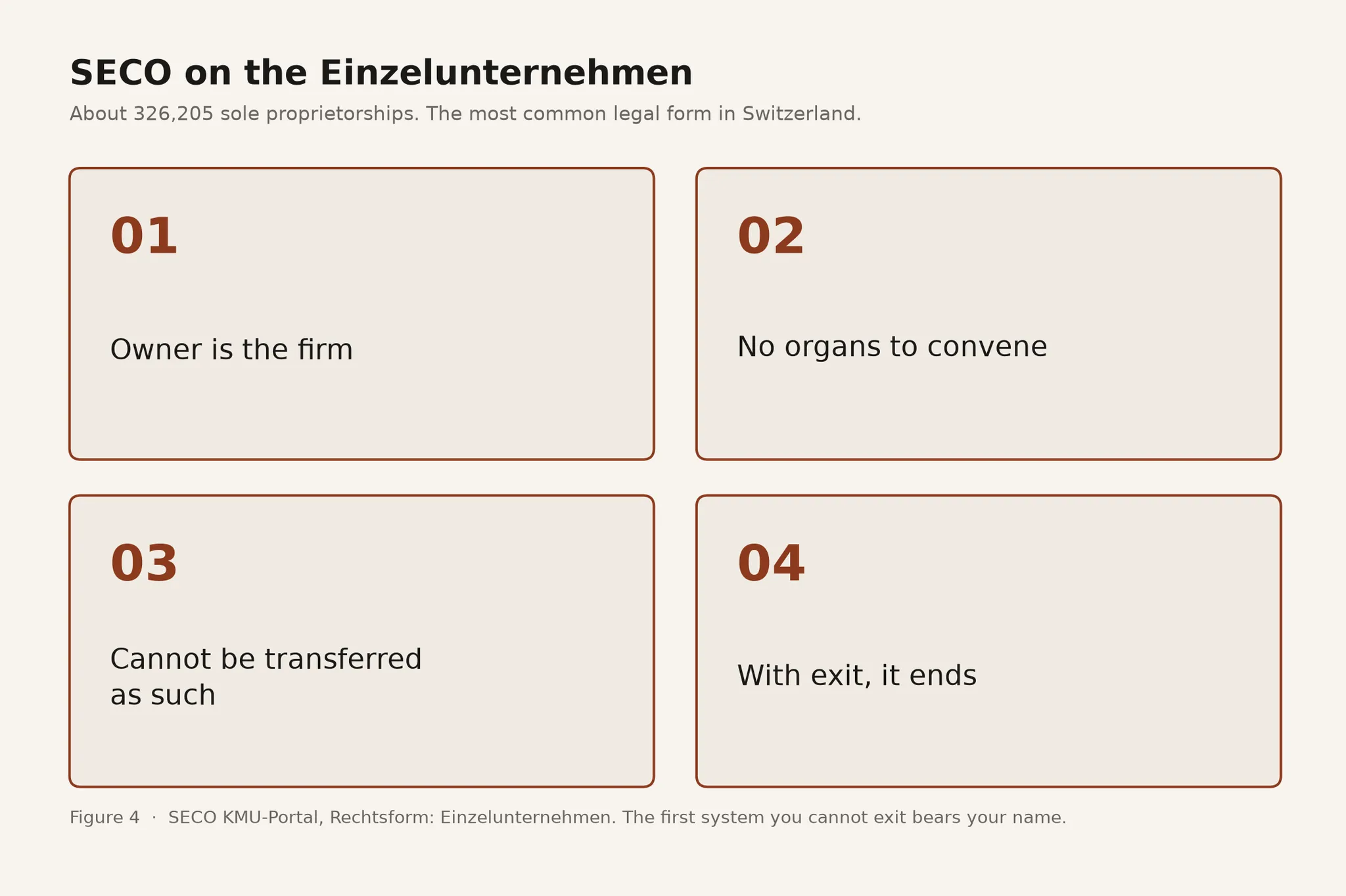
The sole proprietorship, it says, is especially suited to activities closely bound to the owning person. There are no organs to appoint. The owner alone is responsible for management, and may name deputies. Liability is unlimited, including private assets. About 326,205 such firms exist — the most common legal form in the country.
Then the exit paragraph:
An Einzelunternehmen cannot be transferred as such. With succession or an exit, it ends. The successor opens a new sole proprietorship and takes assets and liabilities.
That is not a metaphor.
It is the Confederation telling you that the first system you cannot exit is the one that bears your name.
A one-person company with a registered capital is only slightly less exposed. Practice, not a statute, is what matters on the day: if the sole director and sole shareholder cannot sign, there is no organ that can convene itself. Banks and authorities look at the register. A verbal instruction from a hospital bed is not a signature. A Vorsorgeauftrag or a general power, prepared while the person can still act, is the difference between continuity and paralysis. That is company-law hygiene. It is also the inverse Exit Test applied to authority.
None of this is an argument against the sole trader. Modern work is full of reasonable dependencies. Sovereignty Is Not Self-Sufficiency already refused autarky. The point is narrower.
If the legal form dies when you do — or freezes when you cannot stand — then "I own the firm" is not operational ownership.
It is a title on a form.
The number Swiss succession research already has
In January 2026, UBS and the Center for Family Business at the University of St. Gallen published a survey of 401 Swiss SME owners, taken in September 2025 and weighted to the federal STATENT counts.
Thirty-two per cent plan an ownership transfer within five years — on their extrapolation, something like 168,000 firms by the end of 2030. Seventy-eight per cent of owners founded the firm themselves.
Among those planning a transfer, 76 per cent said the firm's success was strongly bound to the owner or the managing director.
That was the most frequently named risk.
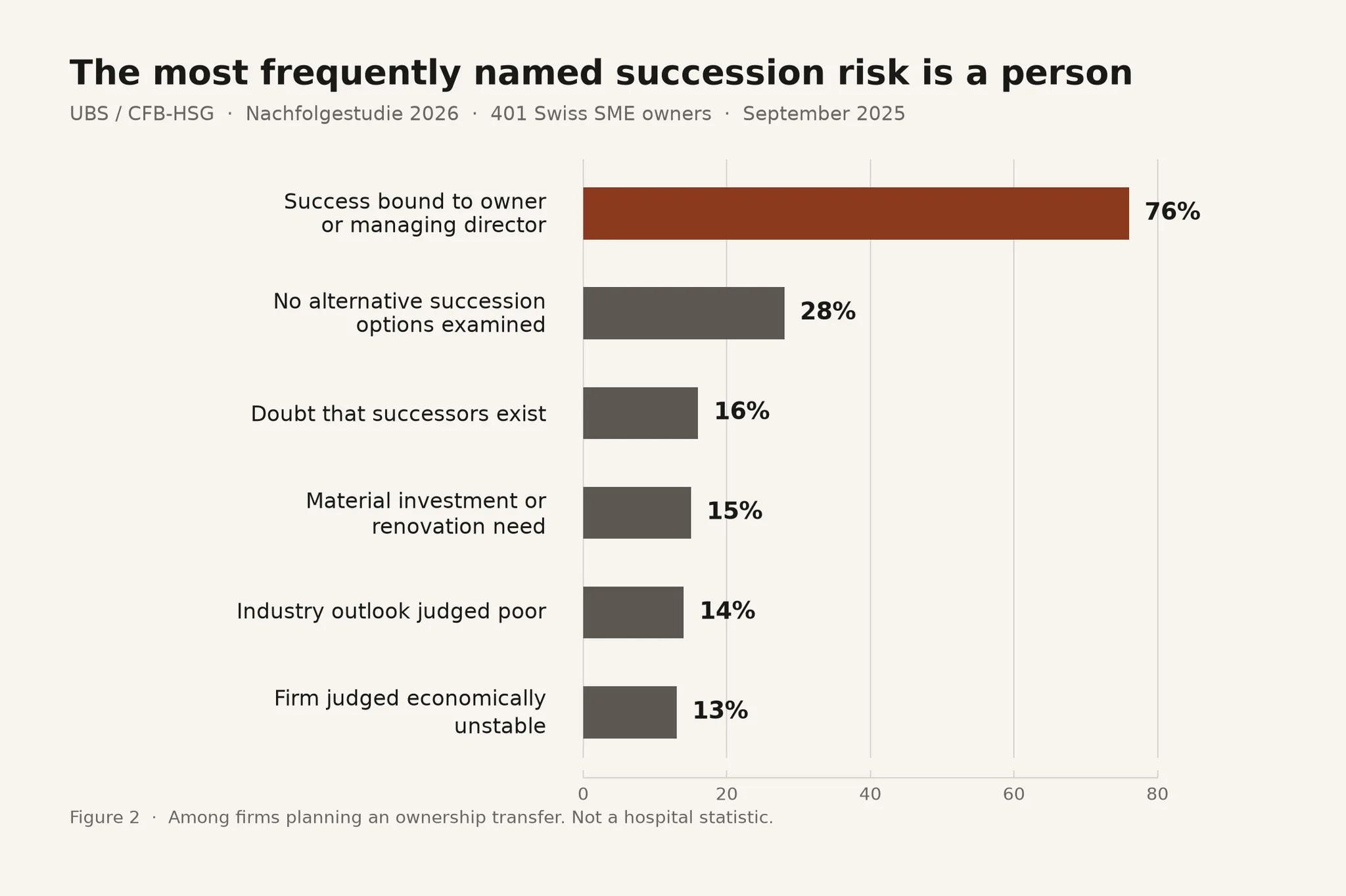
The authors treat it as a reason successors fear the loss of know-how, clients, and leadership. They recommend reducing dependence on key people and documenting processes.
The same study notes, without theatre, that the urgency of succession depends on the age and the health of the owner.
They are writing about planned handover over years.
SECO's own SME portal is no gentler about that clock. Every third Swiss SME, it says, disappears because no successor is found. The transfer process averages 6.6 years.
A collapsed lung is not a succession plan.
Do not collapse the two.
The survey still matters, because it shows what Swiss owners already believe while they can walk: the firm is a person. The hospital does not create that fact. It reveals it.
Basler Kantonalbank's 2025 study of SMEs in Northwestern Switzerland makes the regional version of the same point. Unresolved succession is treated as an economic problem for the region, not a lifestyle choice. Delay raises the risk of liquidation — staff, suppliers, value added. That, too, is planned time. Sudden incapacity is faster than any of those questionnaires.
Preparedness, as Preparedness Is the Highest Form of Sovereignty defined it, is capacity held spare before pressure arrives. A five-to-ten-year succession window is spare capacity. A second signatory is spare capacity. A documented process is spare capacity.
A founder who is the only person who can release pay is not holding capacity spare.
They are the single point of failure, described in polite German as a Schlüsselperson.
The state pays you. It does not replace you.
When a working adult cannot work, Swiss social insurance makes a distinction that founders routinely blur.
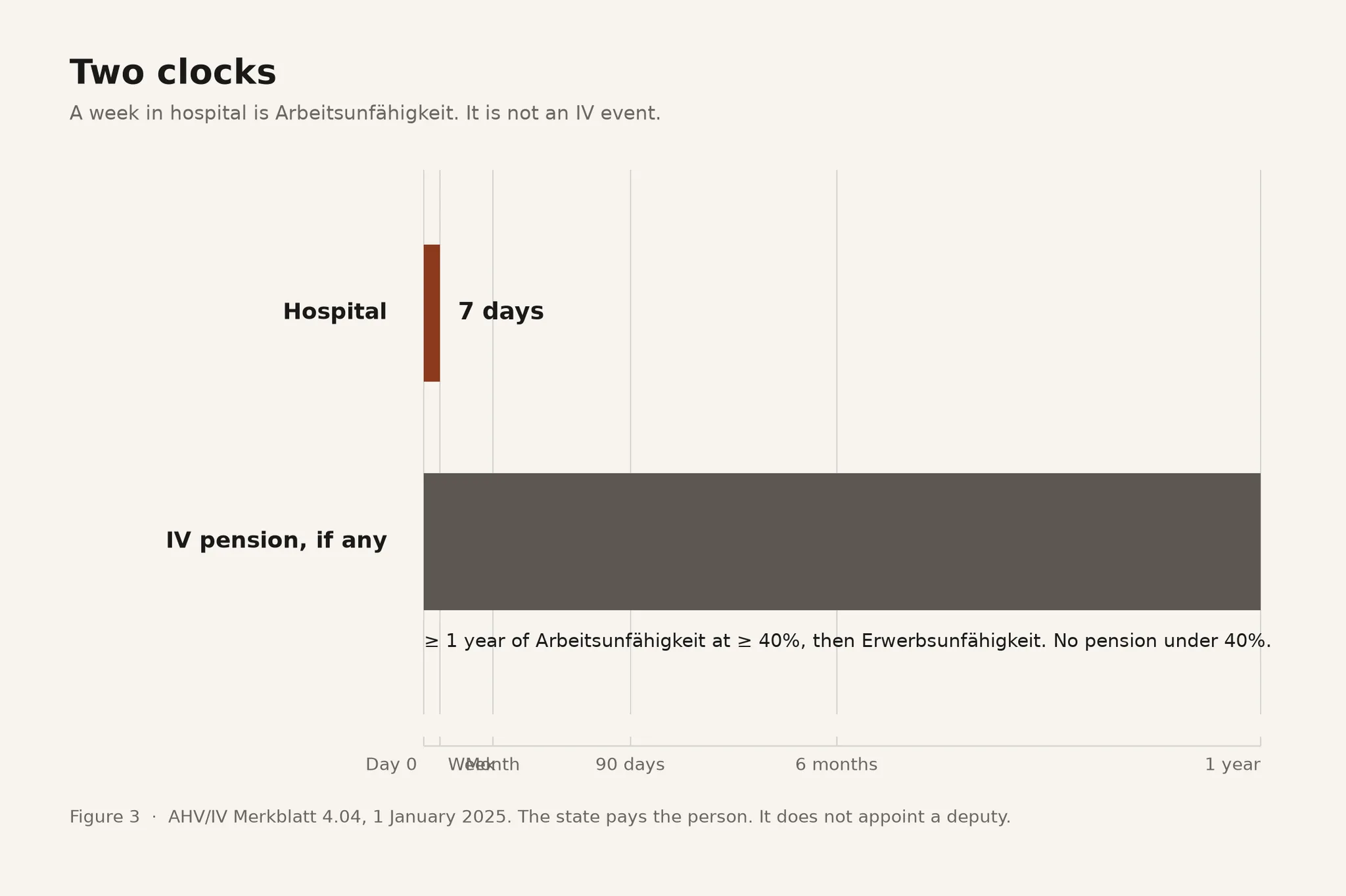
Arbeitsunfähigkeit is the inability to do the previous job or task. A doctor establishes it.
Erwerbsunfähigkeit is the inability to earn on the whole relevant labour market. The IV office establishes it. Only the second counts for the invalidity grade.
An IV pension is paid only if integration measures fail or only partly succeed. The claim begins at the earliest after a one-year waiting period, during which inability to work must average at least 40 per cent, and earning incapacity must then continue at least to that extent. There is no IV pension below 40 per cent. The pension, when it comes, is calculated like an AHV pension: insurance duration and average income. It is money paid to a person.
It is not a deputy.
It is not a second registered signature.
It is not a client who still gets called.
It is not the authority to file, pay, or hire.
The self-employed person, the Federal Social Insurance Office is equally clear, is responsible for their own social protection. Occupational pensions are not obligatory. Accident insurance is not obligatory. Daily sickness benefit is voluntary. There is no unemployment insurance. IV rights are the same as for employees — which means the same residual, personal, slow instrument.
A week in hospital is Arbeitsunfähigkeit.
It is not an IV event.
The invoices do not know the difference.
This is not a complaint about the welfare state. The IV is doing the job it was built for. The mistake is to treat it as operational ownership of a firm. Formal cover can outlive effective control here too.
An insurer will sometimes say, in public, that the loss of a key person is an existential threat to an SME. That sentence can be true and still sit next to a modest product: a premium waiver, a daily benefit if you bought one, a policy that pays the person or trims a cost. It does not create Handlungsfähigkeit. Do not confuse a brochure with a second operator.
What this is not
It is not a wellness instruction.
It is not a medical explainer.
It is not a key-man product to buy.
It is not a second Ebola essay, and not a rewrite of the letter written from the ward.
It is not proof that the founder must become irreplaceable. Irreplaceability is the bug. The SRE line is crude and useful: if a human operator must touch the system during normal operations, you have a bug. A firm that requires one particular body for ordinary Tuesday work has that bug before anyone gets sick.
Human Sovereignty asked whether you could revoke an agent and still function. This volume asks whether the work could lose you and still function.
The answers are different instruments.
One protects authorship from the machine.
The other protects continuity from the author.
Both can fail at once. That is not an argument for panic. It is an argument for not leaving either untested.
Preparedness at the body layer
Capacity held spare, at this layer, is unglamorous.
A second person entered in the register, who has actually signed something this year.
A power that exists before it is needed.
A list of what only you know, written down by you, while you can still write.
A daily benefit you chose, or a reserve that covers the gap the IV will not cover in week two.
A deputy who has operated the alternative — the bank, the inbox, the filing — not merely been told that they could.
An alternative that has never been operated is not yet an alternative. We have said that about clouds. It is true of a spouse, a partner, a trustee, a colleague.
Delegation remains sovereign only when it is bounded and recoverable. A deputy without a bound is a different failure. A deputy who has never acted is an imaginary one.
None of this requires a large organisation. Most Swiss SMEs are micro-firms. The UBS / HSG authors say so. The inverse Exit Test is not a corporate programme. It is the refusal to let ordinary work have a bus factor of one and call that ownership.
Health belongs in that list as infrastructure, not as virtue.
You can recover. I did.
Recovery does not cancel the topology.
The body remains the first dependency. Ageing will test it more slowly than a pneumothorax. An accident will test it faster. Either way the legal form, the register, and the clients will not invent a second operator out of sympathy.
Proof of Human treated the body as a scarce credential: was there a real person there? Liveness is not operability. A person can be real, present, and unable to sign.
The test
Take the work that depends on you.
The firm.
The mandate.
The inbox that is the firm.
The relationship that only you hold.
Then imagine that tomorrow you cannot stand up.
Not die. Not retire. Not hand over in five years.
Just: cannot.
Now ask the six questions.
Can anyone retrieve what matters?
Can anyone else perform the function?
Can the essential processes continue?
Does the competence survive you?
Can a deputy move in time?
Does anyone else have the authority to act?
If the answer to all six is yes, you may still be important.
The dependency remains governable.
If several answers are no, you may still own the firm.
You may still be healthy today.
You may still believe that operational ownership is a character trait.
You have transferred something.
The ability of the work to continue.
Sovereignty does not require you to be replaceable in the sentimental sense.
It requires that your absence, when it comes, has already been treated as a design condition.
We tend to discover that condition in a ward.
We should discover it while we can walk.
You are not sovereign because you own the firm.
You are sovereign when the firm can continue without you.
Sources
- The Exit Test
- Human Sovereignty
- Human Sovereignty in the Age of Machine Intelligence
- Preparedness Is the Highest Form of Sovereignty
- Sovereignty Is Not Self-Sufficiency
- Proof of Human
- Thierry Gilgen, What actually matters. — personal record written from the ward; context for this volume, not the argument.
- State Secretariat for Economic Affairs (SECO), KMU-Portal, Rechtsform: Einzelunternehmen. https://www.kmu.admin.ch/de/rechtsform-einzelunternehmen — sole trader suited to activities bound to the owning person; no organs; owner alone manages; cannot be transferred as such; ends with succession or exit; 326,205 firms.
- State Secretariat for Economic Affairs (SECO), KMU-Portal, Unternehmen: Wie bereitet man die eigene Nachfolge vor?. https://www.kmu.admin.ch/de/unternehmen-wie-bereitet-man-die-eigene-nachfolge-vor — every third Swiss SME disappears because no successor is found; transfer process averages 6.6 years (SECO citing Dun & Bradstreet).
- Pascal Zumbühl (UBS) and Marie Klein (CFB-HSG), Unternehmensnachfolge in der Schweiz: Worum geht es? Nachfolgestudie 2026, January 2026 (editorial close 8 January 2026). Survey of 401 Swiss SME owners, September 2025, weighted to BfS STATENT. https://cfb.unisg.ch/fileadmin/user_upload/HSG_ROOT/Institut_CFB/Forschung/UBS_Nafo_Studie/2026_UBS_Unternehmensnachfolge-Kurzstudie-01_DE-accessible.pdf — 32 per cent plan transfer within five years; ~168,000 firms by end-2030 on their extrapolation; 78 per cent of owners founded the firm themselves; 76 per cent of those planning a transfer say success is strongly bound to owner/MD (most frequently named risk); urgency depends on age and health of the owner. Marketing publication; the survey findings are used, not any product language.
- Basler Kantonalbank, Nachfolgeplanung von KMU in der Nordwestschweiz, 16 October 2025. https://www.bkb.ch/de/die-basler-kantonalbank/medien/medienmitteilungen/2025/bkb-studie-nachfolgeplanung-von-kmu-in-der-nordwestschweiz-viele-unternehmen-brauchen-eine-nachfolge
- Informationsstelle AHV/IV, Invalidenrenten / Merkblatt 4.04, status 1 January 2025. https://www.ahv-iv.ch/de/sozialversicherungen/invalidenversicherung-iv/invalidenrenten — Arbeitsunfähigkeit ≠ Erwerbsunfähigkeit; one-year wait; no pension below 40 per cent invalidity.
- Federal Social Insurance Office (BSV), Was ist bei Selbstständigkeit zu beachten?, 17 July 2025. https://www.bsv.admin.ch/de/selbststaendigkeit — self-employed person is responsible for their own social protection; BVG, accident insurance, and daily sickness benefit are not obligatory; no unemployment insurance.
- Worcestershire Acute Hospitals NHS Trust, Pneumothorax patient leaflet. https://www.worcsacute.nhs.uk/leaflets/pneumothorax-waht-pi-2111/
- British Thoracic Society, Guideline for pleural disease, Thorax 2023;78 (Suppl 3). https://thorax.bmj.com/content/78/Suppl_3/s1
This volume is not legal, medical, or insurance advice.