The question: What does it mean when a Chinese electric hypercar is the first production car independently verified above 500 km/h in a single-direction run? More importantly, what does that record reveal—and fail to reveal—about the distribution of industrial power?
I. One hundred and forty metres in a second
At 503.17 kilometres per hour, a car covers almost 140 metres every second. A football pitch is gone in less than a second. A full kilometre disappears in a little more than seven. There is barely time for a spectator to register what has happened before the machine is hundreds of metres farther away.
On 1 November 2026, on a specially closed section of the E11 highway in Abu Dhabi's Al Dhafra region, German racing driver Marc Basseng took a red electric hypercar past the 500 km/h mark. The highest verified speed was 503.17 km/h, or about 312.65 mph. The car was a Yangwang U9 Xtreme, from the premium marque of China's BYD. The FIA recognised the result. Guinness World Records confirmed two categories for a production car and an electric production car in a single-direction run.123
The number is extraordinary. The manufacturer matters more.
For much of the twentieth century, the highest reaches of automotive performance carried European surnames: Bugatti, Porsche, Ferrari, Mercedes-Benz, Lamborghini, Koenigsegg. Other nations built brilliant cars, of course, and the history is far more complex than a European monopoly. But the language of prestige—the posters on bedroom walls, the race-bred mythology, the engineering confidence—was heavily European.
BYD began in the 1990s manufacturing batteries. It entered the automotive business in 2003. In 2026, a halo vehicle bearing one of its premium brands could travel faster than any production car had previously been verified to travel in a single-direction record attempt.41
That is not proof that every BYD vehicle is superior to every European car. It does not settle whether a Chinese automaker has the best handling, the safest battery, the most durable drivetrain or the strongest brand. It certainly does not settle the economics of selling ordinary cars at a profit.
But a record can do something else. It can puncture an assumption.
If a country has accumulated the capacity to integrate a 3,000-PS electric powertrain, a high-discharge battery, real-time vehicle controls, high-speed tyres and a stable aerodynamic package at this level, what else has the rest of the world failed to notice?
This is a story about a speed record. It is also a story about the industries behind that record—and about the danger of mistaking yesterday's hierarchy for tomorrow's law.
II. The asterisk that makes the record credible
A large number on a speedometer is not, by itself, a world record. High-speed measurements invite legitimate questions. Was the speed independently measured? Was it a production vehicle? Did the car run on a level surface? Was there a tailwind? How much of the machine was a purpose-built prototype? What rulebook defines the category?
In this case, the answer to the first question is unusually clear. Guinness says that the 503.17 km/h figure was checked with a calibrated VBOX measurement system and the vehicle's onboard instrumentation, with FIA review of the data and written confirmation. That is a more serious basis than a viral video or an unverified manufacturer claim.2
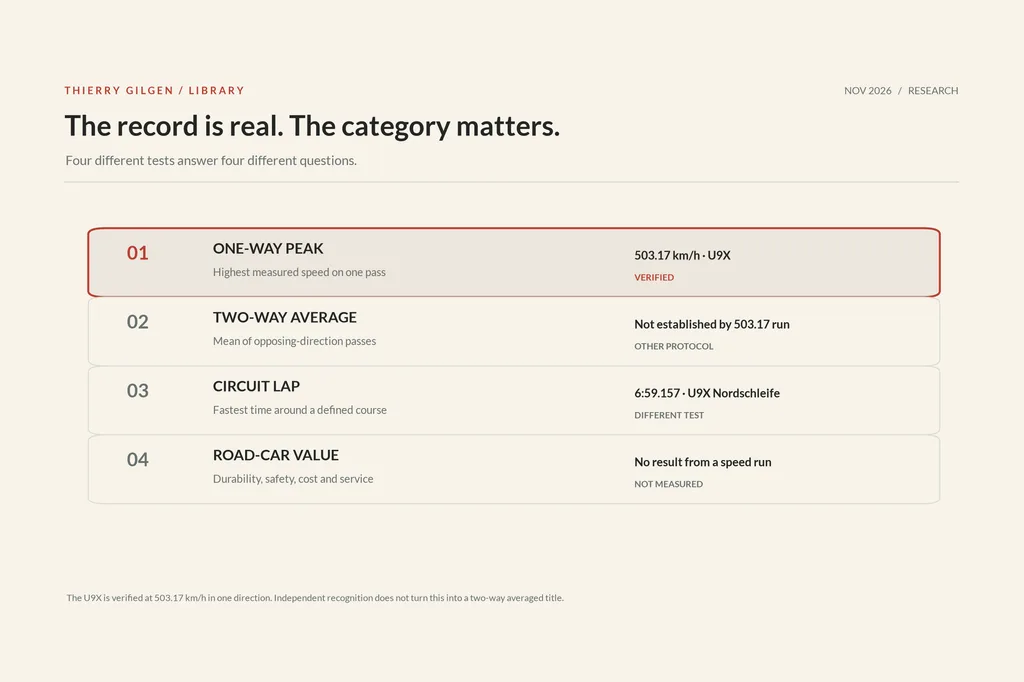
But the record has a specific scope: one direction. A conventional two-way record uses passes in opposite directions and averages the speeds, helping compensate for wind and gradient. The Yangwang's Guinness categories and FIA recognition are real; the result is not interchangeable with a two-way production-car record. The distinction should appear in the headline's supporting copy, the chart labels and the metadata—not just in a footnote.125
There is a second qualification. BYD says the Xtreme is limited to 30 examples, with customers approving bespoke specifications and production scheduling under way. 'Production car' is the certification category used by the record bodies, but this should not be casually interpreted as evidence of a widely delivered, mass-produced consumer vehicle.6
Finally, top speed does not measure the same skill as a lap time, a braking test, 300,000 kilometres of reliability, winter range, or ownership cost. A car that wins at one may lose at another. The correct conclusion is not that the U9 Xtreme is 'the best car in the world'. The correct conclusion is that it achieved a verified, precisely bounded result that others had not yet achieved in that category.
The accuracy of the qualification does not diminish the achievement. It is what allows us to take the achievement seriously.
III. The desert road, not the test oval
The setting matters. This was not a permanently banked German proving ground but a section of public highway temporarily removed from public use. Ten kilometres of road were closed; the longest straight section available for the top-speed runs was seven kilometres. The host authorities coordinated the closure and preparations.13
BYD's account describes the physical work in unusually practical terms: the highway needed to be swept, and the team inspected the surface for wire fragments potentially left by cleaning equipment—small objects that matter enormously when a tyre is rotating at extreme speed. The car completed two runs on 31 October, reaching a maximum of approximately 490 km/h. Overnight, engineers changed rear-wing angle, suspension-control settings and tyre pressures. On 1 November, a further two runs were made. The second yielded 503.17 km/h.6
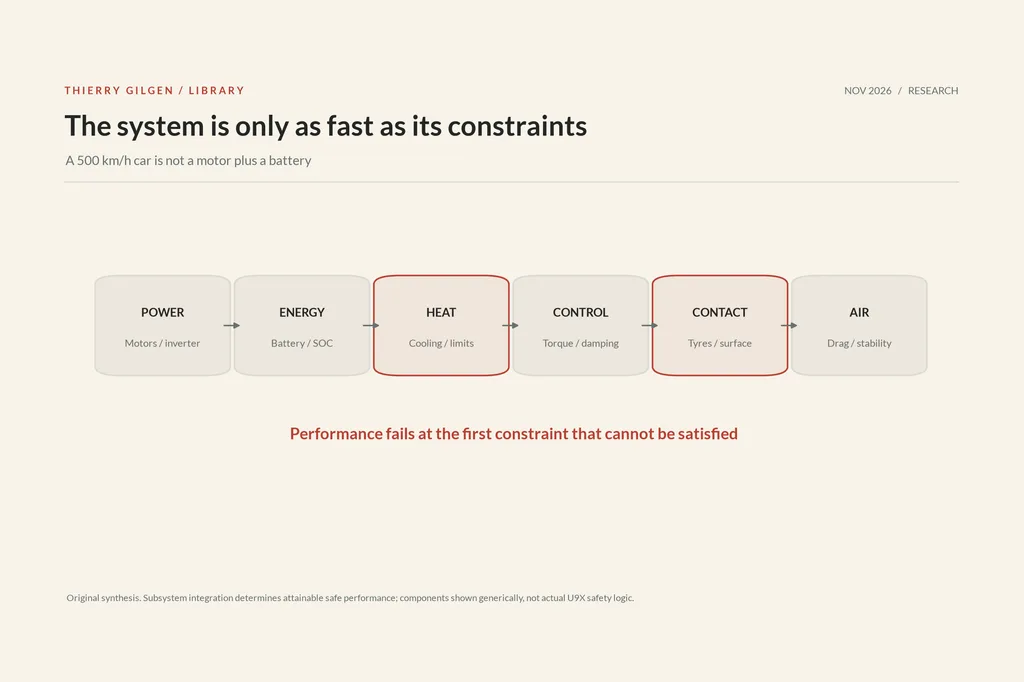
These details are not glamorous, but they reveal an important truth about engineering. The record did not emerge from adding one impressive component. It emerged from integration and iteration. The tyres needed a suitable contact patch. The suspension needed to react to small surface undulations. The aerodynamic configuration needed enough stability without wasting too much energy as drag. Battery and motor temperatures had to be prepared for the narrow operating window of a record run.
The successful machine was therefore not simply 'an electric car with enormous horsepower'. It was a coordinated system with dozens of constraints, several of them invisible to a viewer watching the speedometer climb.
An independent performance publication, evo, points out that the high-speed configuration lacked the conspicuous swan-neck rear wing seen on the Nürburgring car, while BYD describes the record-setting vehicle as the same underlying specification. These statements may reflect a distinction between vehicle specification and aerodynamic setup, but the available public evidence does not settle exactly which hardware was changed. It is another reason not to treat the top-speed and lap-time runs as identical laboratory experiments.67
We should resist making it cinematic by inventing things nobody has reported: there is no need to imagine the driver's thoughts, the sound of the wind inside the cockpit or a dramatic last-minute radio call. The documented sequence is interesting enough.
IV. Physics does not negotiate
At ordinary road speeds, improvements can look incremental. At 500 km/h, the arithmetic becomes unforgiving.
One of the central facts of aerodynamics is that the power needed to push a car through air rises approximately with the cube of its speed, assuming the same aerodynamic properties and air density. Double the speed and aerodynamic power demand rises by a factor of eight. More subtly, increasing speed from 496.22 km/h to 503.17 km/h means only about 1.4% more speed, but roughly 4.3% more aerodynamic power to overcome air resistance, all else equal.
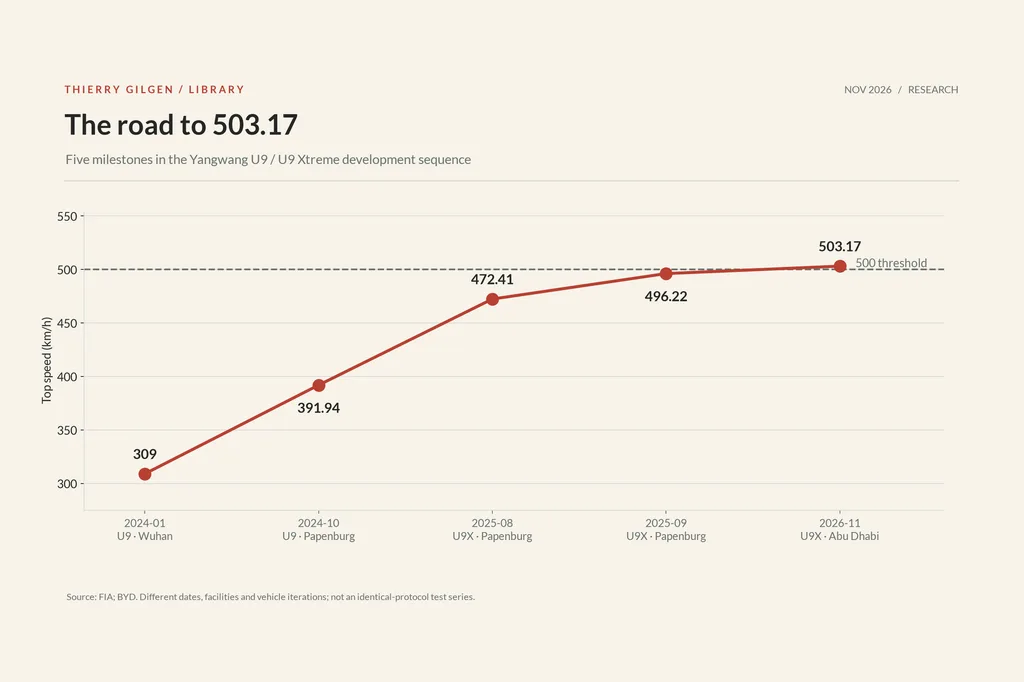
That helps explain why crossing 500 was nontrivial even after the U9 Xtreme reached 496.22 km/h at ATP Papenburg in September 2025. A last few kilometres per hour can demand disproportionate additional power or lower drag, while still preserving stability.18
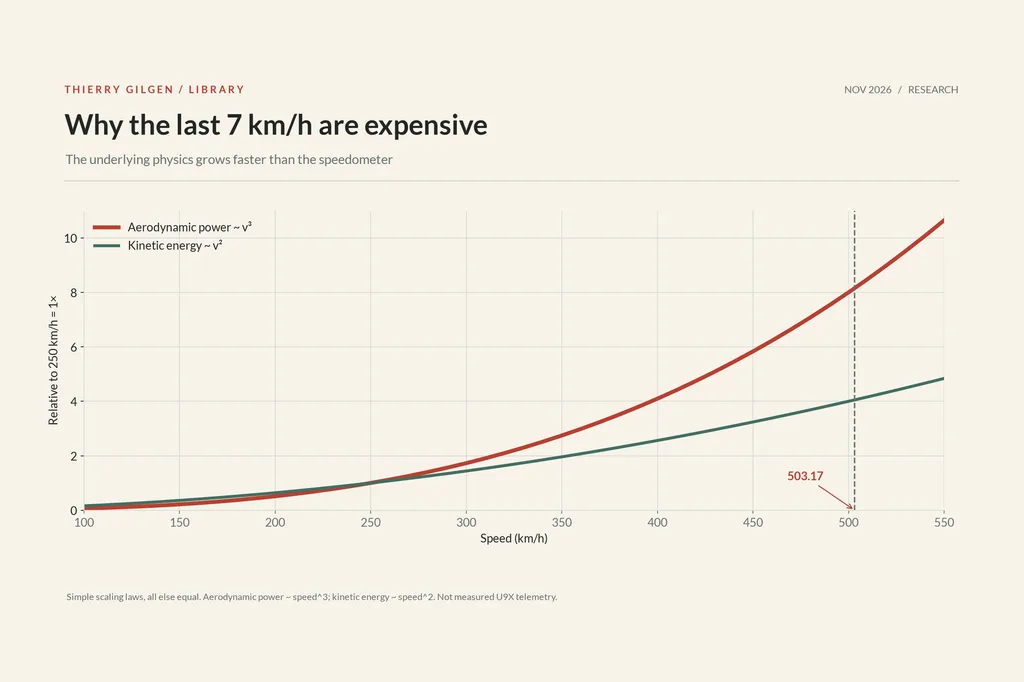
At 503.17 km/h, one tonne of moving mass carries approximately 9.77 megajoules, equal to about 2.71 kilowatt-hours, of kinetic energy. That energy does not simply disappear when the driver brakes. It must be converted, largely into heat, with some potentially recovered through regenerative braking. The higher the speed, the more severe the consequences of any failure or delay.
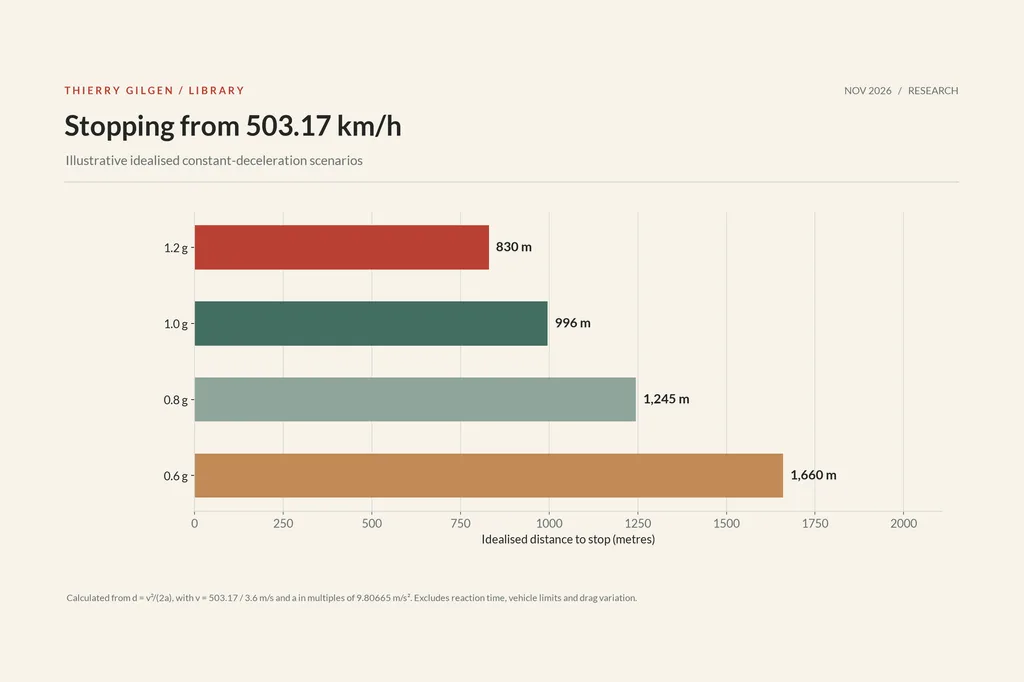
Consider an idealised braking calculation. From 503.17 km/h, a constant deceleration of one standard gravity would require almost a kilometre of road to stop. At 0.8 g, it would require approximately 1.25 kilometres—before adding any reaction time or considering real aerodynamic load, tyre limitations, road surface, vehicle stability or changing deceleration. These are mathematical illustrations, not measured U9 Xtreme braking distances, and they must never be presented as driving guidance.
A tyre has to survive centrifugal stress, heating, deformation, loading and contact with imperfect pavement. An aerodynamic setting that keeps the rear axle planted may produce additional drag. A battery that can supply extraordinary power for a few seconds does not thereby become suitable for an hour at that output. A car that accelerates fiercely may have a completely different challenge maintaining very high speed.
This is why a 500 km/h run is a systems problem, not an advertisement for a single component.
V. Four motors, one machine
BYD says the U9 Xtreme develops approximately 3,019 metric horsepower (PS) from four independent electric motors. Each motor is rated at approximately 755 PS (555 kW), with motor speeds up to 30,000 rpm. The platform operates at 1,200 volts and uses individual torque control at each wheel. The company says its torque-vectoring software adjusts wheel torque more than 100 times per second.6
These figures are manufacturer specifications, not independent laboratory measurements reported by the FIA. They do, however, help explain the engineering architecture behind the record.
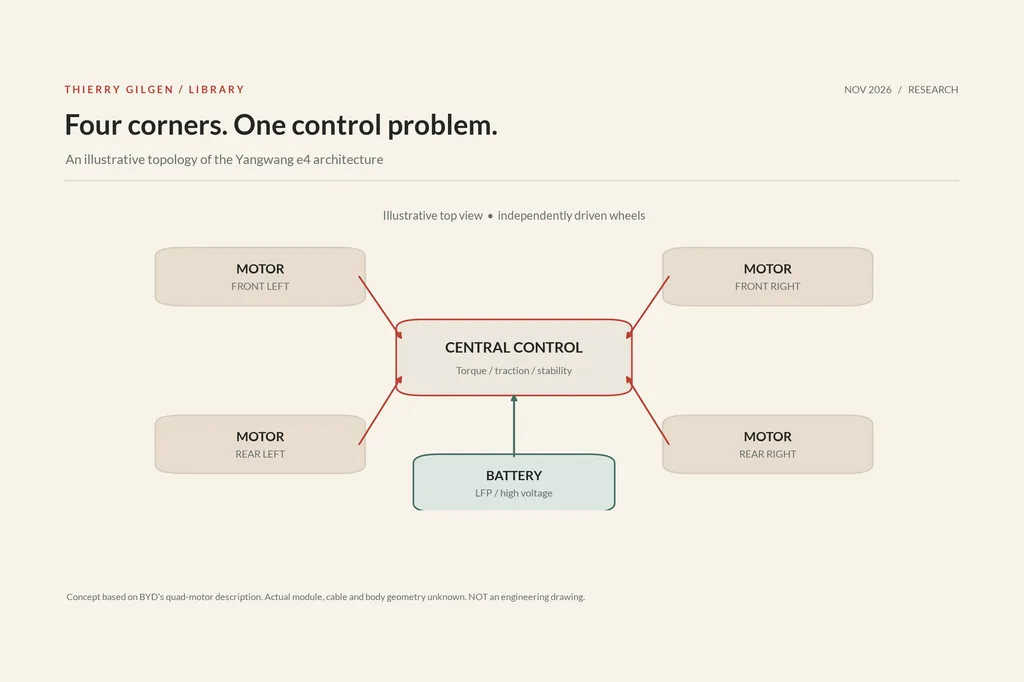
The advantage of an independent motor at each corner is not just total power. In principle, the vehicle can apportion torque with a freedom that a single engine and conventional mechanical differential do not offer in the same way. That freedom also creates a burden: the software must continuously interpret available traction and vehicle motion. An incorrect command becomes a physical event.
BYD calls its independent motor platform e4 and its active body-control system DiSus-X. Its description of the suspension combines electronically controlled dampers with active vertical force control. The manufacturer says the system can alter vehicle posture rapidly, helping manage pitch, roll and the contact patch of each tyre.6
The software in a modern performance vehicle is not a luxury accessory. It participates in the behaviour of the machine itself. A suspension command changes vertical load. A torque command changes longitudinal and yaw forces. A battery control decision changes the power available to the wheels. A thermal limit changes what the driver can demand. Every one of these decisions happens in an environment where time, friction and mechanical materials remain non-negotiable.
That is why one of the most useful ways to read the U9 Xtreme is as a software-defined physical system. The car is neither 'just software' nor 'just hardware'. It is the point at which the two become inseparable.
VI. The battery maker's technical advantage
For electric vehicles, the battery is not merely a fuel tank. It determines how quickly energy can be delivered, how much heat is generated, how rapidly performance degrades under repeated loads, how heavy the vehicle becomes and how the system must be protected.
The U9 Xtreme uses BYD's Blade Battery technology with lithium iron phosphate (LFP) chemistry, adapted to a high-power operating regime. BYD claims discharge rates of 30C, with 1,800 kW still available at 20% state of charge, and more than 700 kW of peak regeneration capability. It also describes specialised cooling and high-voltage power-electronics changes.6
A C-rate is a way of expressing current relative to battery capacity; 30C means, mathematically, a full rated capacity could be transferred in two minutes if an idealised constant discharge were possible. It does not establish that the car will sustain maximum output for two minutes, survive unlimited record runs, or achieve a particular real-world range. Duty cycle, thermal constraints, power electronics and state-of-charge limits matter.
LFP is often associated with lower-cost, longer-lived mass-market battery packs rather than exotic hypercars. Its use here is revealing: BYD is attempting to extend a technology and supply chain in which it has substantial experience into an application at the extreme end of performance. That is a more interesting engineering story than 'LFP wins' or 'NMC loses'. Battery chemistries involve trade-offs, and no single record resolves the full question.
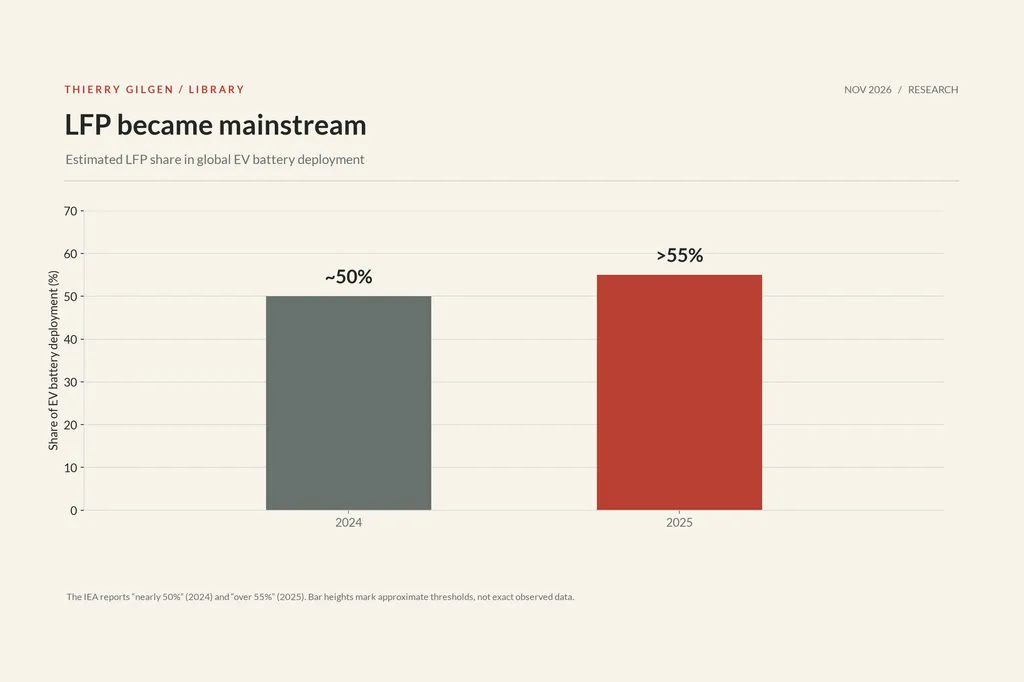
The IEA finds that LFP accounted for over 55% of EV battery deployment globally in 2025, up from nearly half in 2024. It also finds that China dominates LFP materials and production know-how.9
The question is not whether LFP is magically suited to every application. It is what happens when a manufacturer can iterate battery chemistry, packaging, manufacturing, control software and the finished vehicle inside one large industrial group.
VII. A tyre is not a rounding error
The detail that may get the least attention in the viral version of this story is the tyres. They deserve a full section.
At 500 km/h, the tyres are among the final guardians between a highly controlled machine and a loss of control. Mechanical stress, heat, tread deformation, rubber compounds, wheel balance and the interface between tyre and rim become essential. There is no value in a motor capable of more power if the rotating assembly cannot safely transmit the load and survive the run.
BYD collaborated with Giti Tire on special high-performance tyres. It describes a semi-slick construction and a treatment at the tyre-rim interface intended to reduce relative slipping during severe acceleration and braking. The FIA independently reports the collaboration and the use of specialised tyres, though the detailed performance claims remain BYD's.16
The tyre story contains a broader lesson about technological development. Many innovation narratives celebrate the shiny central invention. Real delivery often depends on the 'boring' peripheral systems: seals, bearings, cooling circuits, manufacturing tolerances, power connectors, quality assurance and safety processes.
For an EV, the tyres may be the final constraint. For a semiconductor factory, it may be ultrapure water. For a data centre, it may be a substation. For an AI system, it may be the ability to reliably evaluate and control an autonomous process. In each case, the flagship capability is constrained by the least glamorous part of the system that cannot be wished away.
VIII. The company behind the badge
It is tempting to see the U9 Xtreme as a sudden arrival: China builds a 500 km/h car and the automotive world wakes up. But the event is better understood as the visible tip of a very long industrial investment story.
BYD traces its origins to battery manufacturing in Shenzhen in 1995 and its entrance into the automotive industry to 2003. The company's historical pages are not perfectly consistent about whether the founding date belongs to 1994 or February 1995; the safer formulation is that operations began in 1995 after an earlier corporate inception.410
Its early competence in batteries mattered because the transition to electric powertrains rearranged what an automaker needed to master. A century of engine-building expertise did not vanish. But the relative importance of electrochemistry, power semiconductors, motor efficiency, software controls, thermal integration, and manufacturing yield increased. That shift opened routes for companies whose expertise did not begin in combustion engines.
BYD is also a major manufacturer of ordinary road vehicles, battery systems and electronic components. The U9 Xtreme is a tiny-volume halo product. The distinction is important: a halo car does not pay for its own mythology in the same way as millions of mass-market cars. Its value lies in testing, talent, engineering learning, prestige and the ability to communicate technical ambition.
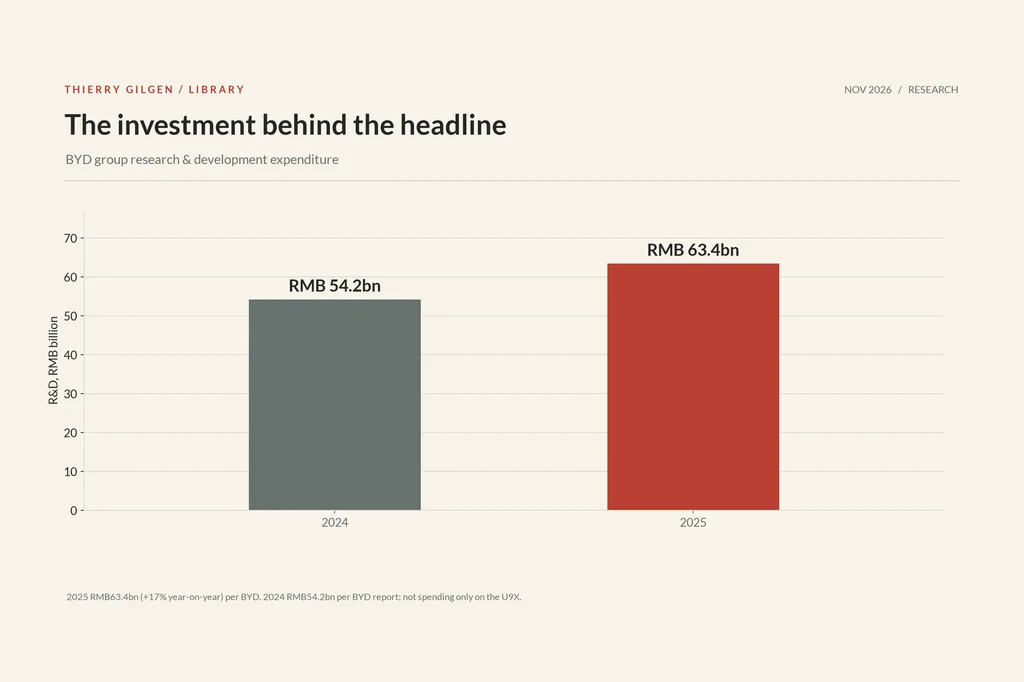
According to BYD's corporate disclosures, research and development spending reached RMB 63.4 billion in 2025, up about 17% year on year. A number this large is neither proof of good allocation nor proof that a specific supercar programme delivered a financial return. But it is evidence of a substantial and sustained engineering organisation.11
A European company contemplating the U9 Xtreme should not ask only, 'Could we build such a car?' For several European engineering organisations, the answer is clearly yes. The more troubling question is whether rivals can develop and scale the supporting supply chain as rapidly, and at what cost.
IX. The factory behind the performance
The 500 km/h record is an extreme-tail event. The industrial statistics are about the centre of the market—and they are even more revealing.
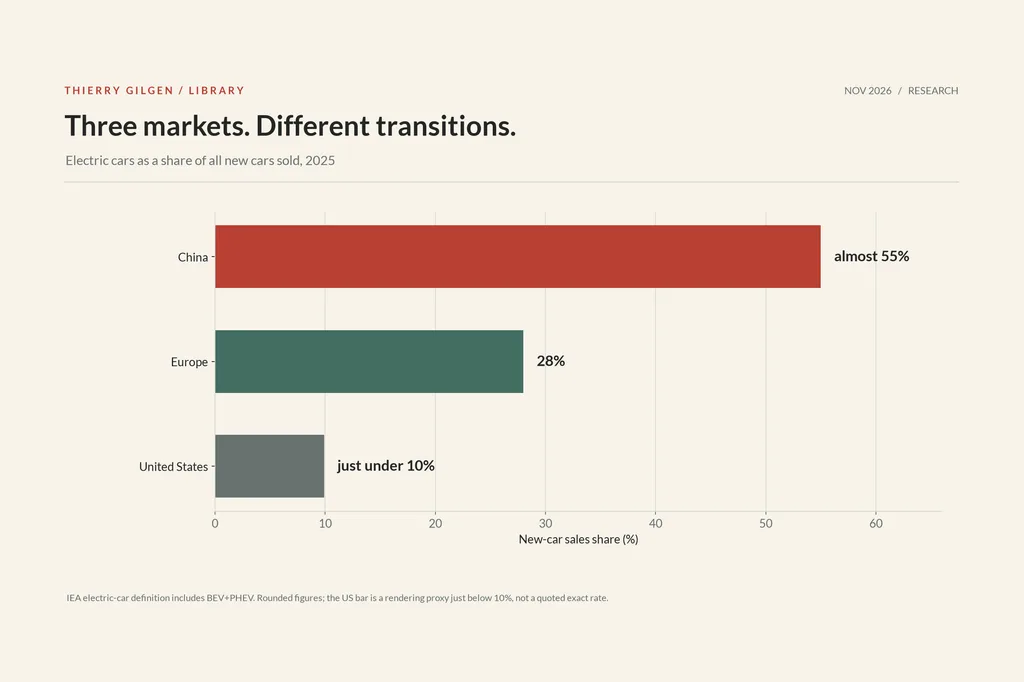
The IEA estimates that more than 20 million electric cars were sold worldwide in 2025, about one in four new cars. China represented more than 13 million of those sales, with plug-in vehicles approaching 55% of China's new-car market. Europe recorded around 4.2 million EV sales, equal to 28% of new cars; the United States sold around 1.5 million, at just under 10% of new cars.1213
An important definition: the IEA's 'electric cars' category includes battery-electric vehicles and plug-in hybrids. It is not the same as BEVs alone, and not the same as China's broader NEV category in every national data set. About 65% of global electric-car sales in 2025 were battery-electric; the remainder were plug-in hybrids and related plug-in types.12
Those numbers reflect not just technology but a market that is already operating on different assumptions. In China, nearly 700 electric-car models were available by the end of 2025, according to the IEA, more than the available conventional-car models there. Competition is intense, price-sensitive and fast-moving. That can accelerate learning. It can also destroy margins and encourage bad incentives.12
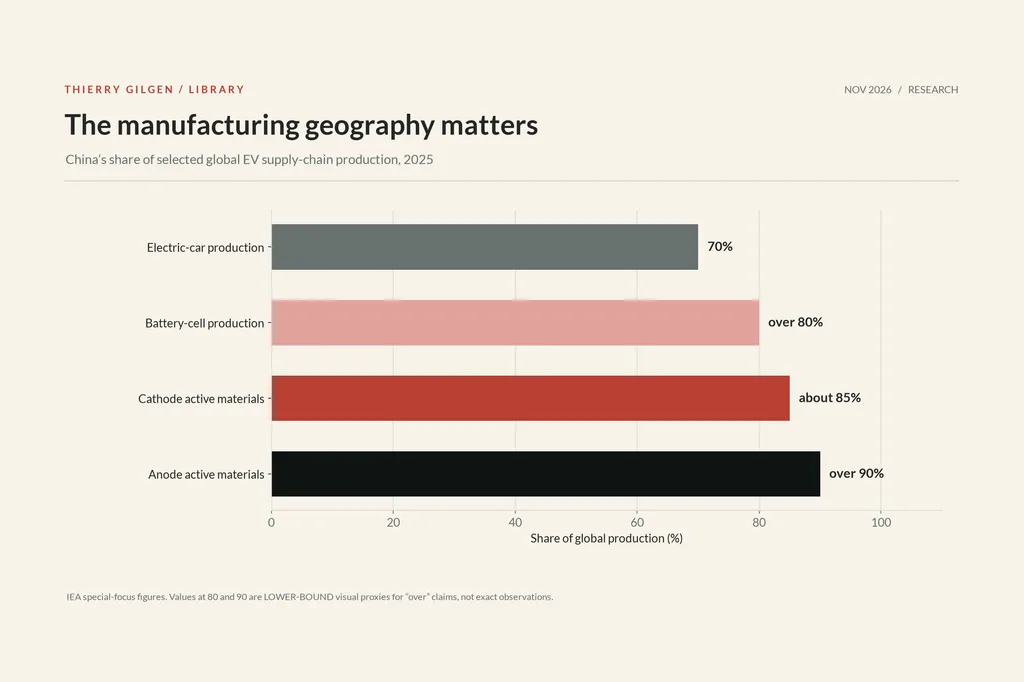
The manufacturing picture is more concentrated still. In one 2025 supply-chain breakdown, the IEA attributes about 70% of global electric-car production to China, over 80% of battery-cell production, approximately 85% of cathode active materials, and over 90% of anode active materials. Another manufacturing overview describes China as producing nearly three-quarters of global electric cars—reflecting different aggregation and rounding choices in the report. The safe interpretation is overwhelming concentration, not a false precision of 73.141%.1415
One of the most powerful misconceptions in international industrial debate is to confuse a factory's address with a brand's passport. Some Chinese-made vehicles are manufactured by non-Chinese firms. Some Chinese-branded cars are increasingly assembled outside China. Some European brands depend on battery materials, components, or technology made elsewhere. The economic geography of a product cannot be read entirely from the company logo on its bonnet.
The supply chain also explains why 'just build a European battery factory' is an incomplete answer. A factory needs skilled staff, reliable upstream materials, manufacturing yields, components, energy, equipment, logistics, and customers. The IEA notes that new plants can take years to approach nominal capacity and that producing saleable cells at high yields is a major competitive challenge.9
X. The price of a battery is the price of a learning curve
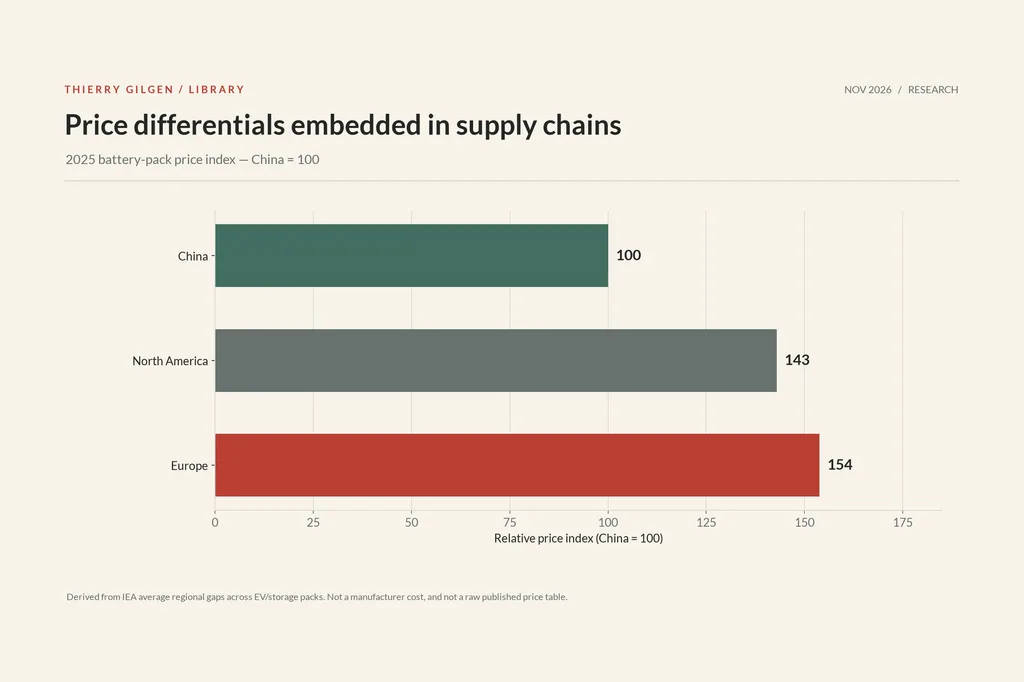
The IEA reports that average battery-pack prices in China were 35% lower than in Europe in 2025 and 30% lower than in North America, with these comparisons spanning EV and stationary-storage packs. A price comparison is not a full cost-accounting statement. But it helps explain why localising a factory does not instantly reproduce a whole ecosystem's economics.9
How did such cost advantages emerge? There is no respectable single-factor answer. Experience matters. Scale matters. Policy support matters. Competition matters. Access to suppliers and machinery matters. Factory yields and automation matter. Component makers willing—or forced—to operate on thin margins matter.
The IEA reports that some battery material producers, including producers in China, have suffered sustained losses. Cheapness at one stage of the supply chain may be supported by economic pressure at another. It would be simplistic to interpret a low battery price as a pure engineering victory, just as it would be simplistic to attribute the entire difference to subsidy.9
The environmental and social costs of resource extraction, refining and production also belong in an honest account. We should not romanticise any industrial model simply because it produces impressive outcomes. A high-quality engineering comparison asks what the system delivers, what it costs, who carries the risk and what is sustainable over time.
XI. Subsidies are part of the story, but not the whole story
A common response to China's automotive progress is that it is artificial: the state pays, the factories overproduce, and export prices do not reflect fair competition. There are factual reasons this argument persists.
The Center for Strategic and International Studies estimated USD 230.9 billion in cumulative Chinese government support for the EV sector between 2009 and 2023. That is a modelled estimate, not an audit of one manufacturer and not a price tag for the U9 Xtreme. It includes calculations of tax exemptions and rebates, R&D support, procurement and other measures, using assumptions documented by CSIS.16
The IEA describes domestic price competition, thin margins and 2025 exports of more than 2.5 million electric cars from China. It also cautions that exports exceeded overseas sales by more than 25% in 2025, implying inventory build-up, while trade policies in 2026 posed further obstacles. A separate concern involves so-called zero-mileage cars, whose reported status may distort parts of the domestic sales picture.141512
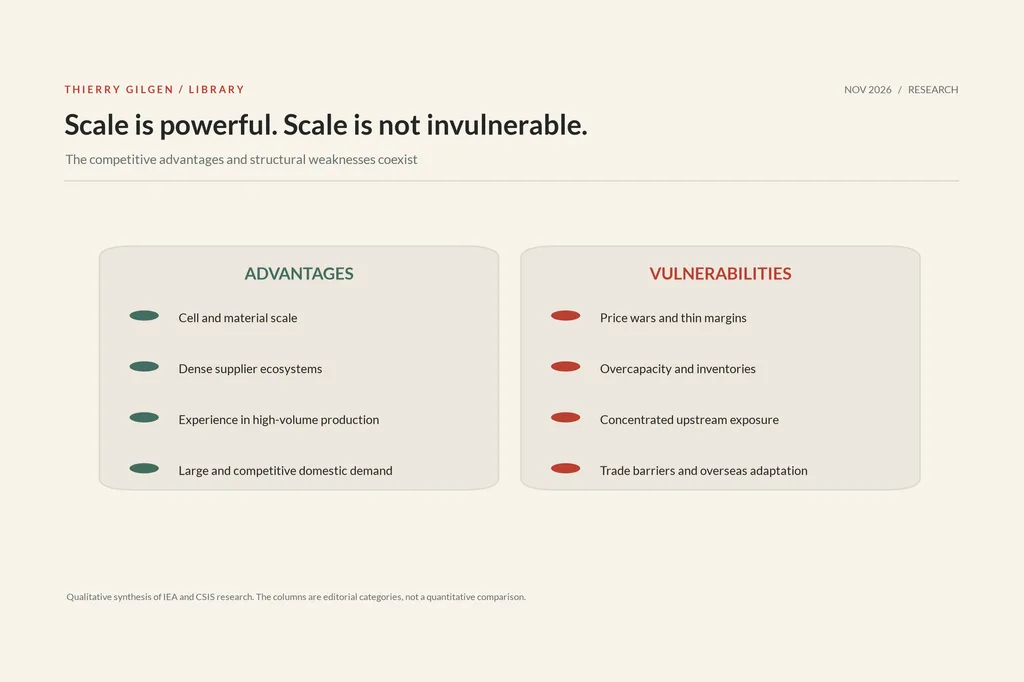
It is entirely legitimate for trade partners to investigate unfair support, negotiate reciprocity, and defend against distortions. It is equally legitimate to ask whether tariffs alone develop a competitive battery supply chain, a better manufacturing process or an affordable electric car.
There is an uncomfortable symmetry here. Governments in Europe, the United States and elsewhere also support strategic industries through grants, tax credits, public research, procurement, infrastructure, protection or regulation. The forms and scale differ and should not be equated without evidence. But the binary 'free market versus subsidised China' is a poor description of the global auto industry.
The serious question is not whether public policy exists. It is which combination of investment, competition, research, market access and accountability produces sustainable capability.
XII. Europe is not a defeated engineering culture
A sensational version of this story would declare that China has beaten Europe. It would get clicks, but it would also be wrong.
Europe remains home to formidable automotive engineering capabilities, valuable intellectual property, manufacturing expertise, performance brands, safety engineering, premium vehicle design, and advanced industrial equipment. A 500 km/h record does not erase any of these strengths. Nor does it show that Chinese manufacturers have solved quality, profitability, overseas distribution and the entire battery supply chain's environmental impact.
Take the Nürburgring Nordschleife. The U9 Xtreme recorded a remarkable 6:59.157, officially classified among electric super sports cars. But a Porsche Taycan Turbo GT with Manthey Kit recorded 6:55.533 in the executive-car category, faster in absolute time. A Xiaomi SU7 Ultra with Track Package recorded 7:04.957 in that category, while the Rimac Nevera has 7:05.298 in electric super sports. Different classes, tyre setups, track conditions and dates make them useful examples, not a scientific ranking of manufacturers.1718
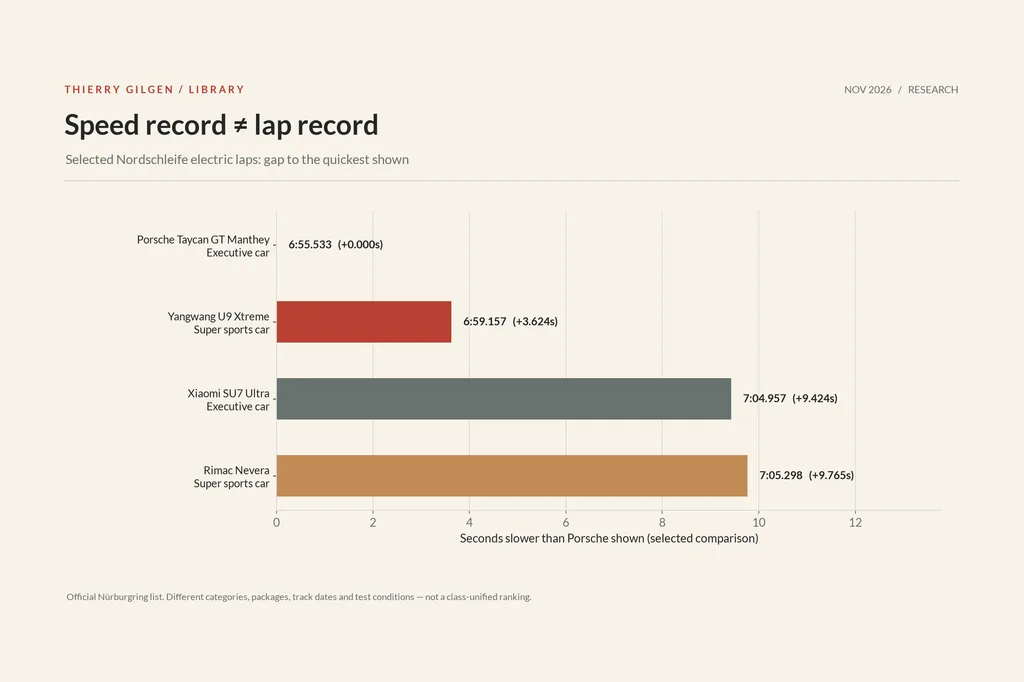
This is the point. Industrial competition is not a single podium. It is a field of capabilities in which different players can lead at the same time.
The European automotive industry is also economically significant: the ACEA industry association estimates more than 13 million direct and indirect jobs across manufacturing, transport, services and related activities. These are not all assembly-line jobs, and they cannot be assumed to be equally at risk. But the scale explains why industrial policy debates carry immense economic and political weight.19
It is possible to admire a Chinese engineering achievement, respect European competitors and demand strong industrial policy without treating any of those positions as contradictory.
XIII. A tariff is not a battery factory
The European Union has imposed definitive countervailing duties on Chinese-origin battery-electric passenger vehicles. Under the EU's consolidated regulation available at the research cutoff, the additional duty rate assigned to the BYD Group is 17.0%, versus 18.8% for Geely, 35.3% for SAIC, and 7.8% for Tesla Shanghai. These are countervailing duty components under the specific EU legal scheme, not a universal 'tax on every Chinese car' and not Swiss tariff rates.20
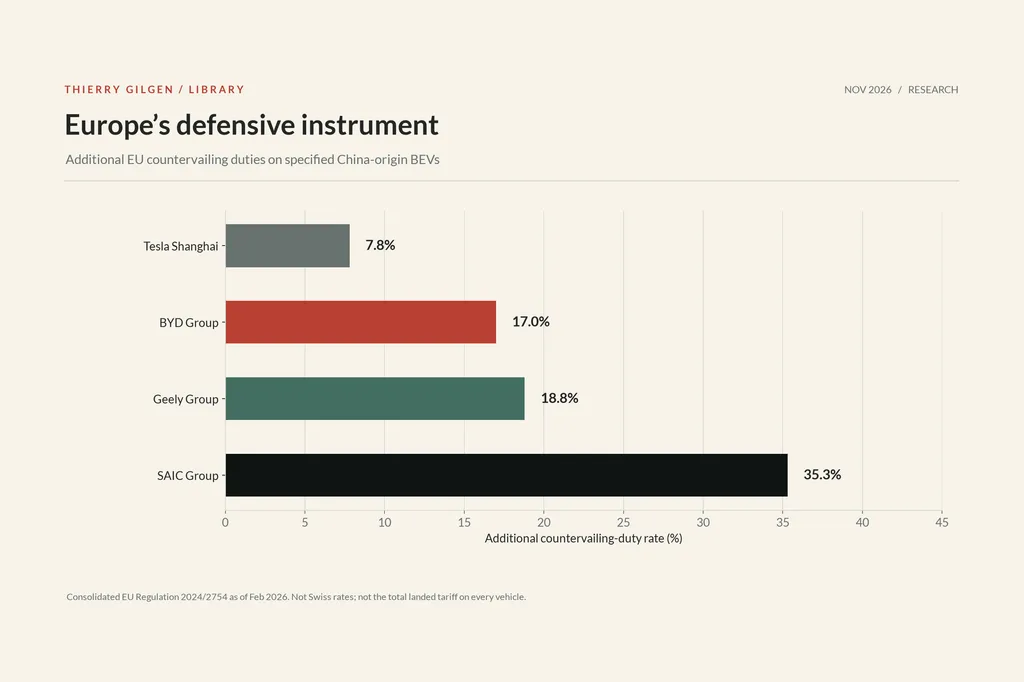
The regulation addresses alleged distortions in a traded market. Its objectives are understandable. Yet a tariff cannot, by itself, produce a new industrial ecosystem. It can create time, change incentives and alter relative prices. Whether that time is used productively depends on investment decisions, research capabilities, workforce development and competitive pressure.
There is a practical European strategic problem. A manufacturer can protect a market and still lose engineering depth if it lets battery materials, advanced controls, production know-how and supplier capabilities mature elsewhere. A country can retain the corporate headquarters and brand while importing more of the economically important technology. Conversely, partnerships and international trade can strengthen local capability if knowledge and manufacturing practice actually transfer.
This should matter to Europeans who care about technological sovereignty. Ownership of a logo is not the same as control of the production system. Control of the production system is not the same as autarky. And sovereignty built only on excluding competition may be less resilient than sovereignty built on the ability to compete.
There are no easy answers. Localisation can be costly. Consumer affordability matters. Jobs matter. Trade retaliation matters. The wrong policies can increase prices without improving European productivity. But the alternative—assuming legacy reputation will keep winning—does not constitute a strategy.
XIV. The environmental argument deserves its own denominator
It is easy to describe the U9 Xtreme as a zero-emissions speed record. That is true in a narrow tailpipe sense: there is no combustion exhaust from the vehicle during the run. It is not an adequate life-cycle claim.
Batteries require raw materials, processing, manufacturing energy and transport. Cars require tyres, brakes, steel, aluminium, electronics, roads and electricity generation. High-speed driving consumes much more energy per kilometre than efficient everyday operation. It would be plainly absurd to use a 503 km/h hypercar attempt as a model for ordinary transport efficiency.
For context, the International Council on Clean Transportation's 2025 life-cycle analysis estimated 63 g CO₂e per kilometre for a representative medium-size battery-electric car sold in the EU and operated using an assumed EU electricity mix over 2025–2044, versus 235 g CO₂e/km for a representative gasoline car. That was about 73% less over the modelled life cycle. But those numbers apply to average passenger-car scenarios, not to the U9 Xtreme or its top-speed attempt.21
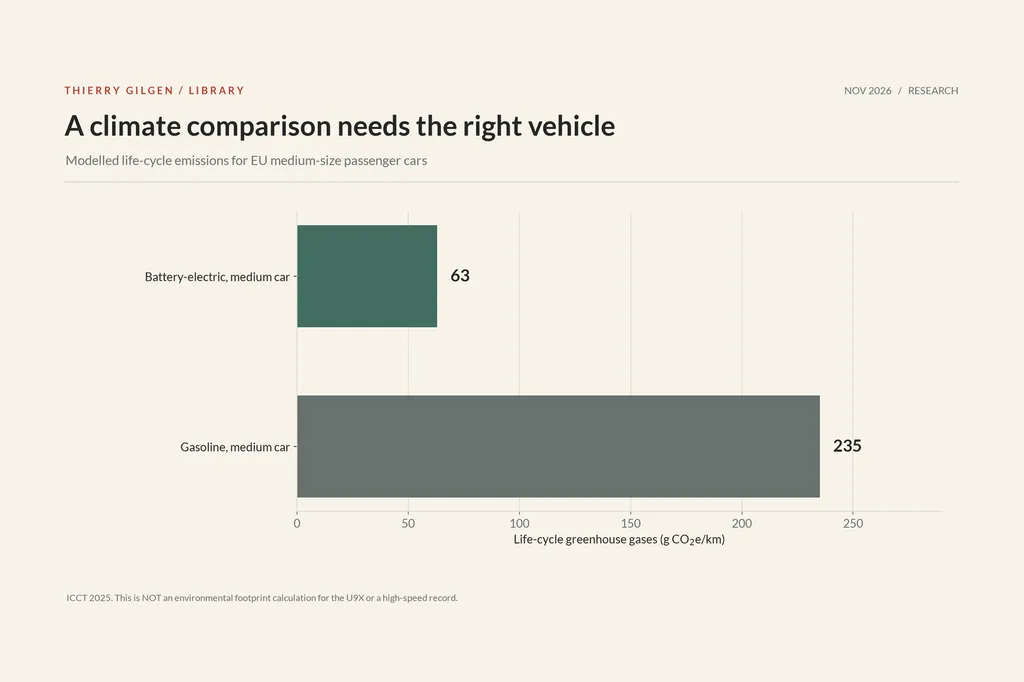
A better argument for electrification must be built on deployment patterns, life-cycle evidence, grid emissions, infrastructure, access and total system cost. The hypercar record is proof that an electric drivetrain can achieve a particular extraordinary speed. It is not a complete environmental verdict.
The same discipline should apply when evaluating battery manufacturing. The IEA's concentration figures are a competitiveness signal, and also a resilience warning. Manufacturing power brings the opportunity to improve methods and reduce costs. It also concentrates upstream exposure, environmental responsibility and geopolitical risk.
XV. Six things the 503.17 km/h record does not prove
It does not prove that electric cars are universally faster. Different measures of acceleration, top speed, braking, lap time, endurance and repeated performance yield different winners. The record is explicitly one-directional.2
It does not prove that Chinese cars are uniformly better built. One halo product cannot substitute for safety, durability, reliability, service and customer evidence across millions of cars.
It does not prove that China's industrial policy is costless. Subsidies, overcapacity, thin margins and concentrated supply chains have costs and vulnerabilities that demand examination.14916
It does not prove that Europe cannot respond. Porsche's verified electric lap performance, together with the expertise of European suppliers and manufacturers, is evidence against a simplistic 'engineering decline' story.1718
It does not prove that a niche vehicle is a mass-market business. The U9 Xtreme's planned run of 30 makes it a technological flagship, not a direct measure of affordable consumer transport.6
It does not prove the long-run climate result of one powertrain. Life-cycle analysis and actual usage are the proper tools for that question.21
Keeping these boundaries is not an exercise in caution for its own sake. It is what stops a compelling factual observation from becoming an ideological story.
XVI. So what should Europe actually learn?
The easy lesson is 'build faster cars'. It is also the least useful.
The U9 Xtreme suggests five questions industrial leaders should ask, whether their field is automotive, robotics, electronics, software or energy.
First: Where is our deep competence? BYD's origins in batteries gave it expertise that became more valuable as the industry's architecture changed. Every established company should understand which capabilities it owns that will remain important when the product changes—and which historical advantages may weaken.
Second: How quickly do we learn? The car's speed increased through a sequence of development milestones, reaching 503.17 km/h only after iterative improvements to systems that had already performed at an extraordinary level. An organisation's ability to test, understand, revise and repeat can matter more than the launch-day specification.16
Third: What is our bottleneck? An impressive motor without tyres, cooling or control software is not a 500 km/h car. A competitive battery-cell factory without a materials ecosystem is not an independent supply chain. A promising AI model without infrastructure and evaluation is not a reliable business system.
Fourth: What does it cost to reproduce our advantage? Manufacturing experience is embodied in operators, suppliers, equipment, yields, logistics and tacit knowledge. It cannot always be purchased on the same timescale as a machine.9
Fifth: Are we measuring the right thing? Speed is a fascinating, narrow result. Consumer value also depends on price, reliability, access, service, safety, charging, maintenance and resale. Industrial strength depends on the ability to deliver those outcomes repeatedly without destroying profitability or externalising unacceptable costs.
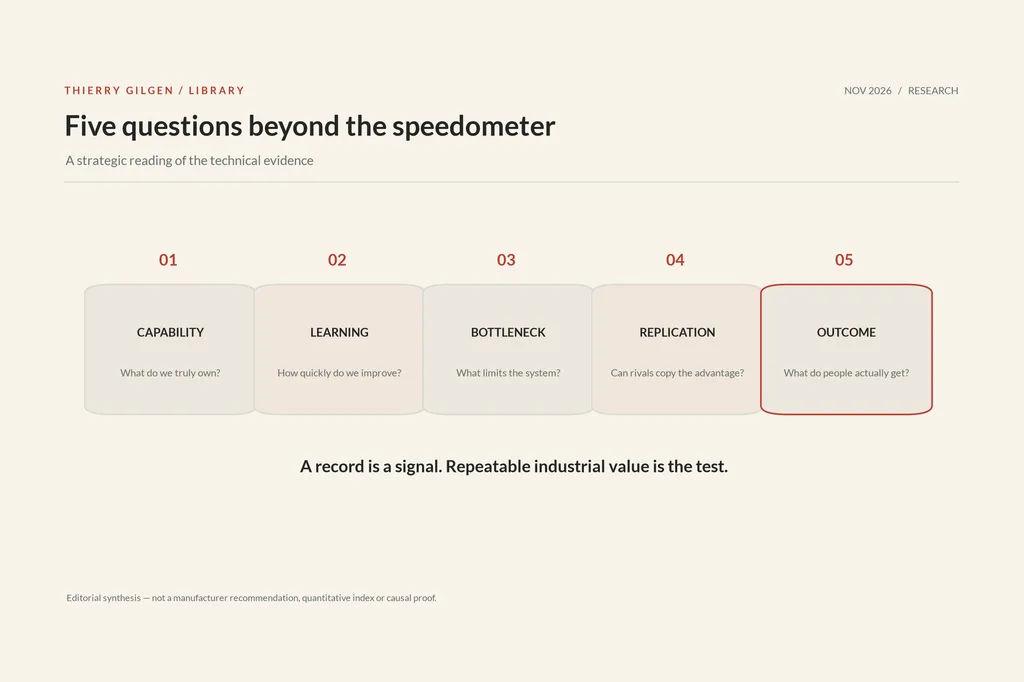
The record offers an answer to none of those five questions by itself. It makes them harder to avoid.
XVII. The next record may have no speedometer
A 500 km/h run is irresistible as a public spectacle because humans immediately understand the number. We can imagine distance, movement and risk. A more efficient battery manufacturing process, a higher cell yield, a better motor controller or a superior automated inspection system is much harder to visualise.
And yet those unglamorous advances may prove more consequential.
A supercar is a signal. A globally competitive production system is a capability. A society that confuses the two can both overreact to a record and underestimate the industrial transformation that made the record possible.
Nor is the future preordained. Chinese manufacturers face overcapacity, commercial pressure, quality and brand challenges, access restrictions and a volatile global economy. European manufacturers possess deep strengths and can adapt. Rivals from Korea, Japan, the United States and elsewhere also influence the pace of progress. A durable account should allow for all of these paths, rather than announce an inevitable national winner.
The better question is how industrial advantage is created and sustained. Can a society train engineers and technicians? Can it support patient capital without protecting failure indefinitely? Can it build competitive supplier networks? Can it turn research into repeatable production? Can it preserve openness to collaboration while retaining critical capability? Can it measure success in outcomes rather than slogans?
The U9 Xtreme answers one narrow question with remarkable clarity: on 1 November 2026, a Chinese battery maker's automotive division, through its Yangwang marque, produced a machine that the FIA and Guinness recognised at 503.17 km/h in a single-direction run.12
Everything else is an argument we still need to earn.
And perhaps that is the most valuable part of this story. Europe did not lose its engineering talent on that desert road. China did not acquire its industrial capabilities on that day. The road merely gave the world a visible number for a transformation that had been happening in factories, laboratories, supplier networks and domestic markets for many years.
The surprise is not that China broke 500. The surprise is how many people still find it surprising.
Reader's evidence note
Fact: The FIA and Guinness recognise 503.17 km/h for the U9 Xtreme on 1 November 2026 in a single-direction production-car run.12
Manufacturer specification: Figures such as 3,019 PS, 30,000 rpm motor speeds, 30C battery discharge and high-frequency control are reported by BYD. They were not independently validated as part of this research.6
Independent analytical context: EV market shares and battery supply-chain figures come chiefly from the IEA's Global EV Outlook 2026. Its definition of electric cars includes plug-in hybrids.12149
Calculated illustrations: Drag scaling, stopping distances, kinetic energy and the indexed regional battery-price comparison are author calculations with disclosed assumptions; they are not Yangwang vehicle telemetry.
Interpretation: The argument about industrial power is an interpretation of multiple sources, not an FIA or Guinness finding.
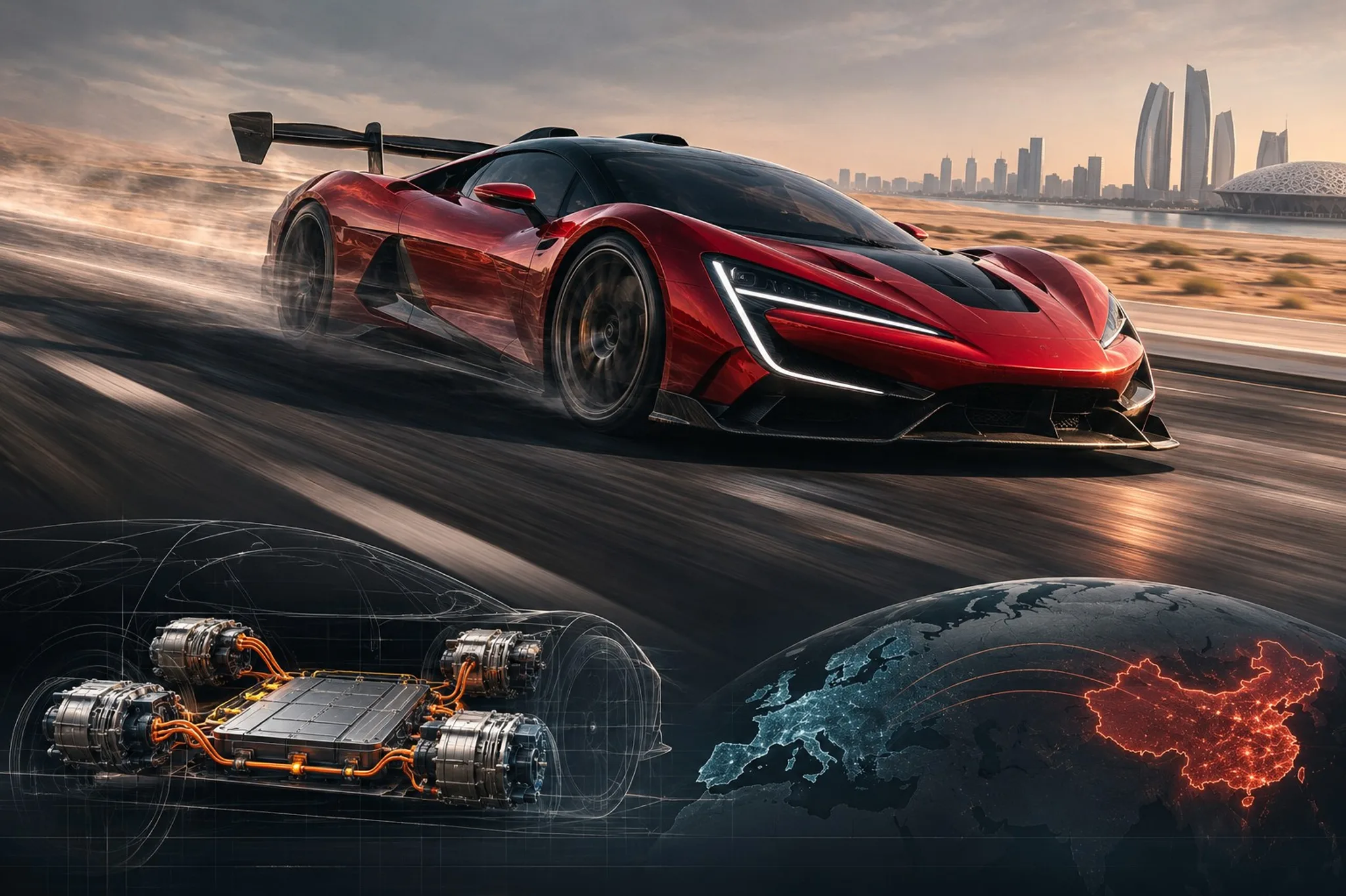
Photo notice: The cover is an AI-generated illustration, not a photograph of the car or road. Other original diagrams are marked as illustrative. U9 and U9 Xtreme are different specifications; they must not be depicted interchangeably as documentary evidence.
Corrections policy: This volume is based on information verified by 7 November 2026. A subsequent record, revised regulation or corrected dataset should lead to an annotated revision, not a silent rewrite.
Sources
Footnotes
-
FIA (2026-11-06): YANGWANG U9 Xtreme surpasses 500 km/h with speed achievement recognised by the FIA. api.fia.com ↩ ↩2 ↩3 ↩4 ↩5 ↩6 ↩7 ↩8 ↩9
-
Guinness World Records (2026-11): Highest speed achieved by an electric production car in a single-direction run. www.guinnessworldrecords.com ↩ ↩2 ↩3 ↩4 ↩5 ↩6
-
Abu Dhabi Media Office (2026-11-06): Abu Dhabi marks automotive milestone as Yangwang U9 Xtreme reaches 503.17 km/h. www.mediaoffice.abudhabi ↩ ↩2
-
BYD Europe (2022-12-29): Hello! We are BYD! Company timeline. www.byd.com ↩ ↩2
-
AutoScout24 Switzerland (2026-11-06): Yangwang U9 Extreme reaches 503.17 km/h. news.autoscout24.ch ↩
-
BYD Global (2026-11-06): The fastest gets faster: YANGWANG U9 Xtreme tops 500 km/h. www.byd.com ↩ ↩2 ↩3 ↩4 ↩5 ↩6 ↩7 ↩8 ↩9 ↩10
-
evo / Ethan Jupp (2026-11-06): Yangwang’s U9X breaks the 500km/h barrier, but SSC’s record still stands. www.evo.co.uk ↩
-
BYD (2025-09-22): Yangwang U9 Xtreme is the world’s fastest production car at 496.22 km/h. www.byd.com ↩
-
International Energy Agency (2026-05-20): Global EV Outlook 2026: Electric vehicle batteries. www.iea.org ↩ ↩2 ↩3 ↩4 ↩5 ↩6 ↩7
-
BYD UK Media Site (2026-11 access): About BYD (historical milestones). www.bydukmedia.com ↩
-
BYD Corporate Media (2026-08): BYD Ranks 91st in 2026 Fortune Global 500. media.byd.com ↩
-
International Energy Agency (2026-05-20): Global EV Outlook 2026: Trends in electric cars. www.iea.org ↩ ↩2 ↩3 ↩4 ↩5
-
IEA (2026): Global Energy Review 2026: Technology EVs. www.iea.org ↩
-
International Energy Agency (2026-05-20): Global EV Outlook 2026: Manufacturing and trade. www.iea.org ↩ ↩2 ↩3 ↩4
-
International Energy Agency (2026-05-20): Global EV Outlook 2026: Executive summary. www.iea.org ↩ ↩2
-
Center for Strategic & International Studies (2024): The Chinese EV Dilemma: Subsidized Yet Striking. www.csis.org ↩ ↩2
-
Nürburgring (2026-11 access): Record Drives official directory. nuerburgring.de ↩ ↩2
-
Porsche Newsroom (2026-05-07): Taycan Turbo GT with Manthey Kit record 06:55.533. newsroom.porsche.com ↩ ↩2
-
European Automobile Manufacturers Association (2026-09-24): Employment in the automotive industry. www.acea.auto ↩
-
European Union (2026-02-11): Commission Implementing Regulation (EU) 2024/2754 consolidated 2026. eur-lex.europa.eu ↩
-
International Council on Clean Transportation (2025-07-08): Life-cycle GHG emissions passenger cars EU: 2025 update. theicct.org ↩ ↩2