In August I carried a grey book into the Universitätsbibliothek Basel. Die Gilgen von Rüeggisberg is a privately printed family history from 1969. It holds names, farms, migrations and lives across almost five centuries. Its owners inherited one instruction: keep it intact and keep it up to date. I wrote then that a scan is not a book.1
At that point I was describing what might become possible. A scan could be transcribed. A family tree could be linked to the original pages. A descendant might ask a question in ordinary language and be shown the passage that made the answer credible.
I also knew what I did not want. I did not want a machine that told a convincing family story because it had found a convenient name. That had already happened to me. An assistant once told me, with full confidence, that my grandfather had worked on the family book. The book itself said otherwise. The mistake was plausible. It was still a mistake.
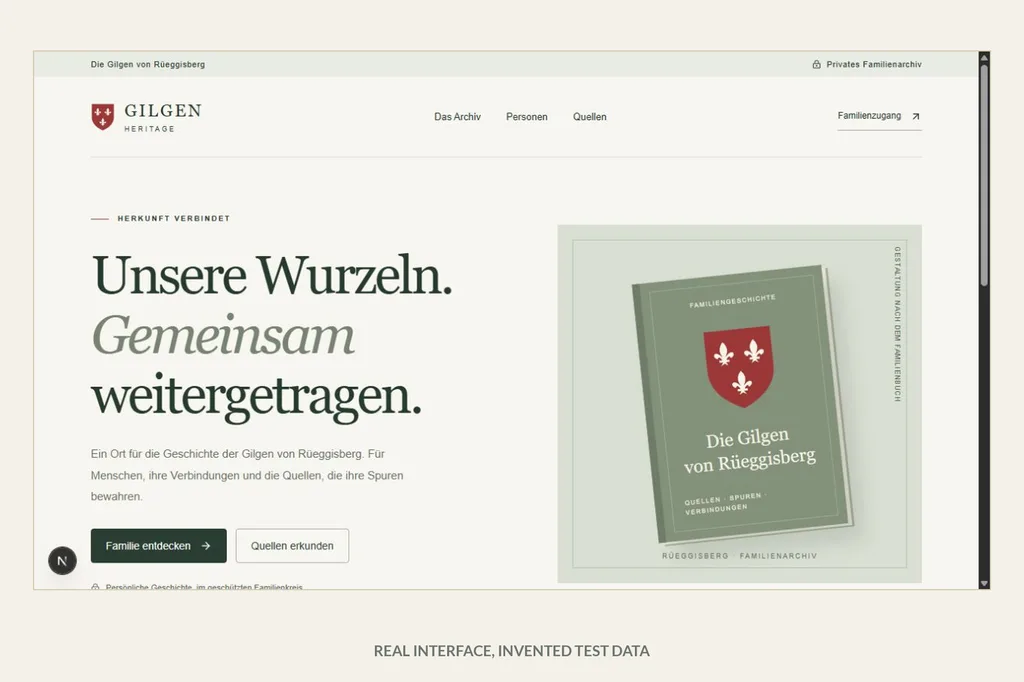
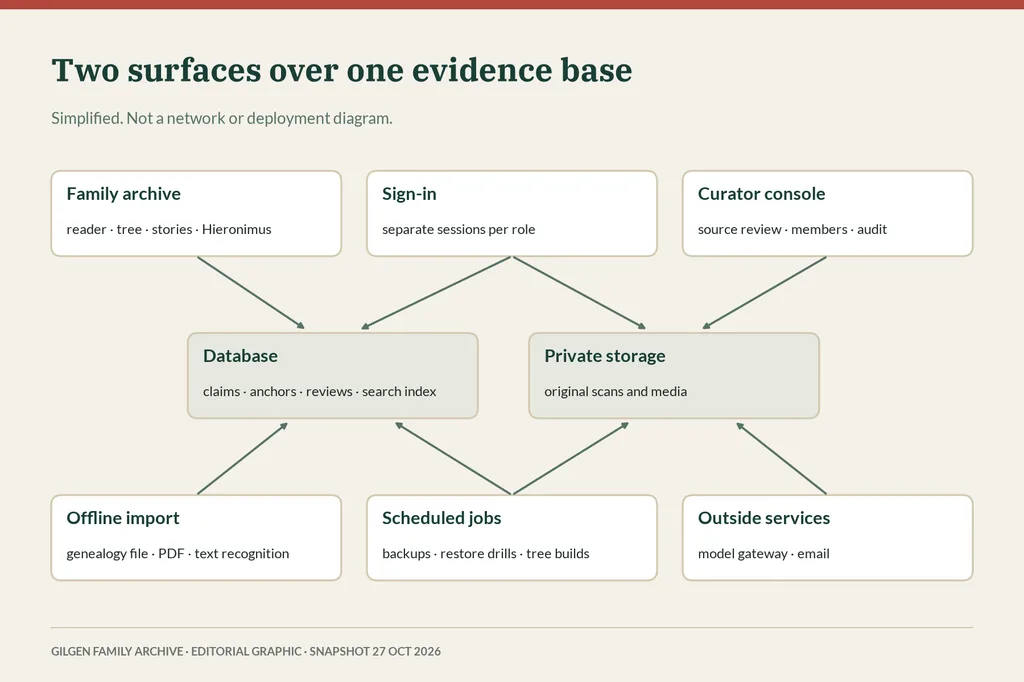
On 21 October 2026, at 17:26, the first line of code for the archive was committed. Less than six days later there was a live, private family archive at familiegilgen.ch. It had a reading room, a tree, maps, stories, members, photographs, invitations, a research assistant and a curator's console.2
The book had become a system.
That sentence needs care. A book does not stop being a book when software begins to describe it. The source is still the source. The software is only the way in.
Six days are not five centuries
It is tempting to tell the first week as a story about speed. There are numbers for that story.
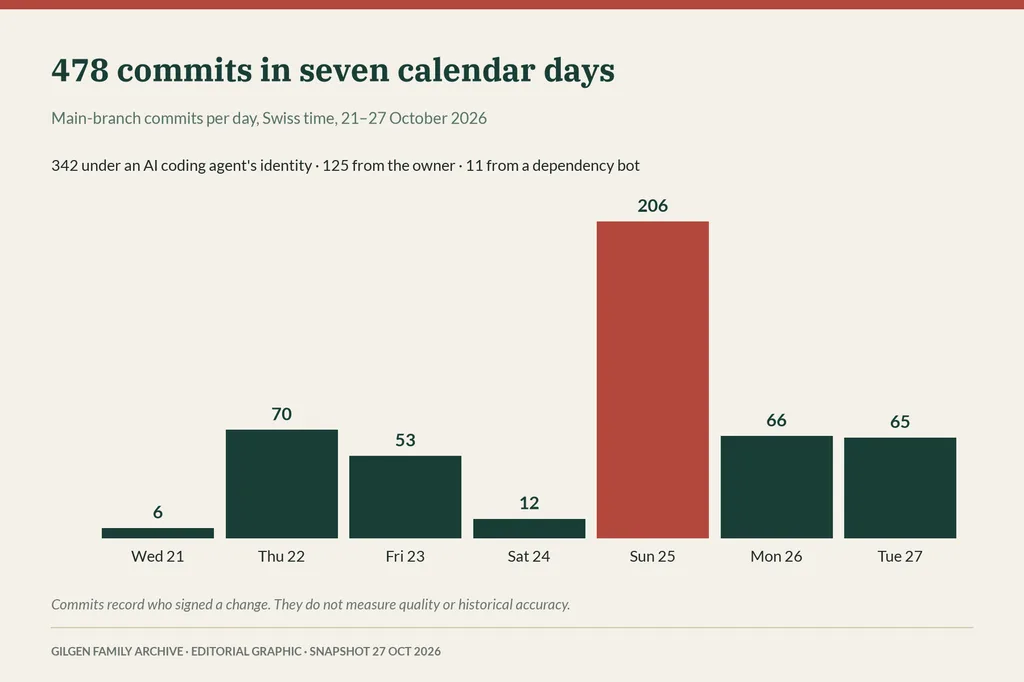
The repository snapshot taken on 27 October 2026 at 16:12 holds 478 commits on the main branch. Of those, 342 carry the author identity of an AI coding agent, 125 come from my own accounts and 11 from an automated dependency bot. There are 122 merged pull requests, 858 tracked files, 64 database migration files that create 87 tables, 85 application routes including 35 console pages, and 10 scheduled server jobs. The code counts about 81,700 lines of TypeScript, and the snapshot lists 410 test cases.2
I am proud of what it took to move that quickly. I am more interested in what those figures cannot say.
A commit is not proof that anything is correct. A test is not an archival source. A table is not a person. A passing pipeline is not permission to publish a living relative's life. And 342 commits under an agent's name do not mean that an agent wrote 72 percent of the archive. They mean exactly what they say: who signed the change.
On 25 October alone, 206 commits landed. On 26 October the production disk was almost full. One relative's registration disappeared somewhere between creating an account and confirming an email address. Two men with the same name still had to be told apart.2
That is the more useful account of the week. Speed made the work possible. It did not make the work go away.
The agents each worked on a bounded task. They proposed changes, fixed what they had broken and handed release decisions to a named owner. I decided about sources, about who may see what, about the direction of the product and about the production system. On 25 October I let the agents merge and release without asking me for every single change. That moved the effort. It did not move the responsibility.
The import that refused to guess
The source files gave the system its first picture of the family: 360 people in a genealogy export, 149 families, 39 family links that pointed nowhere, and only 23 references from a person to a source. The scanned book had 385 pages and no text layer at all.2
An offline text-recognition pass produced 971,318 characters of searchable text. Five pages produced nothing. The importer found 638 possible links between book pages and 116 people. For the other 244 people it found none, and it did not invent any.2
That restraint matters more to me than the size of the result.
A family tree is good at looking finished. A clean line between two names looks like a settled fact. A printed date looks precise even when it came from somebody's memory. Two men called Johannes Gilgen can be merged by a machine that thinks a high matching score is enough. A missing source can disappear under a beautiful interface.
So the first import created questions, not answers.
Every imported statement started life as unverified. Links between a page and a person waited for a human to confirm them. The 39 broken links stayed visible as broken. A new import could not silently overwrite an older one. A name was something to investigate, never a key that allowed the system to merge two lives.2
Even a page has two identities. The page number of the scan and the number printed on the paper are not always the same, because photographic plates interrupt the count. A citation that can be trusted has to carry both.
A file that says something is evidence about the file. On its own it is not proof that the world was that way.
The smallest useful unit is a claim
In the archive a person is an identity to which claims attach. A birth date is a claim. A parent is a claim. A spelling in a register is a claim. Each one keeps its original wording, its uncertainty and an exact anchor in a source: the document, the raw record, the scanned page, the printed page number, the excerpt, sometimes the spot on the page image.2
In the database a claim cannot be saved without at least one anchor. Correcting a claim does not overwrite it; the correction is a second claim beside the first. Imported records and the audit trail can only grow. A review decision needs a human being and a reason.2
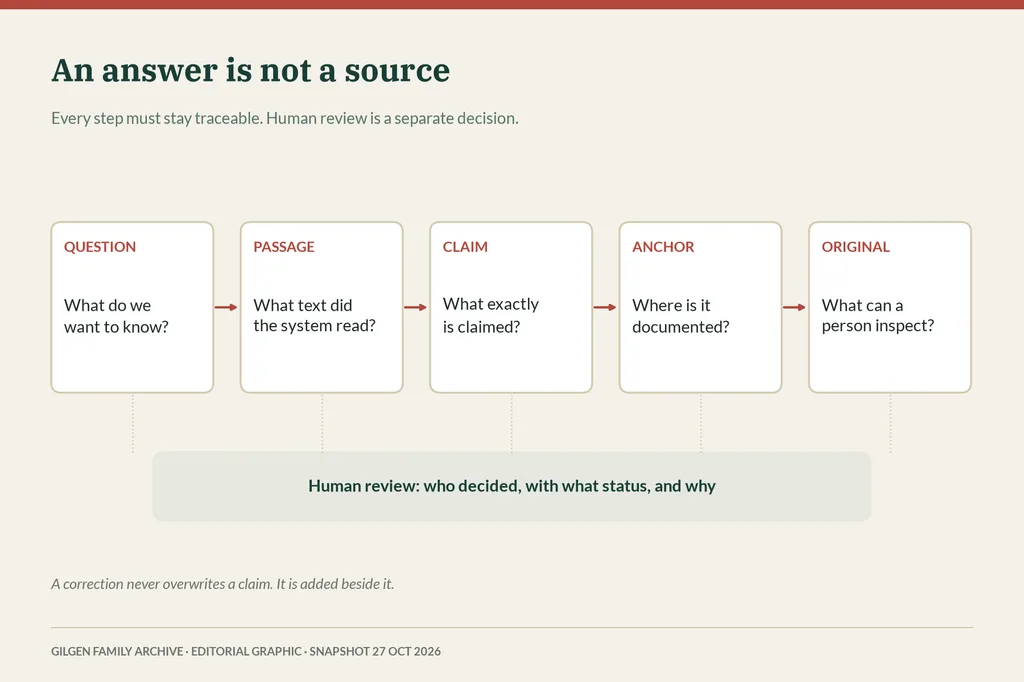
None of this is magic. Somebody with administrator rights can still change a database. A bad source can still contain a bad statement. An anchor in an imported file may prove only that the importer saw it, not that a parish clerk once wrote it down. The project's own documents say as much.
But the rule changes the question we ask. Not which answer should the system keep? but what does each source say, how do the statements relate, and what has a person actually checked?
It leaves room for disagreement. It gives the next custodian somewhere to start. And it stops a pleasant story from quietly replacing an inconvenient original.
A research assistant named after an ancestor
For a short time the chat was called Frag Grossvater, Ask Grandfather. Then I renamed it Hieronimus, after an early ancestor. It is named after him. It is not him.
Its job is not to tell the most fluent story about the Gilgens. Its job is to answer from the parts of the archive the reader is allowed to see, to show where the answer came from, and to admit when a question cannot be answered yet.
Underneath, it is a careful but ordinary search system. Passages from records, book pages and stories go into an index. Search combines meaning with tolerant spelling, which matters for old names, umlauts and a family that never wrote its names quite the same way twice. The assistant can search, open a source and read a person's entry, and it gets five rounds to do so.2
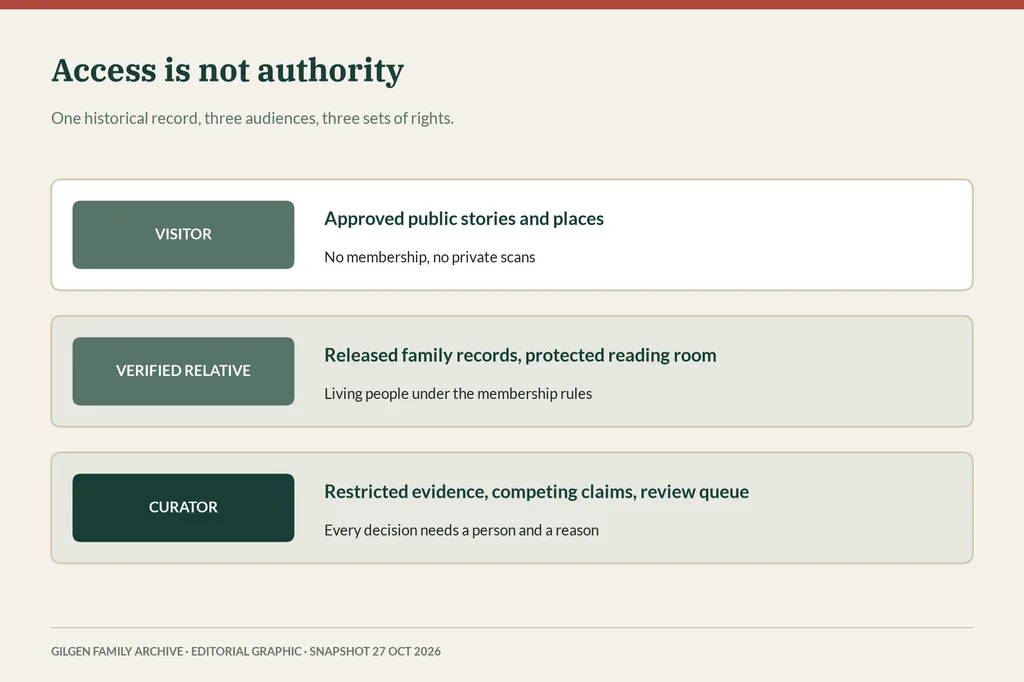
The index is split by audience. A visitor, a verified relative and a curator are different readers, and the machine must not fetch what the person asking cannot see. Private contact details are left out entirely. The model provider is configured not to keep or reuse the data, and the browser never holds a key.
The assistant may cite only passages it was actually given; anything else is stripped. That is a necessary check, not a guarantee. The text recognition may be wrong. A claim may still be unreviewed. A translation may add a shade the original never had. The review status has to travel with the answer.
One of the most useful things Hieronimus can tell my family is: I do not know.
There is nothing embarrassing about an archive that does not know yet. There is something wrong with one that is built to pretend.
When the tree was beautiful and unusable
Some of the best work of the week started with a plain complaint: the family tree was slow and awkward.
The first version drew one large illustrated tree in the browser. For 233 people it produced a drawing of about 19 MB, with around a million path commands and roughly two seconds of processor time. It could be ambitious as a picture and still fail at its one job: helping somebody find a relative.2
The redesign turned the tree into something closer to a map. The drawing is prepared in advance, cut into tiles and opened in a map viewer. It is rebuilt after changes settle and again every night. A child and a researcher can now move through the same family by panning and zooming instead of waiting for one giant image to redraw.
A family tree is a way of looking at evidence. It is not the evidence. If the view freezes, the reader cannot inspect the record. If the drawing simplifies too much, an open question about a parent looks closed. Good design shows where the answer came from.
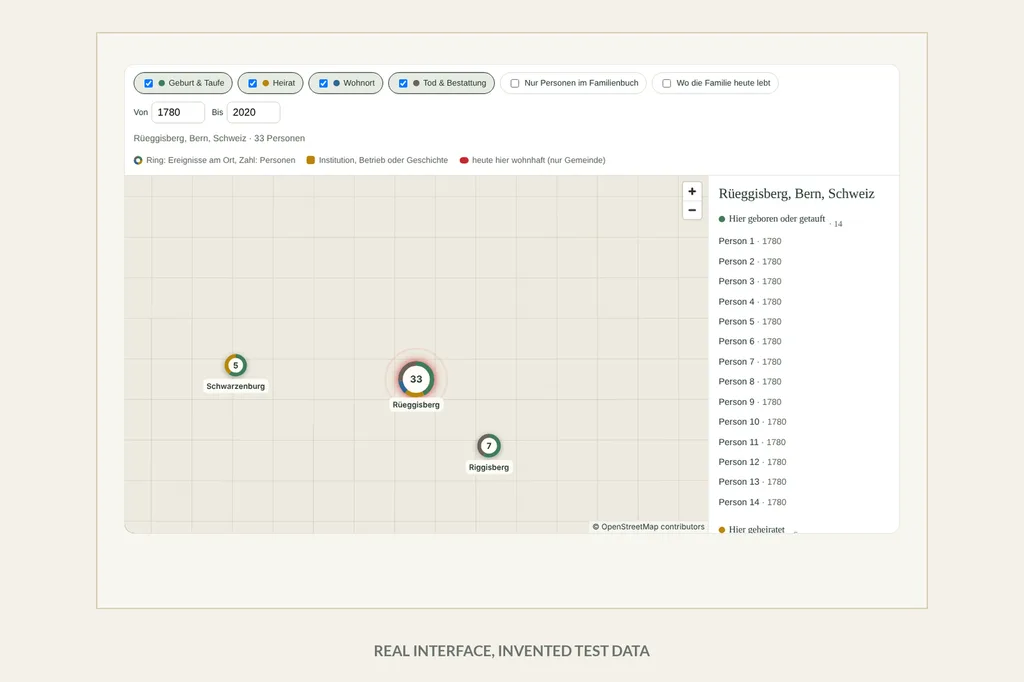
The maps followed the same idea. Farms around Rüeggisberg became places, tied to dated events and stories. An American town that had landed in Switzerland had to be moved back. And two places in Basel, a care home and a bakery, stopped being keywords in a family story and became things to investigate.
The chapel, the family and the missing document
There is a chapel in the garden of the Adullam in Basel. My family has always said that my great-grandfather, Ernst Gilgen-Furer, built it. My daughter was later baptised in that chapel. That continuity moves me in a way no chart can.
It would also be easy to write the sentence carelessly.
I have no document that shows Ernst built it. The foundation itself was set up in 1919 by Maria Vetter-Baumann; Ernst was its early operational leader, not its founder. Its website says the first home in Basel opened in 1927. Its centenary booklet gives 1 October 1928.34 An organ register dates the chapel to 1922.5 I have left those dates side by side. They do not agree, and smoothing them would be a small lie.
In the archive, the story that my great-grandfather built the chapel is kept as family testimony. It is not turned into documentary fact. Who built it, and when, are questions for building records, the foundation's archive, and perhaps somebody who still has a photograph or a letter.
There is a surprise here too. The 1969 family book does not tell the chapel story at all. When we searched it, the account was simply not there. A family can preserve hundreds of pages and still leave out the event that matters most to the people who come later.
That is why the archive has to reach beyond one faithful transcription. Its purpose is not to make the 1969 book know everything. It is to protect what the book says while letting new evidence, and new questions, sit beside it.
I have left my daughter's name and the date of her baptism out of this essay on purpose. A future reader may need to know that the family's link to the chapel continued. That does not give the public a right to a child's details.
The television station nobody should forget
On Tuesday, 17 February 1987, at three in the afternoon, the residents of the Adullam crowded into the day room in front of a large screen. Those who could not get a seat, and those in the hospital wing who could not leave their beds, waited in their rooms. The test card disappeared, and Felix Gilgen, the son of the director Paul Gilgen, greeted the audience. TV Adullam was on air.6
A year and a half later, a magazine for older readers described it. Every week Felix made a new programme with his cousin, Adrian Gilgen. Adrian was my father. Three times a day, on channel 30, the residents could watch their own station. When nothing was on, the screen still showed something alive: fish in an aquarium, a tree in the garden moving in the wind, the skyline of Basel.6
Think about what that meant. A person who could not leave a hospital bed could still see a familiar face. A resident could talk about a life rather than be a room number. An old people's home used a new medium to make contact inside its own walls. There is a gentleness in that idea that has aged well.
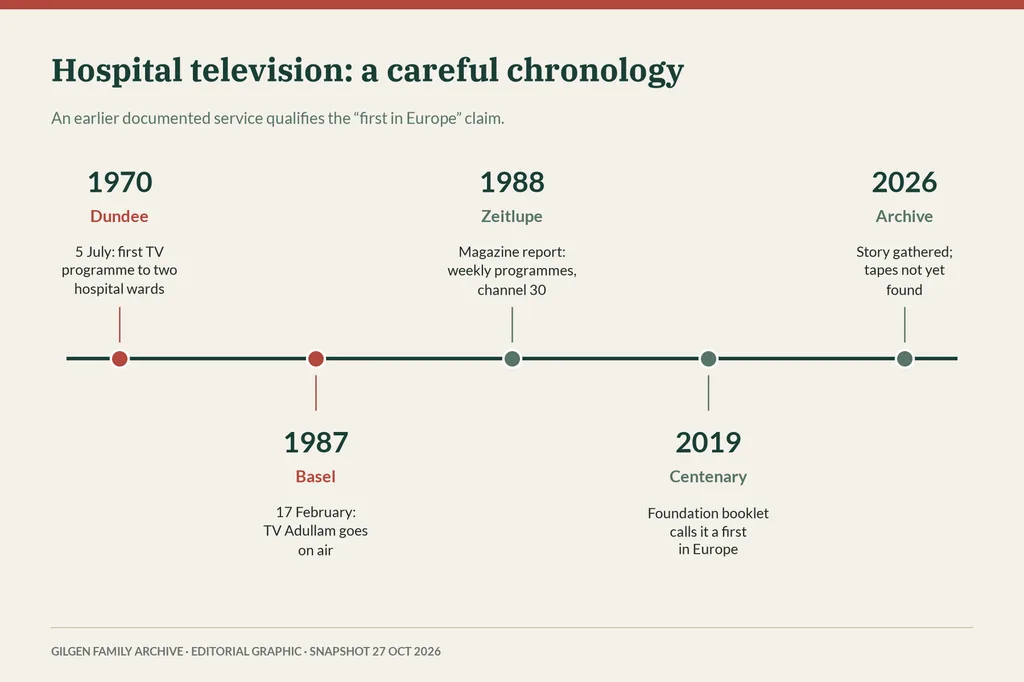
Felix died in January 2026. The archive's account of the station was put together in October, months after his death. We do not know when the last programme went out, whether the tapes survive, or who might have them. Those are not small gaps. They are the questions that make this work urgent.
There is also a correction to keep. The foundation's centenary booklet calls TV Adullam the first hospital television in Europe.4 A hospital broadcasting group in Dundee, Scotland, sent its first television programme to two hospital wards on 5 July 1970, seventeen years earlier.7 A narrower definition might still make some kind of first possible. The broad claim cannot stand without qualification.
An archive that corrects a flattering claim about its own family is doing its job.
The bakery was already in the book
On the Spalenberg in Basel stands the Konditorei Gilgen. Ernst Gilgen and his wife Ruth opened it in 1937. The shop moved to the Spalenberg in 1960, after the old premises in the Hutgasse had to make way for a department store. Most of the ovens date from 1937, and the Berner Butterzopf came with Ernst from Bern, where he grew up.8
At first we could not show any link between the baker and the branch of the family tied to the Adullam. The same surname and the same city were not enough.
Then a reference turned up in the book's Basel section, on page 236. It lists an Ernst II as a son from the elder Ernst's first marriage. Read that way, the bakery's founder was a half-brother of my grandfather Johannes and of Paul Gilgen. The page reading comes from the project's research. I still want to check the printed page itself, and until I have, the link stays marked as a reading rather than a settled fact.
In the earlier essay, an assistant's plausible story was corrected by the book. This time a tempting guess was held back until the book offered an actual route to the answer. Same discipline. Happier result.
And the question grew more interesting. A bakery is not a node on a tree. It is a workplace, a set of recipes, a way of shaping dough passed from hand to hand. A register will not keep those things. Some need interviews. Some need somebody to keep an oven, a photograph or a recipe long enough for the next generation to ask about it.
The missing people are alive
The book reaches back centuries. Its biggest gap is much nearer: the lives, moves, marriages, photographs and ordinary memories since it was printed.
No database can close that gap by being queried harder. The archive has to invite people in.
Verified relatives can register, tell the curators where they fit, and send corrections or new material with evidence. Members can add portraits, write about places, name a face in a photograph and ask to be put in touch. Contact details are shared only when both sides agree. A guest with a link is not treated as family.
Real inconvenience tested this almost at once. One registration got lost between creating the account and confirming the email. A relative needed a way to attach a new person to a parent already in the tree. The answer was not a reassuring help page. It was an eight-step registration tracker and a way to link existing relatives for review.2
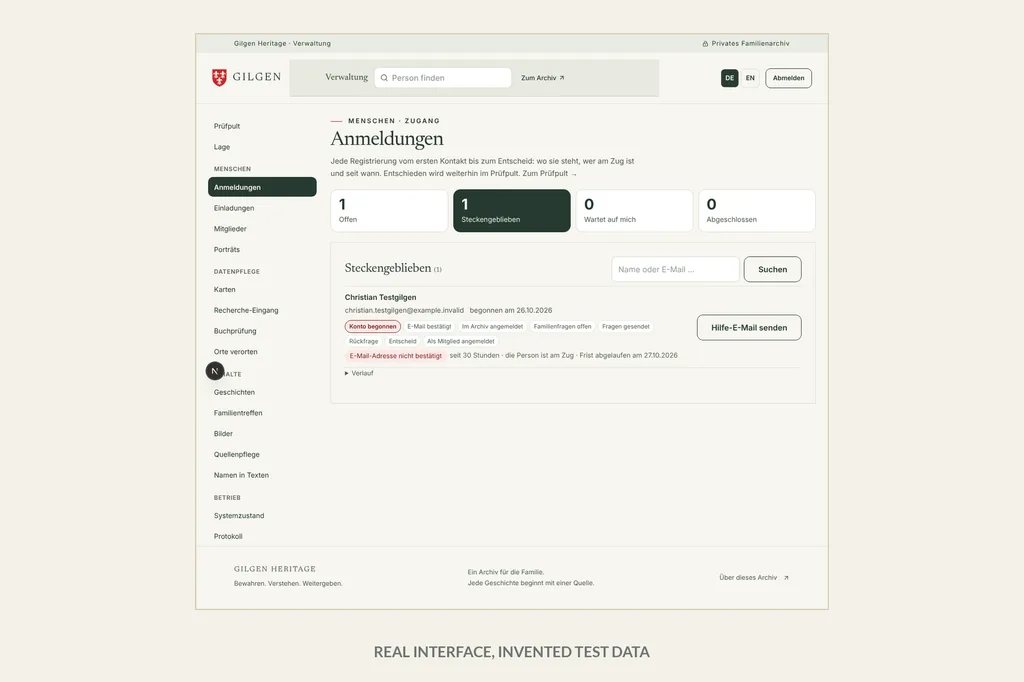
The best feature may be the simplest. A page called Jetzt da, here now, shows a family member that someone else is around and lets them wave.
It is easy to call a project like this a database. That is true and not enough. Its raw material is trust. A relative has to believe that a correction will be handled fairly, that living people are protected, that every statement can show where it came from, and that access to their own history will not depend forever on one person's inbox.
That trust will take longer to earn than the first release took to write.
The day the disk reached 99 percent
The week was not only a sprint through features. It was a live service, and it failed in ordinary ways.
On 26 October a health check found the production disk at 99 percent. The cause was 181 old release images, about 140 GB. They were removed, and the release process now prunes them on its own. Later that day an outage at the storage provider held up releases, because the backup that runs before each release could not finish.2
Those incidents are small next to the task of keeping centuries of history. They are not separate from it.
What use is provenance if the only copy of the evidence disappears? What use is an audit trail if nobody can restore the database? What use is a beautiful interface if a full disk stops the next family story from arriving?
By 27 October the archive had daily encrypted backups, scheduled health checks, controlled releases, automated tests and one completed restore drill, in which 82 tables and 31,780 rows came back. That 82 counts restored tables; the 87 earlier counts tables created by migrations. They measure different things. Some checks were still open, among them a second backup location and outside monitoring.2
I have spent much of my working life on systems. There is nothing romantic about disks, restores and job schedules. I suspect the next custodian will be glad someone cared about them.
Privacy is part of the archive
A public website and a private family archive answer different questions.
The public may read about a farm, a chapel or a business, where rights and evidence allow it. That does not mean everyone should see the birth date of a living cousin, a photograph they never agreed to share, a family quarrel, a home address or an uncertain link between two people. So the archive treats anyone whose living status is unknown as alive, separates members from curators, keeps the original scans behind a sign-in, and lets a living person ask for their record to be hidden.
That design has a cost. It creates reviews and permission checks. Some stories get a public paragraph and a family-only paragraph. Historical photographs can be researched and credited inside the archive without becoming free illustrations for an essay like this one.
I have not used the book's private pages, copyrighted photographs of the chapel or portraits of living relatives here. The screenshots in this volume show the archive's real interface filled with invented test data. That is not a loss. It is the archive behaving as it should.
What is still missing
At the snapshot the archive could do remarkable things. It could not answer every question that matters.
The chapel needs a building record. The Adullam's early dates need to be reconciled. Nobody yet knows whether the TV Adullam tapes are sitting on a shelf somewhere. Some entries in the genealogy file are still ambiguous. The recognised text from the scan has not been checked. The machine translations into English are marked as unchecked. And I do not have current counts of members, claims and stories from the live archive, so I will not make any up.
Some features were still in review. A monthly family letter is planned to start on 1 November 2026. A members-only story about the family's move to Basel was waiting to be merged. A working prototype and a checked historical record are different states of being finished.
A safeguard that is installed is not proof that it worked every time. A citation rule is not a historical review. A restore policy is not a restore until someone has run one. A labelled machine translation still needs a reader.
Both things are true. The week achieved an enormous amount, and most of the work is still ahead.
The next custodian
The title of the earlier volume was a warning: The Scan Is Not the Book.
This title is an answer, not a contradiction. The book became a way in, a web of evidence, a set of review steps, a place where relatives can add what they know, and a machine that helps them ask better questions.
It did not replace the original. It did not give a machine permission to make history up. It did not cancel anybody's right to privacy. And it did not finish the work entrusted to the people who own that book.
When the family book was printed in 1969, its makers could not have imagined maps, automated checks, review queues and a guide you can talk to. The technology is new. The obligation is not.
Keep it intact. Keep it up to date. Pass it on.
The archive will not have succeeded on the day Hieronimus can answer every question. It will have succeeded on the day someone in the family asks a question I never thought to ask, gets a traceable answer or an honest I do not know, and finds enough of the original evidence left to carry on without me.
Sources
Footnotes
-
Thierry Gilgen (2026-08-12, Edition 2): The Scan Is Not the Book, Vol. 25. www.thierry-gilgen-ict.ch ↩
-
Project records of the Gilgen family archive (2026-10-27): repository snapshot dc50441 of 27 October 2026, 16:12, with timeline, statistics and architecture documents. Private; figures as reported by the project, not independently audited. ↩ ↩2 ↩3 ↩4 ↩5 ↩6 ↩7 ↩8 ↩9 ↩10 ↩11 ↩12 ↩13
-
Adullam-Stiftung (accessed 2026-10-27): Geschichte. www.adullam.ch ↩
-
Adullam-Stiftung (2019): Engagiert für Menschen seit 1919, centenary booklet. www.adullam.ch ↩ ↩2
-
Andreas Schmidt, Orgel-Verzeichnis (accessed 2026-10-27): Basel, Abdullam Spital, Kapelle. Photographs not reproduced. orgel-verzeichnis.de ↩
-
Franz Kilchherr (1988): Hauseigenes Fernsehen im Altersheim: TV Adullam. Zeitlupe 66, no. 5, pp. 4–5. doi.org ↩ ↩2
-
BRIDGEfm (accessed 2026-10-27): History, TOC H Hospital Radio and Television Broadcasting, Dundee. bridgefm.org.uk ↩
-
Gilgen AG (accessed 2026-10-27): Über uns. gilgenag.ch ↩