
I want to begin with a rural livelihood project I once worked on. The core idea sounded reasonable enough.
Organise women into Self-Help Groups (SHG). Make affordable loans available to them. Give them the opportunity to start small businesses, strengthen their household income and slowly find a way out of poverty.
The women were given access to credit. Their names appeared in the records as beneficiaries. On paper, it was possible to count how many women had received loans and to report that the money had reached them.
We went into their homes to find out what had happened after that.
In a number of cases, the loan had effectively been taken over by the male head of the household for his own use. In others, the money had been handed to a local political leader. The woman recorded as the beneficiary may have surrendered control knowingly or unknowingly. Either way, having a loan in her name did not necessarily mean that she controlled the money, decided how it would be used, or benefited from it. If you looked at only the records, this reality would be hard to trace.
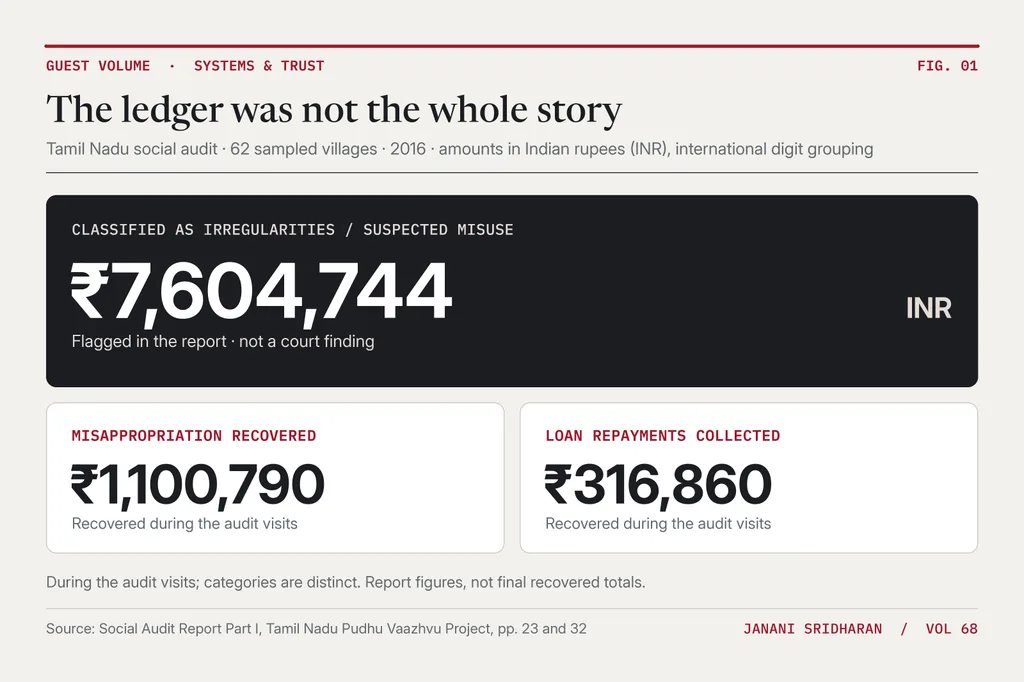
This was part of a rapid social-audit pilot that we carried out across 62 villages. We compared what the records told us with what women told us when we actually visited them. The published social-audit report covers 62 villages. It identifies INR 7,604,744 in suspected misuse or irregularities, and separately records ₹1,100,790 recovered from misuse during the audit visits, plus ₹316,860 in loan repayments. These are not the same categories, nor a measure of all subsequent recoveries.1
Social audits do something quite basic, yet powerful. They take information held in an official system and bring it into a space where the people described by that information can organize and verify it.
The project had created access to loans. But access had not necessarily given women agency.
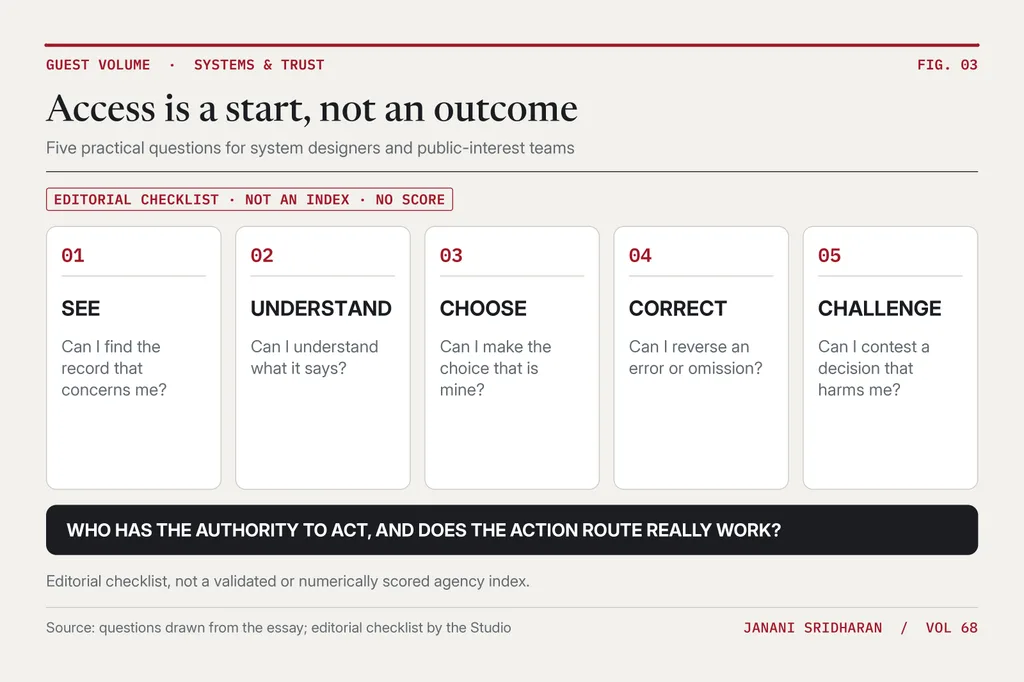
Agency, to me, involves being able to understand a system, exercise meaningful control within it, question what it tells you and challenge it when it is not working for you. It also means having some influence over decisions that affect your life.
Access may create the possibility of agency. It should not be confused with agency itself.
What software quietly changes
Years later, I found myself returning to this distinction through technology.
A digital system is often presented as a way to make an existing process faster, cleaner or more efficient. But moving something online does not simply reproduce what existed offline.
It can quietly change who is allowed to act.
Take the example of an electoral database. The legal and administrative process may deliberately place responsibility for adding, correcting or removing names with officers working at a decentralised level. They are closer to the communities involved. They can examine documents, hear objections and make judgements based on the authority given to them.2
Now imagine that a new centralised software system does not allow those officers to carry out a correction they have lawfully approved.
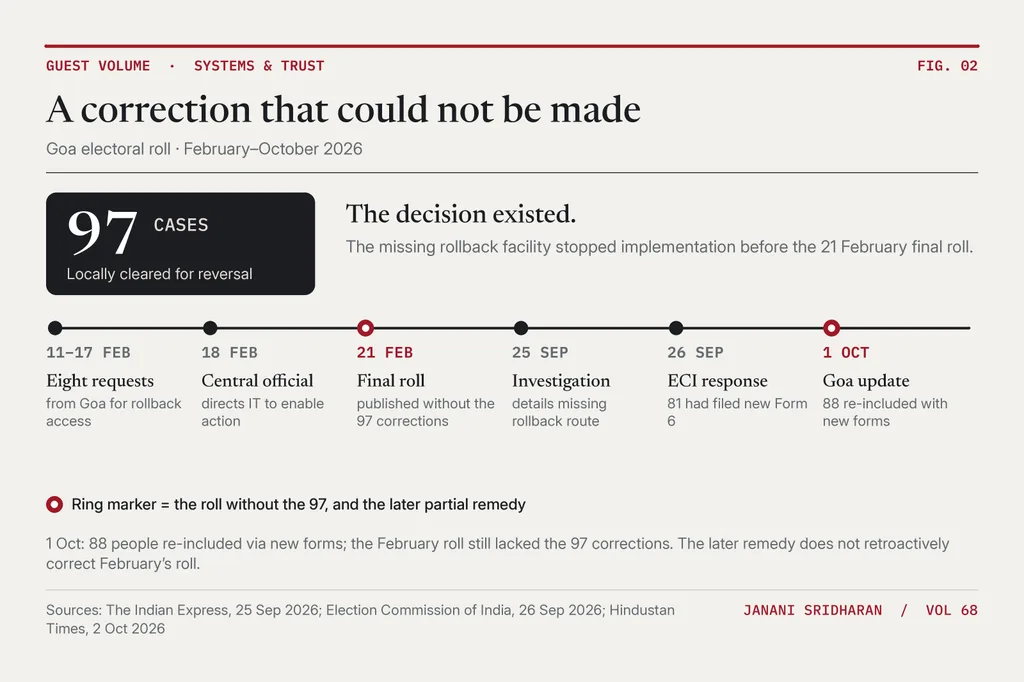
This is not a hypothetical concern. In Goa, India, during the 2026 revision of electoral rolls, local electoral officers examined objections and concluded that 97 voters should be restored. But the centralised ECINet/ERONet workflow lacked the necessary rollback function available to them. Despite eight requests over seven days, the final electoral roll was published on 21 February without those corrections. This account comes from an investigation based on official correspondence; it is not an independent software audit.3
The Election Commission subsequently said, on 26 September 2026, that its field-officer access was legally role-based, announced a review of ECINet and reported that 81 of those 97 voters had applied for inclusion through Form 6.4 On 1 October, Goa’s Chief Electoral Officer reported that 88 had been re-included through fresh Form 6 registrations, while three were identified as Portuguese-passport holders and six were residing abroad.5 This later remedy does not mean the original February correction workflow worked. The final disposition of the remaining cases was not independently established.
The local officers still appeared to hold authority. The software had not visibly rewritten the law or the official process. But if the system would not allow their ruling to be implemented, where did the real authority sit?
Every system contains a distribution of power.
Software permissions are not merely technical details. A button that has disappeared, a field that cannot be edited, a decision that cannot be reversed, an account that lacks the required access: these things decide who can act and who must wait for somebody elsewhere to act for them.
And technology can conceal this transfer of power particularly well. To someone looking at an organisation chart or an official process, nothing may appear to have changed.
This is why I keep coming back to a question for people building public-interest technology: Is your code actually taking away power that people had in the offline system?
What was the earlier relationship between the citizen and the local official? Who could correct an error? Who could see the underlying record? Who was answerable when something went wrong? Does the online system preserve these relationships, or does it quietly introduce a different one?
Technology can make malpractice easier. It can make a legitimate correction harder. It can also make the shift in authority almost invisible to the very people affected by it.
I have written elsewhere about some of the practical questions international organisations should ask when planning technology within programmes for social outcomes: Who decides what the technology should do? Whose requirements shape it? Who owns it? What happens when the project closes? How will harm be prevented?
But beneath all of these sits another question: does the person at the other end gain a greater ability to act, or does the system make them more dependent on decisions they cannot see or challenge?
What I keep trying to build towards
Over the years, I have noticed that this question keeps returning, often in places where people expect a discussion about technology rather than power.
Lately, my freelance work has focused on reviewing technology landscapes for non-profits and international organisations. Across recent client projects, the initial brief is almost always the same: concerns about systems, data pipelines, vendor selection, reporting, or increasingly, AI.
On the surface, they appear to be technology problems.
Yet as I work through interviews, architecture diagrams, contracts, system designs and years of accumulated decisions, the discussion often arrives somewhere unexpected.
Who gets to approve a change?
Who can access the data?
Who receives information first?
Who depends on someone else to obtain it?
Which decisions have become centralised over time, and which have become disconnected from the people most affected by them?
The technology matters, of course. But many of the most important decisions turn out not to be technical decisions at all.
They are decisions about authority, accountability and control.
Perhaps this is why the distinction between access and agency has never really left me. The technologies are different. The organisations are different. The language is different. Yet the underlying question remains remarkably familiar: who is able to act, and who must depend on somebody else acting on their behalf?
This friction between access and agency isn’t limited to enterprise software... it shows up at the household level, too.
During COVID, millions of people were pushed online faster than they were prepared for. Having a smartphone and an internet connection did not mean that someone understood how their data travelled, why an advertisement followed them, what a fraudulent link looked like, or how online exposure might affect different people within the same household.
I moved to Vidarbha in central India and began running digital-safety workshops in Hindi and Marathi. These sessions started with people’s own stories and experiences, before moving into practical discussions on privacy, fraud, data and social media. Later, I wrote about the approach here.
One participant wanted to know why Facebook seemed to know about something he had only recently considered buying. Another worried about what a child might encounter on a shared phone. Access to the internet was already there. What people wanted was to better understand the systems acting upon them. (I later wrote about some of those conversations here.)
More recently, the same questions have followed me into AI and automation.
I worked with a career coach on workshops for women navigating career transitions, including women returning to work after migration, marriage or motherhood. One concern appeared repeatedly: the feeling that the world had moved ahead without them.
I became interested in whether AI could help with some of the invisible work around job-hunting. The tracking. The follow-ups. The remembering. The small pieces of administration that quietly consume time and confidence.
So I built a Telegram chatbot that could analyse job descriptions, identify key requirements, track applications and prompt users when things stalled. Another n8n workflow sent reminders. I was learning too, figuring out how these automations worked while exploring whether they could be genuinely useful to women trying to re-enter the workforce.
The technology itself was never the point.
The question was whether it increased someone’s capacity to act.
A loan can be issued in a woman’s name without giving her control over the money.
A person can appear in a government database without being able to correct what it says.
A family can own a smartphone without understanding the systems operating through it.
An organisation can deploy new technology without fully understanding how it changes authority, accountability and control.
Access matters. Of course it does.
But we should stop treating it as the point at which our work is done.
If technology is meant to be a force for good, the people designing and governing it need to examine its effect on power more openly. Who gains control? Who loses it? Who can inspect the system, correct an error, say no, or demand another way?
Those questions matter just as much as the software requirements.
Because otherwise, we may extend access while quietly taking agency away.
Sources
Footnotes
-
Tamil Nadu Pudhu Vaazhvu Project, 2016. Social Audit Report: Part I. Primary programme audit of 62 sampled villages, pp. 23 and 32. Amounts are in Indian rupees (INR), shown with international thousands grouping. The INR 7,604,744 total covers several audit-flagged categories, including undocumented expenditure; it is not adjudicated fraud. The recoveries are those recorded during the audit visits, not a final loss assessment. ↩
-
Government of India. Representation of the People Act, 1950, section 13B. The Electoral Registration Officer prepares and revises the roll within the statutory framework and under the supervision of the Election Commission. ↩
-
Ritika Chopra, The Indian Express, 25 September 2026. Goa’s 8 emails, 97 voters cut. Investigative reporting based on official correspondence; not a forensic inspection of ECINet. ↩
-
Election Commission of India, via Press Information Bureau, 26 September 2026. Press statement. The Commission’s official response. A new Form 6 application is not evidence that the original records were restored. ↩
-
Gerard de Souza, Hindustan Times, 2 October 2026. Goa SIR: 88 of 97 left-out voters re-included after Form 6, citing the Goa Chief Electoral Officer’s update of 1 October. See also Newslaundry, 5 October 2026: Goa case of 97 voters: deleted voters asked to submit Form 6. Official figures as reported; citizenship status is the officials’ description. ↩