The question after the presentation
On 15 October 2026, a session by Yves Zumbühl of botts.ai on sovereign solution development left me thinking about a very ordinary purchasing question: what do we actually get for the money we spend on AI? The session prompted this investigation; the analysis and conclusions below are my own, not a quotation or an endorsement from Yves.12
We can compare subscriptions. We can count tokens. We can discuss context windows, resets, model families and reasoning settings. All of those details matter to someone operating the tools.
But none of them is the thing the customer ultimately came to buy.
The customer needs a document that can be sent. An image that can be used. A problem that has been resolved. A feature that works in the existing application. A release that survives contact with production.
A machine can be extremely busy without bringing any of those outcomes closer.
This is not an argument against AI. It is an argument for taking its value seriously enough to measure the right thing. A cheap subscription that repeatedly transfers unfinished work back to a human can be expensive. A costly model that removes an hour of expert repair can be excellent value. Neither conclusion follows from the size of the usage allowance.
The relevant unit is accepted work, under stated conditions, at a known total cost.
What this volume establishes
Subscription allowances, API prices and benchmark scores describe different purchases. They must not be combined into an invented figure for “finished tasks per month”. Public evidence is useful for choosing what to test, but it does not identify one universally superior subscription. The missing measurement is the complete path from briefing to acceptance—and, where it matters, the work’s continued reliability afterwards.
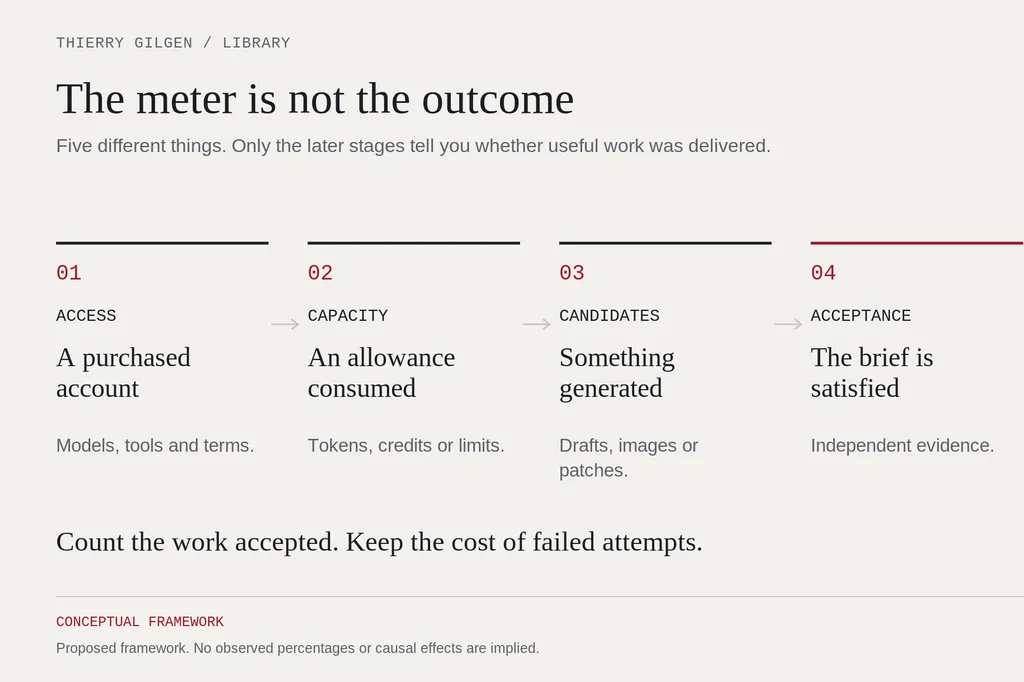
1. Four purchases hiding inside one subscription
An AI plan bundles at least four things: access to models, software that lets those models work, an allowance for using them, and terms governing data and administration.
The model is not the entire product. A coding agent also needs repository context, working tools, useful instructions and a reliable execution environment. An assistant producing a spreadsheet needs more than fluent reasoning: the file must open, formulas must reconcile and the result must be understandable to its recipient.
The allowance is not a common unit either. Claude describes session multipliers alongside weekly constraints. OpenAI publishes model-dependent usage estimates. Cursor’s current subscriptions pool usage across products, while legacy accounts retain another structure. Google’s model limits and creative credits are not interchangeable.34567
Here is the individual-plan price map at this edition’s research cut-off. These are public US list prices, not Swiss checkout quotations. Taxes, billing channel, region and account history can change what a particular customer pays.
| Product family | Monthly public list prices | The distinction to retain |
|---|---|---|
| ChatGPT / Codex | Free; Go USD 8; Plus USD 20; Pro USD 100 / 200 / 500 | Plan, model, speed mode and account cohort affect usable capacity. |
| Claude / Claude Code | Free; Pro USD 20; Max USD 100 / 200 | Max’s 5× / 20× session multipliers are not delivered-work multipliers. |
| Cursor / current X subscription | Free; Plus USD 8; Premium USD 30; Super USD 100; Ultra USD 200 | Shared weekly usage; directly selected third-party models are billed separately on eligible tiers. |
| Legacy Cursor | Pro USD 20; Pro+ USD 60; Ultra USD 200 | Two monthly usage pools, not the current shared weekly bundle. |
| Google AI | Free; Plus USD 4.99; Pro USD 19.99; Ultra USD 99.99 / 199.99 | Gemini usage, Flow credits and developer services have distinct conditions. |
Price sources: the official plan pages and entitlement documentation.891061112
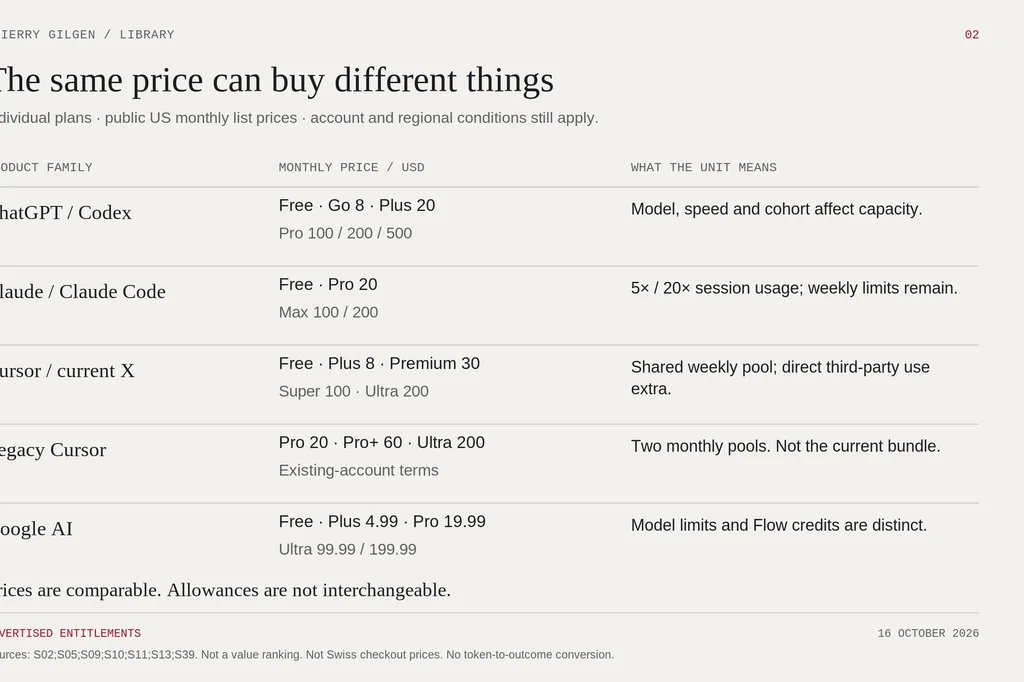
Three details illustrate why the plan name is not enough.
First, qualifying existing OpenAI Pro 200 subscribers retain a previous allowance through 29 October 2026. New accounts outside the qualifying cohort can receive a different allowance at the same price. Fast mode consumes included capacity at 2.5 times Standard; supported Ultrafast usage consumes it at eight times Standard. Those are consumption multipliers, not promises of equivalent speed gains.38
Second, Claude Max’s 5× and 20× figures refer to the five-hour session allowance relative to Pro. Shared weekly limits still matter. It would be incorrect to multiply an old anecdotal prompt count by twenty and present the answer as a contractual monthly entitlement.94
Third, a legacy Cursor Ultra and a current Ultra can both cost USD 200 while purchasing different bundles. The former retains separate Cursor-model and other-model pools; the latter shares a weekly pool with Grok activity. Migrating changes the billing arrangement, including third-party model coverage.56
Before comparing two reviews of the same plan, ask whether the reviewers actually bought the same thing.
2. A freebie is valuable only when it replaces a bill
Promotions can materially change the economics. They can also make an ordinary comparison misleading.
Claude Max currently offers eligible monthly API credits of USD 100 or USD 200, depending on tier. New subscribers must have been on the plan for seven days, and the relevant Console organisation must be linked. Unused credits expire. They do not pay for interactive Claude Code or Claude-app overages; eligible API and correctly authenticated headless workflows are a different billing route.13
For an operator who would otherwise purchase that eligible API usage, this is real value. For someone using only interactive Claude Code, treating the credit’s face value as a subscription refund is false accounting.
OpenAI’s banked resets are conditional promotional benefits, not a standing monthly grant. Applying a full reset changes the weekly reset schedule; the original scheduled reset does not also arrive unchanged. Paid instant resets are separate purchases with account-dependent availability and checkout pricing.1415
An unusually large Anthropic enterprise Code Review offer makes the distinction even clearer: eligible organisations can claim USD 10 000–50 000, with a claim deadline of 15 January 2027 and a 30-day usage window. It is not general API money. Several configurations are excluded, including specified GitHub Enterprise Server, GitHub data-residency and zero-data-retention arrangements. Paid review activity can continue after the credit expires.16
There is also a calendar. Claude’s artifact promotion ended on 15 October at 23:59 Pacific—16 October at 08:59 in Switzerland. It did not discount weekly limits or Claude Code. Cursor closed new redemptions of its legacy student offer on 25 June 2026, although existing redemptions keep their own expiry.1718
A sound promotion ledger distinguishes included benefits, conditional offers, expired promotions and paid extensions. The calculation should show both actual cash spending and the non-promotional cost of sustaining the same workload.
An unused credit is an option, not a saving.
3. “Text, images and code” is not a useful task taxonomy
The work must be separated before the products can be compared.
A short translation, a current research brief and a board paper are all “text”. Yet they fail in different ways. A translation may quietly change meaning. Research may attach a real citation to a claim it does not support. A board paper may be elegantly written but omit the decision its readers need to make.
For visual work, a concept image is not a precise product edit. A beautiful standalone image is not a coherent eight-image campaign. A diagram that looks plausible is not an editable technical drawing with correct labels.
For software, a bounded function is not a feature spanning the interface, API, database and migration path. A code review is not a repaired vulnerability. A merged pull request is not a recovered service.
This volume therefore uses 23 evaluation categories. Twenty-two describe types of work; the twenty-third, sovereign execution, is also a cross-cutting eligibility condition rather than simply another task to average into a score.
| Family | Categories | Acceptance must establish |
|---|---|---|
| Writing and knowledge work | Transformation; commercial writing; grounded synthesis; current research; extraction; decision artifacts | Meaning, evidence, fields, calculations and intended use are correct. |
| Visual production | Concepts; text-heavy compositions; precise edits; consistent sets; editable diagrams | The actual brief is met, including preservation and consistency requirements. |
| Software engineering | Bounded code; repository understanding; local repair; multi-file features; refactoring/migration; terminal work; review; security remediation; production delivery; research code | The relevant tests, integration, verification and operational conditions hold. |
| Automation and control | Cross-application workflows; sovereign execution | The authorised end-state is reached without prohibited actions or data movement. |
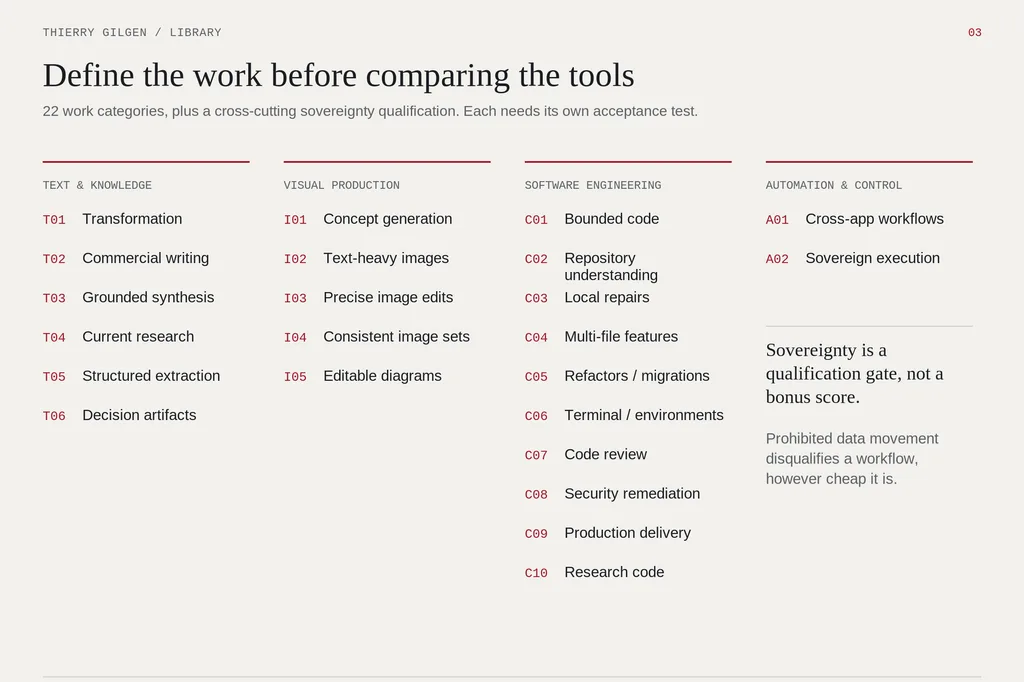
For every category, define the acceptance test before the agent starts. Keep it separate from the agent’s own account of its performance. Require the same standard from each candidate workflow.
“Produce a patch” invites a patch. “Fix this bug, preserve these behaviours, and demonstrate it with a regression test” specifies work that can be assessed.
This is not bureaucracy added to productivity. It is how we know whether productivity happened.
4. Coding: stronger models and cheaper work are different questions
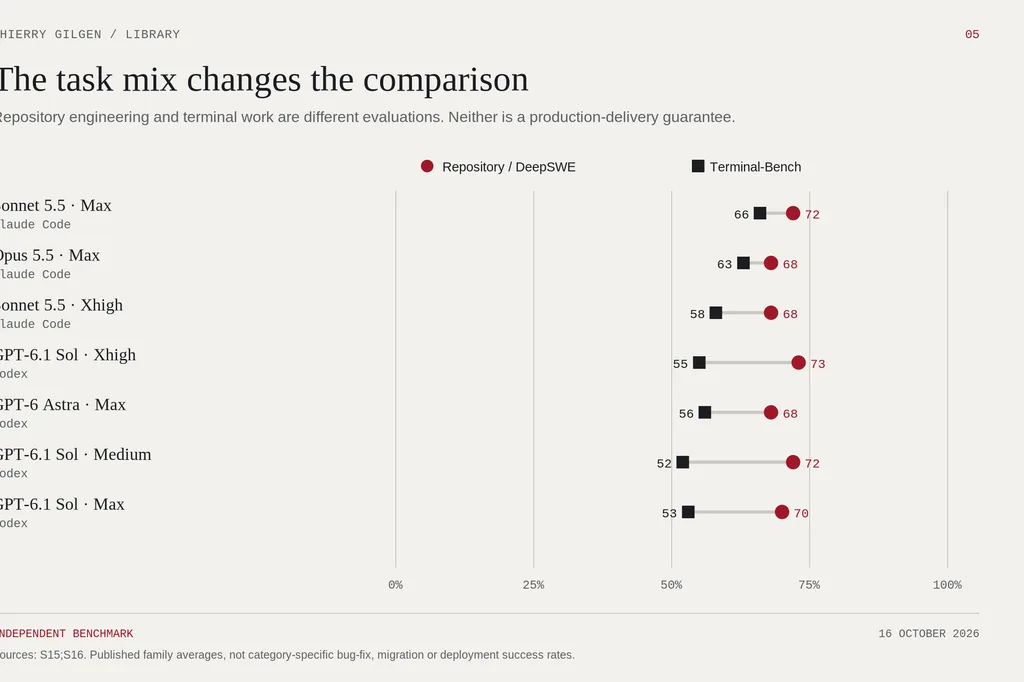
Artificial Analysis’ Coding Agent Index v1.5 provides a useful, explicitly bounded comparison. It covers 113 repository-engineering tasks, 66 terminal tasks and 124 repository questions, with three attempts per task. The composite equally averages the three benchmark scores. Its pooled cost figures are API-priced averages per scored attempt, not subscription charges or production delivery costs.19
The following selection includes high-performing configurations and contrasting effort settings. It is not the entire leaderboard, and small score differences should not be treated as established differences in reliability.
| Agent and configuration | Index | Repository tasks | Terminal tasks | USD per attempt | Agent minutes |
|---|---|---|---|---|---|
| Claude Code · Sonnet 5.5 Max | 68 | 72% | 66% | 14.19 | ≈90 |
| Claude Code · Opus 5.5 Max | 66 | 68% | 63% | 13.04 | ≈66 |
| Claude Code · Sonnet 5.5 Xhigh | 63 | 68% | 58% | 3.33 | 27.0 |
| Codex · GPT-6.1 Sol Xhigh | 63 | 73% | 55% | 1.04 | 15.5 |
| Codex · GPT-6 Astra Max | 62 | 68% | 56% | 7.47 | 29.4 |
| Codex · GPT-6.1 Sol Medium | 61 | 72% | 52% | 0.70 | 10.9 |
| Codex · GPT-6.1 Sol Max | 60 | 70% | 53% | 1.55 | 24.4 |
These are the evaluator’s rounded published results, not measurements made for this article. “Repository tasks” means DeepSWE v1.1; “Terminal tasks” means Terminal-Bench 4.0.20
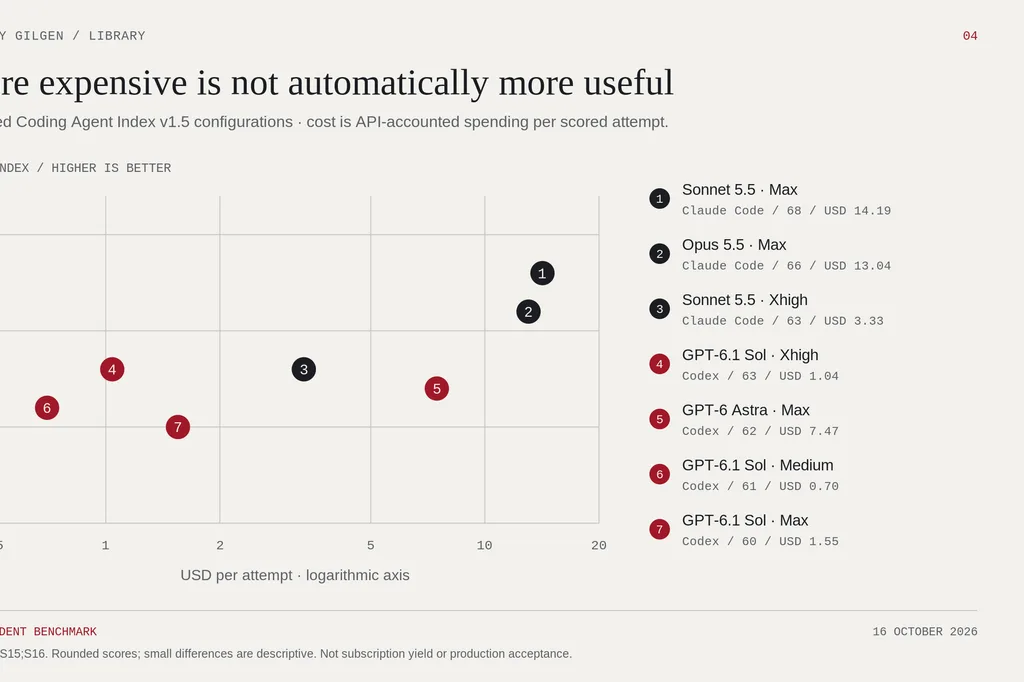
The results support two useful hypotheses for a purchasing pilot. Moderate Sol settings deserve testing for economical repository work. Higher-effort Claude configurations deserve testing when stronger terminal performance might save enough repair to justify the resource cost. They do not establish that either product is always better.20
Notice what “Max” does not guarantee. Sol Medium scored slightly above Sol Max in this snapshot while costing less and completing sooner. On Sonnet, reducing effort substantially also reduced the reported score. Effort is a task-specific setting to test, not a badge of quality.20
A caution is needed for Cursor. This research did not obtain a complete, current, comparable Cursor CLI result table. Historical Composer results use an earlier suite and must not be spliced into the current comparison. Grok Build is another agent, not a substitute measurement of Cursor.2122
That gap is not a finding against Cursor. Editor integration, context management and workflow continuity can create value that another agent’s score does not capture. The honest next step is to measure those advantages on the actual work, not to assign Cursor a borrowed number.
Code review needs its own denominator, too. Anthropic’s March launch estimated USD 15–25 per review; that is not a universal fixed tariff. Current documentation describes usage-based costs and review triggers that can produce several reviews on one pull request. The hosted review analyses code without building or running it.2324
Count confirmed material defects and human review effort, not just comments generated. A reviewer that invents three concerns for every useful finding may make the team busier without making the software safer.
5. Writing: fluent output is not finished knowledge work
There is credible evidence that assistance can improve bounded writing. Noy and Zhang’s 2023 experiment assigned professional writing tasks to 453 college-educated participants. It reported 40% less completion time and 18% higher quality scores. That supports the usefulness of the technology in the tested setting; it does not rank October 2026 subscriptions.2526
For contemporary professional artifacts, GDPval-AA is closer to useful office work than a general knowledge quiz. It covers 220 public tasks across 44 occupations and nine industries. Its current Opus 5.5 Max and Sonnet 5.5 Max entries score 1866 and 1838 Elo respectively, with the evaluator explicitly labelling both configurations Default Fallback. They are tool-enabled configurations assessed through model-judged comparisons—not consumer subscriptions or human acceptance probabilities.27
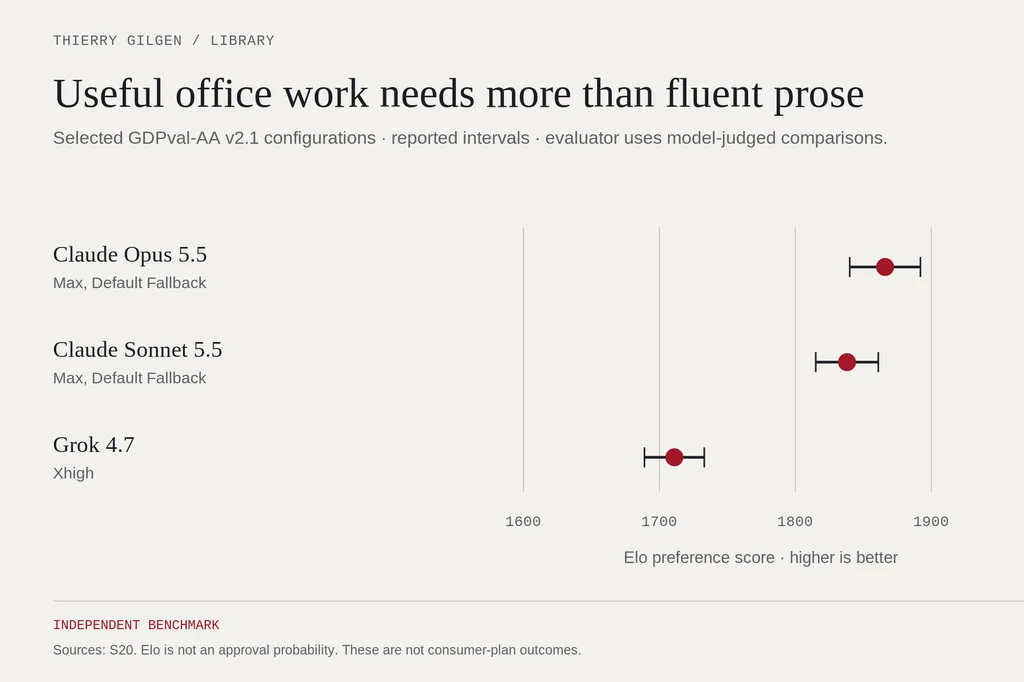
The practical evaluation must remain closer to the customer’s brief.
For rewriting, measure whether meaning and terminology survive, then record editing minutes. For a research brief, verify that sources exist, are current enough and actually support the claims. For extraction, compare fields against a known answer set. For a spreadsheet, require the formulas to work and the totals to reconcile.
Do not reward an assistant for manufacturing additional words that somebody else must audit. And do not penalise a concise, correct result because another model produced a more impressive-looking document.
Knowledge work often fails at the boundary between plausible and defensible. That boundary needs an acceptance test of its own.
6. Images: the generation is not the asset
Image evaluation offers a relatively clear example of the difference between model quality and production economics.
In the retrieved Artificial Analysis preference results, GPT Image 2.5 Sunburst Max scores 1218 for creation, Nano Banana 2.1 scores 1172, and Grok Imagine Image 2.0 scores 1165. Their reported 95% intervals are ±10, ±12 and ±13. The same page lists reference API prices equivalent to USD 0.2107, USD 0.0336 and USD 0.0600 per generated image.28
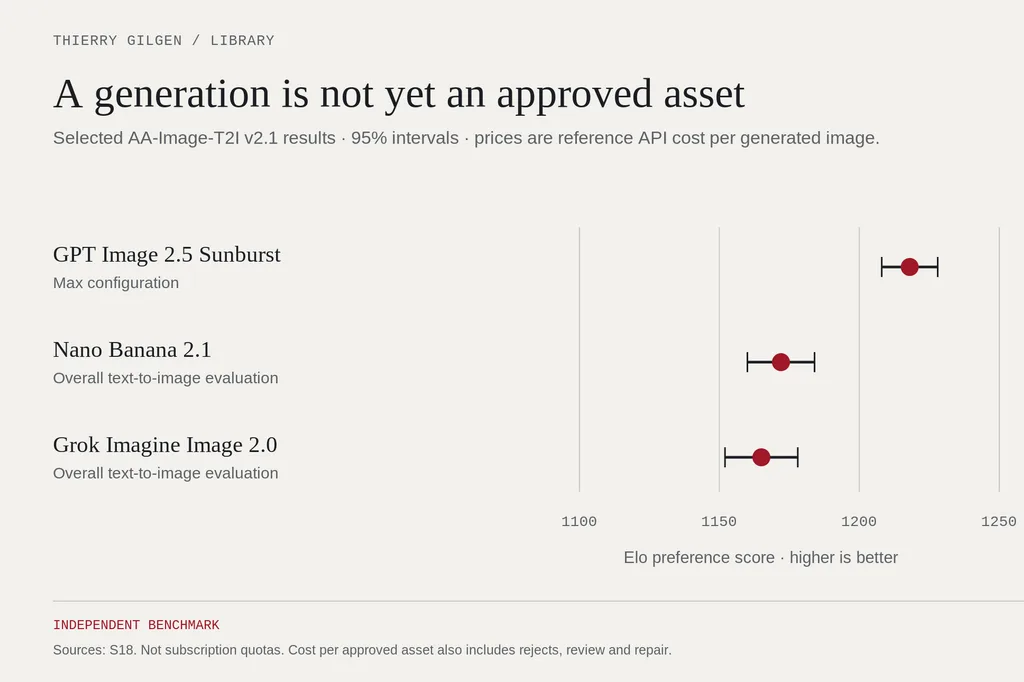
Editing is a separate evaluation: Sunburst scores 1199 ±11, Nano Banana 1152 ±13, and Grok 1117 ±13 in the refreshed snapshot.29
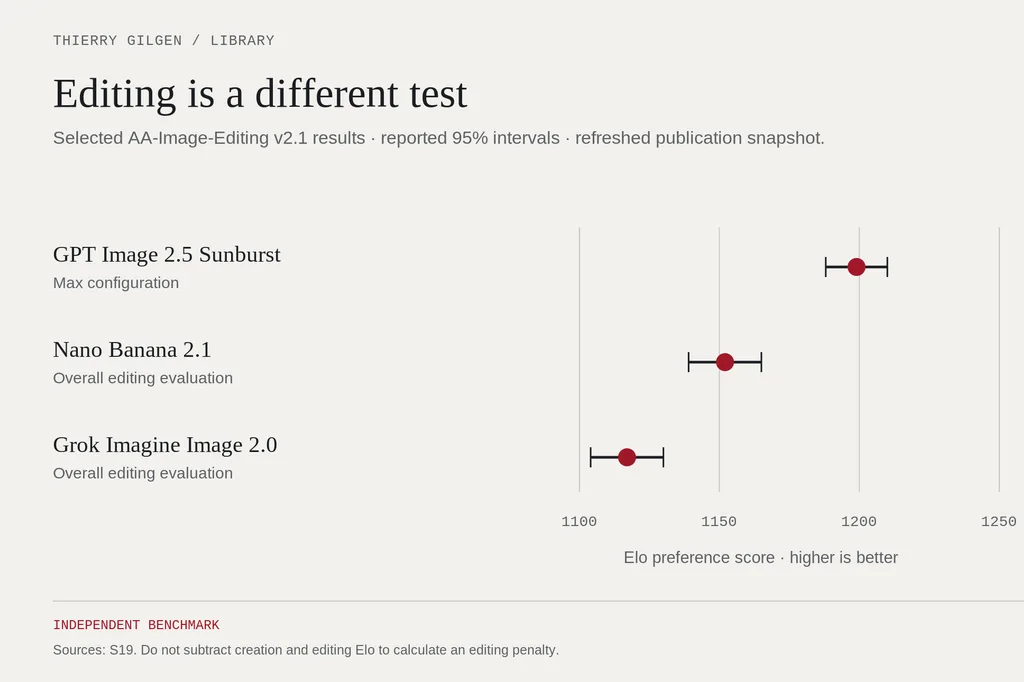
These results help identify candidates. They do not settle the production choice. The lower-priced model may be economical for exploring concepts. The stronger model may be cheaper overall when a demanding edit would otherwise consume repeated attempts and manual repair. That is a hypothesis about the workflow, not a result measured by the preference leaderboard.
For a campaign, count the coherent set. For a product edit, inspect what must remain unchanged. For a diagram, require correct labels and an editable source. Include the cost of rejected generations, review, retouching and any external tools.
Claude can also orchestrate external image tools through integrations. That does not create a native image allowance in the Claude subscription; the external service remains part of the access and cost calculation.30
The unit is the approved asset, not the generated image.
7. Why the productivity studies disagree
A bounded experiment involving GitHub Copilot reported 55.8% faster completion of a JavaScript HTTP-server task. METR’s early-2025 study found a different result: 16 experienced developers working on 246 tasks in their own repositories took 19% longer when AI was allowed.3132
These were not the same tools, users, tasks or acceptance conditions. They are not competing estimates of one universal AI productivity constant.
METR’s February 2026 follow-up is particularly instructive. The later study estimated an 18% reduction in time for returning participants and a 4% reduction for new participants, but both intervals crossed zero. The authors also described selection effects and difficulties measuring concurrent agent work that made the results unreliable as a current productivity estimate.33
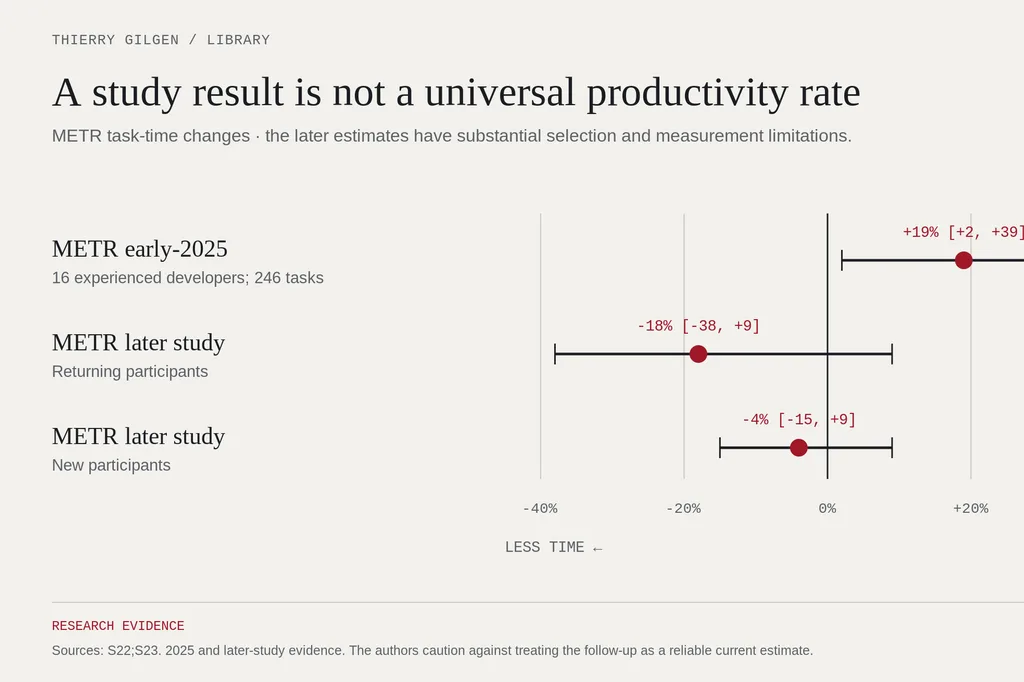
A separate METR survey of 349 technical workers records perceived benefits, not measured counterfactual time savings. DX’s own observational summary reports a median 7.76% increase in pull-request throughput; throughput is not equivalent to software value, and an observational association is not a universal causal effect.3435
Practitioner reports remain useful. They can reveal friction that a benchmark misses: interruptions, changing limits, review burden, integration failures and unexpected bills. But enthusiastic or angry reports are selected experiences. Without a task definition, cost ledger, failure record and acceptance standard, they cannot tell another buyer how much work a subscription will deliver.
The right investigation is not “Does AI feel faster?” It is “Where did the time move?”
From implementation to review? From writing to fact-checking? From generating code to recovering the environment? Or did the total effort genuinely fall while the result remained equally good?
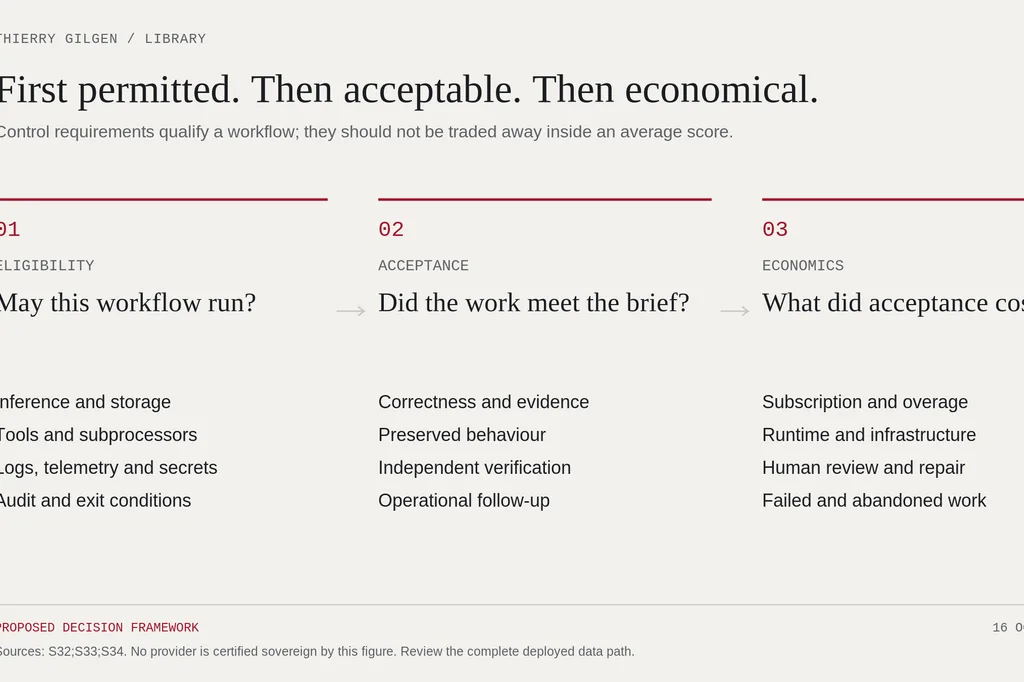
8. Sovereignty comes before the price comparison
The sovereignty question changes which workflows are eligible for comparison in the first place.
Running an agent in a local terminal does not establish that inference happens locally. Cursor documents sending prompts and code context to model or inference providers. Claude’s retention arrangements vary with account and contract. OpenAI distinguishes data residency from inference residency.363738
No training, no retention, regional storage and control over inference are different commitments. A product may satisfy one and not another.
Map the entire path: inference, tool execution, artifacts, logs, telemetry, subprocessors, credentials, audit access and exit. A locally hosted interface is not sufficient if a connected tool silently sends protected content elsewhere.
The enterprise review promotion demonstrates the practical issue: some data-control configurations are excluded. A large allowance that cannot be used under the required conditions has no usable value for that workload.16
Self-hosted systems belong in the economic comparison, but not at a fictional cost of zero. Count hardware or hosting, utilisation, electricity where relevant, maintenance, security operations and human support. Count the same acceptance failures as for a cloud service.
The ordering should be simple: Is the workflow permitted? Does the result meet the standard? What does it cost? A cheap prohibited workflow does not become acceptable by winning a weighted score.
9. The cost that survives acceptance
Two calculations are worth keeping side by side.
Cash cost per accepted outcome is allocated subscription cost, actual overage or API charges, and runtime spending, divided by accepted outcomes.
Fully loaded cost per accepted outcome adds the cost of human briefing, review, repair and attributable post-delivery follow-up before dividing by the same denominator.
Use one accounting period. Include failed and abandoned attempts. Allocate a shared subscription once, not in full to every category. Count labour consistently across AI and non-AI workflows. When no outcome is accepted, report that fact rather than producing a reassuring zero.
Here is a deliberately hypothetical example. These are not provider results.
| One month; 40 equivalent accepted outcomes | Workflow A | Workflow B |
|---|---|---|
| Subscription | USD 20 | USD 200 |
| Other cash costs | USD 120 | USD 80 |
| Human effort | 24 hours | 9 hours |
| Assumed labour rate | USD 60/hour | USD 60/hour |
| Fully loaded cost | USD 1 580 | USD 820 |
| Cost per accepted outcome | USD 39.50 | USD 20.50 |
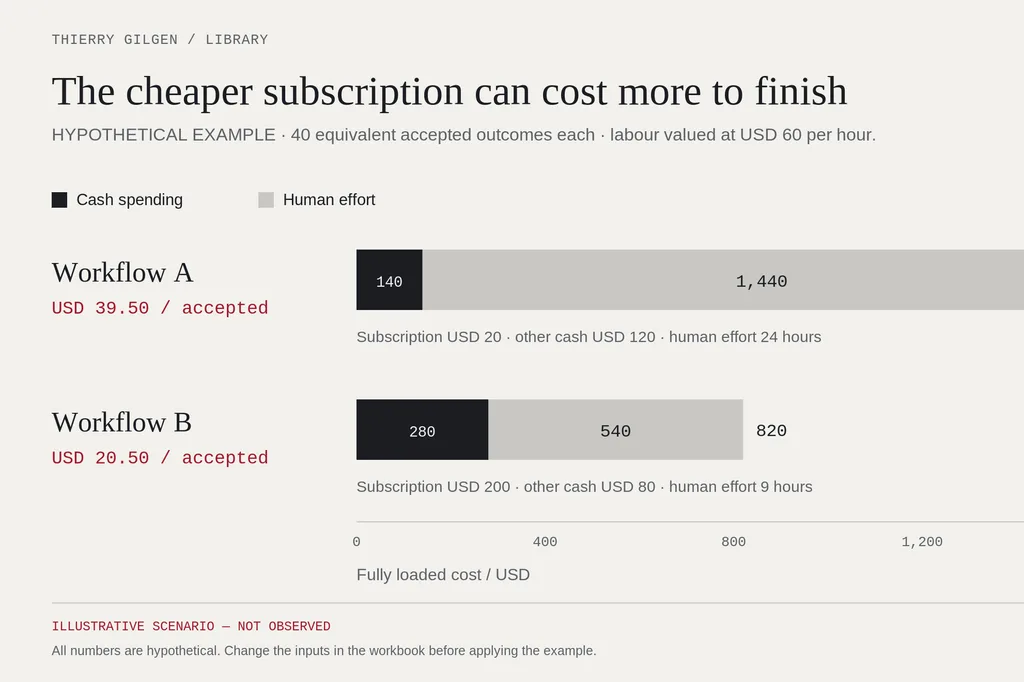
The subscription that looks expensive on the pricing page is cheaper in this constructed workflow. Reverse the repair burden and the result can reverse.
But accepted work is still not automatically profitable work. A campaign can meet its brief and fail commercially. A feature can be correct and unwanted. Acceptance is a necessary operational denominator, not a claim on revenue. Commercial value needs a further outcome measure appropriate to the business.
Keep elapsed time separate from human time, too. An agent working for an hour while its operator does useful work elsewhere has not consumed an hour of that person’s labour. Conversely, an interrupted workflow can impose coordination costs that its token bill never records.
10. The experiment a buyer can actually run
The public evidence is enough to build a shortlist. It is not enough to publish an audited number of accepted releases, approved images or defensible research briefs per subscription.
A practical screening design would use 30 representative private tasks, three candidate workflows and two independent attempts: 180 attempts. This is a proposed pilot, not a statistically powered industry benchmark. Two repeats are far too few to establish reliable task-level failure probabilities.
Choose tasks across writing, research and artifacts, visual production, bounded code, repository engineering, and release or operational work. Freeze the inputs. Specify acceptance before testing. Randomise execution order and blind reviewers where practical. Keep task versions separate to reduce learning and answer leakage.
Crucially, run two different comparisons. A model-and-agent test fixes the task, tools, effort setting and budget, then measures quality, cost and time. A subscription test observes the actual purchased account over a billing cycle, including shared limits, resets, slowdowns, promotions and additional charges. One answers which configuration is efficient; the other answers what the subscription actually buys.
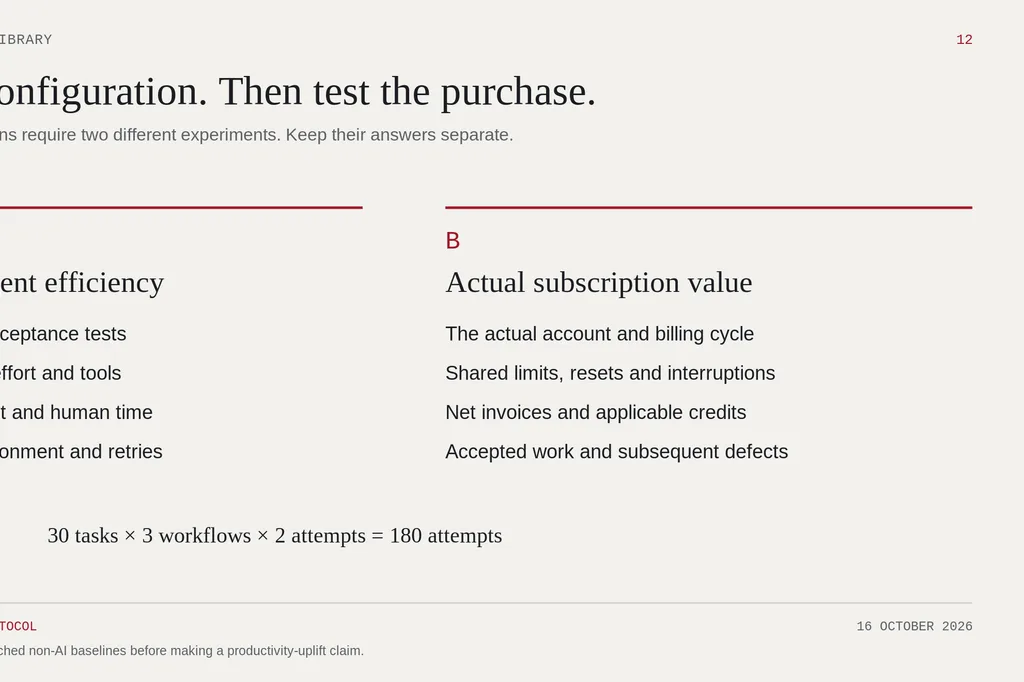
Add a matched non-AI baseline where a productivity claim is intended. Otherwise the study can compare AI workflows but cannot establish how much AI improved on the alternative.
Record first-pass acceptance, capped-repair acceptance, human minutes, elapsed time, cash cost, fully loaded cost, interventions and subsequent defects. Record failures with the same care as successes. A model that edits away the test has not passed the test.
Set a stopping rule before the work starts. A third retry should have a reason: new evidence, a different configuration or a corrected environment. Repeating an unproductive loop with a larger allowance is not an optimisation strategy. Hard budget boundaries matter precisely because agents can continue consuming resources without producing an acceptable result.3940
The work, not the meter
The cheapest model is not always the cheapest workflow. The strongest benchmark configuration is not always the best purchase. And the subscription with the largest allowance is not automatically the one that gives its owner the most useful capacity.
The answer depends on the work, the acceptance standard, the surrounding tools, the operator and the conditions under which the system may run.
That is less convenient than a universal ranking. It is also more useful.
Do not begin by asking which provider will let you consume the most intelligence. Begin by defining what must be true when the work is finished. Then identify the least expensive eligible workflow that can meet that standard reliably.
AI value is not intelligence consumed. It is useful work accepted—and value retained after acceptance.
Method and limitations
This edition combines vendor documentation, independent evaluator results, original studies and explicitly labelled practitioner or observational evidence. It does not report a new installation trial, subscription stress test or production experiment. Official entitlements establish advertised access, not delivered outcomes. Benchmarks establish performance under their own task distributions and accounting rules, not the yield of a consumer subscription.
Prices and leaderboards were checked for this dated edition. Dynamic pages can change; the values cited here are those selected on the access date, with their sources and caveats. Image editing was refreshed during finalisation. Professional-artifact configuration names retain the evaluator’s fallback qualifier. Historical evidence is dated rather than presented as a current-model verdict.
The scope centres on ChatGPT/Codex, Claude/Claude Code and Cursor, with Google and image-model evidence where relevant. It is not a complete market catalogue. Video, audio, every regional offer, every enterprise contract and every self-hosted alternative are outside this edition’s quantitative comparison. No universal monthly token allocation or completed-work quota has been invented where the public evidence does not provide one.
The opening session is an author-supplied recollection, not an independently checked transcript. Source entries distinguish that provenance from public documentation. AI assisted the research, drafting and figure production. The hero is generated conceptual artwork; the evidence figures are drawn deterministically from the dated source data. Published on 16 October 2026 with the author’s approval.
Sources
Footnotes
-
Author-supplied account of the 15 October 2026 session, provided in the research brief on 16 October. No independent transcript was inspected. The wording attributes inspiration, not endorsement. ↩
-
botts.ai. About us: Yves Zumbühl. Accessed 2026-10-16. Primary identity / affiliation. Verifies name and affiliation only. Does not independently verify the 15 October session or endorse this essay. ↩
-
OpenAI. Codex / Work pricing. Accessed 2026-10-16. Vendor entitlement. Current individual/business prices; local-message estimates are not delivered tasks. ↩ ↩2
-
Anthropic. Claude Code on Pro or Max. Accessed 2026-10-16. Usage terms. Shared session and weekly limits; monthly API credits not interactive Code overages. ↩ ↩2
-
Cursor. Models and pricing. Accessed 2026-10-16. Usage terms. Shared weekly Cursor/Grok pool; explicit third-party model usage extra; Auto Cost routing nuance. ↩ ↩2
-
Cursor. Legacy Cursor plans. Accessed 2026-10-16. Legacy entitlement. Existing Pro/Pro+/Ultra separate from new X subscriptions; migration permanent. ↩ ↩2 ↩3
-
Google. Gemini usage limits. Accessed 2026-10-16. Usage terms. Compute-based five-hour and weekly limits; no fixed universal tasks/month. ↩
-
OpenAI. About ChatGPT Pro tiers. Accessed 2026-10-16. Vendor entitlement. Pro 100/200/500; Pro 200 grandfathering through 29 October. ↩ ↩2
-
Anthropic. Claude pricing. Accessed 2026-10-16. Vendor entitlement. Free, Pro, Max and Team; 5x/20x refer to five-hour sessions. ↩ ↩2
-
Cursor. New X subscription pricing. Accessed 2026-10-16. Vendor entitlement. Plus 8, Premium 30, Super 100, Ultra 200 USD/month. ↩
-
Google. AI subscriptions. Accessed 2026-10-16. Vendor entitlement. Plus 4.99, Pro 19.99, Ultra 99.99/199.99; Flow credits distinct from tokens. ↩
-
OpenAI. ChatGPT pricing. Accessed 2026-10-16. Vendor entitlement. Pro image creation described as unlimited, subject to guardrails; not an API or runtime SLA. ↩
-
Anthropic. Monthly API credits. Accessed 2026-10-16. Vendor entitlement. Max 100/200 USD; separate eligible API usage; expires monthly; no interactive Claude Code. ↩
-
OpenAI. Banked Codex resets. Accessed 2026-10-16. Promotion terms. Conditional promotional refresh, not cash; next weekly reset date moves. ↩
-
OpenAI. Paid weekly resets. Accessed 2026-10-16. Billing terms. Eligibility and checkout price vary; reset is immediate. ↩
-
Anthropic. Enterprise Code Review promotional credits. Accessed 2026-10-16. Conditional promotion, 15 Oct 2026. 10,000–50,000 USD; paid eligible Enterprise only; claim by 15 Jan 2027; 30 days; excludes GHES, .ghe.com residency and ZDR setups. ↩ ↩2
-
Anthropic. Artifact promotion. Accessed 2026-10-16. Expired promotion. Ends 15 October 23:59 Pacific = 16 October 08:59 Europe/Zurich; no weekly discount or Claude Code. ↩
-
Cursor. Student discount. Accessed 2026-10-16. Expired promotion. New sign-ups discontinued 25 June 2026; previous redemptions keep rate until expiration. ↩
-
Artificial Analysis. Coding Agent Index methodology v1.5. Accessed 2026-10-16. Independent benchmark. 113 DeepSWE, 66 Terminal, 124 Q&A tasks; 3 attempts each; API-cost accounting, not subscriptions. ↩
-
Artificial Analysis. Claude Code versus Codex. Accessed 2026-10-16. Independent benchmark. Snapshot agent/effort rows; pooled task-attempt costs, not price per accepted production delivery. ↩ ↩2 ↩3
-
Artificial Analysis. Claude Code versus Grok Build. Accessed 2026-10-16. Independent benchmark. Grok Build is not Cursor; do not relabel its result. ↩
-
Artificial Analysis. Cursor’s Composer 2.5: third on the Coding Agent Index and ~10–60x lower cost than rivals. Accessed 2026-10-16. Historical benchmark report, 20 May 2026. Earlier suite and model configuration; historical results excluded from current v1.5 comparison. ↩
-
Anthropic. Code Review costs and usage. Accessed 2026-10-16. Vendor pricing. Usage billing separate from subscription allowances; check current review-level pricing. ↩
-
Anthropic. Code Review launch. Accessed 2026-10-16. Historical vendor estimate. March launch estimate 15–25 USD/review; not a fixed all-review price. ↩
-
Noy and Zhang / CEPR. Productivity effects of generative AI. Accessed 2026-10-16. Controlled study, 2023. Writing time -40%, grades +18%; historical tasks, not a 2026 subscription comparison. ↩
-
Noy and Zhang / Science. Experimental evidence on the productivity effects of generative artificial intelligence. Accessed 2026-10-16. Original study, indexed abstract. 453 participants; 40% lower completion time and 18% higher quality scores. Full journal text not retrieved; indexed abstract and author-written CEPR account used. ↩
-
Artificial Analysis. GDPval-AA v2.1. Accessed 2026-10-16. Independent benchmark. 220 tasks / 44 occupations / 9 industries; model-judged. Preserve Max, Default Fallback labels: Opus 1866 ±26, Sonnet 1838 ±23; Grok 4.7 Xhigh 1711 ±22. ↩
-
Artificial Analysis. Text-to-image v2.1. Accessed 2026-10-16. Independent benchmark. Human pairwise preference; API reference prices at 1024 square/default settings. ↩
-
Artificial Analysis. Image editing v2.1. Accessed 2026-10-16. Independent benchmark. Editing preference snapshot refreshed: Grok Imagine Image 2.0 is 1117 ±13, replacing 1115 ±13 in the initial research file. ↩
-
Hugging Face. Claude and MCP image generation. Accessed 2026-10-16. Integration documentation. Claude can orchestrate external image generators; costs/access are separate. ↩
-
Microsoft Research / Peng et al.. Impact of AI on developer productivity. Accessed 2026-10-16. Controlled study, 2023. 55.8% faster on a bounded JavaScript HTTP-server task; vendor-linked. ↩
-
METR. Early-2025 experienced developer RCT. Accessed 2026-10-16. Controlled study, 2025. 16 developers, 246 own-repository tasks; AI increased completion time 19%. ↩
-
METR. Experiment-design update. Accessed 2026-10-16. Follow-up, 2026. Late-2025 results suggest possible speedup but selection bias and intervals spanning zero prevent strong causal claims. ↩
-
METR. AI usage survey. Accessed 2026-10-16. Self-report, 2026. 349 technical workers; perceived value and speed gains are not measured causal effects. ↩
-
DX. AI coding pricing and ROI guide. Accessed 2026-10-16. Observational/vendor research. Reports median PR-throughput increase 7.76%; not equivalent to software value. ↩
-
Cursor. Privacy and data governance. Accessed 2026-10-16. Data-flow documentation. Prompts/code sent to model/inference providers; no-training does not mean local inference. ↩
-
Anthropic. Claude Code data usage. Accessed 2026-10-16. Data-flow documentation. Retention varies by account/terms; enterprise ZDR qualified and not automatic. ↩
-
OpenAI. Data and inference residency. Accessed 2026-10-16. Data-flow documentation. Storage and GPU execution are separate residency commitments. ↩
-
Simon Willison. Default hard budget caps. Accessed 2026-10-16. Practitioner commentary. Argues for hard spending caps; not a controlled provider productivity comparison. ↩
-
Anthropic. Claude Code costs. Accessed 2026-10-16. Vendor usage observations. About 13 USD/developer/active day; 150–250/month; no completed-output denominator. ↩