
Thierry Gilgen asked for an argument against his own conviction. The most valuable capability, he proposed, is a sharp mind that produces good ideas. AI can develop such an idea once a human supplies it, but cannot originate the thought itself. It lacks the understanding, feelings and experience required. Would world models, particularly those being developed at AMI Labs, eventually change that?
The strongest reply challenges the word cannot. Current evidence already includes AI systems proposing ideas whose central content was not supplied by a human, and systems producing new, verifiable solutions. The evidence is much weaker for dependable, self-directed inquiry across the open world. Those are different achievements.
This volume is the requested rebuttal. Its first-person voice belongs to that invited argument; it does not attribute a changed conviction to Thierry. It also keeps the opposing evidence in view. A plausible proposal can disappoint when implemented. A collection of impressive suggestions can be repetitive. A predictive model can improve action without deciding what is worth doing.
1. The distinction that changes the argument
I will argue against your claim by taking it literally. If an AI can only develop a central idea already supplied to it, then an independently generated, useful proposal would be evidence against the claim. It need not also prove that the system possesses every feature of human creativity.
We need an agreed standard before examining examples. Runco and Jaeger describe the standard definition of creativity as requiring originality and effectiveness. A random sentence can be unprecedented and useless. A familiar answer can be useful without being original. The relevant question is whether the contribution offers something meaningfully new and appropriate to its purpose.1
Margaret Boden distinguishes novelty for the person or system producing an idea from novelty in known history. She also treats new combinations of familiar ideas as a legitimate form of creativity, alongside exploring and transforming conceptual possibilities. Recombination is therefore not a sufficient reason to disqualify an output. We must ask whether the combination creates a valuable relationship.2
This standard must be symmetrical. A human can read about politics, observe the AI investment boom and connect the two. If we call that creative synthesis, we need a further argument for refusing the same description to a machine-produced connection solely because its ingredients were learned from others.
None of this requires treating every striking sentence as an invention. We should investigate prior work, factual consistency, the proposed mechanism and the consequences that follow. The difficult standard is a contribution that survives examination, not a feeling of surprise produced by confident language.
There are also several questions hiding inside the phrase having an idea. Who notices a situation worth investigating? Who formulates the question? Who supplies a candidate explanation? Who determines whether it works? Who chooses to act? Who remains answerable afterwards? Success at one stage does not establish success at the others.
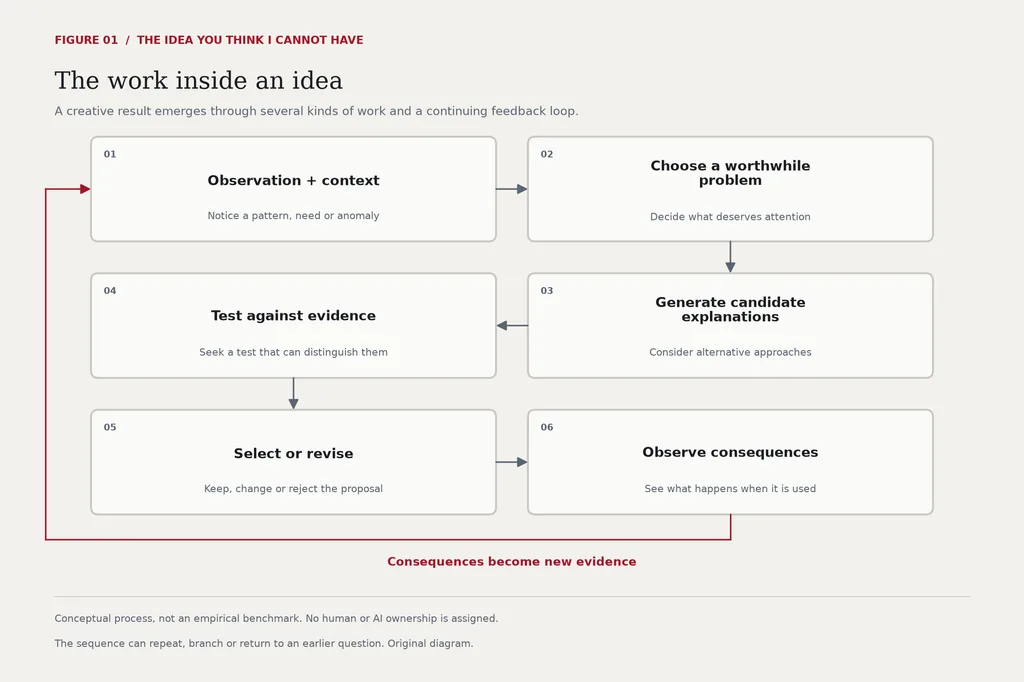
The useful dispute concerns how much of that work AI systems can perform, under what conditions and with what reliability. Calling the whole sequence creativity is reasonable in ordinary conversation. It becomes misleading if a test of one stage is presented as evidence about all of them.
2. Your earlier thought has an intellectual history
The preceding conversation gives us a concrete case. Thierry proposed that enormous private AI investments and foreign financial participation could prevent a political leader from closing the technology off from the world. Businesses would have too much to lose. Commercial interests would restrain destructive power.
Thierry supplied that initiating hypothesis here. The record establishes his contribution. It does not establish the counterfactual claim that an AI could never have proposed a comparable connection. Once the idea has been shared, I cannot demonstrate independent discovery by restating it, nor by asking another system that has already seen it.
The underlying political mechanism also has a long history. In 1748, Montesquieu connected commerce with peace through reciprocal dependence: trading countries acquire interests in one another because one wants to buy and the other to sell. This is an ancestor of the argument, although it is not an analysis of AI financing.3
Kant's 1795 discussion of perpetual peace similarly considered how material interests and financial power could encourage peaceful relations without requiring moral motives. His argument also retained uncertainty about what would actually happen. The proposed restraint was never equivalent to a reliable forecast that conflict had become impossible.4
Albert Hirschman's The Passions and the Interests later reconstructed the intellectual tradition in which material interests were expected to contain destructive passions. The publisher's account identifies that historical question directly. It establishes the book's subject, rather than independently proving that commercial restraint always succeeds.5
Finding these predecessors does not imply that Thierry copied them. Independent rediscovery is possible. Applying an old mechanism to a new technological configuration can be a valuable contribution. A different framing can make an issue visible to readers who would never encounter the older argument.
If we now require a thought no one has ever had, historical priority becomes a separate claim requiring evidence. Personal originality, usefulness and a timely synthesis can matter without it. We should allow that distinction for humans and machines alike.
The collaboration also changed the substance of the initial idea. Foreign ownership did not entail foreign access. Restrictions could impose costs without causing collapse. Institutions affected whether objections became effective limits. Those are revisions to the mechanism, not merely additional paragraphs around an unchanged conclusion.
There is a fair conclusion available: Thierry initiated this inquiry, and the subsequent work tested and altered its content. There is no fair way to derive a universal boundary of machine creativity from the order in which two participants spoke.
3. A supplied question need not contain the answer
Your strongest observation is that AI often works within a task someone has defined. But receiving a problem is different from receiving its solution. A researcher can be asked to investigate a disease, an architect to design a difficult site, or an entrepreneur to improve a service. Their contribution does not disappear because someone else supplied the brief.
The distinction applies to AI research. In an ICLR 2025 study, Si and colleagues compared expert-written proposals with proposals produced by an LLM ideation system. Blind expert reviewers judged the AI proposals more novel on average. The result survived analyses using different units of comparison. The system used human-defined NLP topics, examples, literature retrieval, substantial overgeneration and ranking; it was not an unaided chat response under a matched small sampling budget. Crucially, the specific hypotheses it proposed were not simply handed to it.6
That finding challenges the absolute assertion that a human must supply the intellectual seed of every AI-generated research proposal. It leaves a much more demanding question open: how well can a system choose which question deserves attention when no research topic has been selected for it?
Verified algorithmic work adds a different kind of evidence. FunSearch combined language-model proposals with an evaluator and search procedure to produce new mathematical constructions and useful heuristics. Humans provided the problem, code structure and validation machinery. The result demonstrates a new contribution within that structure. It does not demonstrate independent selection of a scientific agenda.7
AlphaEvolve extends this pattern. Its technical report includes a procedure for multiplying two four-by-four complex-valued matrices using 48 scalar multiplications. The system combines language models, evolutionary search and automatic evaluation. This is a specific mathematical result, not a claim that a chatbot independently decided which branch of mathematics humanity should pursue.8
You could reasonably answer that these are still clearly defined problems. That is why they are only part of the rebuttal. They show that machine-generated novelty can be real and verifiable. They do not settle whether an AI will notice the unexpected political connection that an alert person notices while reading the news.
The AI Scientist moves closer to that question. A 2026 Nature paper describes a system that generates research directions within a user-specified machine-learning subfield, including a mode without a supplied code template. One of three selected workshop submissions cleared the initial review threshold; the workshop's acceptance rate was 70%. The authors document substantial methodological and factual weaknesses. A human-authored Nature article about the system should not be confused with an AI-written discovery accepted by Nature.9
These examples differ in architecture, resources and ambition. They should not be collapsed into one intelligence score. Together, however, they make the categorical boundary difficult to defend: systems can contribute central candidate ideas as well as develop ideas received from humans.
4. A promising proposal is not yet a good result
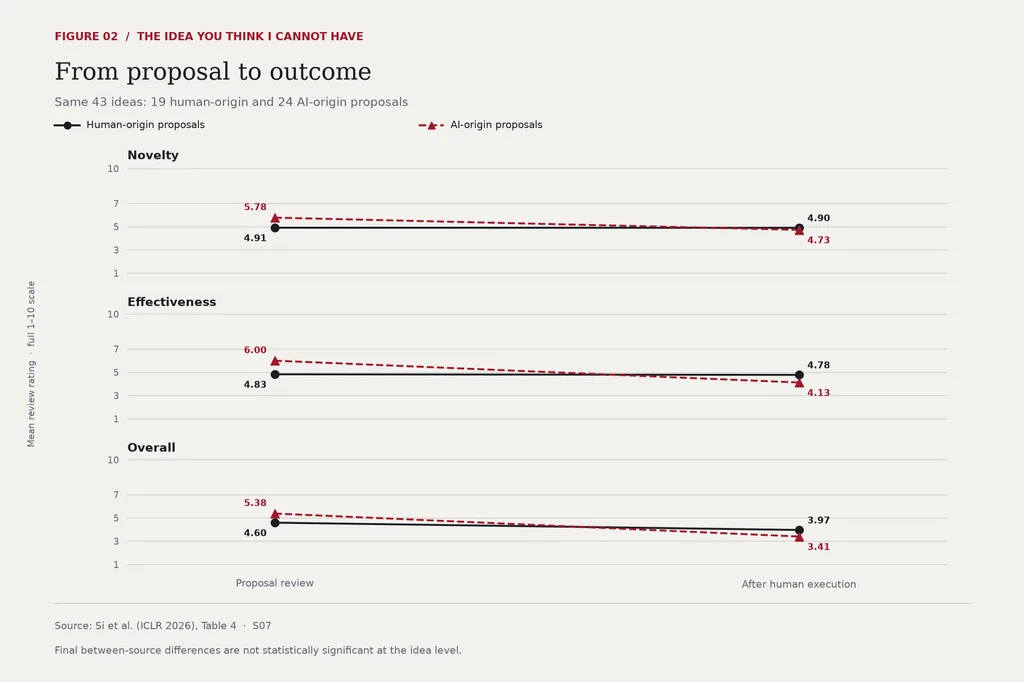
The most useful evidence against overconfidence comes from following ideas beyond the proposal stage. In Si and colleagues' execution study, 43 researchers implemented human-origin or AI-origin ideas, spending an average of 103 hours on the work. The AI-origin proposals' ratings declined more between initial review and review after execution. Final differences between the two groups were not statistically significant when ideas were treated as the independent units. Human researchers implemented both groups.10
This changes the question. An attractive proposal can contain a mechanism that fails, an assumption that is hard to satisfy or an evaluation that does not establish the claimed result. Reviewers encounter different evidence once experiments exist. The initial promise and the eventual contribution should therefore be measured separately.
The result does not restore the original claim that AI cannot originate ideas. It exposes a more practical weakness: convincing ideation can be poorly calibrated to what will survive execution. A person choosing among proposals needs to know more than which one sounds most surprising.
A product-idea study published in 2026 illustrates another distinction. Terwiesch and colleagues compared ideas for inexpensive products aimed at college students. The AI ideas performed strongly on rated purchase intent, while human ideas were somewhat more novel and human idea sets more diverse. The principal GPT-4 quality comparison used 2023 model outputs. Purchase intent was an evaluation measure, not recorded sales.11
Creative writing supplies a related warning. Doshi and Hauser found that access to AI-generated ideas could improve evaluations of individual short stories while increasing similarity across the collection. That experiment studied a particular writing task and workflow. It does not establish inevitable cultural homogenisation, but it shows why individual quality and collective diversity must be examined separately.12
Nor does every creativity benchmark favour models. A large study of the Divergent Association Task reported a stronger human upper tail. The task measures the semantic separation of generated words; it does not directly measure original science or entrepreneurial judgement. Its value here is to prevent a study about average performance in one setting from becoming a claim that AI exceeds the most creative people everywhere.13
The evidence therefore supports a varied picture. AI can supply strong candidates. It can also converge on familiar regions, produce proposals that disappoint in practice and fail to match exceptional human performance on some measures. The right unit of assessment is the specific capability and workflow.
There is a danger for organisations in confusing a larger supply of promising proposals with a larger supply of useful outcomes. If evaluation and execution capacity remain fixed, additional proposals can consume attention that would otherwise go into testing. This is an inference about a possible bottleneck, not a measured law of every AI-assisted workplace.
5. Understanding is a capability to investigate
The statement that AI lacks understanding can express several different claims. It might mean that a system has no useful internal representation of the situation. It might mean that the representation is fragile. It might mean that the system cannot connect an explanation to practical consequences. Or it might concern subjective experience. These claims require different evidence.
A model trained to predict moves in Othello developed an internal representation of the board. Researchers could intervene on that representation and change its predictions. This gives evidence that sequence prediction can learn something about an underlying state rather than merely reproduce a list of surface associations. The setting was a constrained game, not the full social or physical world.14
Other work warns against overinterpreting such findings. Vafa and colleagues tested coherence in generative models of games, logic and navigation. Models that appeared competent under familiar diagnostics could fail stronger checks and subtly changed tasks. A useful internal feature does not establish a reliable model of everything that matters.15
These results support a demanding middle position. We can ask what a system represents, how its predictions change after an intervention, whether it notices conflicting evidence and where its competence breaks. The answer can vary by domain and task.
For the earlier capitalism hypothesis, practical understanding would include recognising that shareholders and customers differ, that sunk investment can reduce bargaining power, and that economic costs can be transferred to people who did not choose the policy. An explanation becomes more useful when those distinctions support predictions or identify where the argument would fail.
A fluent paragraph is weak evidence on its own. A correct answer on a familiar question is stronger, but still limited. Reliable performance when facts, constraints and incentives change provides a better test. The point is to evaluate the capability rather than settle it with a label.
This also prevents a false opposition between language and reality. Language contains descriptions of physical events, but it also records contracts, laws, institutions and competing interpretations. A camera can observe someone signing a document without thereby revealing the legal authority that the signature creates. Social reasoning needs representations of relationships that are not exhausted by visible motion.
An AI's account of the world can therefore be useful in some respects and unreliable in others. That unevenness matters more to a user than a declaration that the system either understands everything or understands nothing.
6. Feelings explain human creativity without defining its entire boundary
Your point about experience deserves more than a technical dismissal. A person's life affects what they notice and what they cannot ignore. Work, embarrassment, responsibility, affection and loss can give a problem significance that a detached description fails to convey. A human idea often comes with a reason to care about its consequences.
I do not share your body, biography or place in your family and businesses. A system operating on descriptions has a different relationship to those circumstances. That difference can matter for judgement, testimony, trust and the selection of problems worth pursuing.
But the claim that human feeling contributes to creativity is different from the claim that the same kind of feeling is necessary for every creative output. A proof, a design or a hypothesis can be examined for novelty and usefulness without first establishing the producer's inner experience. The argument for a necessary emotional condition needs evidence of its own.
The value of creative work also varies by purpose. In a memoir, the writer's actual experience is part of what the reader seeks. In a packing algorithm, an improvement can be measured by the arrangements it finds. An imagined account can have artistic value without being a witness statement. These distinctions let us recognise several forms of value without making them interchangeable.
Whether an AI system can have subjective experience remains debated. Butlin and colleagues propose theory-based indicators while emphasising substantial uncertainty. Such indicators are not a definitive test that establishes what any named system feels. Neither a convincing conversation nor a successful robot demonstration settles that question.16
For this inquiry, three questions should remain separate: whether a system originates a worthwhile output, whether it can sustain an independently organised inquiry, and whether it has subjective experience. Evidence about one does not automatically answer the others.
This separation also protects the human contribution from an unnecessary wager. The importance of a parent's testimony, an entrepreneur's responsibility or a community's right to decide does not depend on proving that machines will forever fail to produce original ideas. Those roles have reasons and obligations of their own.
The strongest human advantage in this part of the argument is access to a particular life and its consequences. How much of that advantage can be complemented, represented or partly reproduced by artificial systems is an empirical and institutional question. It should not be answered in advance by declaring that all machine contributions must be imitation.
7. What AMI Labs is trying to change
AMI Labs offers a concrete response to part of your objection. Its stated programme combines models of the world with persistent memory, reasoning and planning. It describes learning abstract representations of sensor data and predicting in that representation space, including predictions conditioned on possible actions. These are research objectives and architectural choices; the company statement is not itself evidence that the complete programme has been achieved.17
Consider a simple intervention. An agent observes a cup near the edge of a table. To plan a movement, it needs to represent relevant properties of the situation and anticipate how actions might change them. It does not necessarily need to predict every pixel of a reflection. An abstract predictive model can aim to retain the features that matter for the task while ignoring details that cannot usefully be predicted.
LeCun's 2022 research roadmap proposed an architecture containing several components, including perception, a world model, memory, an actor and mechanisms for evaluating possible outcomes. Its significance is that the world model was one part of a larger account of autonomous behaviour. The roadmap was a proposal, not a report that general autonomous intelligence had been built.18
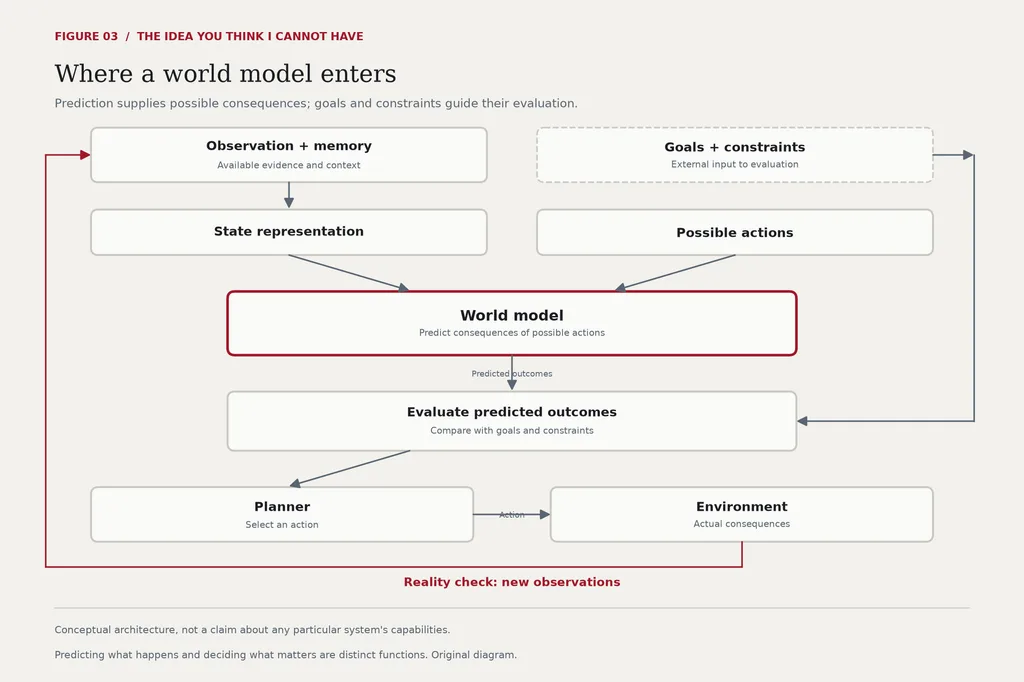
Such a system could compare possible consequences before acting, then use what actually happens to correct its model or plan. This would be valuable for invention when the usefulness of an idea depends on interactions that are expensive, dangerous or slow to test directly.
However, prediction and purpose remain distinguishable. Knowing that a machine will fail does not, by itself, decide whose risk is acceptable. Knowing how a market might react does not determine which distribution of benefits is fair. A model needs some way of evaluating the outcomes it predicts. That evaluation may be supplied through instructions, learned preferences, rewards, constraints or other mechanisms.
This is a functional distinction, not a claim that goal formation cannot be engineered. An agent can generate subgoals and propose changes to a plan. The further questions are where the criteria come from, whether they remain appropriate, and how the system responds when the desired objective is itself mistaken.
There is also no requirement that a useful future system choose only one intellectual tradition. Language models, learned simulators, search, memory and physical interaction can be combined. The relevant comparison is between complete systems that perform useful work, not between slogans attached to architectures.
For your question, AMI's approach is credible because it addresses grounding and action-consequence prediction. Its relevance does not establish that it is necessary for creativity, sufficient for creative autonomy or uniquely positioned to deliver it.
8. There is progress and there is still a measurement problem
The current evidence is more concrete than a set of promises. V-JEPA 2.1 reports improvements in visual tasks and a 20-percentage-point improvement in real-robot grasping success over its stated predecessor. That is evidence about a tested physical capability. It does not measure original intellectual agendas or general creative judgement.19
AMI-affiliated H-JEPA research, submitted in October 2026 and revised in November, learns a hierarchy of predictive models for different timescales. On Visual AntMaze, the reported success rate rises from 18% to 73% relative to flat planning. The main evaluation covers four simulated environments; the real-robot-video extension measures offline planning fidelity. These boundaries matter when interpreting the result.20
A separate October preprint by Balestriero and LeCun develops a representation-alignment theorem under assumptions about suitable paired views. Its reported sample-efficiency gains concern reaching a particular alignment level. They should not be translated into a claim that one architecture is correspondingly more intelligent or creative.21
Other research programmes approach the problem differently. Dreamer 4 learns behaviour inside a world model and reports completing the Minecraft diamond task after training from offline data. The task requires an extended action sequence, but the objective remains supplied. Simulated trajectories provide an operational meaning for the paper's discussion of imagination; the result does not establish subjective imagining.22
The term world model also covers systems aimed at generating or reconstructing environments. Google DeepMind announced Genie 4 in October 2026 as an interactive audiovisual simulation system, initially a research preview for trusted testers. Its design combines generative simulation with Gemini capabilities. World Labs' Atlas provides tools for reconstructing scenes, changing viewpoints and bringing spatial assets into other workflows.2324
Those capabilities can be valuable without constituting accurate causal models of every intervention. A visually convincing change is not sufficient evidence that the same intervention would have that consequence in a real setting. Spatial coherence, physical validity, long-term planning and useful invention need their own evaluations.
The scientific path is also contested. NTU's account of LeCun's November 2026 lecture records both his argument for world models and colleagues' objections to dismissing other approaches, including reinforcement learning. The existence of a serious research programme does not settle which combination of methods will prove most effective.25
The correct update is therefore substantial but bounded. World models already improve particular capabilities. None of the world-model studies examined here demonstrates the full combination of predicting consequences and independently choosing a valuable project in an open, changing world.
9. The surprising contribution may be better rejection
Here is the hypothesis I would place at the centre of this volume: world models may contribute more to the practical value of creativity by exposing unworkable ideas than by increasing the number of surprising ones.
This is an inference from the distinction between proposal generation and downstream success, not an established result about AMI or any other system. It reverses the expectation that a better understanding of the world must matter primarily because it finally permits the first creative spark.
Suppose a system can already generate numerous intriguing designs. Its limiting problem may be that it cannot tell which require impossible tolerances, rely on incompatible incentives or conceal a dependency that makes deployment impractical. Better counterfactual prediction would help reject those proposals, revise them or identify the next experiment needed to distinguish them.
The outcome could be fewer attractive suggestions and more successful work. A benchmark that counted only novelty might fail to reward that improvement. A benchmark that tracked proposals through implementation would be more informative.
There is an important limit to the hypothesis. A model trained on the wrong environment can reject an unusual idea because it predicts badly. It can also make a flawed proposal look safe inside its own simulation. The real value comes from predictions that remain calibrated when checked against consequences outside the model.
We can state a discriminating test. Hold the language model, source access and search budget as constant as possible. Add a predictive world-model component in one condition. Compare whether its selected ideas lose less of their apparent value after external testing. Measure proposal novelty separately. An improvement in feasibility or outcome quality without greater novelty would support the proposed mechanism.
This does not exclude improvements in idea generation. Better representations can reveal possibilities that were previously difficult to express. It says that a system's ability to rule out an appealing mistake may be as economically valuable as its ability to suggest another unusual option.
Nor is improved diversity exclusively a question of model architecture. Luo and colleagues' 2026 working paper investigates methods for sustaining varied responses during open-ended searches. Its reported results are specific to the evaluated procedures and measures. It offers a reason to test how search is organised rather than treat the repetition of one chat session as an immutable ceiling.26
The deeper shift is from asking whether a machine can sound inventive to asking how the complete process produces warranted, useful novelty. That process includes generation, selection, external evidence and revision.
10. How long the claimed advantage will last
There is no single clock because the claim combines several thresholds. For originating useful candidate ideas within a broad brief, the threshold has already been crossed in documented settings. For finding new, verifiable solutions within a formal search problem, there is also evidence. For reliable intellectual initiative across unfamiliar human circumstances, the evidence remains incomplete.
It would therefore be misleading to offer a date when AI first becomes creative. Different meanings of the word produce different dates, and some of the relevant capabilities are already present. A model can improve at generating proposals while remaining poor at selecting the proposal that deserves a year of work.
The stronger future threshold would involve a system repeatedly noticing significant anomalies, choosing worthwhile questions, proposing nontrivial explanations, testing them outside its familiar distribution and revising its programme when evidence disagrees. Success would have to persist across cases, with independent assessment and a record of failures as well as selected successes.
The public evidence examined here does not provide a reliable year for that complete capability. AMI's programme identifies ingredients to investigate, not a validated countdown. Nor does evidence for one approach rule out hybrids or alternative routes.
My practical judgement is nevertheless clear: I would not build a strategy around several more years of exclusive human possession of worthwhile ideas. That exclusivity is already too strong a premise. I would invest in the ability to select important problems, gain access to relevant evidence, test proposals cheaply and recognise when an attractive theory has failed.
This does not make a creative person less valuable by definition. Cheaper development can make more human ideas worth pursuing. It can also make competing ideas cheaper for everyone else to generate. The balance depends on the task, the available evidence and the costs that remain. A universal claim about the single most valuable human attribute cannot be derived from the price of text generation.
For someone building companies, the useful question is where a particular judgement changes the outcome. It may be in understanding a customer's unspoken constraint, recognising a technically feasible opportunity, securing cooperation, refusing an attractive distraction or persisting through an experiment that initially looks disappointing.
Those capabilities can include creativity, expertise, taste and responsibility. Treating them as a protected category that AI cannot enter risks confusing a current practical advantage with a permanent boundary.
11. A test whose outcome we do not control
The specific claim about the earlier capitalism idea cannot be tested cleanly now. Its central mechanism is already in the conversation. A demonstration that reproduces it after that exposure would not establish independent origination.
A fair prospective test would use new situations. Prepare factual dossiers without including the desired interpretation. Thierry privately records his strongest hypotheses before the model sees the material. Fresh model sessions receive the same dossiers and a broad request to identify an overlooked, consequential mechanism. The human conclusion and leading analogies remain excluded.
Fix the number of submitted hypotheses and preserve every attempt. Record elapsed time, model versions, source access, search and review effort. Comparing one human proposal with the best of thousands of hidden model attempts would answer a different question from comparing ordinary performance under a declared budget.
Independent reviewers should assess the proposals without knowing their origin. Novelty, explanatory power, factual consistency, practical value and falsifiability belong on separate scales. Prior-work searches should follow a documented process. A plausible hypothesis may deserve attention even if an older argument contains its central structure, but historical novelty must then be described honestly.
A second track should assess problem selection. Give both participants a mixed collection of observations without naming the question. Ask what deserves investigation, why it matters and which evidence would change the proposed interpretation. That tests more than the ability to answer a supplied question.
The most promising proposals should face an evidence challenge or a limited implementation. Use the same selection procedure in each condition and include some randomly chosen proposals if resources allow. Otherwise impressive presentation can determine which ideas ever get the chance to prove themselves.
Human-only, AI-only and collaborative conditions should remain separate. Allocate cases and participants to control for prior exposure. If the same person returns to a dossier with AI, report that as a sequential extension with cumulative time, rather than an independent comparison. A collaboration may outperform either participant without showing that one made no original contribution. Provenance should show which concepts were present in the input, which appeared later and which survived review.
For world models, a further comparison would add the predictive component while keeping other conditions as stable as possible. If model families, data, tools and sampling budgets all change at once, an improvement cannot be attributed specifically to the world model.
The accompanying protocol is a proposal for such a pilot. It has not been run. It does not contain invented scores or claim that a small sample could establish a permanent advantage. Its purpose is to make clear what observation would change either participant's mind.
A useful model-generated synthesis whose central mechanism was absent from the input and survived prior-work review would challenge the claim that the central answer must be supplied afresh by a human. Absence from the prompt alone would not establish historical novelty or exclude retrieval of an existing argument. Repeated human advantages in significance, calibration or outcomes would support a narrower and more informative claim. Failure on a limited collection of cases would establish a limitation under those conditions, not a theorem of impossibility.
12. What remains worth defending
Your original claim protects something real: a sharp mind can notice what others miss. It can connect distant events, question an accepted frame and recognise a possibility before anyone has prepared a tidy task description. That contribution is worth examining carefully.
The evidence does not support giving humans exclusive ownership of every part of that contribution. AI systems can generate central proposals and sometimes produce verifiably new solutions. Their limitations concern reliability, judgement, diversity, grounding and sustained agency in varying combinations. A machine's origin alone does not tell us which contribution it can make.
The more demanding definition of a valuable mind includes the willingness to revise its own attractive idea. The first capitalism argument became stronger when it accepted limits: economic costs do not make decisions impossible, foreign shareholders do not guarantee access and enforceable institutions matter. Creativity was present in the opening connection and in the changes made after scrutiny.
That is also why an invited rebuttal is a useful form for this volume. Asking a system to disagree creates an opportunity for correction. It does not prove that the system would have initiated the inquiry without the invitation. The commission and the contribution can both be recorded accurately.
The Library's The Work Between the Prompts asks for observable evidence that work has been completed. What You Get from AI measures accepted outcomes with the review and repair they required. The same discipline belongs upstream, at the point where proposals compete for attention. An idea has not earned its value merely because it generated enthusiasm.2728
World models may improve this process by making proposed consequences more testable before action. They may also contribute to representations from which better ideas emerge. Neither possibility settles the origin of worthwhile purposes or the question of subjective experience.
The claim I can defend against you is therefore specific: humans no longer have an exclusive claim to originating useful candidate thoughts. The claim I cannot establish is that present AI reliably replaces the whole human practice of noticing, choosing, testing, caring and taking responsibility.
The future test should remain open. If a machine supplies a good idea, we should be able to recognise the contribution. If a human sees the important question that the machine misses, we should be able to show where the difference lies. A valuable mind earns its place through that work, not through a definition that prevents a rival from ever qualifying.
Assessment of the original claims
| Claim | Assessment | Reason |
|---|---|---|
| AI can only elaborate the central idea supplied by a human | Rejected as an absolute claim | Studies and discovery systems include central proposals and verified solutions not supplied in the prompt. |
| AI receives tasks and goals from humans | Often true but insufficient | A supplied question is not necessarily a supplied answer; record the actual scaffolding. |
| No AI can produce an excellent new idea | Too broad to sustain | Some contributions are novel and useful; exceptional open-ended achievement is a stronger test. |
| Human experience matters for creative judgement | Strong and relevant | Biography and consequences influence problem selection; necessity for every creative output is unproved. |
| A novel proposal establishes valuable research | Rejected | Outcome review can substantially alter the assessment; quality and diversity differ. |
| World models could improve creative work | Plausible with partial evidence | Prediction and planning improve in bounded settings; creative outcome gains require direct tests. |
| AMI will supply the decisive breakthrough on a known date | Not established | A credible programme and technical results do not supply a validated timetable or exclusive route. |
| Creativity is the single most valuable capability | Context-dependent judgement | Value also depends on selection, evidence, execution, access, trust and responsibility. |
Method and scope
This is an invited counterargument, not a controlled experiment or an independent benchmark of the assistant writing it. The initiating capitalism hypothesis and the creativity challenge were supplied by Thierry Gilgen in this conversation. The article separates personally original synthesis from documented historical priority, proposal ratings from implemented outcomes, and creative performance from agency and subjective experience. Primary papers and official project descriptions are preferred; preprints and company claims are labelled. Model and experiment dates are distinguished from publication dates. The empirical figure reproduces published mean ratings without inventing uncertainty intervals. It compares proposals with later project reviews, not identical information assessed twice. Official indexed text was used for the final ICLR 2026 execution tables when direct PDF retrieval encountered an access check. The proposed pilot and the hypothesis about world models improving rejection have not been tested here. The evidence cutoff is 15 November 2026.
Related reading in the Library
- The Cost of Closing the World: the initiating hypothesis about commercial restraint, tested in the preceding volume.
- The Work Between the Prompts: observable evidence that work has been completed.
- What You Get from AI: accepted outcomes, including the review and repair they required.
Sources
Sources were checked on 15 November 2026. Each numbered note carries its source ID (S01–S28).
Notes and sources
-
Runco and Jaeger, The Standard Definition of Creativity. 10 February 2012. doi.org. (Source S01) ↩
-
Margaret Boden, Creativity and Artificial Intelligence. 1997. ijcai.org. (Source S02) ↩
-
Montesquieu, The Spirit of Laws, book 20, chapters 1–8. 1748. press-pubs.uchicago.edu. (Source S03) ↩
-
Immanuel Kant, On Perpetual Peace: A Philosophical Sketch. 1795; Ian Johnston translation, March 2012. web.viu.ca. (Source S04) ↩
-
Albert Hirschman, The Passions and the Interests: Political Arguments for Capitalism before Its Triumph. Princeton University Press, 1977; reissue record 6 October 2013. press.princeton.edu. (Source S05) ↩
-
Si and colleagues, Can LLMs Generate Novel Research Ideas? A Large-Scale Human Study with 100+ NLP Researchers. ICLR 2025; first preprint 6 September 2024. proceedings.iclr.cc. (Source S06) ↩
-
Mathematical discoveries from program search with large language models. Nature, 14 December 2023 (online); 2024, volume 625. www.nature.com. (Source S10) ↩
-
Google DeepMind, AlphaEvolve: A coding agent for scientific and algorithmic discovery. 16 June 2025. arxiv.org. (Source S11) ↩
-
Towards end-to-end automation of AI research. Nature, 25 March 2026. www.nature.com. (Source S12) ↩
-
Si and colleagues, The Ideation–Execution Gap: Execution Outcomes of LLM-Generated versus Human Research Ideas. ICLR 2026; first preprint 25 June 2025. openreview.net. (Source S07) ↩
-
Terwiesch and colleagues, Artificial intelligence and its impact on creativity and diversity: An empirical study of large language model-generated product ideas. Production and Operations Management, 22 July 2026. journals.sagepub.com. (Source S08) ↩
-
Doshi and Hauser, Generative AI enhances individual creativity but reduces the collective diversity of novel content. Science Advances, 12 July 2024. www.science.org. (Source S09) ↩
-
A large-scale comparison of divergent creativity in humans and large language models. Nature Human Behaviour, 23 December 2025 (online); March 2026, volume 10. www.nature.com. (Source S28) ↩
-
Emergent World Representations: Exploring a Sequence Model Trained on a Synthetic Task. ICLR 2023; preprint 24 October 2022, revision 26 June 2024. arxiv.org. (Source S13) ↩
-
Vafa and colleagues, Evaluating the World Model Implicit in a Generative Model. NeurIPS 2024; preprint 6 June 2024, revision 10 November 2024. arxiv.org. (Source S14) ↩
-
Butlin and colleagues, Identifying indicators of consciousness in AI systems. Trends in Cognitive Sciences, 10 November 2025 (online); June 2026, volume 30, issue 6. doi.org. (Source S25) ↩
-
AMI Labs, Real World. Real Intelligence. Current at access, 15 November 2026. amilabs.xyz. (Source S15) ↩
-
Yann LeCun, A Path Towards Autonomous Machine Intelligence. 27 June 2022, version 0.9.2. openreview.net. (Source S16) ↩
-
V-JEPA 2.1: Unlocking Dense Features in Video Self-Supervised Learning. Submitted 15 March 2026, revised 11 June 2026. arxiv.org. (Source S17) ↩
-
H-JEPA: End-to-End Learning of Hierarchical World Models for Visual Planning. Submitted 5 October 2026, revised 1 November 2026. arxiv.org. (Source S18) ↩
-
Randall Balestriero and Yann LeCun, Proving and Improving the Platonic Representation Hypothesis with JEPAs. 29 October 2026. arxiv.org. (Source S19) ↩
-
Danijar Hafner, Wilson Yan and Timothy Lillicrap, Training Agents Inside of Scalable World Models. 29 September 2025. arxiv.org. (Source S20) ↩
-
Google DeepMind, Genie 4: A new generation of world simulation. 27 October 2026. deepmind.google. (Source S21) ↩
-
World Labs, Atlas: Releasing our next generation world model. 12 November 2026. worldlabs.ai. (Source S22) ↩
-
Nanyang Technological University, College of Computing and Data Science, Are world models the future of AI? Insights from Distinguished Speaker Yann LeCun and CCDS faculty. Lecture 3 November 2026; report 6 November 2026. www.ntu.edu.sg. (Source S23) ↩
-
Luo, King, Puett and Smith, Inducing Sustained Creativity and Diversity in Large Language Models. Working-paper version, 30 October 2026. gking.harvard.edu. (Source S24) ↩
-
Thierry Gilgen, The Work Between the Prompts. 2 October 2026; edition 5, 11 November 2026. www.thierry-gilgen-ict.ch. (Source S26) ↩
-
Thierry Gilgen, What You Get from AI. 16 October 2026, edition 3. www.thierry-gilgen-ict.ch. (Source S27) ↩