
In October, the fastest graphics card you can buy for a gaming PC quietly disappeared from its maker's own online shop in the United States. A senior NVIDIA executive said in Taipei that production had not stopped and that the company would keep shipping. Elsewhere, the few cards still listed sold for more than twice their launch price.1
Both things can be true at once. That is the uncomfortable part.
A graphics card used to be a toy for a particular kind of person. Expensive, loud, a little unreasonable. But it was built for someone who wanted to play. Today the same class of chip is also what companies use to train and run AI models. One customer buys frames per second. The other buys capacity it can sell again, by the hour, to the whole economy.
Those two customers are not equally strong. This volume looks at what that means for a gamer, for someone who wants to run AI at home, and for a company deciding whether to own its compute at all. It is written from public sources as of 3 November 2026. Prices and rumours move faster than essays, so read the numbers with their dates.
Where the money goes
In the quarter that ended on 26 July 2026, NVIDIA reported revenue of 96.2 billion US dollars. Its Data Center business brought in 89.0 billion of that. Everything else, gaming included, came to about 7.2 billion.2
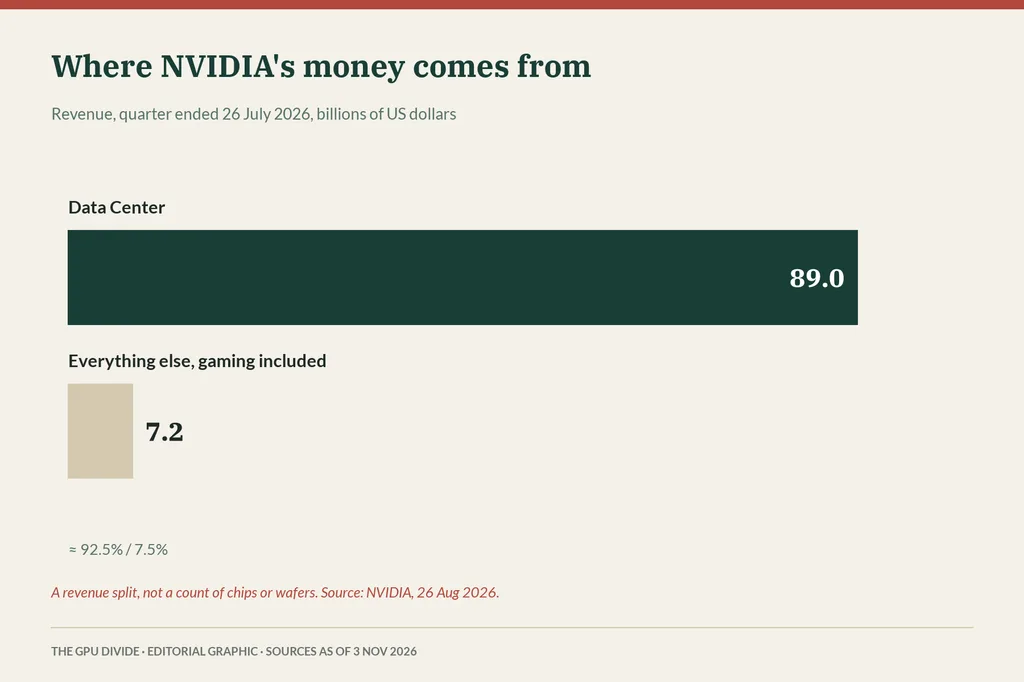
That is roughly 92 cents of every dollar. It is worth reading carefully. It is a revenue split, not a count of chips. A data-centre system sells for far more than a gaming board, so the split says nothing about how many wafers went where. What it does say is where the incentive lies. When capacity is short, a company will look first after the customer that pays for almost everything.
Capacity is short in a second place too: memory. AI accelerators use large amounts of high-bandwidth memory. The market analyst TrendForce expects that memory and ordinary DRAM will keep competing for the same advanced production capacity, with tight supply through 2027.3 That is a forecast, not a fact. And gaming memory is not the same product. But it all comes from the same strained supply chain.
So the real question is not whether NVIDIA still likes gamers. It is whether the person at home is still the customer the fastest chips are built for.
What a gamer should buy now
For a gamer, the honest answer is less dramatic. Buy measured performance at the resolution you actually play.
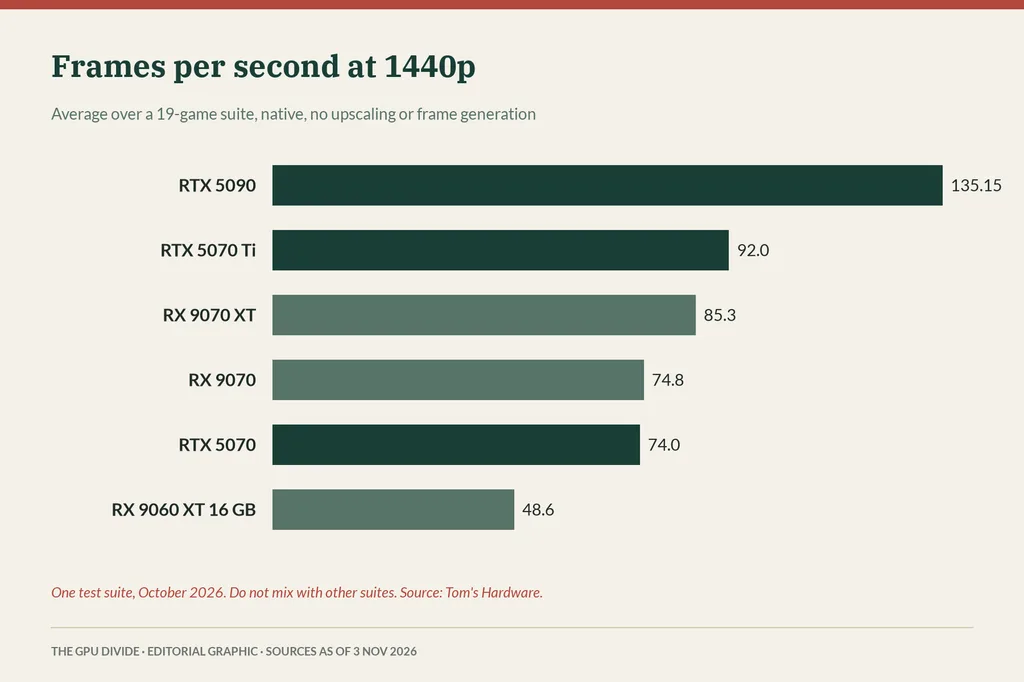
In its October 2026 guide, Tom's Hardware measured an average of 135 frames per second at 1440p for the RTX 5090 across its 19-game suite, without upscaling or frame generation. The RTX 5070 Ti reached 92, the Radeon RX 9070 XT 85, the RX 9070 75, the RTX 5070 74, and the 16 GB RX 9060 XT 49.4 These are results from one test suite. Another suite will give other numbers, and the two should not be mixed.
The same guide sampled a median street price of 4,299 US dollars for the RTX 5090, against 1,999 at launch.4 AMD launched the RX 9070 XT at 599 dollars and the RX 9070 at 549.5 Those are American prices with their dates. Swiss shop prices were not checked for this volume, and they would need the same care: same model, same day, tax and warranty included.
What follows from the numbers is fairly plain. For native 1440p, the Radeon RX 9070 and 9070 XT are strong value. The RTX 5070 Ti costs more but brings NVIDIA's upscaling, better ray tracing and the CUDA software that many AI tools expect. The RTX 5090 is a remarkable machine that makes little sense for gaming alone at today's prices. And if you already own a 4090-class card, keep it. Measure the task that actually hurts before you buy a new logo.
Is the RTX 50 series over?
In 2026, reports said that the RTX 5090 was being halted, and that its chips would go into professional cards instead. In October, NVIDIA's head of GeForce, Jeff Fisher, denied that production had been discontinued. He said supply was constrained and that NVIDIA would continue to ship.1 Earlier in the year, NVIDIA had said it was shipping all GeForce models while dealing with memory shortages.6
The shortage reports are still real. A board partner, quoted through the overclocker der8auer, said it could not order the chip-and-memory package needed to build RTX 5090 cards, and had no reliable date for when that would change.7 That is evidence of a broken supply chain. It is not proof of a cancelled product.
People often mix four different statements. A shop has no cards. A partner cannot get parts. A maker moves production somewhere else for a while. A product line has ended. Only the last one is an end of life. The public record, as of today, supports the first three in places. It does not support the fourth.
The card that does not exist yet
There is no RTX 6090. Not officially. As of 3 November 2026, NVIDIA has announced no specifications, no price and no date.
In September, a well-known leaker predicted that the next GeForce generation might not arrive until 2028. NVIDIA does not comment on unannounced products.8 The company's Vera Rubin platform is real and, by NVIDIA's account, in full production. But Rubin is built for data centres. It is not a promise of a gaming card.2
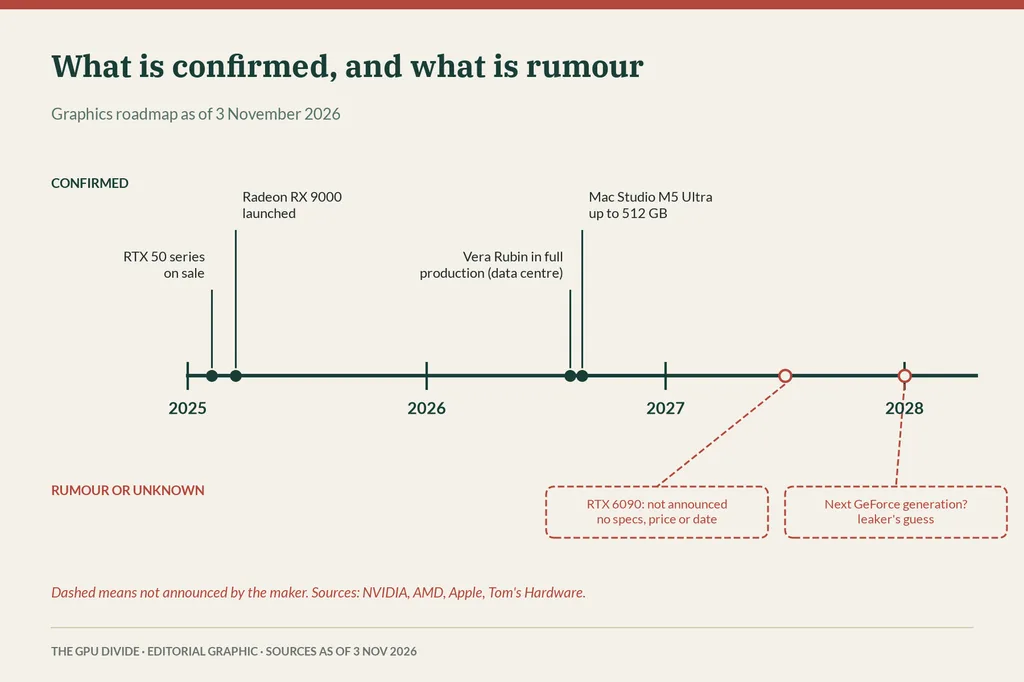
Several futures are possible. A new gaming generation arrives in 2028 and prices relax. Or memory stays tight and the next flagship becomes rarer and more expensive. Or AMD and Intel push harder in the middle of the market, and gamers benefit without any dramatic new NVIDIA card. These are scenarios, not forecasts.
A gamer should not prepay for any of them. Not in money, and not in two years of waiting for a card nobody has announced.
A different bottleneck
Someone who wants to run AI models has different questions. Does the model fit? How fast does the first word appear? How many words per second after that? How many people can use it at once? Does the software actually run on this card?
The first question is about memory, and it has a simple starting point. The weights of a dense model take roughly the number of parameters in billions, times the precision in bits, divided by eight, in gigabytes.
So a 70-billion-parameter model at 4-bit precision needs about 35 GB just for its weights. Then come the cache for the conversation, the runtime and everything else. Real use always needs more than the formula says.
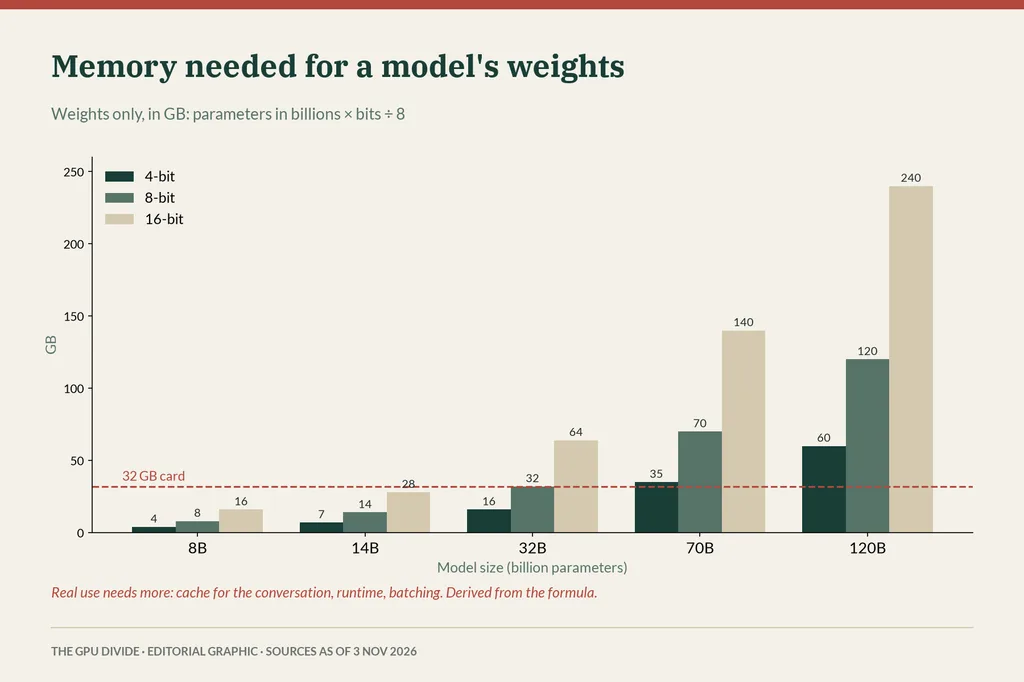
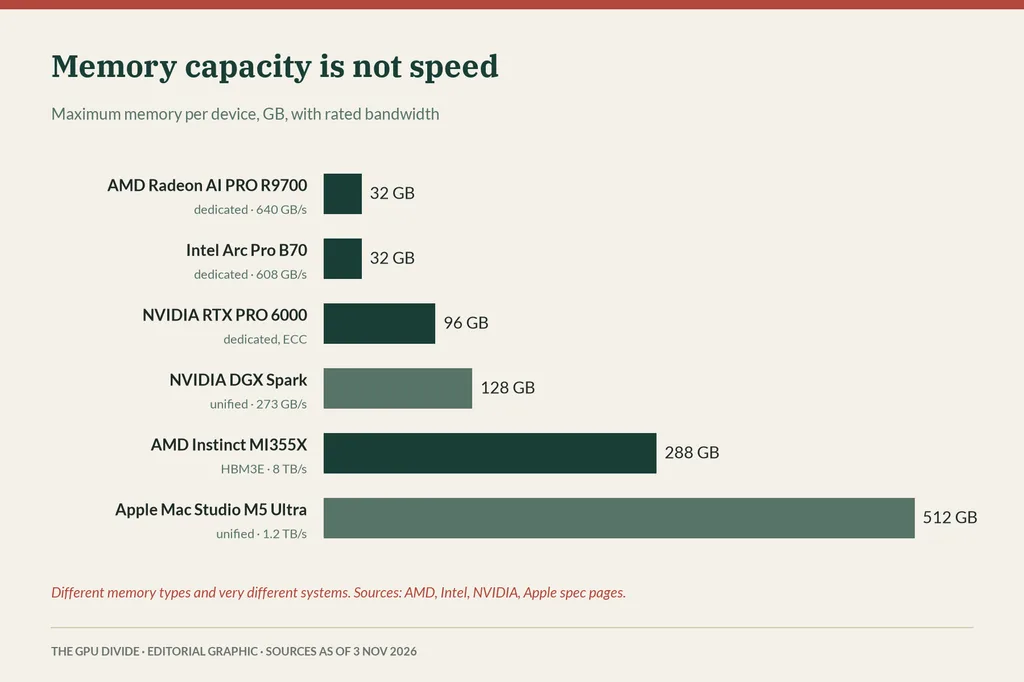
The second thing people miss is the difference between capacity and speed. A desktop with a large pool of shared memory can hold a model that a 32 GB card cannot. It may still produce text more slowly. And the peak performance numbers vendors print, measured at different precisions, are not benchmarks of real work.
What to buy for AI, at home and at work
For a technically capable person, the sensible place to start is usually a well-supported card with 16 to 32 GB of memory, not a server. Sixteen gigabytes is a useful entry point for smaller models and many image tools. Thirty-two gives room for larger models in compressed form.
NVIDIA remains the practical default because so much software is written for CUDA first. The RTX 5090 has 32 GB, but at current prices its case is weak. A used RTX 3090 with 24 GB can be good value, if it is tested and fairly priced.
There are now real alternatives. AMD's Radeon AI PRO R9700 has 32 GB of memory, 640 GB/s of bandwidth and a 300-watt power rating.9 Intel's Arc Pro B70 has 32 GB and 608 GB/s.10 Both are worth a look, if the software you rely on is confirmed to run on them first.
For holding very large models, two small machines stand out. NVIDIA's DGX Spark has up to 128 GB of unified memory at 273 GB/s.11 Apple's Mac Studio with M5 Ultra can be configured with up to 512 GB of unified memory at 1.2 TB/s, with the largest configuration arriving in late October.12 Capacity like that changes what fits on a desk. It does not mean fast service for a whole team.
For a small company, start with the workload, not the rack. Owning hardware brings real advantages: data stays in the house, nobody changes the model under you, and a price rise from an API provider no longer decides your budget. It also makes you responsible for security, patches, monitoring, backups and the day it breaks.
A disciplined path has three steps. Measure on rented hardware. Run one well-instrumented reference machine. Grow only after real use has proven the need. An hour of rented testing can prevent a five-figure mistake. For the reference machine, NVIDIA's RTX PRO 6000 Blackwell offers 96 GB of error-correcting memory, a serious expense that only sustained demand justifies.13
Larger companies are buying an architecture, not a card. At that scale, accelerators such as AMD's Instinct MI355X, with 288 GB of high-bandwidth memory, 8 TB/s and a typical board power of 1,400 watts, belong in data-centre systems, not desktop cases.14 A fair comparison with the cloud includes depreciation, electricity, cooling, support, staff, idle time and the cost of moving away again. The useful measure is completed tasks per Swiss franc. Not parameters per franc, and not peak performance on a datasheet.
Who gets to own compute
A graphics card is an odd symbol of independence. It sits in your house. But it still depends on drivers, compilers, model weights, electricity and software support from someone else. Owning the silicon is necessary for some kinds of independence. It is not enough for all of them.
I wrote earlier this year that the computer is coming home.15 This is the price tag on that idea. Running capable AI yourself is becoming economically meaningful for a household, a small firm, a school or a laboratory. It gives you an option that does not vanish when a provider changes its terms.
It should not be romanticised. A shared cloud is often more efficient when use is low. Not everyone needs a large model at home. Independence has a cost. So does dependence. Both deserve to be measured.
The new divide is not only between people who can afford a five-thousand-dollar card and people who cannot. It is between those who can still choose where their computing runs, and those for whom that choice is quietly narrowing.
Sources
Footnotes
-
PC Gamer (2026-10-19): RTX 5090 not dead, says Nvidia, but it's mysteriously vanished from the company's official marketplace. www.pcgamer.com ↩ ↩2
-
NVIDIA (2026-08-26): NVIDIA Announces Financial Results for Second Quarter Fiscal 2027. investor.nvidia.com ↩ ↩2
-
TrendForce (2026-09-29): HBM and DRAM capacity outlook through 2027. www.trendforce.com ↩
-
Tom's Hardware (2026-10-02): Best Graphics Cards for Gaming in 2026, October update. www.tomshardware.com ↩ ↩2
-
AMD (2025-02): AMD unveils next-generation RDNA 4 architecture with the launch of Radeon RX 9000 series graphics cards. ir.amd.com ↩
-
Tom's Hardware (2026-02-05): Report claims Nvidia will not release new RTX gaming GPUs in 2026. www.tomshardware.com ↩
-
PC Gamer (2026-10): Nvidia may not have discontinued the RTX 5090, but one AIB partner says it can't get hold of the parts. www.pcgamer.com ↩
-
Tom's Hardware (2026-09-21): Nvidia's next-gen RTX 60 GPUs might not be released until 2028, leaker claims. www.tomshardware.com ↩
-
AMD (accessed 2026-11-03): Radeon AI PRO R9700 specifications. www.amd.com ↩
-
Intel (2026-03): Arc Pro B70 datasheet. www.intel.com ↩
-
NVIDIA (accessed 2026-11-03): DGX Spark specifications. www.nvidia.com ↩
-
Apple (2026-08-25): Apple introduces new Mac Studio with M5 Max and M5 Ultra. www.apple.com ↩
-
NVIDIA (accessed 2026-11-03): RTX PRO 6000 Blackwell family specifications. www.nvidia.com ↩
-
AMD (accessed 2026-11-03): Instinct MI355X specifications. www.amd.com ↩
-
Thierry Gilgen (2026): The Computer Comes Home, Vol. 60. www.thierry-gilgen-ict.ch ↩