
The adjective changes
A few years ago, everyone was talking about data sovereignty.
Then it became cloud sovereignty.
Today, almost every discussion seems to revolve around AI sovereignty.
Every conference. Every strategy paper. Every political speech. Every procurement document.
The adjective changes.
The conversation gets louder.
And every time it does, the definition of sovereignty becomes a little smaller.
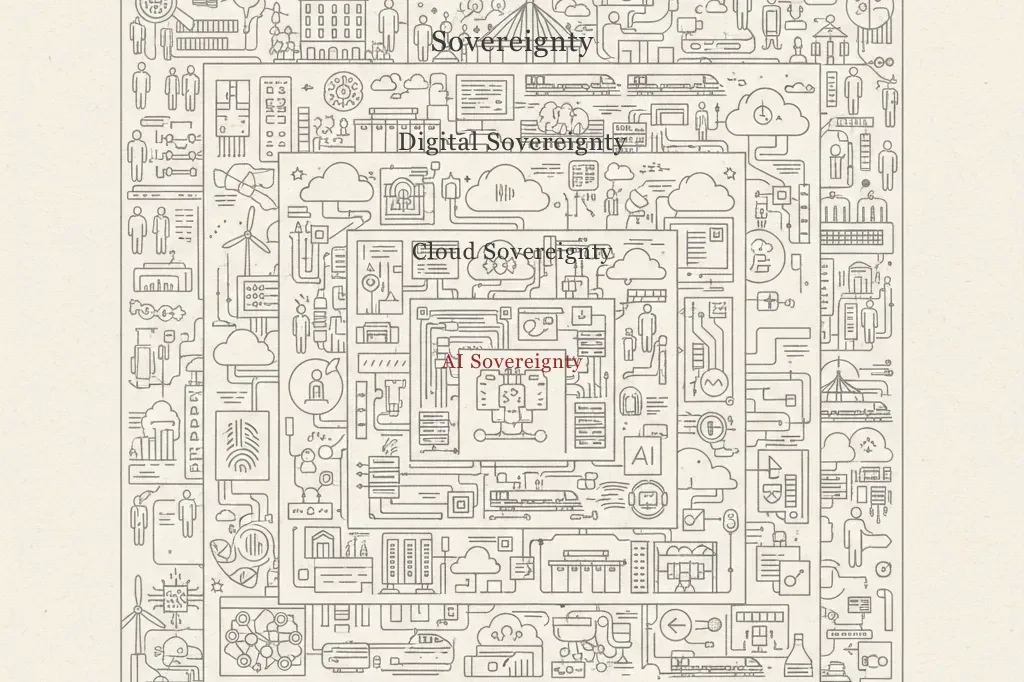
Perhaps we should simply speak about sovereignty.
Not because data, cloud or artificial intelligence are unimportant. Quite the opposite. They matter enormously.
But because sovereignty was never about a particular technology.
It is a property of a system.
The visible layer
Technology has always had a remarkable ability to reshape our vocabulary.
Every generation invents new terms to describe the technology that currently dominates its attention. The internet became cyberspace. Software became the cloud. Automation became artificial intelligence. Now sovereignty itself is following the same path.
Rather than asking whether a country, an organisation or an individual remains sovereign, we increasingly ask whether they possess AI sovereignty.
The subtle shift in language is easy to overlook. The consequences are not.
The irony is that this narrowing happens at precisely the moment when the opposite is required. Artificial intelligence is expanding into healthcare, energy, manufacturing, finance, government, education and critical infrastructure. If AI becomes embedded everywhere, then discussing sovereignty only through the lens of AI risks overlooking everything that makes AI possible in the first place.
This is not an argument against AI sovereignty. Sovereign AI capacity — compute, research, frontier models, operational ownership — is a necessary capability in a world where intelligence is becoming infrastructure. Europe and Switzerland are right to invest in it.
The danger lies elsewhere: mistaking that capability for sovereignty as a whole.
AI sovereignty is an important layer. Digital or technological sovereignty is the wider system that makes that layer usable under pressure. Sovereignty itself is the underlying strategic condition — the preserved freedom to choose, adapt and continue acting on your own terms.
Europe’s Technological Sovereignty Package is revealing in this respect. It is not merely an AI strategy or a cloud strategy. It includes artificial intelligence, semiconductors, cloud infrastructure, open-source software and energy technologies. The European Commission deliberately chose the broader frame. That may prove to be one of the most important decisions in the entire package.
Yet almost immediately, the public conversation returned to AI. Headlines focused on Europe’s multi-billion-euro investment in AI Gigafactories. Commentators asked whether Europe could catch up with the United States. Politicians began speaking about AI sovereignty as if it were the objective itself.
The investment is important. Europe needs compute, world-class research and frontier models. None of this is controversial.
But capability at the visible layer is not the same as sovereignty of the system beneath it.
Someone else’s foundation
Imagine, for a moment, that Europe succeeds.
Imagine it builds the world’s most advanced sovereign language model.
Now ask a different question.
What happens if the energy that powers the data centres remains fragile? What happens if semiconductor supply can be interrupted? What happens if the physical compute, the networks, the cloud platform or the operating system come from somewhere else? What happens if the software supply chain depends on foreign services? What happens if identity and security systems, critical data, the institutions that govern them, or the engineers capable of maintaining the system cannot be replaced — or if legal and operational authority over the switch lies elsewhere?
Is the AI sovereign?
Or is it merely sitting on top of someone else’s foundation?
This is the danger of reducing sovereignty to a single technology. It encourages us to optimise the visible layer while forgetting the invisible ones.
Artificial intelligence is visible. Infrastructure is not. Language models attract headlines. Identity systems rarely do. GPU clusters make excellent press releases. Software supply chains do not.
Yet history repeatedly reminds us that invisible systems are usually the ones that determine resilience.
Different systems, the same weakness
The past two years have been full of reminders.
When a faulty CrowdStrike software update disrupted airlines, hospitals, broadcasters and financial institutions around the world, the problem had nothing to do with artificial intelligence. It was a concentration of operational dependency. A single software component became a global point of failure.
When security researchers discovered undocumented communication modules inside power infrastructure components, the issue was not AI either. It was supply-chain trust. Hardware itself had become a potential dependency.
More recently, restrictions affecting access to some of the world’s most advanced AI models highlighted another dimension entirely. For many organisations outside the United States, access to frontier AI could change almost overnight because the ultimate decision lay elsewhere. Again, this was not primarily an AI story. It was a sovereignty story — a dependency story. A reminder that if someone else controls the switch, they ultimately influence your ability to act.
These incidents share almost nothing technologically.
One concerns software.
One concerns hardware.
One concerns legal control.
One concerns artificial intelligence.
Yet they expose the same weakness.
Dependency.
Perhaps that should tell us something.
Different technologies can expose the same underlying condition: dependency without a viable alternative.
One definition of sovereignty, published this year by the House of Lords Library, describes it as the capacity of a state to govern the rules, standards, infrastructure and data flows that underpin its digital economy on its own terms. I like that definition. But I would simplify it even further.
Sovereignty is the ability to continue making your own choices tomorrow.
Everything else follows from that.
If another government can withdraw access to a technology, your choices become smaller. If one company controls infrastructure you cannot replace, your choices become smaller. If essential knowledge exists only outside your organisation or country, your choices become smaller. Every unnecessary single point of dependency reduces practical sovereignty.
Sovereignty is not binary. It exists on a spectrum. Every unnecessary dependency moves us a little further away from it.
Sovereignty is not a product
That also explains why sovereignty cannot be purchased.
You cannot buy it in the form of a sovereign cloud.
You cannot install it as a sovereign operating system.
You cannot train it into a sovereign language model.
These things may contribute to sovereignty.
None of them are sovereignty itself.
Sovereignty emerges from how the entire system works together.
Governance. People. Infrastructure. Networks. Software. Data. Applications.
Artificial intelligence is one layer — an increasingly important one. But still only one.
Language directs investment
There is another reason why the growing popularity of the term AI sovereignty deserves scrutiny.
Language shapes investment. Governments tend to fund what they can easily explain. It is relatively straightforward to announce a new GPU cluster, a sovereign foundation model or an AI research institute. It is much harder to announce investments in software maintenance, engineering education, procurement reform, open standards, resilient networking or interoperability.
None of these produce spectacular headlines. Yet history suggests they often determine whether complex systems survive periods of stress.
Switzerland offers an interesting contrast. Its Digital Switzerland Strategy for 2026 deliberately speaks about strengthening digital independence and resilience rather than focusing narrowly on artificial intelligence. The emphasis is on the capacity to act under conditions of technological dependency and growing cyber risk.
That feels closer to the essence of sovereignty — not because Switzerland has solved the problem (no country has), but because resilience is treated as a property of the entire ecosystem rather than a single technology.
A more useful question
Perhaps that is the question we should ask more often.
Not: “Do we have AI sovereignty?”
But: “If one important technology disappeared tomorrow, how much of our ability to act would disappear with it?”
That question immediately forces us to think differently. It shifts the discussion away from products and towards systems. Away from ownership and towards capability. Away from technology and towards resilience.
The adjective will change again
Every generation believes the defining technology of its time deserves a new definition of sovereignty.
History suggests otherwise.
Steam power transformed industry. Electricity transformed civilisation. The internet transformed communication. Artificial intelligence will transform almost everything.
Yet sovereignty has never belonged to the technology attracting the most attention. It belongs to those who retain the capacity to choose, adapt and continue acting when technologies, markets and political conditions change.
AI will not be the last adjective. Tomorrow we may speak about quantum sovereignty, robotics sovereignty or biological sovereignty.
The adjective will change again.
Sovereignty should not.
Every adjective makes sovereignty a little smaller.
Perhaps AI should remind us why sovereignty never needed an adjective.
Perhaps we should simply speak about sovereignty.