Microsoft owns LinkedIn. It can afford to advertise on LinkedIn. It can build audiences of millions on LinkedIn.
And still, when Microsoft publishes another corporate announcement, it may receive less visible conversation than a person speaking under their own name.
That is not proof that the platform secretly punishes its owner. It is a more interesting observation.
The ability to distribute a message is not the ability to make somebody care about it.
1. A curious asymmetry
On one side is a global technology company with an extraordinary distribution apparatus: established customers, enormous budgets, product announcements, marketing teams, and a professional network it has owned since 2016. 1
On the other is a person. Not an ordinary person in this case: Satya Nadella, Microsoft’s chief executive, with his own unusually large reputation and following.
Consider the contrast between Microsoft’s company feed and the responses visible on Nadella’s June 2025 European sovereignty announcement. The executive’s post attracted both approval and substantive criticism. Some commenters questioned the relationship between US jurisdiction and European operational independence. 23
There is no reliable way to turn those observations into a platform-wide causal conclusion without collecting a controlled, timestamped set of posts. We would need comparable topics, formats, publication dates, organic and sponsored status, audience composition, and impressions. Public engagement counters do not give us that.
Still, the case exposes a distinction worth examining.
Microsoft owns part of the machinery through which professional attention travels. It does not thereby own the decisions of its users to respond.
A platform can sell access to an audience. The audience retains a measure of agency over what it finds worth discussing.
2. The numbers do not say what the slogans say
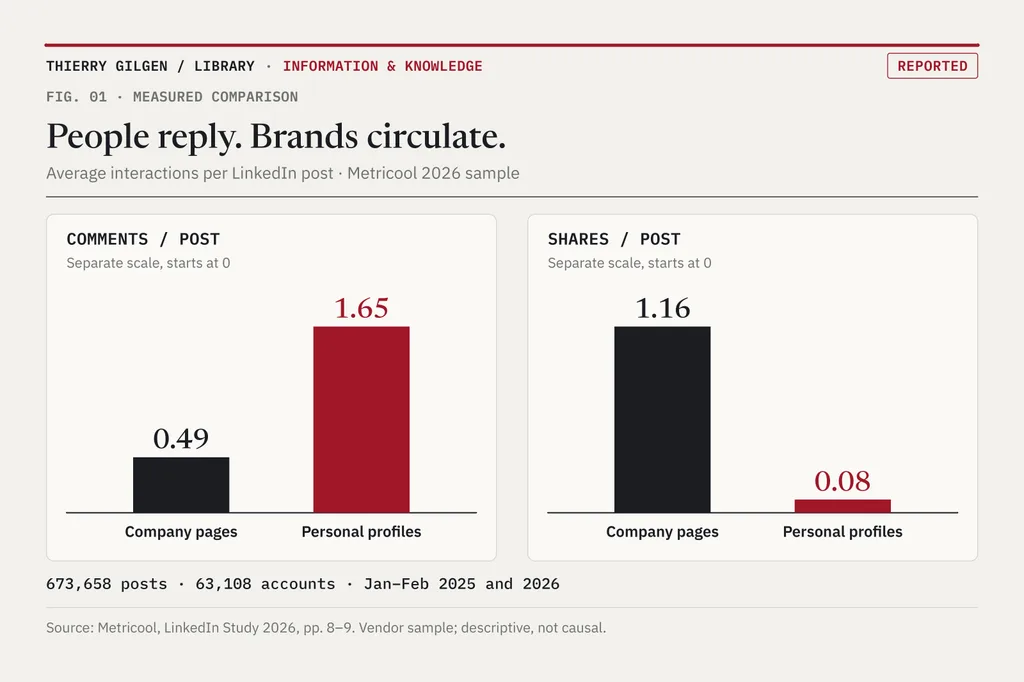
In April 2026, social-media analytics provider Metricool published a study of 673,658 LinkedIn posts from 63,108 accounts, covering January and February in 2025 and 2026. For the first time in that series, it compared company pages and personal profiles. The sample consists of accounts visible to Metricool’s measurement system, not a random census of LinkedIn. 4
The headline appeared to confirm the familiar marketing advice that people outperform brands.
Personal profiles had an average engagement rate of 2.60%. Company pages had 1.60%.
But the second number is just as important. Average impressions per post were approximately 818 for personal profiles and 832 for company pages. The sample showed similar visibility, not obvious evidence that brands had been made invisible. 5
The behaviour following an impression was different. Personal posts received about 1.65 comments on average, versus 0.49 for company pages. Company pages, however, averaged about 1.16 shares, versus 0.08 for personal profiles. The share figure runs counter to the claim that branded communication is simply useless. 5
There is another complication. Metricool reports that likes, comments and shares were lower year over year while clicks increased. Its interpretation is that interactions invisible to casual observers—including opening content and clicking links—make public counters a poor stand-in for total activity. This is vendor-defined engagement measurement, not independent knowledge of LinkedIn’s ranking weights. 4
If an announcement receives few comments but persuades a procurement officer to read a technical brief, the public record may show almost nothing. If a controversial post receives a thousand hostile replies, the public record may show enormous engagement without trust.
Attention is not approval. Engagement is not agreement. Agreement is not authority. And authority is not always commercial value.
3. Why a person becomes easier to answer
A company statement is usually a negotiated object. Legal, communications, sales, product and leadership may all have touched it. That is sometimes necessary. It is also part of the problem.
Corporate language tends to describe what an institution wants audiences to believe. A human voice can explain what someone observed, why it surprised them, what they got wrong, and what they have not resolved.
A 2024 study in Industrial Marketing Management combined a content analysis of 130 LinkedIn profiles with 20 professional interviews. It found that individual-driven profile elements tended to produce more favourable perceptions for B2B engagement than purely corporate-driven elements. This is narrower evidence than an algorithmic experiment, but it supports the usefulness of identifiable personal expertise. 6
LinkedIn itself published a March 2026 engineering account of newer language-model-assisted feed ranking. Its public explanation emphasises professional interests, relevance, and content understanding. It also says it is acting against automated comments, engagement pods and generic engagement bait. Those are descriptions of LinkedIn’s goals and systems—not a transparent audit of exactly how any one post is distributed. 78
The irony is easy to miss: the platform’s owner has a commercial interest in automated communication, while the platform tells its members it wants authentic professional perspectives, not automated scripts.
There is no logical contradiction. Generative AI may help people research or draft while a genuinely accountable author supplies judgment. The distinction is not between handwritten and machine-assisted text. It is between communication for which someone is answerable and content designed only to occupy the feed.
A real person can be wrong. That matters. A real person can be asked what evidence would change their mind.
A brand account usually cannot answer that question with the same credibility.
4. The hidden advantage of already having an audience
The richest people in attention do not necessarily receive the best information, and the best information does not necessarily reach the most people.
Herbert Simon was writing about this problem long before a news feed existed. When information becomes abundant, the limited resource is the attention needed to receive it. 9
Sociology has a related concept: cumulative advantage, sometimes called the Matthew effect. Initial recognition can lead to further recognition, making reputation partly self-reinforcing. That concept explains a possible mechanism; it is not, by itself, evidence that LinkedIn’s 2026 ranking system mechanically favours fame. 10
An established executive can start with an audience of employees, partners, customers, reporters, investors, and other executives. A knowledgeable specialist with a few thousand connections starts somewhere else entirely.
The specialist may publish a better argument and receive fewer reactions.
But two errors follow if we stop there.
First, we might conclude that publishing is futile unless one is already famous. That is unsupported. The question is how recognition can form among a small, interested audience. A paper read by thirty relevant people may be worth more than a joke liked by three thousand strangers.
Second, we might confuse the platform’s apparent unfairness with our own uncertainty about what readers actually do. The number underneath a post is a narrow instrument. It cannot tell us what happened after a reader clicked, forwarded a link privately, cited the work in a meeting, or returned two weeks later.
Those are not comforting stories. They are measurement questions.
5. Advertising works. That does not make it a conversation
Here is the strongest counterargument to the idea that LinkedIn is bad for brands.
LinkedIn sells products specifically intended to generate commercial outcomes. Its Lead Gen Forms offer advertisers reporting on cost per lead, form completion and audiences reached. Its Thought Leader Ads allow a brand to promote a post originating from an identifiable person. The existence of those products does not prove universal effectiveness, but it shows that engagement and business objectives are not identical. 1112
LinkedIn also publishes promotional case studies. One describes Dreamdata’s employee-led material generating higher engagement than brand-led ads and reports a connection to commercial outcomes. As a vendor-selected case, it demonstrates what is possible, not what a typical advertiser should expect. 13
More broadly, Edelman and LinkedIn’s 2025 survey of nearly 2,000 professionals documents the role of thought leadership in B2B buying groups, including people who influence decisions but are not the immediate buyer. The authors define thought leadership as substantive expertise, not principally product advertising. The survey measures reported attitudes and behaviour, not randomised campaign outcomes. 14
There is a reason LinkedIn itself advises brands to publish ideas rather than merely try to sell their products. 15
A company page may perform useful institutional work: announcements, product documentation, recruitment, reassurance to existing clients, and dissemination of material others wish to share. A person may perform a different kind of work: interpretation, argument, accountability, and dialogue.
Treating them as interchangeable forces both to fail at something they were not designed to do.
6. When the message is about trust
Microsoft’s European digital-sovereignty messaging adds a particularly instructive complication.
When its CEO publishes about sovereign cloud, some responses challenge the proposition that data residency or a European operating partner necessarily establishes independence from US law or technology. Other responses praise new local options. A reader can observe this disagreement without inferring the opinions of Europe. 3
A post’s low reaction count cannot establish a public loss of confidence in a supplier. For that, we would want procurement choices, independent technical tests, contractual evidence, vendor-switching behaviour, and surveys with clearly specified populations.
That investigation belongs in a different essay: Control Cannot Be Promised.
Here, the useful point is communicative. A claim about trust requires a form of evidence that public relations cannot create by repetition.
Some claims become more credible when a named person stands behind them. Other claims—including who holds a cryptographic key, who can suspend operations, and who can compel disclosure—remain technical and legal questions no matter who posts them.
Personal credibility can open a hearing. It does not replace proof.
7. A better way to measure a public argument
For a researcher, consultant, or independent publisher, the temptation is to optimise for visible reactions. They are immediate, public, easy to compare, and sometimes discouraging.
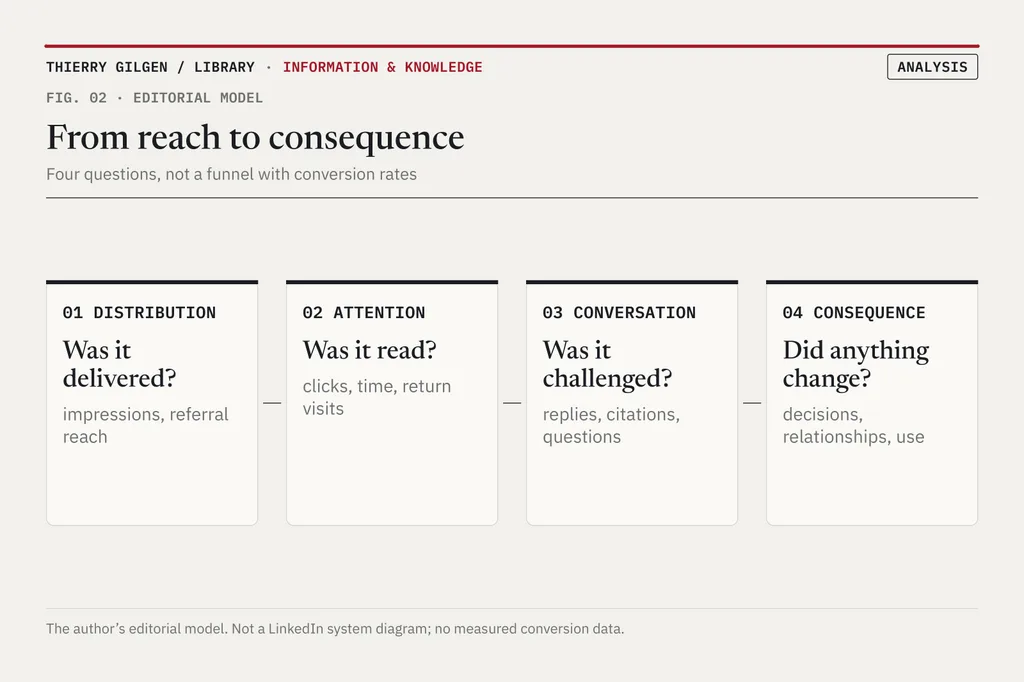
But a serious publishing operation should distinguish four stages:
Distribution. Did the work become available to the people who might need it? Measure impressions or reach, but remember that follower counts are not delivered impressions.
Attention. Did anyone engage with the substance? On an owned website, use privacy-conscious aggregate analytics, scroll/read signals where lawful, return visits, and referral paths. Do not treat a forced pageview as comprehension.
Conversation. Did the argument provoke identifiable questions, criticism, citations, invitations, or correspondence? Count the quality of disagreement as well as the applause.
Consequence. Did the work change a decision, lead to collaboration, enter a briefing, or improve an institution’s understanding? Attribution is often uncertain and lagged, so avoid fictional revenue claims.
Do not manufacture reactions. LinkedIn explicitly says it is working to disrupt engagement pods and unauthorised automated comments. Artificial applause weakens precisely the thing an independent voice should protect: the ability to distinguish a genuine reader from a coordinated signal. 8
Build a record that someone can revisit. Give each piece a stable URL and a clear source trail. Let people arrive through search, a forwarded email, a conversation, or a recommendation as well as the feed.
You cannot force the audience to arrive on the day of publication.
You can make the work worth finding when it does.
8. What a platform actually owns
A platform owns infrastructure, interfaces, economic incentives, and important ranking machinery. It can make some types of communication easier to encounter and other types less visible.
That is substantial power. It deserves scrutiny.
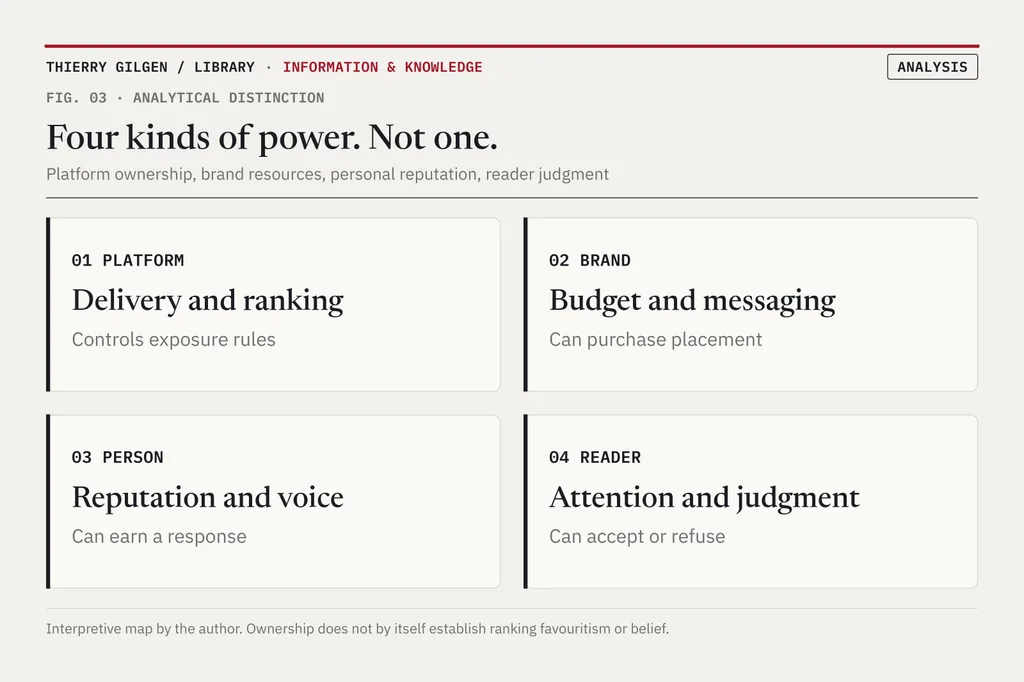
But it is not the same thing as owning people’s judgment. It cannot guarantee that a post will be believed, or that reach becomes respect, or that respect becomes a decision.
The distinction should not make us romantic about professional networks. They do shape the conversation. Their opaque choices affect who is heard. Well-known people can begin with enormous advantages. Independent authors may struggle despite doing careful work.
Nor should it make us romantic about individuals. A charismatic person can distribute nonsense with exceptional efficiency. The presence of a face is not proof of truth.
The important thing is not person versus brand. It is accountable judgment versus institutional volume.
The institution can purchase placement.
The person can attract attention.
Neither one earns authority without a claim worth examining.
Owning the platform is not owning the conversation. And owning the conversation is not owning the truth.
Method and limitations
Research cutoff: 14 October 2026. This essay did not access LinkedIn internal analytics, Microsoft advertising performance, or a controlled post-level comparison of Microsoft and Satya Nadella. Claims about motives, whole populations, or algorithmic penalties are not inferred from reaction counts.
Sources
Footnotes
-
LinkedIn Corporate Communications, 8 December 2016. Microsoft completes acquisition of LinkedIn. Ownership completion date; says nothing about ranking preferences. ↩
-
Microsoft, official LinkedIn company feed, checked 14 October 2026. Microsoft on LinkedIn. Illustrative only; no audited dataset was extracted, and live counters and ranking change. ↩
-
Satya Nadella, LinkedIn post, 16 June 2025. Microsoft announces new sovereign cloud offerings for Europe. Publicly visible, mixed reactions; a non-representative comment thread, not a measure of public opinion. ↩ ↩2
-
Metricool, press release, 14 April 2026. 2026 LinkedIn Study. 673,658 posts from 63,108 accounts, January–February 2025 and 2026. Accounts visible to a vendor’s tool, not a random census; descriptive, not causal. ↩ ↩2
-
Metricool, 16 April 2026. LinkedIn Trends: 6 Strategy Insights from Our 2026 Study. Engagement rates 2.60% and 1.60%; impressions, comments and shares per post from the full study (pp. 8–9). Averages of a vendor sample; no matched control. ↩ ↩2
-
Anastasia Stathopoulou, Maria Kreuzer and Caroline Frisenberg, Industrial Marketing Management 121 (2024), 55–73. Is social media B2B engagement driven by impression management strategies?. Content analysis of 130 LinkedIn profiles and 20 interviews; perceptions in a B2B setting, not a study of the ranking algorithm. ↩
-
LinkedIn Engineering, 12 March 2026. Engineering the next generation of LinkedIn’s Feed. The operator’s own description of an LLM-based ranking system; no independent view of model weights. ↩
-
LinkedIn Newsroom, 12 March 2026. How LinkedIn Is Improving the Feed to Show More Relevant, Authentic Professional Content. Stated action against engagement pods, comment automation and engagement bait; not proof that enforcement catches everything. ↩ ↩2
-
Herbert A. Simon, 1971. Designing Organizations for an Information-Rich World. The concept of attention as the scarce resource; decades old and not a LinkedIn estimate. ↩
-
Robert K. Merton, Science 159 (1968). The Matthew Effect in Science. A mechanism of cumulative advantage; not evidence of a fame advantage on LinkedIn in 2026. ↩
-
LinkedIn Marketing Solutions, checked 14 October 2026. Lead Gen Forms. Product documentation: cost per lead, form fill rate, audience reporting. Not evidence of typical campaign returns. ↩
-
LinkedIn Marketing Solutions, checked 14 October 2026. Thought Leader Ads specifications. Shows the format is sold; says nothing about its effectiveness. ↩
-
LinkedIn Marketing Solutions, checked 14 October 2026. Dreamdata case study. Vendor-selected case: 3–4x higher engagement rate for employee-led than brand-led ads. Shows what is possible, not what is typical. ↩
-
Edelman and LinkedIn, 2025. 2025 B2B Thought Leadership Impact Report. Survey of nearly 2,000 professionals, co-sponsored by the platform; self-reported attitudes, not campaign outcomes. ↩
-
LinkedIn Marketing Solutions, checked 14 October 2026. How to Use LinkedIn for Marketing. Platform advice to brands to publish ideas and thought leadership; promotional guidance, not a ranking guarantee. ↩