From the Analytical Engine to the age of agents: a history of machines, promises, and changing definitions.
The summer that was meant to settle intelligence
In August 1955, four researchers submitted a proposal for the following summer. They wanted a small group of scientists to spend two months at Dartmouth College investigating whether machines could use language, form concepts, solve problems, and improve themselves. Their opening conjecture was radical: perhaps every feature of learning or intelligence could be specified precisely enough for a machine to simulate it.
John McCarthy, Marvin Minsky, Nathaniel Rochester, and Claude Shannon gave the proposed field its name: artificial intelligence. Their document is dated 31 August 1955; the gathering took place in the summer of 1956. These dates matter because the popular version of the story tends to compress a proposal, an event, and the birth of an entire discipline into a single moment.12
The proposal also contains a sentence that deserves to be read again today. Its authors considered the principal obstacle not simply a lack of computing capacity, but the inability to write programs that exploited the machines already available.1
Seventy years later, we argue about the same question from the opposite end. We possess extraordinary computing capacity. We have systems that can write programs. Yet we still struggle to specify what it means for those systems to be dependable, truthful, authorised to act, or sufficiently competent to carry consequences without constant supervision.
The Dartmouth group did not solve intelligence. It gave a durable name to an argument that had already begun—and that has never stopped changing its terms.
That is the history worth telling.
01 · Before AI had a name, it already had a problem
In 1843, Ada Lovelace published extensive notes on Charles Babbage’s proposed Analytical Engine. The engine was not built as designed. But Lovelace recognised that a general-purpose symbolic machine could, in principle, manipulate more than ordinary arithmetic. If relationships could be expressed formally, the machine might work with them. She also warned against exaggerating its powers: it could execute what humans knew how to instruct it to do, not independently anticipate mathematical truths.3
This was neither a prediction of ChatGPT nor a definitive refutation of machine creativity. It was something more useful: a distinction between the machinery, the instructions, and the claims made on behalf of both. Turing would revisit what became known as Lady Lovelace’s objection a century later.4
In 1936, Alan Turing gave a mathematical account of computable procedures. In 1943, Warren McCulloch and Walter Pitts described simplified neuron-like elements in logical terms. In 1948, Norbert Wiener’s Cybernetics offered another vocabulary: feedback, communication, control, and the similarities between organisms and machines. These were different projects, not versions of a single algorithm. But they made it possible to ask how thinking and acting might be treated as processes rather than mysteries.567
In 1950, Turing asked whether machines could think, then replaced the question with an operational test involving conversation—the imitation game. He was not offering a consciousness meter. He was challenging readers to examine what evidence they would accept for intelligent performance and why.4
Notice the order. First came formal computation, artificial neurons, feedback, and argument over evidence. Only later came the institutional label AI.
The name did not create the possibility. It created a field in which incompatible methods could compete for the right to explain it.
02 · The first demonstrations—and their small worlds
Even before Dartmouth, IBM and Georgetown University staged a machine-translation demonstration in 1954. A restricted Russian-to-English vocabulary and a handful of grammatical rules produced an impressive public display. In the carefully controlled setting, the machine did what it was shown doing. What it did not demonstrate was general translation of unrestricted language.8
After Dartmouth, the field quickly developed multiple personalities.
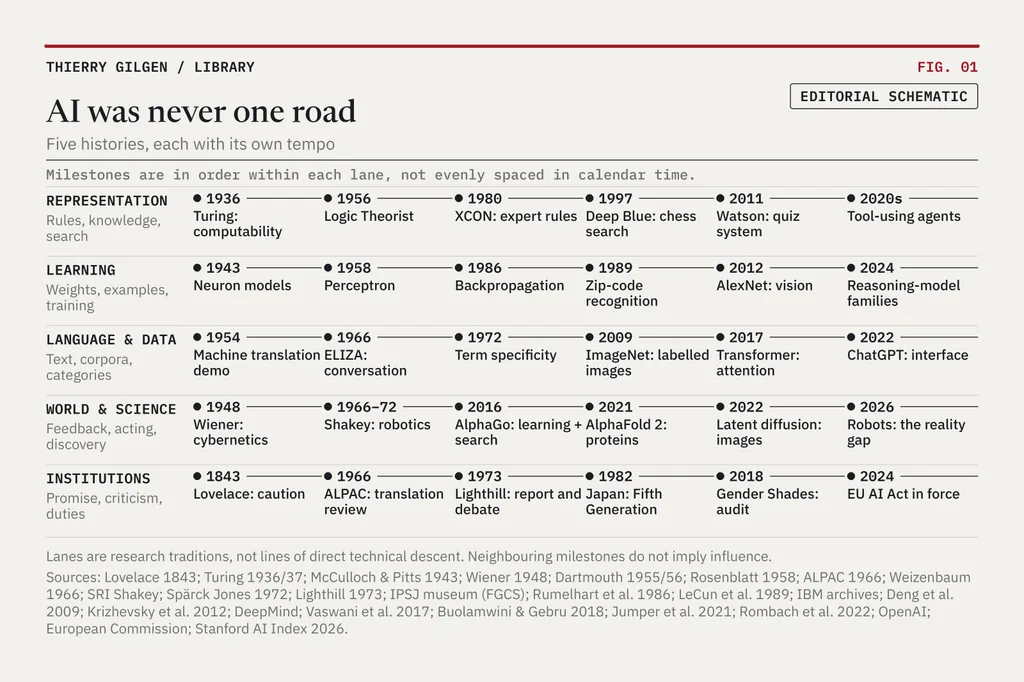
Allen Newell, Herbert Simon, and Cliff Shaw worked on programs that manipulated symbols and pursued logical proofs. This tradition approached intelligence as structured reasoning: represent the world, define allowable operations, search for conclusions. Frank Rosenblatt’s perceptron, publicly demonstrated in 1958, explored a very different ambition: adapt the machine’s behaviour by changing numerical connections from examples. Arthur Samuel’s checkers research showed that a program could improve its play through experience.2910
The popular idea that AI began as symbolic reasoning and only discovered learning decades later is wrong. Learning was present near the beginning. So were methods that looked toward probability, control, search, and embodiment. The question was not whether computers should learn or reason; it was which approach would generalise when the tidy example ended.
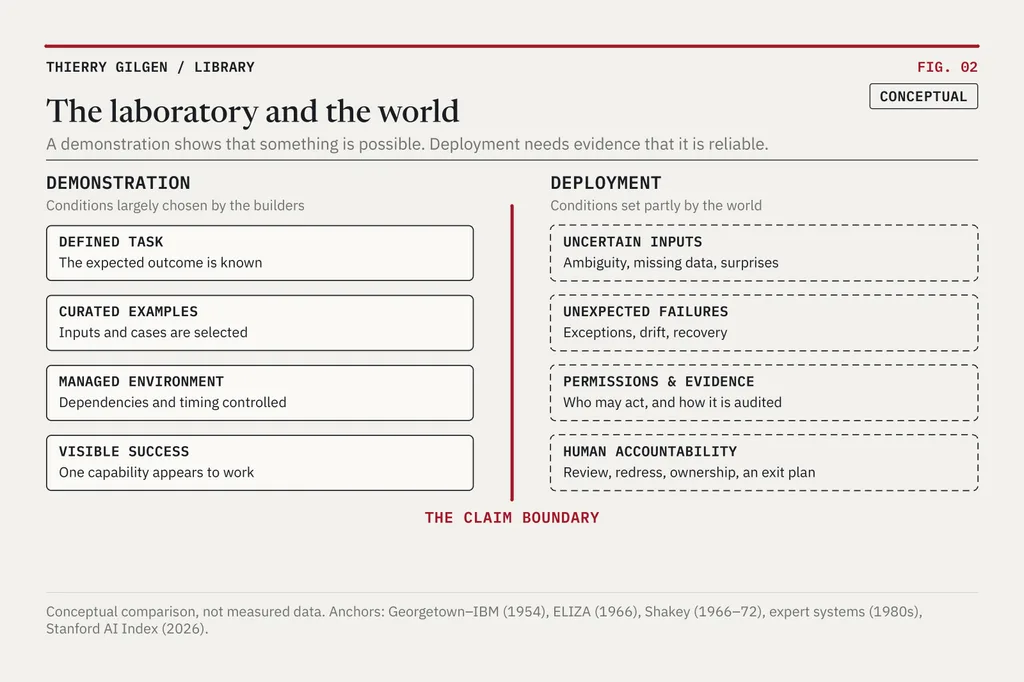
There was also a recurring asymmetry between a demonstration and a deployment. In a demonstration, researchers choose the task, the examples, the timing, and the boundaries. In deployment, the world chooses much of that for them.
This distinction would shape almost every subsequent boom and disappointment.
03 · The machine that sounded as though it understood
Joseph Weizenbaum’s ELIZA, described in 1966, could simulate a conversation by detecting patterns and rearranging parts of the user’s text according to rules. One script resembled a nondirective psychotherapist. Its responses could be astonishingly effective at eliciting further conversation, despite the absence of the understanding many users were inclined to attribute to it.11
ELIZA matters not because it was a primitive version of a modern language model. Technically, it was profoundly different. It matters because it revealed something durable about us: people can infer competence, care, or comprehension from the form of an interaction before inspecting how the system works.
The same year, the United States’ Automatic Language Processing Advisory Committee delivered a sceptical assessment of machine translation. The report challenged optimistic claims about progress and practical value, contributing to a redirection of American funding priorities. It did not stop research everywhere, nor did it prove translation impossible.12
One year could accommodate both the appearance of conversational understanding and the institutional loss of confidence in language technology.
The apparent contradiction is the lesson. A machine can create a convincing local experience without solving the general problem. And a field can make substantial progress without yet delivering the economic or operational results it promised.
04 · Why the first winter came
AI researchers were learning that the obvious examples were often the easy ones. A mathematical puzzle, a simplified game board, or an engineered room could be formally described. Ordinary perception, common-sense knowledge, language, and physical action resisted clean specification.
Shakey, developed at Stanford Research Institute between 1966 and 1972, was a remarkable mobile robot. It could perceive a constrained environment, plan routes, and act upon simple objects. It was not a self-sufficient robot for the unpredictable human world. Its achievement was the difficult integration of seeing, planning, and moving—not the elimination of environmental assumptions.13
The publication of Marvin Minsky and Seymour Papert’s Perceptrons in 1969 exposed limitations of important classes of early perceptron models. A simplified retrospective often claims their book single-handedly killed neural networks. That is too neat. Specific mathematical limits, hardware constraints, research fashions, and funding structures interacted; work on learning networks continued.14
In Britain, James Lighthill wrote a critical assessment of AI research in 1972. It was published in 1973 and argued over in a televised debate that year. Programmes and research priorities were questioned. American funders also tightened expectations in parts of the field. Historians now speak of a first AI winter, often placed in the mid-1970s. But winter is a retrospective metaphor, not a global switch that somebody turned off.15
The most revealing story is not that enthusiasm was irrational. Many early systems were ingenious. The problem was that their successes were easily mistaken for evidence of near-term generality. The tasks we can formalise first are not necessarily representative of the work we ultimately want the machine to perform.
A benchmark can be conquered while the world remains indifferent.
05 · When intelligence became a product of rules
Artificial intelligence did not disappear after the first disappointments. It grew useful in narrower, better-defined work.
DENDRAL helped analyse scientific data in chemistry. MYCIN explored rule-based medical recommendations. In business, expert systems captured specialised knowledge as rules and inference procedures. Digital Equipment Corporation’s XCON, introduced around 1980 to configure computer orders, became an emblem of the approach: software could apply a complicated body of expert rules with real operational value.16
But the rules had to come from somewhere. Domain experts supplied them. Knowledge engineers translated them. Other people corrected inconsistencies, updated exceptions, tested outputs, and maintained an accumulating web of dependencies.
Calling this software intelligent did not remove the human labour that made its intelligence useful.
In 1982, Japan launched the Fifth Generation Computer Systems project, an ambitious national effort centred on logic programming, parallel computation, and new computing architectures. It became a global competitive signal: AI was no longer simply a university question but a matter of industrial strategy. The project produced research and technical results, while its broader commercial ambitions proved harder to realise.17
A second period of disillusionment followed the expert-systems boom in the late 1980s and early 1990s. Commercial maintenance costs, limited flexibility, shifting hardware markets, and inflated expectations all mattered. Again, the field did not stop. Some companies left; other researchers kept working; useful methods were incorporated into ordinary software.
This cycle holds a warning for today’s agent platforms. A prototype that handles the happy path is not a business process. Reliability, updates, exception handling, permissions, recovery, and the cost of human supervision determine whether an apparently clever system deserves to be deployed.
06 · What survived underneath the winter
The familiar history leaps from expert systems to deep learning. Doing so erases some of the most important work.
Karen Spärck Jones’s 1972 research on term specificity helped establish principles of statistical information retrieval: some words carry more discriminating information than others. Statistical and probabilistic methods advanced in speech recognition, language processing, classification, and information retrieval even when headline-making AI ambitions were being reassessed.1819
In 1986, David Rumelhart, Geoffrey Hinton, and Ronald Williams demonstrated how error backpropagation could train multilayer networks to learn useful internal representations. It was a decisive demonstration and popularisation, not the sole invention of the backpropagation idea. Earlier mathematical and computational work mattered.20
In 1989, Yann LeCun and colleagues applied backpropagation to recognising handwritten postal codes. Later neural-network systems would process documents in commercial settings. This was not general intelligence. It was the bridge between an appealing learning theory and repetitive, measurable tasks whose errors and costs could be studied.21
The broader lesson is easy to overlook: not everything that becomes transformative is new at the moment it becomes famous. An idea can wait for appropriate data, chips, tools, institutions, and economics. The breakthrough is sometimes the algorithm. Sometimes it is the environment in which that algorithm finally becomes practical.
AI’s progress resembles a collection of tributaries more than a single river.
07 · The machine wins at chess; the definition moves
In 1997, IBM’s Deep Blue defeated world chess champion Garry Kasparov over a six-game match. The result was historically important. It was also highly specific. Deep Blue combined enormous search, chess knowledge, evaluation machinery, engineering, and human preparation. It did not need to think like Kasparov in order to beat him at chess.22
Once the match was over, people could draw opposite conclusions: computers had crossed a threshold formerly reserved for human intelligence; or chess had turned out to be a specialised computational task rather than the measure of mind we had assumed.
Both claims carry something true, and neither settles the central philosophical question.
In 2011, IBM Watson defeated skilled human players on Jeopardy!, combining language analysis, retrieval, ranking, and structured engineering in a system built for a constrained quiz-show environment. Its victory was real; its architecture and task boundaries mattered.23
These were not detours on the way to a chatbot. They were evidence that different forms of intelligence-like performance can be engineered using different combinations of methods.
The goalposts did not simply move because people were unwilling to credit machines. They moved because success forced us to notice how much more there is to intelligence than the task we had chosen to represent it.
08 · Data becomes part of the invention
The ImageNet project, introduced in a 2009 paper by Jia Deng and colleagues, helped build a much larger, hierarchically labelled resource for recognising objects in images. It depended on the construction of categories, collection of pictures, and human annotation. Data did not arrive as an objective, naturally occurring inventory of the world. Researchers and workers designed and assembled it.24
In 2012, Alex Krizhevsky, Ilya Sutskever, and Geoffrey Hinton showed that a deep convolutional neural network trained with substantial computation could deliver a dramatic result on ImageNet classification. The significance was bigger than one neural-network architecture. It was the convergence of training data, GPUs, optimisation techniques, benchmark infrastructure, and repeatable experimentation.25
Notice the change in what the engineering team had to author. In an expert system, a human encoded an extensive body of decision rules. In a trained neural system, engineers specified the architecture, learning process, dataset, objectives, and evaluation; the fitted representations emerged from optimisation.
The labour changed form. It did not disappear.
Nor did bias disappear because the rules were no longer written by hand. What the dataset represented, what the model optimised, and what the benchmark rewarded remained human choices—sometimes explicit, sometimes invisible.
09 · The world stops being one benchmark at a time
In 2016, DeepMind’s AlphaGo defeated Lee Sedol by four games to one. Its achievement drew on deep learning, reinforcement learning, and tree search. It is often invoked as proof that learning replaced classical AI. The actual architecture tells a more interesting story: distinct methods can strengthen one another.26
In 2017, eight researchers introduced the Transformer architecture in Attention Is All You Need. The paper was motivated by sequence modelling and machine translation. Its design removed recurrent computation from the principal encoder–decoder architecture and made attention central. That architectural choice helped make large-scale language training more effective. The paper did not announce that general intelligence had been solved.27
The years that followed produced several branches, not one inevitable product. BERT, published in 2019 from work released in 2018, showed the power of bidirectional pretraining for language understanding tasks. GPT-3, described in 2020, showed striking few-shot capabilities from a very large autoregressive language model. Scaling research documented empirical relationships between compute, data, model size, and loss, while later compute-optimal work complicated the popular assumption that parameter count alone determines progress.28293031
Elsewhere, AlphaFold 2 made a major contribution to predicting protein structures, with its landmark paper published in 2021. By 2022, the related database contained predictions for roughly 200 million protein structures. Predictions are not the same as experimentally measured structures, and protein-structure prediction is not equivalent to solving biology. Yet the scientific utility is substantial.32
Diffusion-based image generation offered another route to useful generative systems. Modern AI was not converging exclusively on one form of language model. It was becoming a family of industrial and scientific techniques, sharing computational infrastructure but solving different problems.33
A better question than ‘Which model became intelligent?’ is ‘Which forms of capability became reliable enough to matter in which settings?’
10 · When the interface became the turning point
The public remembers 30 November 2022. OpenAI released ChatGPT as a conversational research preview. The event was not the invention of transformers, neural networks, or language models. It was an interface, a training recipe, a distribution decision, and a cultural moment that made a previously specialised class of systems unusually easy to interrogate.34
Human feedback and instruction-following research helped turn raw text prediction into models that more often behaved as assistants. The 2022 InstructGPT work is especially important here. Human preferences could shape model behaviour, but preference optimisation does not automatically confer truthfulness, domain competence, or an obligation to the user’s actual interests.35
GPT-4, introduced in March 2023, expanded the public sense of what one model might do across tasks and inputs, even as its developer documented weaknesses, including confidently wrong answers. Other groups broadened access to model weights and challenged how centralised these capabilities would be. Access to weights, however, is not the same thing as full access to training data, compute, documentation, or the means of independently recreating the system.3637
The interface mattered because it changed the social unit of adoption. Earlier systems often required a research team or a dedicated application. A chatbot invited almost anyone to test thousands of possible uses simply by typing. For the first time, many people encountered AI not as a narrow product feature but as a general-purpose conversational counterpart.
That made the technology easier to understand superficially—and much harder to assess rigorously.
We saw a remarkable paradox: the more fluent the systems became, the more work users needed to do to distinguish eloquence from evidence, completion from correctness, and helpful suggestions from authorised decisions.
11 · The parts of AI history that benchmark charts leave out
Progress measured by accuracy and speed is real. But it is not the entire history.
In 2018, Joy Buolamwini and Timnit Gebru documented substantial error disparities in commercial gender-classification systems. Their Gender Shades study is a reminder that average performance can hide who bears the failures. Its findings were specific to the systems, dataset, and task studied; they should not be copied forward as universal error rates for every subsequent model.38
In 2021, the Stochastic Parrots paper by Emily Bender, Timnit Gebru, Angelina McMillan-Major, and Shmargaret Shmitchell warned of risks involving training-data scale, environmental costs, opacity, and social harms. Some of its arguments about what language models can understand remain debated. Its historical importance does not depend on treating any side of that philosophical debate as settled.39
Training data is collected, licensed, filtered, annotated, and sometimes disputed. Behind datasets sit creators, workers, languages, institutions, and unequal bargaining power. Behind industrial deployment sit infrastructure, electricity, cooling, national policy, and market concentration. Behind a system presented as autonomous often sit human evaluations, safety interventions, tool permissions, and operators handling exceptions.
In 2024, the European Union’s AI Act entered into force, introducing a risk-based legal framework with provisions taking effect in phases. In the United States, NIST’s AI Risk Management Framework offered a voluntary governance structure. These are different instruments. Neither ends the argument. Their emergence is itself a historical shift: evaluating AI is no longer purely a question of whether it performs. It is also about what society permits it to do, who can contest the outcome, and who must correct it.4041
This is where the history of artificial intelligence becomes a history of institutions. The question ‘Can we automate it?’ acquires a necessary companion: ‘Under whose authority, using whose information, with whose right to refuse?’
12 · 2024–2026: more reasoning, more agency, more exposure
From 2024 onward, AI developers increasingly emphasised models trained to spend more computation on difficult tasks, as well as systems able to call tools and carry out multistep work. OpenAI described its o1 reasoning models in September 2024. DeepSeek-R1, released in 2025, illustrated how rapidly reasoning-focused methods could spread across laboratories and national boundaries. The labels reasoning and agent are useful product descriptions, not agreed philosophical verdicts about minds or intentions.4243
Measured progress is substantial. Stanford’s 2026 AI Index reports that leading agents’ success on the OSWorld computer-use benchmark rose from roughly 12% to 66.3% over 2025. It also reports that robots succeeded in only 12% of real household tasks, despite much stronger performance in simulated manipulation environments. Different benchmarks, tasks, dates, and evaluation setups must not be merged into one number called intelligence.44
The same report finds industry produced more than 90% of the notable frontier models in 2025 and that the AI Incident Database recorded 362 documented AI incidents for that year, up from 233 in 2024. The incident count reflects reporting and documentation as well as underlying events; it is not a complete census of all AI harm. But it shows how capability, concentration, and exposure now develop alongside one another.4546
This does not mean that autonomous systems never work. It means that agentic performance must be judged at the granularity of the task, the environment, the authority granted, the recoverability of mistakes, and the frequency of human intervention. Completing a benchmark episode is not the same thing as managing a company’s payroll, handling patient information, or executing a production deployment without supervision.
The 1955 researchers wanted machines to use language and improve themselves. In 2026, that ambition is no longer merely rhetorical. But the practical questions their proposal could leave aside—cost, ownership, data, safety, sovereignty, environmental demand, recovery, and accountability—are now inseparable from the technology.
13 · Seven things this history keeps telling us
1. The demonstration is not the deployment. Georgetown’s translation showcase, ELIZA’s fluent dialogue, early mobile robots, quiz-show victories, and today’s agent benchmarks all teach the same distinction. Performance inside a constructed environment cannot be silently generalised to the uncontrolled world.
2. Learning did not arrive after reasoning. Symbolic methods, neural methods, statistics, feedback, and search have been entangled for decades. The history is not an orderly succession of mutually exclusive religions.
3. The benchmark is not the mind. Chess skill, visual classification, translation quality, benchmark mathematics, and computer-use task completion are meaningful achievements. None is a standalone proof of human-like understanding, consciousness, judgement, or moral agency.
4. The human work moves. Rules gave way to data, datasets to large-scale pretraining, static outputs to tool-using agents. At every stage people defined objectives, selected evidence, provided feedback, supplied infrastructure, and carried responsibility when the system failed.
5. Economics chooses which inventions become history. Faster computation, cheaper storage, datasets, organisational adoption, and investor support can turn an old technique into the defining breakthrough of a new decade. History written entirely as a sequence of scientific papers conceals this.
6. Winter is a judgement about promises, not the absence of progress. Important work persisted while funding and attention migrated. The disappearance of a headline is not proof that the underlying research failed.
7. Capability and authority are different things. The ability to produce a correct answer does not confer the right to access a dataset, impersonate a professional, spend another person’s money, or act without a route to challenge and repair.
14 · The question we should have been asking all along
There is a tempting way to end this story. We could assemble a timeline of milestone after milestone, add a curve showing increasing compute, and conclude that the machines are approaching their inevitable destination.
But a timeline can be a poor explanation. It puts breakthroughs in sequence and makes the path look deliberate. History was not deliberate. Researchers backed competing theories. Commercial products succeeded for reasons that philosophy did not predict. Funding vanished and returned. An algorithm could be ignored for twenty years and then suddenly find the hardware and data it needed. A toy dialogue system could reveal more about human trust than a far more complicated scientific achievement.
Ada Lovelace warned that new machinery tempts us first to overrate its powers and then, in disappointment, to underrate what it can genuinely accomplish.3 Nearly two centuries of artificial intelligence have not abolished that rhythm.
Today’s systems do things that would have been astonishing to the Dartmouth organisers. That matters. The progress is not an illusion. Nor is it a licence to assume the next system will do what the last one could not, or that fluent answers imply reliable action.
Perhaps the history of AI is therefore not principally about the moment machines become intelligent. It is about the repeated moment humans decide which abilities to call intelligence—and what happens when those abilities leave the laboratory.
Every generation has tried to settle the question with a new demonstration.
The more consequential question comes afterwards.
Who understands the machine well enough to govern it, who can challenge it when it is wrong, and who can still turn it off?
That question was waiting in 1843. It is waiting again in 2026.
The historical record: selected milestones
| Year | Milestone | What changed—and what did not |
|---|---|---|
| 1843 | Lovelace’s notes on Babbage’s unbuilt Analytical Engine | Programmable symbolic machinery imagined; no operational AI yet |
| 1936 | Turing’s computability paper | Formal limits and possibilities of mechanical computation |
| 1943 | McCulloch–Pitts neuron model | Mathematical connection between networks, neurons and logic |
| 1948 | Wiener’s Cybernetics | Feedback and control as a framework across organisms and machines |
| 1950 | Turing’s imitation game | A test of intelligent-seeming behaviour, not consciousness |
| 1954 | Georgetown–IBM translation demonstration | A working, highly restricted language showcase |
| 1955 / 1956 | Dartmouth proposal / summer project | A field receives its name, not a consensus theory |
| 1958 / 1959 | Rosenblatt perceptron / Samuel checkers | Learning systems alongside symbolic work |
| 1966 | ELIZA and ALPAC report | Persuasive dialogue alongside institutional scepticism |
| 1966–1972 | Shakey robot project | Integrated planning, perception and movement under constraints |
| 1973 | Lighthill critique and public debate | High expectations face severe scrutiny |
| 1980s | Expert systems; Japan’s Fifth Generation effort | Genuine special-purpose value; limits of maintenance and generality |
| 1986 / 1989 | Backpropagation paper / handwriting recognition | Learning representations becomes demonstrably useful |
| 1997 | Deep Blue wins Kasparov match | Machine superiority in a well-defined game, not general cognition |
| 2009 | ImageNet dataset introduced | Large labelled image resources underpin reproducible vision benchmarks |
| 2011 | IBM Watson wins Jeopardy! | Sophisticated constrained question-answering |
| 2012 | AlexNet transforms ImageNet benchmark performance | GPUs and deep neural networks become decisive in computer vision |
| 2016 | AlphaGo defeats Lee Sedol | Deep learning reinforced by search and self-play |
| 2017 | Transformer published | Attention-based modelling reshapes language AI |
| 2018–2020 | BERT, GPT-3 and scaling studies | Broad pretraining and transfer across tasks |
| 2021 / 2022 | AlphaFold 2 paper / predicted structures released at scale | Major AI-for-science utility; predictions remain predictions |
| 2022 | Diffusion systems, InstructGPT, ChatGPT | Generative capability becomes accessible to the public |
| 2023 | GPT-4; LLaMA research model | Multimodal capability and competing access strategies |
| 2024 | EU AI Act in force; reasoning-model emphasis | Governance and inference-time computation gain prominence |
| 2025–2026 | Reasoning-model competition; tool-using agents | Better real-task performance, persistent reliability gaps |
Method and editorial note
This volume is a historical synthesis, not a definitive history of every AI subfield. Dates are anchored to original papers, official archives and institutional records wherever possible. The essay distinguishes a research paper, a public demonstration, a commercial deployment and a later retrospective. Its evaluative claims, particularly about hype, trust and the limits of benchmarks, are editorial interpretations grounded in those sources, not statements the sources make themselves. Contested points are marked as such in the text: the first-program claims around Lovelace, the priority for backpropagation, the causes and reach of the AI winters, and the transfer from benchmark to world.
The milestones leave out important individual, regional and disciplinary contributions, among them Soviet cybernetics and much of continental-European, Canadian and Chinese research. Their selection is meant to explain conceptual changes, not to assign exclusive credit. All technological and policy observations reflect the research cut-off of 20 October 2026. The sources below give, for each reference, what kind of evidence it is and what it does not show.
Sources
Footnotes
-
McCarthy, Minsky, Rochester and Shannon, Dartmouth AI summer project proposal (1955). www-formal.stanford.edu; corroborating source: doi.org. Primary proposal (Stanford archive; republished in AI Magazine). Dated 31 August 1955. A proposal is not the outcome of the 1956 workshop. ↩ ↩2
-
Dartmouth project fiftieth-anniversary retrospective (2006 on 1956). doi.org. First-hand retrospective, 2006. Testimony written fifty years later; cross-checked against the proposal. ↩ ↩2
-
Ada Lovelace, Notes to Sketch of the Analytical Engine (1843). psychclassics.yorku.ca; corroborating source: www.hsm.ox.ac.uk. Primary historical text. The engine was never built as designed; “first program” and AI-precursor claims are contested. ↩ ↩2
-
Alan M. Turing, Computing Machinery and Intelligence (1950). academic.oup.com. Primary paper. A behavioural test, not a validated test of consciousness. ↩ ↩2
-
Alan M. Turing, On Computable Numbers (1936/1937). doi.org. Primary mathematics paper. Received in 1936; the publisher lists the volume as 1937. ↩
-
Warren McCulloch and Walter Pitts, A Logical Calculus of the Ideas Immanent in Nervous Activity (1943). doi.org. Primary research paper. Stylised mathematical neurons, not today’s trainable architectures. ↩
-
Norbert Wiener, Cybernetics (1948). direct.mit.edu. Primary monograph. First published 1948; the online edition is a modern reprint. ↩
-
Georgetown–IBM machine translation demonstration (1954). aclanthology.org; corroborating source: www.ibm.com. Specialist historical study; IBM archive. A restricted demonstration, not general-purpose translation. ↩
-
Frank Rosenblatt’s perceptron (1958). news.cornell.edu. University retrospective. Written with hindsight. ↩
-
Arthur Samuel, Some Studies in Machine Learning Using the Game of Checkers (1959). doi.org. Primary IBM research paper. Not a claim to the universal “first” learning system. ↩
-
Joseph Weizenbaum, ELIZA—A Computer Program for the Study of Natural Language Communication Between Man and Machine (1966). doi.org. Primary research paper. Rule-based; ELIZA does not share the training mechanism of language models. ↩
-
ALPAC, Language and Machines: Computers in Translation and Linguistics (1966). www.nationalacademies.org; corroborating source: www.nationalacademies.org. Primary report, US National Research Council. Its effect varied by funder, language and country. ↩
-
SRI, Shakey the Robot (1966–1972). www.sri.com; corroborating source: www.darpa.mil. Research retrospective; institutional archives. Controlled environment; institutional histories tend to stress firsts. ↩
-
Minsky and Papert, Perceptrons, and reassessments of AI winter (1969). www.open.edu; corroborating source: ai100.stanford.edu. Historical reviews. Avoids the single-cause story that one book stopped neural-network research. ↩
-
Lighthill debate/report at University of Edinburgh (1973). www.aiai.ed.ac.uk. Archive of the report and debate (University of Edinburgh). Report written in 1972, published and debated in 1973; not a universal shutdown of AI. ↩
-
DENDRAL, MYCIN and XCON expert-system era (1960s–1980s). doi.org; corroborating source: ai100.stanford.edu. Primary XCON case study; historical overview. Constrained, maintained applications; early success did not imply broad intelligence. ↩
-
Japanese Fifth Generation Computer Systems project (1982–1992). museum.ipsj.or.jp. Computer museum of the Information Processing Society of Japan. Unmet commercial ambitions are not the same as no scientific contribution. ↩
-
Karen Spärck Jones, A Statistical Interpretation of Term Specificity (1972). doi.org. Primary information-retrieval paper. An influential precursor, not the sole origin of statistical language processing. ↩
-
Speech Recognition with Continuous-Parameter Hidden Markov Models (1987). research.ibm.com. IBM research publication. One research strand, not a full account of statistical AI. ↩
-
Rumelhart, Hinton and Williams, Learning Representations by Back-Propagating Errors (1986). doi.org. Primary research paper. Not the first formulation of backpropagation. ↩
-
LeCun et al., Backpropagation Applied to Handwritten Zip Code Recognition (1989). direct.mit.edu. Primary research paper. A narrow task; later commercial deployment developed further. ↩
-
IBM, Deep Blue (1997). www.ibm.com. IBM history archive. Company source; not the first computer win over a human at chess. ↩
-
IBM, Watson and Jeopardy! (2011). www.ibm.com. IBM history archive. An engineered competition setting, not all-purpose reasoning. ↩
-
Deng et al., ImageNet: A Large-Scale Hierarchical Image Database (2009). collaborate.princeton.edu. Primary conference paper. The 2009 dataset size differs from later ImageNet expansions. ↩
-
Krizhevsky, Sutskever and Hinton, ImageNet Classification with Deep Convolutional Neural Networks (2012). papers.nips.cc. Primary conference paper. Benchmark results depend on test set, metric and year. ↩
-
DeepMind, AlphaGo versus Lee Sedol (2016). deepmind.google. Developer retrospective. Developer source; claims limited to the match. ↩
-
Vaswani et al., Attention Is All You Need (2017). arxiv.org. Primary research paper. Published 2017; later uses were not predetermined. ↩
-
Devlin et al., BERT: Pre-training of Deep Bidirectional Transformers for Language Understanding (2018/2019). aclanthology.org. Primary conference paper. Preprint 2018, proceedings 2019. ↩
-
Brown et al., Language Models Are Few-Shot Learners (GPT-3) (2020). arxiv.org. Primary research paper. Sensitive to prompts and evaluation; not proof of truthfulness. ↩
-
Kaplan et al., Scaling Laws for Neural Language Models (2020). arxiv.org. Primary research preprint. Empirical fits for a given regime, not physical laws. ↩
-
Hoffmann et al., compute-optimal language-model training (Chinchilla) (2022). deepmind.google. Developer research summary. Developer source; no single parameter count determines useful capability. ↩
-
Jumper et al., highly accurate protein structure prediction with AlphaFold; EMBL-EBI database expansion (2021/2022). www.nature.com; corroborating source: www.ebi.ac.uk. Primary research paper; EMBL-EBI database release. Computational predictions are not experimentally measured structures. ↩
-
Rombach et al., High-Resolution Image Synthesis with Latent Diffusion Models (2022). openaccess.thecvf.com. Primary conference paper. Not synonymous with all image generators. ↩
-
OpenAI, Introducing ChatGPT (30 November) (2022). openai.com. Vendor announcement. Vendor source; establishes launch timing, not independent impact. ↩
-
Ouyang et al., Training Language Models to Follow Instructions with Human Feedback (2022). arxiv.org. Primary research paper. Optimising for human preference does not guarantee factual correctness. ↩
-
OpenAI, GPT-4 Research (2023). openai.com. Developer report. Self-reported assessment. ↩
-
Meta AI, Introducing LLaMA (2023). ai.meta.com. Developer announcement. Open weights are not a fully open training process or dataset. ↩
-
Buolamwini and Gebru, Gender Shades (2018). proceedings.mlr.press. Peer-reviewed paper. Disparities specific to the systems and period studied. ↩
-
Bender et al., On the Dangers of Stochastic Parrots (2021). doi.org. Peer-reviewed paper. Its philosophical claims remain debated; attributed, not asserted. ↩
-
European Commission, AI Act Enters into Force (2024). commission.europa.eu. European Commission announcement. In force 1 August 2024; obligations apply in phases and dates may be amended. ↩
-
NIST, AI Risk Management Framework 1.0 (2023). www.nist.gov. US standards agency resource. A voluntary framework, not a legal duty or certification. ↩
-
OpenAI, Learning to Reason with LLMs (2024). openai.com. Developer announcement. “Reasoning” is a product label, not proof of thought. ↩
-
DeepSeek-R1: Incentivizing Reasoning Capability in LLMs via Reinforcement Learning (2025). arxiv.org; corroborating source: www.nature.com. Preprint, later peer-reviewed in Nature. Reported benchmarks reflect the training setup and date. ↩
-
Stanford HAI, AI Index: Technical Performance (2026). hai.stanford.edu. Annual research index, technical chapter. Benchmark-specific numbers; test sets and baselines change. ↩
-
Stanford HAI, 2026 AI Index: Top Takeaways (2026). hai.stanford.edu. Annual research index, summary. Definitions of “industry” and “notable model” shape the share. ↩
-
Stanford HAI, AI Index: Responsible AI (2026). hai.stanford.edu. Annual research index, responsible-AI chapter. Counts from the AI Incident Database depend on reporting and inclusion rules. ↩