
Private investment gives governments reasons to keep artificial intelligence connected to the world. Investors want returns, firms want customers, and competing suppliers want the business that a restriction leaves behind. Those interests can make political isolation expensive and contested. They cannot guarantee that a government will abandon it.
The strongest case for a competitive market economy begins with that ability to expose costs and organise alternatives. AI illustrates both its strength and its limits. To understand the restraint, we have to distinguish the money already spent from the money still free to move, the availability of a service from control over it, and a profitable industry from a society whose members broadly benefit.
1. The investment that crosses the border
On 1 October 2026, SoftBank announced that it had completed another USD 10 billion investment in OpenAI. The Japanese group reported cumulative investment of USD 64.6 billion and an ownership interest of approximately 13 percent. These were completed financing transactions, giving a foreign investor a substantial financial stake in an American AI company.1
The scale extends beyond one company. Stanford's 2026 AI Index records USD 344.66 billion in worldwide private AI investment during 2025. That category measures investment, not simply buildings and computing equipment. It should not be added indiscriminately to every capital expenditure announcement that happens to mention AI.2
The original Stargate announcement set out an intention to invest USD 500 billion over four years and named SoftBank, OpenAI, Oracle and MGX as initial equity funders. The headline described an ambition. It did not establish that the entire sum had been spent. Even with that distinction, the proposed coalition makes the international character of the project visible.3
From these observations comes an appealing political argument. A government that damages international confidence threatens more than a foreign customer. It can threaten valuations, future investment and domestic employment. Firms with something to lose have reasons to contest a restriction. They may recruit suppliers and workers into that opposition, ask courts to review the decision or move their next investment elsewhere.
That is the mechanism worth investigating. An economy containing many independent decision makers may be harder to command than an economy in which the same authority controls the firms, the banks and the channels through which mistakes become visible.
The mechanism does not require investors to be generous. A company can want to serve a foreign customer because the transaction is profitable. A pension fund can favour predictable international relations because its beneficiaries need reliable returns. Cooperation can emerge from interests that are much narrower than a commitment to universal friendship.
Customer demand supplies a separate economic reason. A larger reachable market can help recover development costs and support further research. Serving users still consumes computing resources, so every additional sale is not pure profit. The argument is that profitable international demand improves the opportunity available to a firm, without assuming that every project could survive only through foreign sales.
But an economic interest becomes a political restraint only through a further chain of events. Someone has to recognise the loss, retain the ability to object, and influence an institution that can change the decision. Large numbers alone do not complete that chain.
2. Why a market can make a mistake harder to sustain
The positive case for markets concerns how a society discovers useful activity and corrects failed decisions. An entrepreneur can test an idea without first persuading a single national planning authority. A customer can choose a rival. A lender can refuse another loan. When these options are real, disagreement produces observable consequences.
Hayek's 1945 essay on knowledge in society explained one part of this advantage: economically relevant information is dispersed, and prices can coordinate decisions without requiring one mind to possess every local fact. The argument concerns the use of knowledge, rather than a claim that every observed price is fair or every private decision wise.4
Applied to AI, this suggests a valuable form of experimentation. Different organisations can try different models, applications and business arrangements. A failed project need not discredit every alternative. A successful approach can attract resources even when it embarrasses an incumbent. These are possible benefits of competition; they depend on entry, finance and customer choice remaining available.
International commerce adds another route for correction. A restriction that makes one supplier expensive or unreliable creates an opportunity for another. Policymakers then face a second cost beyond the immediate lost sale: customers may learn to operate without the restricted supplier. A temporary political intervention can produce a lasting commercial disadvantage.
This is an argument about feedback. It is also an argument about divided power. An executive who controls the state must bargain with people whose assets, information and decisions are not wholly under that executive's control. The ability to refuse can matter before it is used.
The distinction between protecting competition and protecting particular investors is essential. If the only people able to refuse are a handful of privileged firms, commercial influence can become another route to concentrated power. A convincing defence of a market economy must include the small entrant and the customer, as well as the investor already sitting at the negotiating table.
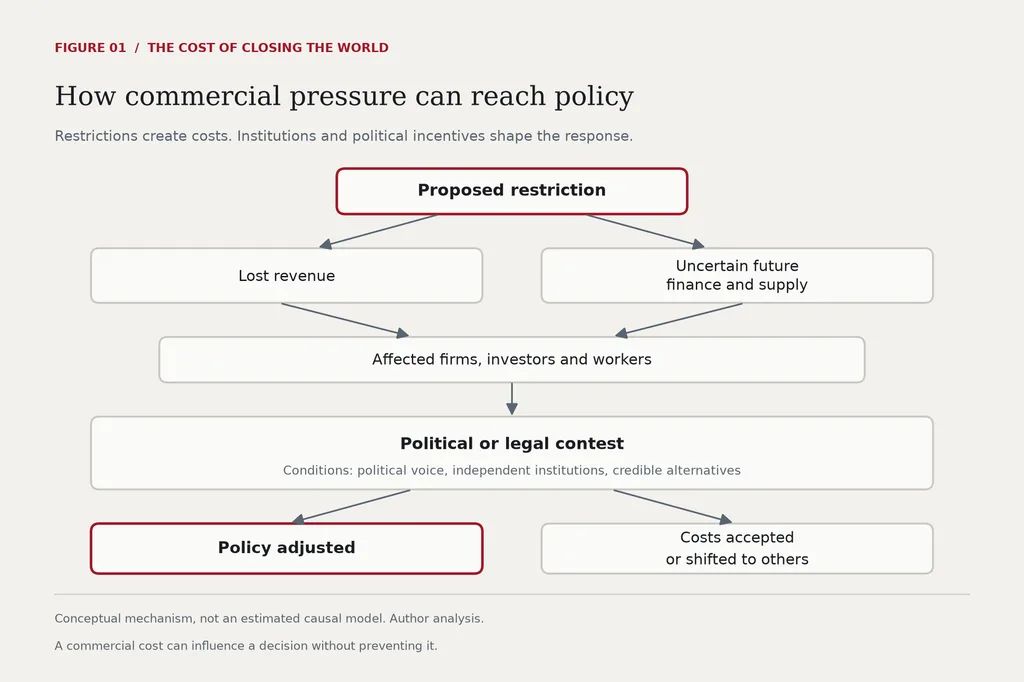
The diagram describes a conditional mechanism. It does not estimate how often the mechanism wins. Governments may revise a policy, compensate its opponents, find alternative customers or decide that the cost is acceptable. Evidence of commercial opposition is therefore weaker than evidence that the opposition caused a policy change.
3. Washington also wants the world as a customer
The international direction of American AI policy is explicit. Executive Order 14320, signed on 23 July 2025, established an effort to promote exports across the AI technology stack. It combined commercial expansion with strategic goals and provided for public financing instruments. The same order required compliance with export controls.5
In July 2026, the Commerce Department reported 78 applications from industry consortia. That is evidence of participation in an export programme. It is not a count of approved projects or completed installations.6
These documents support the idea that global deployment matters. They do not establish that private capital defeated a president who otherwise intended to keep all AI at home. The government describes international adoption as a source of American influence. National ambition and commercial expansion can point in the same direction.
This makes the story more interesting. A nationalist administration can want foreign customers to buy its country's technology, use its standards and depend on its suppliers. The customer may receive an extremely useful service while the exporting state gains strategic influence. Both outcomes can occur in the same transaction.
There are consequently two distinct propositions to test. One is that companies and governments see value in exporting AI. The evidence for that is direct. The other is that foreign financial exposure prevents a government from restricting access when its priorities change. That requires evidence from confrontations in which commercial and political objectives actually diverge.
We also need to separate foreign investors from foreign customers. An overseas shareholder can earn returns from a business serving only American customers. Share ownership does not, by itself, establish a right for the shareholder's home population to use a model. The case for openness becomes stronger when it rests on future finance, customer demand and substitutable suppliers together, rather than treating the nationality of shareholders as decisive.
4. The restriction that a profitable industry could not prevent
NVIDIA supplies a useful test because the commercial cost is visible. Following a new US export licensing requirement for its H20 chips in April 2025, the company reported a USD 4.5 billion charge for excess inventory and purchase obligations. This is an accounting charge, distinct from revenue that could not be shipped or sales the company expected to lose later.7
The broader semiconductor licensing policy later shifted. In January 2026, the Bureau of Industry and Security announced conditional case by case review for H200 and similar semiconductor exports to China. That was a limited opening with security requirements, rather than unrestricted permission.8
NVIDIA's filing for the quarter ended 26 July 2026 then described continuing constraints from both governments and said it was effectively excluded from China's data centre computing market. Licensing on one side of a transaction did not secure permission on the other.9
The company nevertheless reported USD 96.221 billion in quarterly revenue, compared with USD 46.743 billion a year earlier, a reported increase of 106 percent. Restrictions and rapid company growth coexisted.10
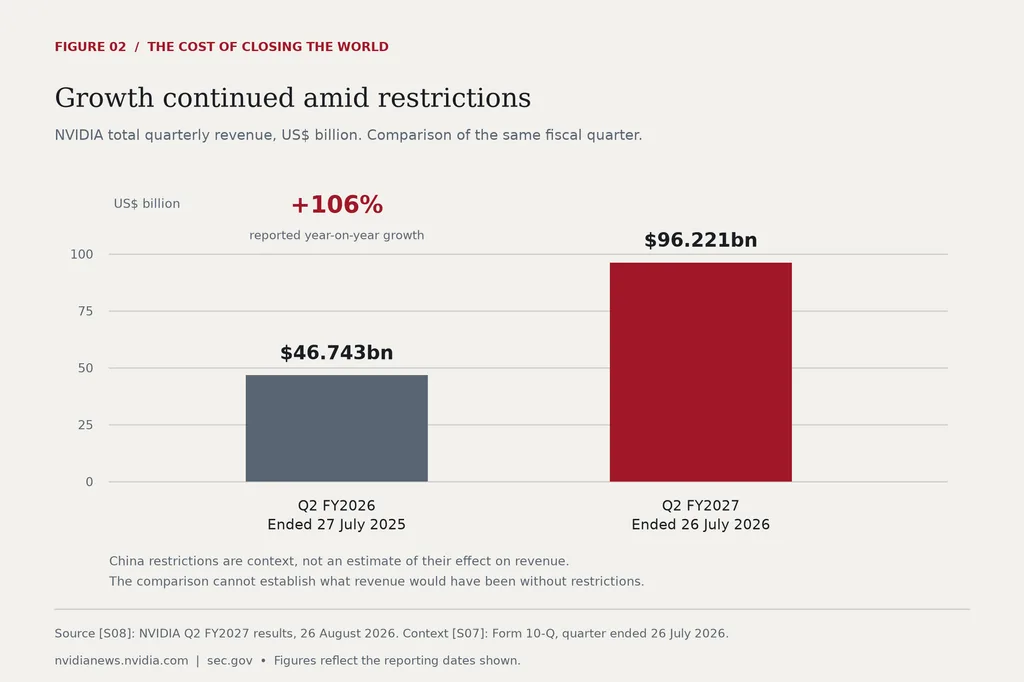
The inference has to be exact. This example refutes the claim that losing a commercially important foreign market necessarily destroys an AI business. It does not show that the restrictions were costless. It also does not establish that losing every foreign market would be manageable. A selective exclusion and complete national isolation are different economic experiments. NVIDIA's resilience also does not establish how a model developer dependent on successive financing rounds would withstand a similar loss of access.
Nor does a later policy relaxation, by itself, prove that lobbying caused it. Commercial concerns may have mattered alongside security assessments, diplomacy, changes in available products and a wish to influence the competing technology ecosystem. Without stronger causal evidence, the defensible finding is that policy was contested and adjustable while remaining restrictive.
This episode leaves the central intuition alive in a more limited form. There were substantial reasons to favour sales, and those reasons were relevant to the debate. They did not grant the seller an overriding right to complete the transaction. A government can injure a profitable industry without immediately breaking either the industry or the national economy.
5. Ownership, access and the investment still to come
Nationalisation and exclusion are separate decisions. A privately owned company can be required to restrict exports. A publicly owned enterprise can sell abroad. Changing who owns an asset does not mechanically determine who may use its output.
The legal distinction is concrete in the United States. The export control framework in 50 USC 4812 allows controls to apply despite contracts, joint ventures and collaborative agreements. The existence of commercial commitments does not place a transaction outside that framework.11
The size of past investment can also be misleading. Consider an unbuilt data centre and a completed one. Before construction, an investor can compare locations. Once the site, power connection and cooling infrastructure exist, part of the investment is tied to a place. Threatening to leave may become expensive.
Bennon and Fukuyama describe this bargaining mechanism in infrastructure research: completed capital investment can shift negotiating power towards the host government. Their work is not a study of American AI, but it identifies a relevant possibility. Applying it to AI requires attention to the different mobility of sites, equipment, software, people and future funding.12
The commercial restraint may therefore be strongest in the next decision. A government can put pressure on existing assets while still needing the next generation of equipment, the next research team and the next expansion. Those future choices provide bargaining power if alternatives remain credible.
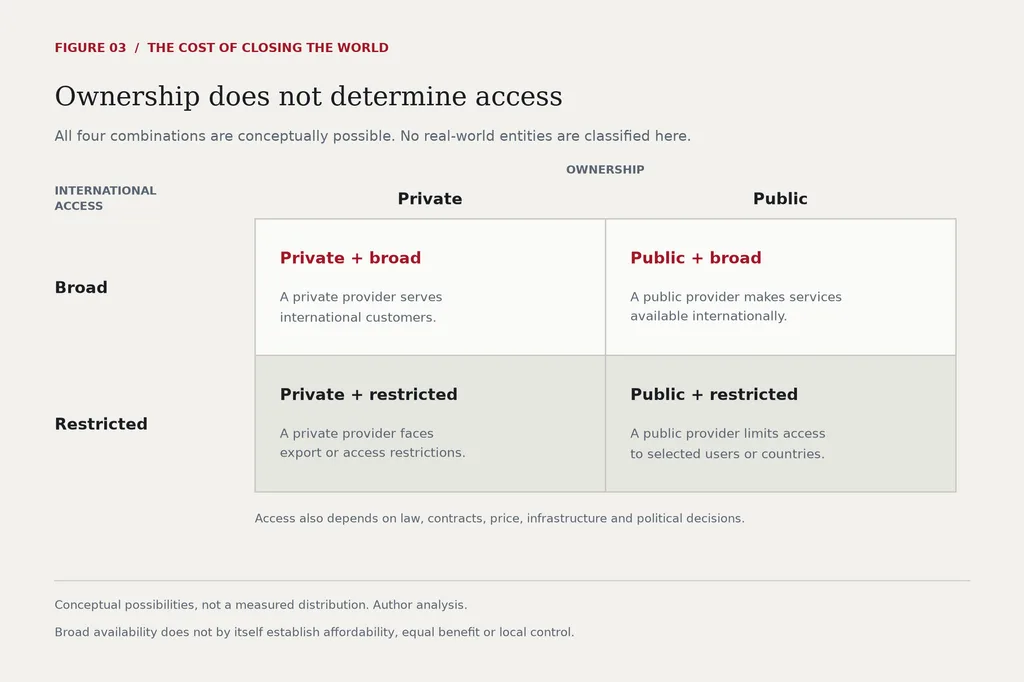
This is also why the claim that the state cannot afford to lose an industry has an ambiguous political meaning. A government might respond by accommodating private firms. It might instead offer subsidies, demand control or preserve a capability under different ownership. Strategic importance creates reasons for intervention as well as reasons for restraint.
The Library's Too Strategic to Fail examines how private AI activity can create public obligations. The present question approaches the same relationship from the other direction: when do private interests limit the government's choices? The two arguments can both be true. Their interaction depends on who has alternatives and who can transfer losses to somebody else.13
6. Political promises encounter financing conditions
Earlier confrontations help reveal what economic restraint can accomplish. In March 1983, François Mitterrand publicly acknowledged the constraints imposed by an international environment following different economic policies. He also rejected isolating France from European integration and set out objectives concerning inflation and the external balance.14
The lesson is narrower than the familiar story of a government discovering that only one economic doctrine could work. Continuing European integration was itself a political commitment. It changed the costs of other choices. The government faced a constrained set of options, and it chose within that set.
Britain in 2022 provides a useful companion. On 17 October, Jeremy Hunt announced reversals of almost all unlegislated tax measures from the recent fiscal programme and explicitly tied the change to restoring confidence and stability. Financing conditions had become an immediate obstacle to the government's plans.15
The Bank of England's account supplies a complication that belongs in the story. Leveraged pension investment arrangements amplified the gilt market disturbance, and the Bank intervened with temporary purchases. Financial markets transmitted a warning while private financial structures intensified the danger. A public institution helped stabilise the situation.16
These episodes show that political promises operate within economic constraints across ideological camps. They do not turn every market reaction into a reliable judgement about public welfare. Investors price their expected returns and risks; they do not directly aggregate every citizen's rights, needs or interests.
A financing constraint can expose an implausible promise. It can also narrow a legitimate democratic choice. Evaluating the response requires asking whether the original programme was feasible, what alternatives existed and whose losses the eventual adjustment imposed. Market discipline describes a force. It does not settle those questions for us.
The common feature is the government's inability to make every other actor behave as though its preferred assumptions were true. Investors, trading partners and households have decisions of their own. An open economy makes those decisions harder to ignore, even while leaving considerable room for political choice.
7. What market reforms actually demonstrate
The argument for market mechanisms becomes strongest when it identifies what changed in people's ability to produce and exchange. Vietnam's agricultural reforms illustrate that approach. The OECD describes a shift towards household production decisions, reduced price controls and greater participation in trade under Doi Moi. The reforms expanded economic discretion while continuing substantial state involvement.17
The significance lies in the incentives. A producer with room to respond to demand, improve methods and retain a return has reasons to use local knowledge. More reliable rights and access to customers can make investment worthwhile. These mechanisms are understandable without treating a party name as a complete description of an economy.
China's transformation offers a much larger outcome. A World Bank retrospective published in 2022 reported close to 800 million fewer people below the then used USD 1.90 daily poverty line, measured in 2011 purchasing power parity terms, over four decades. Its account combined economic transformation with targeted support, education, infrastructure, outward orientation and competition. It did not attribute the entire result to private ownership alone.18
These cases give serious support to incentives, market coordination and openness. They also resist a simple equation between the word socialist and a single economic outcome. Market-oriented reforms can occur under a party that retains that label. Public investment can complement private production. Political authoritarianism can coexist with extensive market activity.
Social democracy requires a separate distinction. Nordic economies combine substantial international commercial activity with extensive welfare arrangements. The Nordic Council of Ministers' research describes successful high income economies with large export sectors, high taxes and strong labour institutions. Those features do not amount to comprehensive central planning.19
The appropriate comparison concerns rules and mechanisms: who can start a firm, whether prices carry useful information, whether losses can be concealed indefinitely, how new competitors enter, and whether public services and social protection support people's ability to participate. Calling every public programme socialist obscures these choices.
AI itself also developed through several institutional channels. The National Science Foundation documents public support for AI research stretching back to the 1960s. Recognising that contribution is compatible with recognising the importance of private firms in turning research into products and financing deployment. The evidence does not require choosing a single institutional author of progress.20
On criteria such as innovation, living standards, personal choice and the capacity to correct mistakes, a competitive market economy operating under effective public institutions is a strong candidate for the best arrangement humanity has so far developed. That is a reasoned institutional judgement. One episode in AI investment cannot establish a universal ranking across every definition of welfare.
8. When the cost fails to prevent the decision
The European gas crisis supplies a direct warning against treating commercial dependence as a guarantee. The International Energy Agency describes deliberate Russian supply cuts alongside wider disruption and estimates that Russian pipeline gas exports to OECD Europe fell 50 percent in 2022. Valuable commercial relationships did not prevent a severe rupture.21
Russia's state dominated gas sector is not a clean comparison with a competitive liberal market economy. It is nevertheless enough to defeat the broader claim that large cross-border economic stakes make destructive choices impossible. Dependence creates a cost; leaders can value other objectives more highly or impose much of the cost on other people.
Interdependence can also become a source of coercion. Farrell and Newman's research explains how control over central nodes in international networks can let states gather information or exclude others. Their original cases concern finance and internet communications. The application to AI is an inference: concentrated providers and essential infrastructure could supply similar opportunities for political pressure.22
This produces two opposing possibilities within the same network. A supplier may argue against exclusion because it wants revenue. A government may value the supplier precisely because its international position makes exclusion consequential. Greater global adoption can strengthen both incentives.
There is a related problem inside the market. The FTC's January 2025 staff study of major cloud and AI partnerships identified contractual arrangements and potential risks involving access to inputs and switching costs. It was a study of competitive risks, not a finding that all such partnerships were unlawful.23
The implication for the argument is substantial. Private ownership creates a potential source of independent power, but concentrated private ownership can reduce the alternatives that make that power useful to the public. An incumbent may prefer protection. A government may find it easier to negotiate with a few dominant firms than with an open field of competitors.
The positive case therefore depends on competition being maintained. A market that allows successful firms to prevent future competition can erode its own capacity for correction. Defending a market economy sometimes requires opposing the wishes of its most powerful participants.
9. The institutions that turn resistance into a limit
In 1952, President Harry Truman ordered the seizure of American steel mills during the Korean War. The owners challenged the action, and the Supreme Court ruled that the president lacked the necessary authority. The official account of Youngstown emphasises constitutional separation of powers. It does not establish that every form of public acquisition is prohibited.24
This is a useful example of how economic independence and public institutions interact. The companies had assets and reasons to resist. Their resistance became effective because a court could impose an enforceable limit. If an executive could disregard the judgement, the same private interests would offer less protection.
The lesson applies beyond property owners. Employees need meaningful rights if they are to object without intolerable retaliation. Customers need workable alternatives. Journalists and researchers need access to facts. Citizens need institutions through which they can challenge decisions whose costs they bear. Economic independence contributes to this structure without replacing it.
The Schuman Declaration of 1950 illustrates the deliberate construction of economic restraint. Its proposal placed coal and steel production under a common authority to strengthen the foundations of peace. The document establishes an intention and an institutional design; it cannot isolate the causes of subsequent European peace. Its relevance is that governments sought to make shared interests more reliable through common rules.25
Acemoglu's research on institutions and technological change offers a framework for the broader question: the organisation of power affects both what an economy can produce and how its benefits are distributed. A society's technical capability and the lived outcome for its population are connected by institutional choices.26
For AI, the practical questions follow. Can new suppliers enter? Can foreign customers switch within a useful period? Can firms contest a rule openly? Can officials explain the security objective and the economic cost? Can a government preserve a capability without silently guaranteeing every investor's expected return?
The answers need not eliminate export controls. Some restrictions can serve legitimate security objectives even when they reduce commercial returns. Economic scrutiny is valuable because it makes the trade-offs visible. It cannot decide the public purpose merely by measuring the seller's lost revenue.
This is where the argument becomes a defence of a governable market economy. It protects many sources of initiative while preserving public authority capable of addressing harms, enforcing rules and resisting capture. Its strength depends on the continuing possibility of correction in both the private and public sectors.
10. What would make the argument stronger or weaker
The evidence supports the existence of competing economic interests. It is less decisive about how much those interests change particular AI policies. That causal question should remain open to further observation.
The thesis would gain support from documented cases in which policymakers narrowed restrictions because of demonstrated effects on foreign sales, future investment or the viability of domestic suppliers. Comparisons between firms with different international exposure would also help, provided they account for different security risks and products.
It would weaken if firms accepted extensive restrictions in exchange for protected markets or public subsidies; if investors continued financing increasingly closed systems without demanding compensation for the risk; or if foreign shareholders obtained satisfactory returns while access in their home countries remained constrained. These are observable possibilities, rather than exceptions to be explained away in advance.
The current NVIDIA episode already rules out one exaggerated prediction: an important lost market does not necessarily bring immediate commercial collapse. It leaves open a subtler question about the cumulative cost of lost customers, rival ecosystems and slower future investment. That cost requires evidence over time.
The distinction between absolute and conditional claims matters politically. Saying that commerce makes an action impossible encourages complacency. Saying that commerce can raise its price invites examination of how the price is transmitted, how quickly it becomes visible and who can refuse to pay it.
11. Keeping cooperation worth choosing
For an organisation outside the United States, the practical conclusion is neither resignation nor a demand for complete self-sufficiency. It is reasonable to buy useful foreign technology and to expect its suppliers to value continuing customers. It is also reasonable to preserve the ability to function if the terms change.
The Exit Test examines that second obligation: whether an organisation can continue essential work without a particular dependency. Here, the same capacity has an economic role. A customer with a usable alternative is a stronger reason for a supplier to remain reliable than a customer whose entire operation is captive.27
That suggests a constructive position for countries seeking AI capability. Participate in trade. Develop skills and local applications. Support research and maintain competition. Preserve access to data and the practical knowledge needed to operate alternatives. These choices can deepen the benefits of cooperation while limiting the power created by dependence.
The original intuition about capitalism survives because it identifies a valuable feature of divided economic power. Private actors can force consequences into the political calculation. Their ability to invest, switch, compete and seek legal remedy can make a destructive decision harder to sustain.
The ambitious claim is therefore about a society's ability to keep decisions answerable to reality. Competitive markets contribute by generating information and alternatives. Public institutions contribute by making rights enforceable, addressing harms and ensuring that the people bearing the costs retain a voice.
AI has made the commercial reasons for international cooperation unusually large. It has also made the strategic attractions of control unusually visible. The outcome will depend on the institutions and alternatives surrounding those interests.
Capitalism can make closing the world expensive. Whether that expense restrains political power depends on who must pay, who can object and whether cooperation remains a choice worth preserving.
Assessment of the original hypothesis
| Claim | Assessment | Reason |
|---|---|---|
| Large private AI investment creates incentives to seek customers and returns | Supported mechanism | Investment and export policy establish the scale and incentives; causal political effect varies. |
| Foreign investment guarantees foreign access | Not established | Shareholder participation and service access are distinct. |
| A US president cannot restrict AI exports because losses would be intolerable | Rejected in this absolute form | Export controls imposed measurable costs; significant restrictions persisted. |
| Global commerce can induce policy revision | Supported in selected cases | UK and French cases show constraints and adjustment, with institutional and causal limits. |
| Capitalism prevents destructive leadership | Rejected as a guarantee | Economic constraints can be overridden, accommodated or shifted onto others. |
| Market incentives and openness can improve prosperity | Supported with qualifications | China and Vietnam show transformation involving markets and public institutions together. |
| Any policy called socialist leads to poverty | Rejected as a category claim | Central planning, social democracy and market reforms under socialist parties differ. |
| The AI evidence proves capitalism is the best system on every criterion | Not established | A conditional argument about one mechanism cannot determine a universal welfare ranking. |
Method and scope
This is a documentary investigation of a proposed mechanism, not a statistical estimate of the effect of capitalism or trade on political behaviour. It uses corporate disclosures, official policy records, historical statements and research. Company disclosures establish reported financial facts and the company's account of business effects; government statements establish policy and stated rationale. Neither alone reveals every motive behind a decision. Historical cases were selected to examine both restraint and failure, not to estimate how frequently either occurs. Applications of infrastructure bargaining and network research to AI are identified as analytical inferences. Investment and revenue amounts are nominal US dollars; the historical poverty threshold uses purchasing power parity as stated. Fiscal labels follow the reporting company. The evidence cutoff is 15 November 2026.
Related reading in the Library
- Too Strategic to Fail: when private AI becomes a public obligation.
- The Exit Test: the practical ability to leave a dependency.
- The Human Chokepoint: export controls, corporate governance and who really controls AI.
Sources
Sources were checked on 15 November 2026. Each numbered note carries its source ID (S01–S27).
Notes and sources
-
SoftBank Group, Execution of Follow on Investment Third Tranche in OpenAI. 1 October 2026. group.softbank. (Source S02) ↩
-
Stanford HAI, The 2026 AI Index Report Economy. 2026. hai.stanford.edu. (Source S01) ↩
-
OpenAI and SoftBank, Announcing The Stargate Project. 21 January 2025. openai.com. (Source S03) ↩
-
Friedrich A. Hayek, American Economic Review (reproduced by Econlib with permission), The Use of Knowledge in Society. September 1945. www.econlib.org. (Source S24) ↩
-
The White House, Promoting the Export of the American AI Technology Stack. 23 July 2025. www.whitehouse.gov. (Source S04) ↩
-
International Trade Administration, Commerce Statement on Application Conclusion and Next Steps of the American AI Exports Program. 6 July 2026. www.trade.gov. (Source S05) ↩
-
NVIDIA, NVIDIA Announces Financial Results for First Quarter Fiscal 2026. 28 May 2025. nvidianews.nvidia.com. (Source S06) ↩
-
Bureau of Industry and Security, Department of Commerce Revises License Review Policy for Semiconductors Exported to China. 13 January 2026. www.bis.gov. (Source S09) ↩
-
NVIDIA (filed with the US Securities and Exchange Commission), Form 10-Q for the quarter ended 26 July 2026. August 2026. www.sec.gov. (Source S07) ↩
-
NVIDIA, NVIDIA Announces Financial Results for Second Quarter Fiscal 2027. 26 August 2026. nvidianews.nvidia.com. (Source S08) ↩
-
US House Office of the Law Revision Counsel, 50 USC 4812 Authority of the President. Text current through 22 October 2026. uscode.house.gov. (Source S23) ↩
-
Michael Bennon and Francis Fukuyama, Stanford FSI, The obsolescing bargain crosses the Belt and Road Initiative. 18 May 2022. cddrl.fsi.stanford.edu. (Source S19) ↩
-
Thierry Gilgen, Too Strategic to Fail. 23 September 2026, edition 6. www.thierry-gilgen-ict.ch. (Source S26) ↩
-
French Presidency (François Mitterrand), Televised address on the objectives of the new government. 23 March 1983. www.elysee.fr. (Source S12) ↩
-
HM Treasury, Chancellor Statement 17 October. 17 October 2022. www.gov.uk. (Source S10) ↩
-
Bank of England, Financial stability buy sell tools a gilt market case study. 20 November 2023. www.bankofengland.co.uk. (Source S11) ↩
-
OECD, Agricultural Policy Monitoring and Evaluation 2026 Viet Nam. 2026. www.oecd.org. (Source S14) ↩
-
World Bank, Lifting 800 Million People Out of Poverty. 1 April 2022. www.worldbank.org. (Source S13) ↩
-
Nordic Council of Ministers, Nordic Economic Policy Review 2025 Introduction. 2025. pub.norden.org. (Source S15) ↩
-
US National Science Foundation, Building the Foundations of Artificial Intelligence. Undated page, accessed 15 November 2026. www.nsf.gov. (Source S22) ↩
-
International Energy Agency, Anatomy of a natural gas crisis. 2025. www.iea.org. (Source S17) ↩
-
Henry Farrell and Abraham Newman, International Security, Weaponized Interdependence How Global Economic Networks Shape State Coercion. 2019. cyberlaw.stanford.edu. (Source S18) ↩
-
Federal Trade Commission, FTC Issues Staff Report on AI Partnerships and Investments Study. January 2025. www.ftc.gov. (Source S21) ↩
-
US Capitol Visitor Center, Library of Congress collection, Draft opinion in Youngstown Sheet and Tube Co v Sawyer. Draft opinion of 22 May 1952. www.visitthecapitol.gov. (Source S20) ↩
-
European Union (reproduction of the original declaration), Schuman Declaration May 1950. 9 May 1950. european-union.europa.eu. (Source S16) ↩
-
Daron Acemoglu, American Economic Review (MIT author page), Nobel Lecture Institutions Technology and Prosperity. June 2025. shapingwork.mit.edu. (Source S25) ↩
-
Thierry Gilgen, The Exit Test. 10 August 2026, edition 1. www.thierry-gilgen-ict.ch. (Source S27) ↩