People say they want an AI company.
What they usually mean is a better chat box. One window. One clever reply. The human still carries every next step — copy here, paste there, restate the brief, decide who looks next.
That is not a company. That is a person with several clever tools and no seating plan.
The interesting shift in the last two years was not a new model. It was furniture. Research in one seat. Drafting in another. Review in a third. A chief of staff who knew which seat owned the next move. Specialists that could pass work across the room under rules a human had set.
If the human remains the router, the machines never become colleagues. They remain tabs.

What AI-first means
The World Economic Forum, in a June 2026 blueprint written with Kearney, gave the phrase a usable test. AI-first enterprises systematically redesign workflows, roles and decision rights so AI becomes the strategic lever for creating and delivering value at industrial scale. The litmus is blunt: if AI systems were removed, could the business still operate — workflows, decisions and delivery? If the answer is no, the enterprise is AI-first. That is different from AI-enabled work, which bolts models onto existing jobs, and from AI-native startups founded with models as a production core from day one.
Microsoft’s Work Trend Index of 23 April 2025 named the same shape in corporate language: the Frontier Firm — hybrid teams of humans and agents, multi-agent workflows, a journey from assistant to digital colleagues to agents that run entire processes. The companion idea was the agent boss: someone who builds, delegates to, and manages specialised agents; every worker thinking like the CEO of an agent-powered startup.
The labels differ. The object does not. An AI-first company is an operating model. Seats and decision rights come before prompts.
Setup: seats, remits, tools, done
Most agent talk begins with prompts. Clever instructions. Long system messages. A diagram of boxes and arrows.
I found myself starting somewhere duller.
Who owns the brief?
Who may touch the source of truth?
Who writes, who checks, who is allowed to ship?
Who stops the work when the work is wrong?
Those are seat questions. They sound like management because they are management. A seat is not a personality. It is a bounded job: a remit, a set of tools, a standard for “done”, and a named handoff when the job ends. Ship and stop belong to named seats, not to the ambient chat.
Microsoft called the next chart a Work Chart — teams forming around goals rather than functions, powered by agents — and asked for a human-agent ratio: how many agents for which roles, and how many humans to guide them. Founders writing in public have been sketching the same furniture. A standing roster of roles. A chief of staff that folds work into one briefing. A fleet rather than a single prompt — Artificial Curiosity Labs put “20+ specialised agents” as the working system, with an org chart of roles and trigger conditions that drop wasteful invocations. Paperclip’s docs model AI companies as reporting trees where managers hold budgets for their subtree.
Framework docs say the same thing in quieter clothes. CrewAI’s hierarchical process: a manager coordinates, delegates and validates. LangChain’s subagents: a central agent treats specialists as tools with context of their own. OpenAI’s Agents SDK: handoffs, agents-as-tools, manager-style orchestration.
The names differ. Somebody still has to decide which chair faces which desk.
Isolation sits at the same altitude as the seating plan. Anthropic’s October 2025 note on Claude Code sandboxing is a clear public statement of principle: effective sandboxing needs both filesystem isolation and network isolation; without network isolation a compromised agent can exfiltrate files; without filesystem isolation it can escape; sensitive credentials stay outside the sandbox. MIT Technology Review’s February 2026 CEO guide (produced with Protegrity; sponsored, not editorial staff) puts the same idea at the boundaries where agents touch identity, tools, data and outputs — each agent as a non-human principal, tools pinned, an inventory of agents and scopes. CIO’s July 2026 piece on shadow agents adds runtime isolation: no agent outside a defined policy boundary.
You do not need a proprietary vocabulary for this. Filesystem. Network. Credentials out of reach. An inventory. A human who can revoke access. That is enough to begin.
Day-to-day: handoffs, not a human conveyor
The expensive failure mode is subtle.
The research seat finishes. It dumps a pile into the chat. The human reads it, rewrites the brief, pastes it into the writer. The writer returns a draft. The human carries that draft to the reviewer. The reviewer returns notes. The human carries the notes back.
Every carry is a tax. Context thins. Ownership blurs. The person who was meant to appoint the work becomes the conveyor belt.

Public product documentation for Grok Bot describes a different shape: persistent named bots that share one computer, group chats, and bot-to-bot messaging so the human is not the middleman of every hop. That is a product fact from xAI’s August 2026 launch note and docs — not a brochure claim for this studio. What matters for craft is the pattern. Specialists should be able to pass work to each other under rules you set, with a single owner at each stage, and with you still able to redirect or stop the turn.
A useful kickoff looks like ordinary speech, not a launch script: gather the sources and link every claim; turn the findings into a draft; check the draft against the sources and list only blocking issues. Do not publish.
One owner per stage. Visible handoffs. The human at the door, not in the corridor.
Earlier Library notes already drew the hard line around acting systems — The Unappointed Operator, The Appointed Door, One Agent, Many Sovereignties. This note sits beside those three and stays domestic. Appointment here is the act of naming a seat, giving it tools, stating what it may change, and keeping a human who can revoke the work. A specialised agent that can message another specialised agent is useful. It is still an appointed colleague only if someone remains responsible for the harness.
Oversight: four modes, not one dashboard
Developers studying production practice have been documenting the oversight work that follows. A June 2026 paper on arXiv (2606.05391) found at least four forms of emergent oversight work: a priori control, co-planning, real-time monitoring, and post hoc review. Oversight, the authors stress, is not only reactive and retrospective. It is also preventative and proactive.

In studio language the four modes are ordinary objects.
A priori control is the seat roster and the tool list decided before the first token. What may this seat open. What may it never touch. What counts as done.
Co-planning is the short conversation at the start of a turn: agree the steps, the sources, the stop conditions — before the fleet starts walking.
Real-time monitoring is watching the run while it still can be redirected. Logs you can read. A stop you can press. Not a status emoji.
Post hoc review is the check after the fact: claims against sources, diffs against the brief, a named human who says ship or send back.
The same paper notes a quieter risk: developers adopt efficiency heuristics — the plan as a proxy for correctness, tests as a guarantee, eyeballing, trust when the domain is unfamiliar. Good-enough supervision drifts toward automation bias. The vocabulary is academic. The studio version is simpler. If you cannot stop it, see the steps, and name the person on watch, you did not appoint a colleague. You released a process.
Where to be careful
Gartner’s newsroom forecast of 25 June 2025 is the care note many boards still under-read: over 40% of agentic AI projects will be cancelled by the end of 2027, due to escalating costs, unclear business value or inadequate risk controls. The same release coined the tidy insult — agent washing — for vendors rebranding assistants, RPA and chatbots without substantial agentic capability. Gartner estimated only about 130 of the thousands of “agentic” vendors were real.
Shadow agents are the domestic version of the same problem. DataRobot’s public definition is plain: AI agents operating outside approved governance, security or deployment workflows — no central inventory, no assigned owner, no defined permission model, no audit trail. CIO’s July 2026 piece describes autonomous processes at the API layer that never log in, never leave a session record, and never wait for a human. Seats without appointment are just more unappointed operators with nicer names.
Forbes Technology Council’s 3 September 2026 note names the governance shift many firms are already feeling: from seats to spend. Monthly AI cost equals seat fees plus model usage across users, applications and agents. Budgets have to live at company, department, application, agent and user levels. Without that control plane, consumption-based pricing turns fragmented usage into financial risk.
Add automation bias from the oversight paper and you have the care stack: hype-driven projects, washed products, unsanctioned agents, seats mistaken for spend controls, and humans who stop checking because the system sounded confident.
Cost: how to compare an AI org to a human org
Here the furniture meets the invoice — and the temptation is to treat tokens as salaries.
That is the wrong comparison.
Public sources do not supply a credible small-studio multi-agent fleet monthly total with an open method. What they do supply is a method for reading the bill.
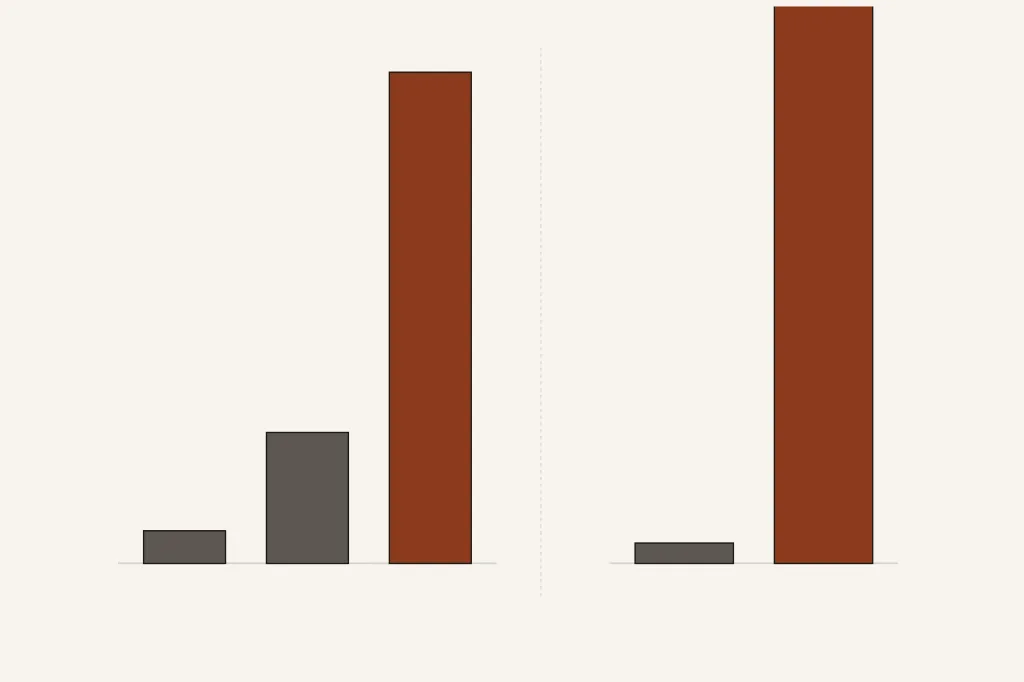
Anthropic’s engineering post of 13 June 2025 is blunt about token burn: in their data, agents typically use about four times more tokens than chat interactions, and multi-agent systems about fifteen times more than chats. That is a vendor measurement against chat, not a studio monthly total. It is still the clearest public disclosure that parallel specialised workers are not a free upgrade from a single conversation.
EY’s agentic pages and investment paper put a different ruler on enterprise customer-service work: a chat that once cost about $0.04 can become a $1.20 orchestration once tools, planning and subagents enter the path — roughly a thirty-fold jump per task in the example they publish. EY’s FinOps framing adds the categories boards often miss: tokens, subscriptions, platform, governance (including human-in-the-loop reviews), organisational change, failure and recovery, and speculative AI taxes. Tokens are the visible line. They are not the full cost. An agent is not a licence.
a16z’s August 2026 computer-use essay offers an order-of-magnitude hourly frame, not a studio fleet quote: running an agent costs roughly $6–8 per hour of inference today (practice range about $3–15 depending on the harness); offshore BPO sits near $10/hour fully loaded; US back-office labour near $30–45/hour. The authors say order of magnitude, not a precise quote. Useful as a yardstick. Useless as a substitute for oversight, retries and rework.
A controlled October 2025 study (arXiv:2510.22780) compared 48 Upwork workers to OpenHands agents on sixteen tasks. Humans charged about $24.79 per task on average; agents ran about $0.94–$2.39 — ninety to ninety-six percent cheaper on that meter. The same study found agents 32.5–49.5% lower in success, and noted that human oversight may still be needed. Automation slowed the humans who had to verify and debug by about 17.7%; augmentation sped work by about 24.3%. Cheap $/task is not the same object as a cheaper organisation.
The interpretive line is the one that belongs on a Field Note page: cheap $/task or $/h does not prove a cheaper org. Add the token multiplier, the refinement share, the human review labour, failure and rework, and the quality gap. a16z’s own caution travels well beyond computer-use BPO: if a person reviews every output, no labour was saved.
Quality and discrepancies
Cost without quality is a half-invoice. Multi-agent systems can raise the ceiling — and amplify the floor.
Anthropic’s same multi-agent research post reports that a system with Claude Opus 4 as lead and Claude Sonnet 4 subagents outperformed single-agent Opus 4 by 90.2% on an internal research evaluation. Hedge it as vendor-internal; no independent replication was found in the public lock. The authors are also clear about fit: multi-agent work excels when value is high, parallelisation is heavy, context overflows and tools are many; domains that need shared context and real-time delegation — most coding among them — are poor fits. Token usage alone explained most of the variance on one of their public benchmarks.
Google Research’s scaling study (arXiv:2512.08296; blog 28 January 2026) maps when the topology helps and when it hurts. Centralised multi-agent systems gained about 80.8% over single-agent baselines on a parallelisable finance-agent task. Every multi-agent variant degraded sequential PlanCraft by about 39–70%, with independent agents at the worst end. Independent multi-agent systems amplified errors by 17.2×; centralised coordination contained amplification to about 4.4×. Once a single-agent baseline sat near 45% or higher, coordination often showed diminishing or negative returns.

Other 2026 preprints sharpen the discrepancy. Collective hallucination papers show undefended multi-agent reasoning amplifying false claims; sequential finance pipelines let errors snowball so that end-of-pipeline checks barely help, while boundary gates cut survival sharply. Under equal thinking-token budgets, single-agent systems can match or outperform multi-agent systems on multi-hop reasoning (arXiv:2604.02460). Automatic multi-agent generators can cost up to about 10× chain-of-thought self-consistency while adding little (arXiv:2606.13003) — an “illusion of multi-agent advantage” when evaluation ignores marginal compute.
Human review remains a first-class cost line. LangChain’s State of Agent Engineering (12 June 2026; survey late 2025, n=1,340) found human review used by 59.8% of teams for nuanced or high-stakes work, with LLM-as-judge approaches at 53.3%. A September 2026 clinical-audit framework (arXiv:2609.02095) showed two systems nearly tied on autonomous accuracy still needing 39.2% versus 29.6% human review to hit the same reliability target. Similar accuracy, divergent oversight burden.
Multi-agent is not a quality upgrade by default. It is a topology choice with a token bill attached.
How to interpret the bill
The seating plan designs the invoice.
Every extra seat that can wake another seat multiplies coordination. Every parallel worker that must share context multiplies tokens. Every handoff that lacks a single owner multiplies duplicate work. Every output that still needs a human eye returns the labour you thought you had removed.
Read public multipliers as shape: Anthropic’s roughly 15× tokens versus chat; EY’s roughly 30× $/task from chat to orchestration; a16z’s order-of-magnitude $/h against BPO and back-office bands; per-task studies that are cheaper and less successful at once. Read FinOps categories so governance and failure sit on the same page as tokens. Do not invent a fleet-to-FTE substitution from list prices. Do not treat a seat subscription as a spend control plane.
Restraint is part of the craft. A seat should exist because a repeated job needs a remit, not because the org chart looks impressive. Idle specialists that wake on every message burn money and attention. A chief of staff that cannot say “this does not need three bots” is not a chief of staff. It is a megaphone.
Understanding before technology. Seats before prompts. Appointment before autonomy. Cost as a property of the design, not a surprise after launch.
I still open the door. I still redirect a turn when priorities change. I still say stop. The machines can pass work across the room. They do not get to appoint themselves.
Human judgment is the scarce seat. Keep it at the appointed door.
Sources
Definitions and operating model
- World Economic Forum (with Kearney), The AI-First Operating System: A Blueprint for Operating and Business Model Innovation, June 2026. https://reports.weforum.org/docs/WEF_The_AI_First_Operating_System_A_Blueprint_for_Operating_and_Business_Model_Innovation_2026.pdf · hub: https://www.weforum.org/publications/the-ai-first-operating-system-a-blueprint-for-operating-and-business-model-innovation/
- Microsoft Work Lab / Work Trend Index, 2025: The year the Frontier Firm is born, 23 April 2025. https://www.microsoft.com/en-us/worklab/work-trend-index/2025-the-year-the-frontier-firm-is-born
- Official Microsoft Blog, The 2025 Annual Work Trend Index: The Frontier Firm is born, 23 April 2025. https://blogs.microsoft.com/blog/2025/04/23/the-2025-annual-work-trend-index-the-frontier-firm-is-born/
- Artificial Curiosity Labs, The AI Chief of Staff Is a Fleet, Not an Agent, 15 May 2026. https://artificialcuriositylabs.ai/posts/ai-chief-of-staff-fleet-architecture/
- Justin Bartak, My C-Suite of Agents Named Themselves, 28 July 2026. https://justinbartak.ai/blog/ai-agent-c-suite-chief-of-staff
- Paperclip docs, Org Structure. https://paperclipai-paperclip.mintlify.app/concepts/org-structure
- CrewAI Docs, Hierarchical Process. https://docs.crewai.com/edge/en/learn/hierarchical-process
- OpenAI Agents SDK (Python). https://openai.github.io/openai-agents-python/
- LangChain Docs, Multi-agent. https://docs.langchain.com/oss/python/langchain/multi-agent
- Anthropic Engineering, Making Claude Code more secure and autonomous with sandboxing, 20 October 2025. https://www.anthropic.com/engineering/claude-code-sandboxing
- MIT Technology Review (produced by Protegrity), From guardrails to governance: A CEO’s guide for securing agentic systems, 4 February 2026. https://www.technologyreview.com/2026/02/04/1131014/from-guardrails-to-governance-a-ceos-guide-for-securing-agentic-systems/
Oversight and day-to-day ops
- arXiv:2606.05391, Human oversight of agentic systems in practice…, submitted 3 June 2026. https://arxiv.org/abs/2606.05391
- xAI, Introducing Grok Bot, 11 August 2026. https://x.ai/news/introducing-grok-bot
- xAI Docs, Grok Bot overview / Bots / Chat and collaboration. https://docs.x.ai/grok-bot/overview · https://docs.x.ai/grok-bot/bots · https://docs.x.ai/grok-bot/chat-and-collaboration
Care and failure modes
- Gartner Newsroom, Gartner Predicts Over 40% of Agentic AI Projects Will Be Canceled by End of 2027, 25 June 2025. https://www.gartner.com/en/newsroom/press-releases/2025-06-25-gartner-predicts-over-40-percent-of-agentic-ai-projects-will-be-canceled-by-end-of-2027
- Forbes Technology Council, From Seats To Spend: Why Enterprise AI Needs A Control Plane, 3 September 2026. https://www.forbes.com/councils/forbestechcouncil/2026/09/03/from-seats-to-spend-why-enterprise-ai-needs-a-control-plane/
- DataRobot, Shadow agents. https://www.datarobot.com/blog/shadow-agents/
- CIO, Shadow agents: How IT leaders must govern ‘headless’ AI…, 1 July 2026. https://www.cio.com/article/4191250/shadow-agents-how-it-leaders-must-govern-headless-ai-before-it-breaks-the-enterprise.html
Cost interpretation (public multipliers and methods)
- Anthropic Engineering, How we built our multi-agent research system, 13 June 2025 — agents ~4× / multi-agent ~15× tokens vs chat; internal 90.2% research-eval claim. https://www.anthropic.com/engineering/multi-agent-research-system
- EY, agentic AI token costs / Unlocking agentic value (PDF) ©2026 — chat ~$0.04 → orchestrated ~$1.20; FinOps categories. https://www.ey.com/en_us/insights/ai/agentic-ai-token-costs · https://www.ey.com/content/dam/ey-unified-site/ey-com/en-us/insights/ai/documents/ey-unlocking-agentic-value-a-new-investment-discipline-for-the-agentic-era.pdf
- a16z, Can Agents Use a Computer Yet? We’ve Got the Data, 10 August 2026 — ~$6–8/h agent inference order of magnitude; BPO ~$10/h; US back-office ~$30–45/h; “if a person reviews every output, no labor was saved.” https://a16z.com/can-agents-use-a-computer-yet-weve-got-the-data/
- arXiv:2510.22780, human vs agent $/task and success gap, October 2025. https://arxiv.org/abs/2510.22780
Quality discrepancies
- Google Research blog, Towards a science of scaling agent systems…, 28 January 2026; arXiv:2512.08296 — MAS +80.8% parallel finance; −39–70% sequential; error amp 17.2× independent / 4.4× centralised. https://research.google/blog/towards-a-science-of-scaling-agent-systems-when-and-why-agent-systems-work/ · https://arxiv.org/abs/2512.08296
- arXiv:2606.07941, collective hallucination / defence, 2026. https://arxiv.org/abs/2606.07941
- arXiv:2608.14588, sequential snowball hallucination (FinanceBench), 2026. https://arxiv.org/abs/2608.14588
- arXiv:2604.02460, budget-matched SAS ≥ MAS on multi-hop, 2026. https://arxiv.org/abs/2604.02460
- arXiv:2606.13003, automatic MAS vs CoT-SC cost illusion, 2026. https://arxiv.org/abs/2606.13003
- LangChain, State of Agent Engineering, 12 June 2026 — human review 59.8%. https://www.langchain.com/state-of-agent-engineering
- arXiv:2609.02095, READY oversight-burden divergence, submitted 2 September 2026. https://arxiv.org/abs/2609.02095