# The Human Chokepoint
Jensen Huang, the intelligence allegations, and who really controls AI
Volume 83 · Edition 3 · 2026-11-11
Category: G · Economy & Power (https://www.thierry-gilgen-ict.ch/library/economy-power)
Canonical: https://www.thierry-gilgen-ict.ch/field-notes/the-human-chokepoint
## Before we enter
This is an investigation of the public record and an essay about infrastructure. It is not a finding of espionage. Huang has acknowledged infidelity. NVIDIA has opened an independent inquiry into reports of foreign-intelligence targeting. The intelligence allegations remain contested. No public evidence reviewed for this volume establishes that the relationship caused a particular export decision or compromised company or national-security secrets. The distinction is part of the story, not a disclaimer to be forgotten after the first page.[^1][^2][^3]
There are no reconstructed private conversations in these pages. The historical passages follow published records; the operational exercise near the end is explicitly hypothetical. The illustrations are conceptual. Charts identify their sources, units and limits. The research cut-off is 11 November 2026, not the eventual outcome of an investigation still in progress. Developments of 12 and 13 November 2026 appear in dated updates directly after this section.
## Update — 12 November 2026
On 12 November 2026, the day after this volume went online, NVIDIA announced that Jensen Huang had resigned as president, chief executive and member of the board, effective immediately. The company's filing with the SEC gives 11 November as the date on which the board accepted the resignation. Colette Kress, chief financial officer since September 2013, became interim chief executive and keeps her finance role. Harvey C. Jones, a director since 1993, became the company's first chair of the board. The board will search for a permanent chief executive among internal and external candidates.[^4][^5]
The announcement gives no reason. It carries no statement from Huang, and it does not mention the independent inquiry led by Wachtell or the congressional request. The board said it has full confidence in Kress and the leadership team and expects operations, customer commitments and the product roadmap to continue without interruption. That sentence is a forecast. The filing discloses no separation terms. NVIDIA confirmed that it will report third-quarter fiscal 2027 results on 17 November as scheduled.[^4][^5]
Reports preceded the announcement. Late on 11 November, US time, The New York Times reported, citing five people who worked at NVIDIA, that Huang had also had a relationship with an executive who reported to him. NVIDIA declined to comment. Huang, reached by phone, told the reporters he did not think they should be talking to him directly.[^6] Reuters, citing a person familiar with the matter, reported that the board met on 11 November to consider his removal, and CNBC confirmed the meeting that evening.[^7][^8] The company has not said whether either report moved the board. This volume does not name the executive: the allegation rests on anonymous sources, and the reports reviewed carry no comment from her.
The three House chairs who requested the 18 November briefing had asked Huang to accept it or propose another date by 11 November, 5 p.m. Eastern, and two of them said subpoenas were under consideration if he did not.[^9][^10] On the morning of 12 November, Representative John Moolenaar said that Huang had agreed to brief the committees on his interactions with Alice Huang and on NVIDIA's security protocols, and that Huang was "in discussions to find a date that works and in the right form". No date had been published.[^11] Senator Elizabeth Warren said the resignation "does not absolve him, other executives, or the company as a whole of responsibility for putting our national security at risk".[^12]
Singapore added detail on the same day. Its Ministry of Home Affairs said police and customs opened an investigation in February 2025 into several companies, Megaspeed among them, over possible false declarations in server purchases. Alice Huang was investigated as Megaspeed's then-chief executive and chairperson, and not for espionage. In February 2026 the police concluded there was insufficient evidence that she had committed offences relating to those declarations. They also assessed that she had given them information she knew to be inaccurate in order to downplay her role; she received a stern warning and was barred from re-entering Singapore. The investigation into Megaspeed and six other individuals continues.[^13] Megaspeed, in its first public statement since the reports, said it had cooperated with inspections by the US Bureau of Industry and Security and had retained a US law firm to lead a census of its GPUs. The statement did not address the allegations concerning Alice Huang.[^14]
NVIDIA's Nasdaq-listed shares closed at $173.73 on 11 November, against a closing high of $239.24 on 6 October. On 12 November they fell more than 12% in early trading, according to Reuters (update of 15:49 CET, 09:49 ET), and had touched an intraday low of $148.80 by 16:11 CET (10:11 ET), according to CoinDesk.[^7][^12][^15] These are intraday figures from the day of the announcement; the closing price for 12 November appears in the update of 13 November. Its revenue figures are unchanged; they measure sales.
None of these developments adds evidence for or against the intelligence allegations. The open item is the inquiry: the 12 November announcement does not say whether it continues, and no result has been published.
The epilogue asks what still works when the person is removed. NVIDIA's first public answer came within a day of this volume's publication: a finance chief who has worked beside the founder for thirteen years, a board chair in a role the company had never had, and a statement that operations will continue without interruption. The results due on 17 November will be a first public test of that statement.
## Update — 13 November 2026
This update reflects information available at 08:48 CET on 13 November 2026, before the US stock market opened. It covers what was published after the update of 12 November.
The share price first. NVIDIA's shares closed at $166.19 on 12 November, down 4.34% from $173.73 the day before, after opening at $151.01 and touching the intraday low of $148.80, according to Yahoo Finance's price history.[^16] That close is 30.5% below the closing high of $239.24 on 6 October, by this volume's own comparison of closing prices. CNBC, in a report published at 06:51 CET (00:51 ET) on 13 November, counted a loss of 29%, roughly $1.6 trillion of market value, since the slide began in early October. It also reported that the shares were down 11% for the week and heading for a sixth straight weekly decline, the longest losing streak since 2012.[^17] Gil Luria of D.A. Davidson lowered his price target to $200 from $300 and kept a buy rating, writing that "the market has appropriately adjusted for this transition". Analysts at Oppenheimer wrote that they "expect fundamentals to take a backseat near term" and that Huang's departure "could, in our view, translate to a lingering share overhang".[^17] The analyst consensus compiled by LSEG, as cited by CNBC, expects third-quarter revenue of $108.9 billion, up 91% from a year earlier; NVIDIA reports on 17 November.[^17] US trading for 13 November had not begun when this update was written.
Inside the company, interim chief executive Colette Kress and board chair Harvey Jones wrote to employees on 12 November, according to emails that CNBC obtained from a person familiar with the matter. Kress called it an "extraordinarily difficult period", said staff would "hear more from leadership in the coming days" and announced a company meeting on 18 November at 9 a.m. Pacific time, 18:00 CET, the day after the results.[^18] Jones wrote that the board "has full confidence in Colette".[^18] CNBC also reported that NVIDIA did not immediately say whether the newer allegation would change the parameters of the independent inquiry; a spokeswoman for Wachtell, Lipton declined to comment.[^19] No finding of the inquiry has been published.
Reuters reported on 12 November, citing two people familiar with the matter, that Huang also had an intimate relationship with another NVIDIA employee, in addition to the relationship with Alice Huang and the one The New York Times had described. Reuters did not name her and could not reach her. NVIDIA declined to comment; Huang and a board representative did not reply.[^20] The reports reviewed rest on that single account, and this volume does not name her either.
In the United States, Attorney General Todd Blanche said at a press conference on 12 November that the Justice Department had not reached a conclusion on whether Alice Huang was a Chinese spy and that "of course" the FBI was investigating reports that she had worked for the Chinese government, according to Reuters. In an interview released later that day, President Trump said it had not been determined whether she was a spy and that he had spoken to Huang on Wednesday.[^21] Beijing has denied that she is a spy.[^21]
Congress moved on several tracks at once. Representative Brian Mast, chair of the House Foreign Affairs Committee, said on 12 November that Huang had agreed to brief lawmakers, with date and venue still under negotiation. He also sent Huang a new letter asking him to appear on 1 December for a closed-door, transcribed interview. According to NBC News, the letter says a subpoena would be issued if Huang did not confirm by Friday evening, 13 November.[^22] The committee's press release lists letters to Huang, to NVIDIA's general counsel, Tim Teter, and to Under Secretary of Commerce Jeffrey Kessler, requesting their appearance.[^23] Reuters wrote that Huang is expected to testify before Thanksgiving, which falls on 26 November, and that committee staff had spoken with NVIDIA on Wednesday night about a date and place.[^24] The two accounts give different timing, and this volume reports both with their attribution.
In the Senate, Tim Scott, chair of the Banking Committee, asked Huang and Commerce Secretary Howard Lutnick on 12 November to appear voluntarily on 3 and 10 December respectively. A spokesperson for Lutnick said he had "proactively agreed to appear voluntarily"; representatives of Huang had not immediately responded to NBC News.[^22] House Speaker Mike Johnson said there was "a developing consensus in Congress" on limiting chip exports to China, and the three House chairs urged passage of four chip-export bills in the annual National Defense Authorization Act.[^24][^23]
On 13 November, Malaysia's Ministry of Investment, Trade and Industry (MITI) stated that it has never cleared Megaspeed or its Malaysian affiliate Speedmatrix and that its verification visits at data centres are routine monitoring. With the Royal Malaysian Customs Department it is determining whether any chips that Speedmatrix brought into Malaysia were later re-exported, and whether that was lawful. Bringing AI chips into Malaysia needs no permit; since July 2025, re-exporting or transshipping high-performance US AI chips requires a MITI permit. The ministry said it is working with authorities in Singapore and the United States.[^25] The statement describes a check and reports no finding. Reuters reported that Chinese AI shares fell on 13 November, Z.AI by 12% and MiniMax by 8.4%, as investors worried that Huang's departure could further restrict Chinese access to advanced US chips.[^24]
None of this adds evidence for or against the intelligence allegations, and the Justice Department's own statement says its conclusion is open. What has changed is the number of parties asking for answers: NVIDIA's inquiry, the Justice Department and the FBI, committees in both chambers of Congress, Singapore's continuing investigation and now a Malaysian check by MITI and Customs. They differ in what they can compel and in what they will publish. The first deadline falls on Friday evening in Washington, followed by the results on 17 November and the company meeting on 18 November.
## Prologue — Two bulletins on a Sunday
On 8 November 2026, two different versions of technological sovereignty appeared in the same corporate newsroom.
One was a product announcement. NVIDIA, Rebellions and SK Telecom described a collaboration for Korean sovereign AI: Korean-designed processors, domestic models and services, and infrastructure built around NVIDIA’s NVLink Fusion and MGX technologies. The companies expected the new R200 systems to be ready in 2028. This was a plan, not a completed installation.[^26]
The other was an apology.
“I was unfaithful to my wife,” Jensen Huang wrote in a message to employees. He accepted responsibility, asked for his family’s privacy and said he would cooperate with a board investigation into national-security concerns raised by news reports. The statement did not identify the other person.[^1]
A third bulletin supplied the institutional response. Independent directors, assisted by outside counsel, would investigate. The board expressed confidence in Huang and said it had no reason to believe that national-security or NVIDIA secrets had been compromised.[^2]
Read the announcements separately and they belong to different desks: business development, executive conduct, corporate governance. Read them together and a less comfortable question appears. What exactly is a country buying when it buys sovereign AI from a company whose founder’s personal relationships have become an intelligence concern?
The answer cannot be that all the machines suddenly became unsafe. A chief executive’s misconduct does not rewrite a processor’s instruction set. Nor does an investigation establish that the most serious allegation is true. Thousands of engineers, operators and customers do not vanish behind the reputation of one man.
But a machine is only one part of an infrastructure system. Allocation, support, licensing, information, escalation and political access sit around it. Those functions are exercised by institutions, and institutions are operated by people. Sometimes the people become so central that the diagram stops showing them. Their judgement is treated as a constant, like the voltage at the wall.
This volume is about that omission.
It follows three routes: the public evidence around Huang and Megaspeed; the physical and legal pathways through which computing power changes hands; and the decisions that determine whether a country can keep using the infrastructure on which it has become dependent. The routes intersect. They must not be confused with one another.
The first discipline of a spy story is to resist the part that already sounds like a spy story.
## 1 — What the record will bear
By 10 November, NVIDIA’s independent directors had named Joon H. Kim and Wachtell, Lipton, Rosen & Katz to conduct the inquiry. The appointment made the process more concrete. It did not supply a verdict.[^27]
Reuters identified Alice Huang, also known as Huang Le, as a businesswoman whose career moved from Chinese finance into the AI-computing industry. Its reporters reviewed more than thirty financial records, corporate filings and company materials. They described her former controlling shareholding in Singapore-based Megaspeed and documented business proximity to NVIDIA. Reports that American authorities regarded her as a Chinese intelligence asset were a different evidentiary category. Reuters did not turn them into a public judicial finding.[^28]
The distinction is easy to lose. A company record can establish a director’s appointment. A photograph can establish that two people were together. An admission can establish the conduct that the speaker actually admits. None of these things, alone, establishes recruitment by an intelligence service, the transfer of protected information or the alteration of an export-control decision.
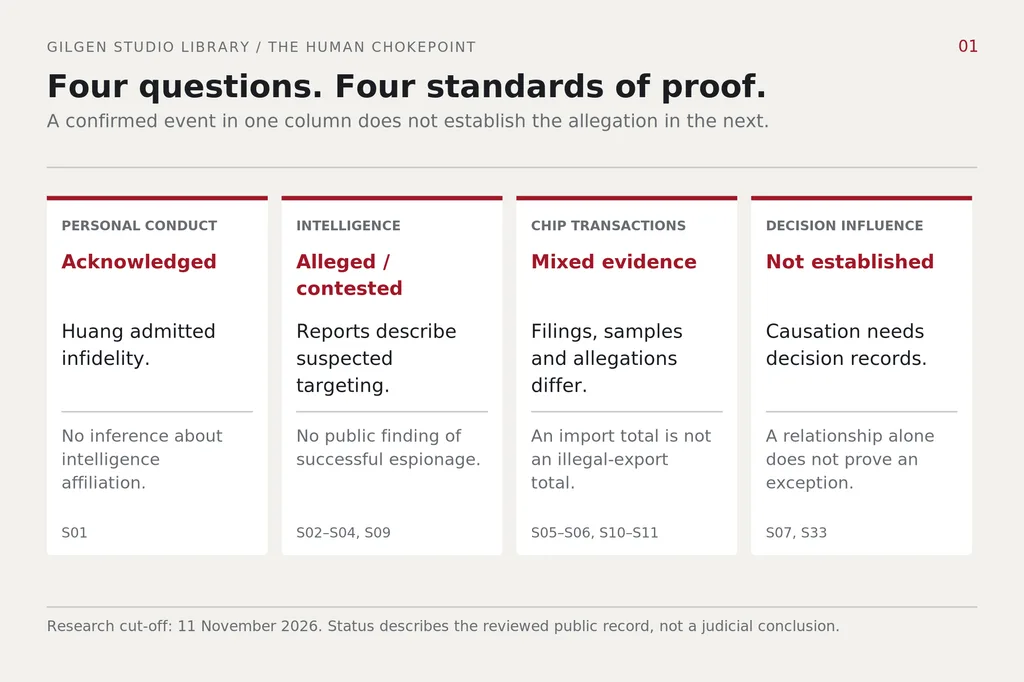
There are therefore several investigations inside what the headlines present as one affair. One concerns personal conduct. Another concerns possible intelligence targeting. A third concerns chip transactions and end users. A fourth concerns whether relevant decisions inside a company were properly disclosed, challenged and recorded. Evidence may connect those questions eventually. A writer cannot make the connection on investigators’ behalf.
Three Republican committee chairs had already requested a closed-door briefing for 18 November in a letter dated 4 November, according to Reuters. NVIDIA responded that Huang meets many customer executives and that its Asian cloud customers receive ordinary business information rather than sensitive secrets. The requested briefing was still in the future at this volume’s cut-off.[^29]
A shareholder complaint added another institution to the scene. Reuters reported a proposed class action filed in San Jose alleging misleading disclosures. Filing a complaint establishes that somebody made an allegation in court; it does not independently verify the allegation. Treating a lawsuit as a second confirmation of the reporting on which it relies would manufacture corroboration.[^30]
China’s foreign ministry rejected the intelligence allegation. Singapore supplied a more specific correction: its government said it had not conducted the reported investigation into Alice Huang’s alleged intelligence ties. At the same time, Singapore confirmed that investigations involving Megaspeed continued. These statements are not interchangeable. A denial about an investigation of a person does not terminate a separate investigation of a company.[^3][^31]
The four questions. A documented event in one column does not establish the proposition in the next. Sources: S01–S09, S33. This is an editorial evidence map, not a probability model.
There is a temptation to treat caution as a failure of nerve. Readers arrive expecting the hidden explanation, the moment when the documents align and the motive becomes obvious. But prematurely closing an uncertainty produces a weaker story. It removes the very problem that makes intelligence reporting difficult: some records are public, some are classified, some are described by interested parties, and some may not exist.
The strongest available claim is narrower than the most dramatic headline. The acknowledged misconduct has generated a legitimate institutional question about exposure and governance. The public record does not yet answer that question completely.
That leaves plenty to investigate. It also leaves the family outside the investigation. There is no sound reason to predict a divorce or to treat a spouse’s response as evidence about chip policy. The public interest concerns power exercised over public-facing infrastructure, not the private consequences of a marriage.
## 2 — A company that became a dependency
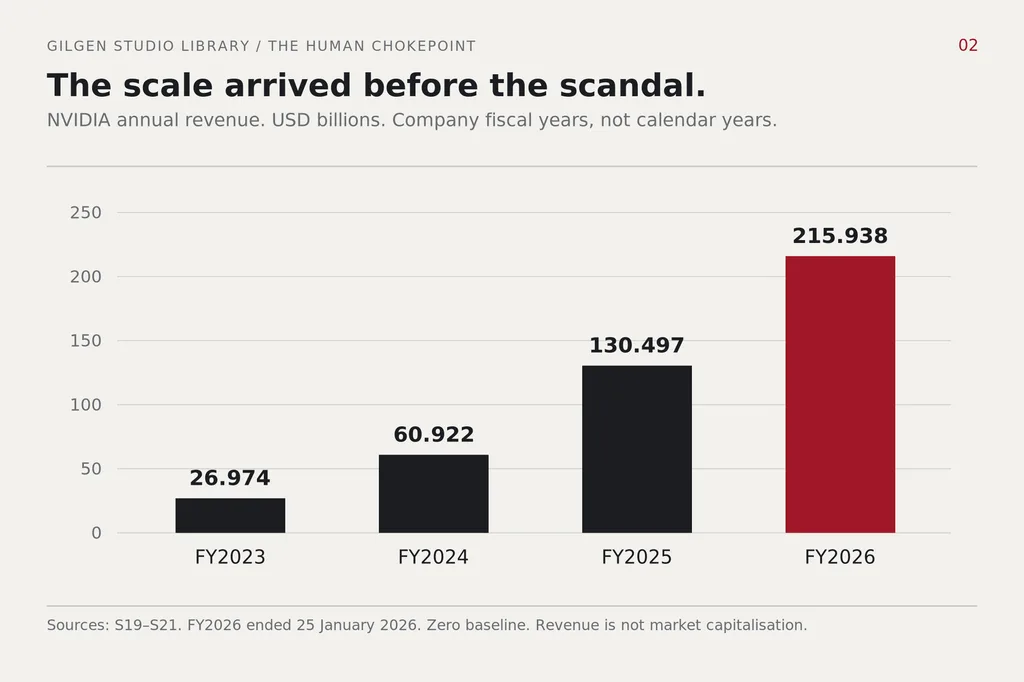
NVIDIA’s growth gives the question its scale. The company reported annual revenue of $26.974 billion for fiscal 2023, $60.922 billion for fiscal 2024, $130.497 billion for fiscal 2025 and $215.938 billion for fiscal 2026. These are fiscal years, not calendar years; the final period ended on 25 January 2026. The series measures sales, not market value or the economic output produced by customers.[^32][^33][^34]
In its quarter ended 26 July 2026, NVIDIA reported total revenue of $96.221 billion, including about $89.0 billion from Data Center. The quarterly figure should not be placed alongside annual totals as though they measure the same interval. It nevertheless makes clear that the dependence being discussed is already industrial, rather than a speculative promise about a future market.[^35]
The scale arrived before the scandal. Revenue in USD billions, company fiscal years. Sources: S19–S21. No stock-price claim or causal attribution is implied.
The familiar description of NVIDIA as a chipmaker is accurate but incomplete. Its platform includes processors, interconnects, systems and software. CUDA is a programming model and software platform through which developers make GPUs perform useful work. Buying a different accelerator does not automatically reproduce a system’s performance, software compatibility or operational behaviour.[^36][^37]
Consider the difference between replacing an appliance and replacing a working practice. A procurement team can order hardware. It cannot order, by the same transaction, every optimisation, diagnostic habit and failure-recovery routine accumulated by the engineers who operate the existing system. Those must be carried over, rewritten or learned again. The extent of that work varies by application. It should be measured, not assumed to be impossible.
That is why a benchmark is a poor substitute for an exit rehearsal. Two processors can produce attractive results on a controlled test while the production application depends on a library, a numerical behaviour, a memory layout or a debugging tool that the test does not exercise. A credible alternative is the one that has run the actual workload under actual constraints and survived the actual failures.
This dependence is not proof of wrongdoing. Much of it can be the result of engineering that customers genuinely prefer. A successful integrated platform solves problems that would otherwise have to be solved separately. The risk emerges when the convenience of integration is mistaken for the absence of dependence.
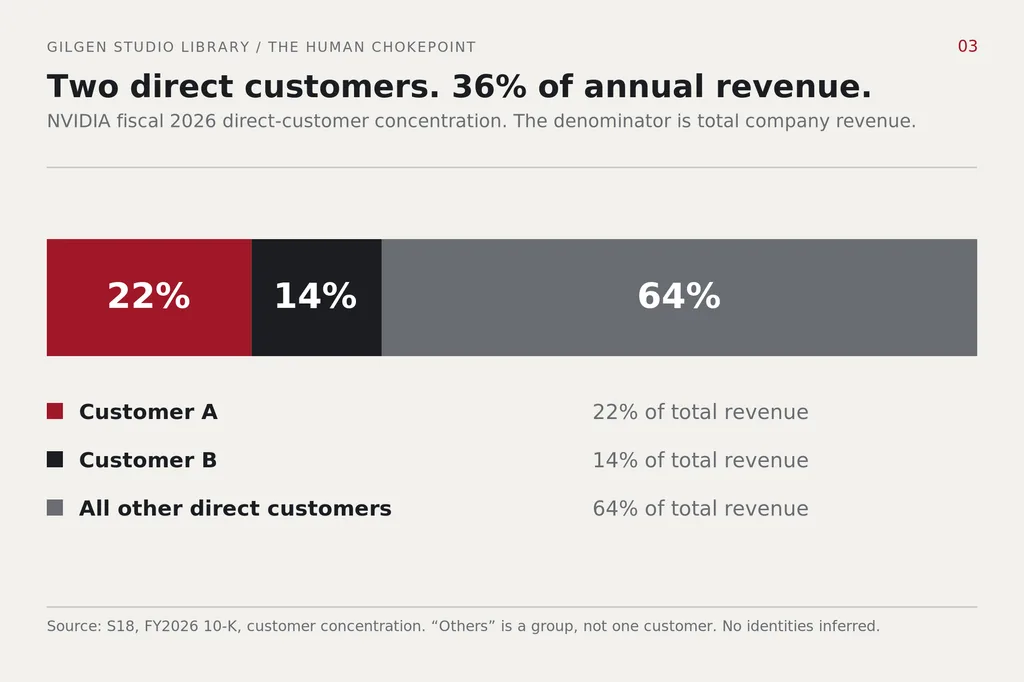
The company itself also depends on concentrated relationships. Its fiscal 2026 filing says two direct customers accounted for 22% and 14% of revenue. Those percentages concern direct customers; they do not reveal the ultimate end users or allow us to attach the numbers to named cloud companies. The remaining 64% is everyone else combined, not a third customer.[^36]
Dependence runs both ways. Derived remainder: 100 − 22 − 14 = 64. Source: S18, Form 10-K printed page 23. Customer identities and ultimate beneficiaries are not inferred.
A founder sits at a particular point in this structure. The significance is not that he personally approves every shipment or controls every technical process. Nothing in the public evidence reviewed here would justify that description. It is that strategy, trust, external relationships and escalation can accumulate around a person faster than an organisation formalises the ability to replace those functions.
A company can have excellent disaster recovery for its servers and poor disaster recovery for its decisions.
NVIDIA’s annual filing recognises dependence on its longstanding executive team and the importance of succession and knowledge transfer. The human continuity question therefore predates this controversy. It was already a business risk, in sober filing language, before it became a headline.[^36] On 12 November the company announced a change of chief executive; see the update above.
The founder problem is not solved by declaring founders dispensable. Experience, technical judgement and credibility are real assets. The institutional task is to preserve their value without requiring every consequential relationship to remain personally mediated. A functioning company should be able to distinguish “this person is extraordinarily valuable” from “the system cannot challenge this person”.
## 3 — The company behind the company
Megaspeed makes the story less cinematic and more instructive.
Reuters reported that the company was incorporated in Singapore in 2015 under a different name, became Megaspeed International in 2023, and was wholly owned by Singapore-registered Swiftdata. The same reporting described assets rising from about $33 million in 2023 to about $3 billion in 2024, with 2024 revenue of $294 million. These figures establish reported financial scale. They do not establish the source of every asset or the destination of every chip.[^38]
A company register answers some questions very well. It can tell you which legal entity holds shares, when directors were appointed and where notices can be served. It may answer the operational question less well: whose instruction causes a machine to be bought, a customer to be approved or an exception to be granted?
C4ADS’s September investigation examined ownership records and described a late-2023 transfer of Megaspeed shares to SwiftData. It treated ultimate control as unresolved and assessed possible continuing influence by Huang Le. That is an attributed assessment, not a fact we can silently promote to certainty. The report expressly warns that mentioning an entity does not imply a violation of law.[^39]
The distinction between legal and practical control is not inherently suspicious. Businesses routinely delegate operations, use holding companies and buy infrastructure through subsidiaries. International commerce would be difficult without those arrangements. But the same structures that make legitimate investment possible can make end-user verification harder. The answer is not to treat every corporate layer as a conspiracy. It is to identify the question each layer answers and the one it leaves unanswered.
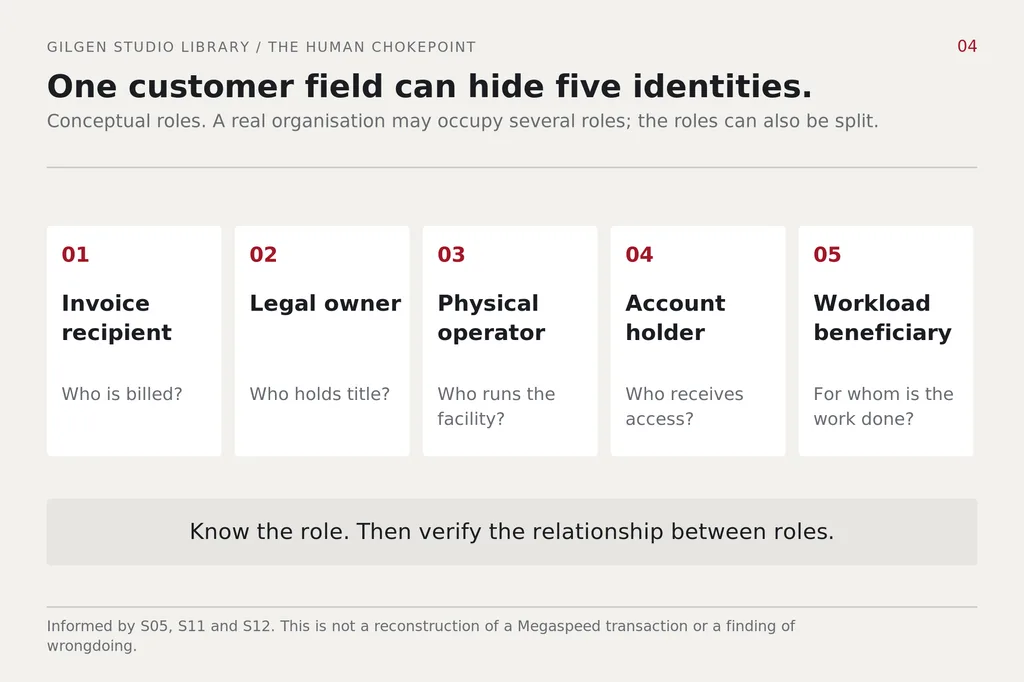
Who pays is not necessarily who uses. Who holds title is not necessarily who administers. Who administers is not necessarily who determines the purpose. A compliance system that stores one field labelled “customer” may have compressed several different people and institutions into one convenient name.
This becomes more consequential when the product is scarce computing capacity. The asset may sit in a facility owned by one company, be financed by another, be sold as capacity by a third and be accessed by users outside all three jurisdictions. Each participant can possess a locally plausible account of its own transaction. The risk sits in the connection between accounts.
There is no need to invent a smoky room. The important scene may be a spreadsheet whose columns do not line up.
Five identities that a single “customer” field can hide. Analytical model, not a reconstruction of a particular Megaspeed transaction. Informed by S05, S11 and S12.
The investigation must also survive the possibility of an ordinary explanation. Rapid expansion, a poorly documented business relationship, a succession of holding companies and a founder who meets customers are not, separately or together, a sufficient definition of espionage. To move from risk indicators to a finding, investigators need evidence of conduct, knowledge and causation appropriate to the allegation.
That standard protects more than the individuals involved. It protects the analysis from becoming useless. A theory that interprets every observation as confirmation cannot tell an illicit network from a legitimate company operating in an awkward jurisdiction.
Megaspeed has disputed the diversion allegations and has pointed to inspections and compliance measures in its defence, according to published reporting. Those claims deserve inclusion alongside the allegations; they are not a substitute for independently examining the relevant records.[^40]
The counterargument is worth stating at full strength: perhaps the relationship was personal, the shipments were lawful, the company’s policies were independently enforced, and the suspicion will not be substantiated. A serious volume must remain useful under that outcome. The need to know who controls infrastructure does not disappear because a particular allegation fails.
## 4 — Follow the chips, but do not add the headlines
The procurement problem exists independently of the relationship.
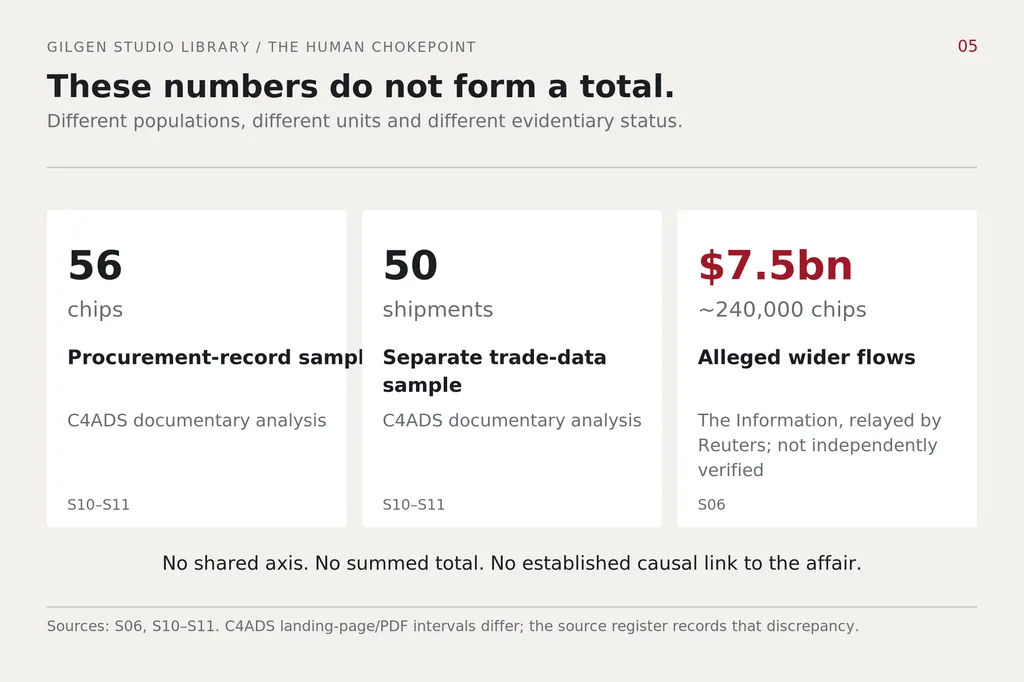
C4ADS identified at least 56 restricted chips in a sample of Chinese institutional procurement records and 50 shipments in a separate trade-data analysis. These are different units and different populations. They cannot be added into “106 incidents”, scaled into a national total or connected to Huang’s private conduct by arithmetic.[^41]
There is a small but revealing editorial problem in the material itself. C4ADS’s landing page and PDF use different date ranges for some of their summaries. This volume records the discrepancy rather than selecting whichever range best suits the narrative. The figures are treated as published sample findings, not as a perfectly harmonised time series. An exact-looking chart built from incompatible intervals would be less honest than an explicit note.[^41][^39]
On 11 November, Reuters separately reported procurement and rented-compute records involving restricted NVIDIA equipment and Chinese institutions, including a blacklisted university. That reporting supports the broader question of access to controlled compute. It does not establish a connection between those purchases and the affair.[^42]
A US enforcement case supplies a different kind of evidence. In December 2025, the Justice Department announced Operation Gatekeeper and described guilty pleas by Alan Hao Hsu and Hao Global, alongside allegations against other defendants. Its account concerned exported and attempted exports of advanced GPUs. The difference between an admitted offence and an unproven charge must survive every retelling. Nothing in the reviewed material links that case to Huang’s relationship.[^43]
The largest figures in this story demand the greatest restraint. Reuters relayed a report by The Information alleging that the relationship helped facilitate at least $7.5 billion in chip shipments and about 240,000 processors. Reuters explicitly said it could not independently verify the reports. That number belongs in an attributed account of the allegation. It does not belong in a chart labelled “proven smuggling”.[^44]
Numbers that must not be totalled. Different units, periods and evidence classes. Sources: S06, S10–S11. The $7.5bn figure is an allegation relayed by Reuters, not an independently verified loss, illegal-export total or finding against Huang.
An effective investigation follows serial numbers, counterparties, dates, licences, delivery records and access rights. A weak one follows the largest number until it finds a person to attach it to.
The distinction changes what the next question should be. Instead of asking how many billions one relationship supposedly moved, ask what records would establish that a particular order received preferential treatment, who authorised it, what they knew at the time and where the equipment or computing access ultimately went. That is a sequence of testable propositions.
There may eventually be an answer. There may be several answers for different transactions. A public essay cannot substitute narrative momentum for the missing records.
## 5 — The border does not run through the same place
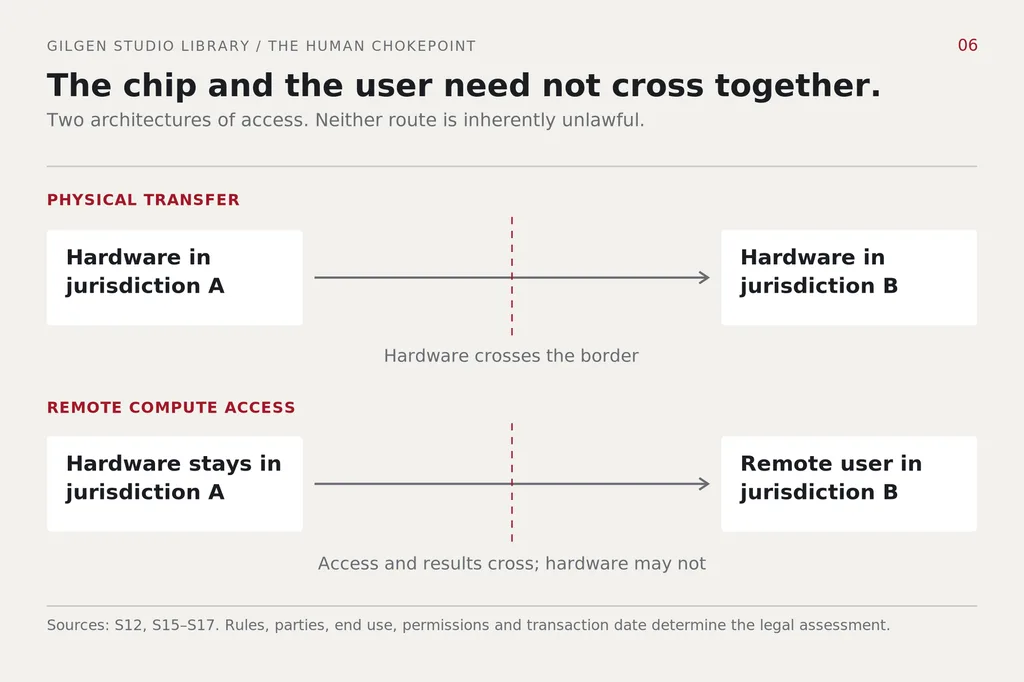
An export-control rule has to distinguish between things that look nearly identical from a distance. A processor sold to an authorised customer is not the same transaction as the same processor diverted to a prohibited end user. A chip physically shipped into a country is not the same event as a user in that country renting computing time elsewhere. A sale made under an earlier rule must be assessed against the rule and permissions applicable to that transaction.
The American control regime changed materially in October 2022, when the Bureau of Industry and Security announced restrictions on advanced computing and semiconductor manufacturing connected to China. The government’s stated objectives included limiting military and surveillance capabilities. That establishes the policy’s rationale. It does not establish how effectively every element achieved it.[^45]
On 13 January 2026, BIS announced a conditional case-by-case licensing approach for NVIDIA H200, AMD MI325X and similar products for China. Applicants had to satisfy specified requirements, including customer compliance procedures and independent testing. The published regulations retain a qualifying case-by-case provision. Consequently, the statement “an H200 reached China” is not, by itself, a legal conclusion.[^46][^47]
Singapore’s position exposes the jurisdictional seam. Its government says it does not implement other countries’ unilateral export controls, while expecting businesses to take foreign regulations into account and acting against fraud and violations of Singaporean law. That is not a declaration that anything goes. It is a statement that the legal systems are not identical.[^31]
A reader might reasonably ask why the United States should be able to constrain a transaction between companies elsewhere. Another might reasonably ask why a third-country intermediary should be able to neutralise restrictions attached to strategically sensitive American technology. Those questions express conflicting ideas of sovereignty. Neither is resolved by putting the word “sovereign” on a data centre.
There are two competing strategic arguments. The restriction argument says that denying an adversary advanced computing capacity can delay dangerous capabilities. The ecosystem argument says that refusing sales can accelerate substitution and reduce long-term influence over the platforms people use. Their relative strength depends on empirical questions: which products, which customers, what substitute capacity, what delay, what enforcement cost and what security effect?
That disagreement exists without an affair. A commercial preference for a larger market is not evidence that a company executive was manipulated. Conversely, a policy that benefits a company is not automatically the best policy for national security. The intellectually difficult work is to separate an argument’s merits from the personal interests of the people making it.
A sound inquiry would examine records of decisions rather than assume that a controversial position reveals its own hidden cause. Did an official or executive depart from a documented process? Was relevant information withheld? Was an exception granted after an unusual intervention? Did independent reviewers have the information and authority needed to disagree? Those questions can be answered without pretending that every pro-export argument is a confession.
Two different borders. Conceptual architecture based on S12 and S15–S17. Neither route is inherently unlawful; legality depends on the applicable rules, parties, end use and permissions.
Georgetown’s CSET makes the operational limit explicit in its assessment of chip-location verification. Geolocation can help investigate diversion, but it cannot establish the identity of an end user when hardware remains in the same place. Offline equipment and adversarial obfuscation create additional ambiguities. Location checking is a tool, not a complete account of control.[^48]
You can know where the GPU sits and still not know for whom it is working.
The appropriate response is not to abandon location information. It is to avoid asking it to answer a different question. Physical inventory, customer identity, beneficial ownership, workload access and legal authorisation are different records. They need to be reconciled over time. A correct shipping address is the beginning of that work, not its completion.
## 6 — Espionage without the film set
The public imagination is unusually unhelpful here. It offers a cast, a seduction, a secret and a betrayal, then urges us to arrange the available facts into that order. Real institutional exposure is often less tidy.
A relationship can matter because it grants access. Access can matter because it creates opportunity. Opportunity can matter because somebody uses it. Each movement is conditional. A person can be targeted without knowing it, trusted without acting improperly, or close to a decision without changing it. Investigators must establish which of those possibilities describes the case.
A useful hypothetical makes the difference visible. Suppose a senior executive informally discusses which customers are likely to receive equipment first. No circuit design is transferred. No classified document leaves a safe. The information could still have commercial value. Or suppose a contact asks the executive to have a delayed order examined. An ordinary customer escalation and an improper intervention could begin with the same sentence. The difference lies in the context, the authority, the records and the decision that follows.
These are mechanisms to investigate, not descriptions of what Huang or Alice Huang did.
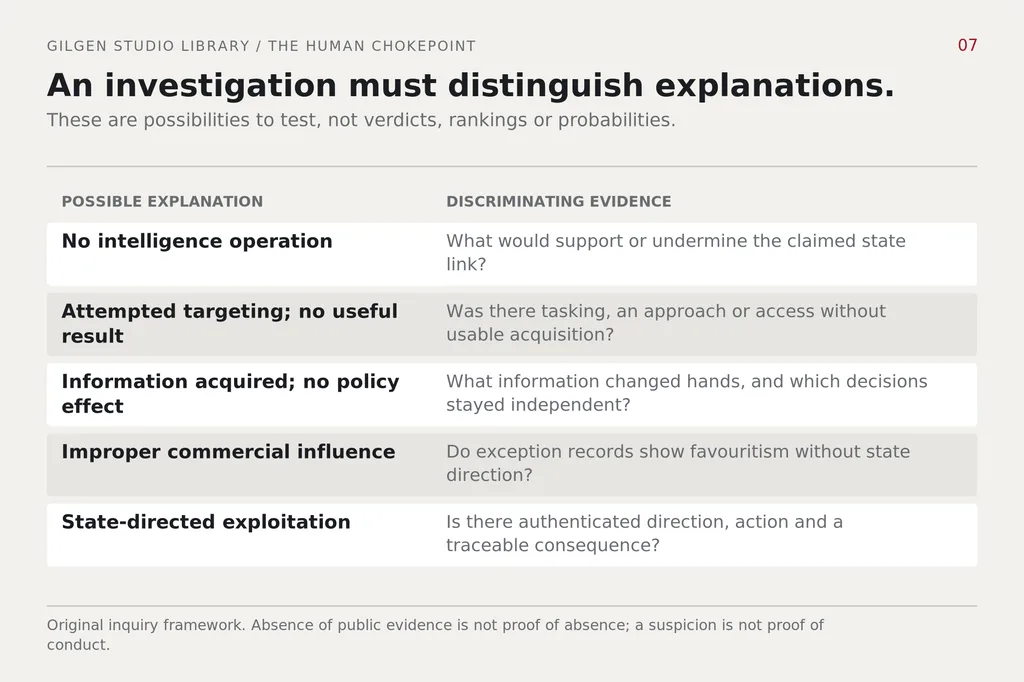
The allegation also has to be tested against alternatives. Perhaps there was no intelligence operation. Perhaps there was an attempted operation but no useful information or influence resulted. Perhaps business information was obtained without affecting policy. Perhaps a transaction benefited from influence without any state direction. Perhaps the most serious account is supported by evidence not yet public. A good investigation distinguishes these hypotheses rather than treating them as different adjectives for the same conclusion.
The most informative evidence would vary accordingly. Recruitment records would speak to intelligence direction. Communications and access records might speak to what information was exchanged. Order histories and exception logs could speak to commercial treatment. Contemporary decision records would matter more to causal claims than later recollections shaped by the scandal.
Competing explanations, not a ladder of presumed guilt. Original analytical framework. The public record reviewed here does not select a final explanation.
A board can use this framework without assigning guilt in advance. Preserve the relevant records. Establish independent control of the inquiry. Identify the decisions that might have been affected. Separate personal embarrassment from corporate exposure. Require each serious proposition to carry its own evidence.
It should also avoid building a personnel-security programme around nationality, ancestry or a stereotype about women. The relevant questions concern access, conduct, undeclared conflicts, coercion, influence and authorisation. A system that treats an ethnic background as a substitute for those questions will produce both injustice and poor detection.
There is another human problem: an organisation can make concealment easier by making disclosure feel impossible. A senior person who admits a compromising situation may need to lose particular powers while the matter is assessed. That is different from arranging the institution so that admitting vulnerability instantly destroys every prospect of a fair process. The latter creates an incentive to keep the vulnerability private.
This is an operational design argument, not an excuse for misconduct. Accountability and a usable reporting channel serve different purposes and should support each other. The objective is to surface a risk early enough that somebody else can act.
The phrase “human attack surface” can make this sound as though people are defective hardware. People are the reason organisations exist. The design failure is allowing their ordinary fallibility to become a system-wide, unreviewable dependency.
## 7 — The machine from Zug
Long before GPUs became geopolitical objects, a Swiss company sold machines intended to protect the most sensitive communications of its customers.
The Swiss National Museum describes the CX-52, introduced by Boris Hagelin’s Crypto AG in 1952: a mechanical cipher device with wheels, a dial and a lever. Some equipment was secure; other versions and operating arrangements weakened protection. In 1970, the CIA and West Germany’s BND acquired the company through a cover arrangement. The historical record is about a supplier whose apparent commercial identity concealed intelligence control, not about a modern GPU manufacturer.[^49]
The physical object is useful because it removes the abstraction. A customer could receive the machine, install it in a protected room, assign trusted staff and operate it entirely inside its own country. Every visible element of possession could be satisfied. The unresolved question was upstream: who had determined how much secrecy the machine would actually provide?
This was not simply a lesson about a backdoor. It was a lesson about which parts of a procurement were being inspected. A buyer could verify delivery, inventory, payment and installation while failing to verify the property for which the equipment was bought.
Switzerland’s parliamentary oversight delegation reported in November 2020 that Swiss intelligence had known from 1993 that foreign intelligence services stood behind Crypto AG. Political leadership was informed only in late 2019. The delegation identified failures of leadership and oversight and political co-responsibility for the export of weakened equipment.[^50]
The passage from technical knowledge to political authority had failed. Some people knew something that mattered, but the institutions nominally responsible for governing the consequences did not receive or act on that knowledge in the way the oversight body considered necessary.
That is a different failure from a stolen password. It cannot be repaired by changing a password.
There are strict limits to the comparison. Crypto AG involved a historically documented intelligence-controlled supplier and compromised products. The current NVIDIA controversy involves allegations and an ongoing inquiry. There is no basis here to say that NVIDIA is a Crypto AG, that Alice Huang performed an equivalent role or that NVIDIA hardware contains secret state controls. Analogy is useful only if it preserves the difference that could make it wrong.
The durable connection is the buyer’s mistake: treating a familiar commercial or national identity as a complete account of control.
A Swiss address is evidence of an address. It is not a proof of who benefits from the system. A domestic company registration is evidence of incorporation. It is not a guarantee that every consequential decision is domestic. An open model is evidence that certain artefacts can be inspected and used. It does not establish who can withhold replacement hardware, change access terms or operate the surrounding services.
These statements are not arguments against buying anything. They are arguments for specifying what has actually been purchased.
In a well-designed procurement, the answer is not “trust nobody”. The answer is a list of claims with ways to test them. Can the customer inspect the implementation? Can it administer the system without the supplier? Can it preserve the necessary software and records? Can an independent party reproduce the promised behaviour? Can the customer continue operating under a defined supplier failure?
A country that cannot answer those questions may possess the machinery while borrowing the assurance.
## 8 — The other side suspects a switch
The argument becomes more revealing when the direction of suspicion reverses.
On 31 July 2025, China’s Cyberspace Administration said it had called on NVIDIA to explain alleged security risks associated with H20 chips and provide supporting materials. The regulator referred to concerns about tracking and remote shutdown. Its statement established a regulatory concern, not the existence of a backdoor.[^51]
On 5 August, NVIDIA published a response rejecting hardware backdoors and kill switches. The company argued that such mechanisms would introduce dangerous single points of failure and undermine trust in technology. That was NVIDIA’s stated security position; it was not a substitute for an independent examination of every product.[^52]
The symmetry is uncomfortable. American policymakers worry that advanced chips may strengthen an adversary. Chinese authorities worry that imported chips could expose their users to foreign control. European buyers worry about strategic dependence. Suppliers want their technology to be ubiquitous and trusted. Everyone can use the language of security while seeking a different distribution of authority.
A location-verification mechanism, an administrative access control and a secret hardware kill switch are not three names for the same feature. One observes or attests, another authorises use, and the third is a particular disabling capability. Conflating them makes both policy and technical scrutiny worse. Any proposed mechanism should be described by what it can actually do, who controls it, how it fails and what it exposes.
It is equally misleading to imagine that every form of dependence requires a remote shutdown button. A supplier can become consequential through future deliveries, support, replacement parts, software releases or commercial access. Some constraints act immediately. Others become visible only when a component fails, a contract renews or a workload grows.
Those are different time horizons. An organisation may be able to keep a purchased system running today and still be unable to expand or maintain it next year without a particular external relationship. “They cannot switch it off” is a narrower assurance than “we can sustain it independently”.
This is why the sovereignty debate should resist spectacular mechanisms. The most important lever may be less cinematic than a hidden switch. It may be a dependency that nobody bothered to exercise without the supplier because everything was working.
The same discipline applies to the intelligence allegation. No secret hardware capability is needed for a human relationship to create a governance concern. Conversely, a human relationship does not demonstrate a hardware vulnerability. The analysis becomes clearer as soon as each mechanism is given its own name.
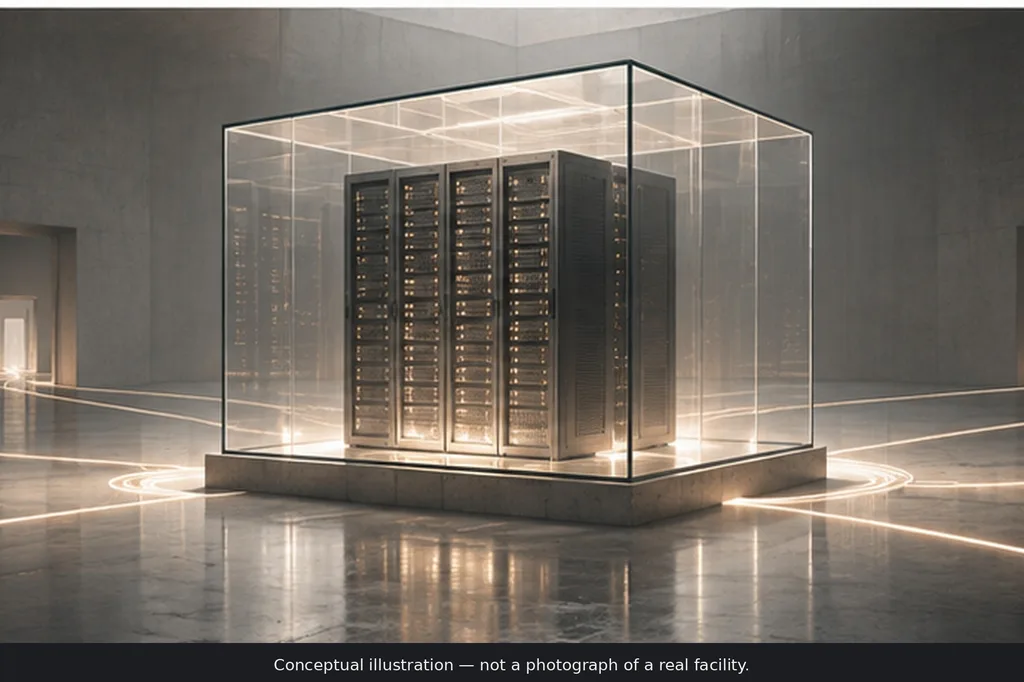
Conceptual illustration. A visible boundary does not reveal every dependency.
## 9 — The world behind the rack
There is a geographical fiction inside the phrase “our AI infrastructure”. It encourages the picture of a self-contained national object: a building, a flag, some machines and a policy announcement.
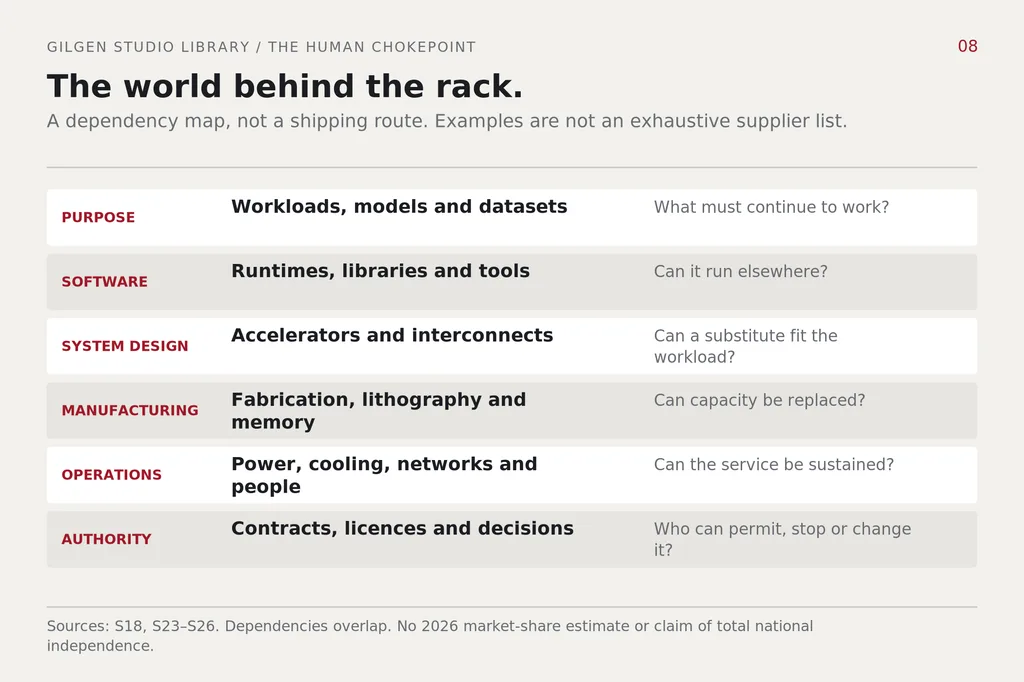
The OECD’s 2025 assessment instead describes a concentrated supply chain. It reports leading-provider shares above 80% in advanced lithography, advanced AI chip fabrication and GPUs for AI compute, naming ASML, TSMC and NVIDIA respectively. The OECD cautions that it did not perform a formal market-definition exercise. These are descriptions of distinct supply-chain segments, not three shares to add, and not a live market-share survey for November 2026.[^53]
The world behind the rack. A functional schematic, not a shipping-route map or an exhaustive bill of materials. Sources: S18, S23–S26. The diagram does not claim that any country controls every activity within its labelled segment.
A flag over the final assembly cannot nationalise that entire history. Nor would reproducing every layer within one border automatically produce a dependable system. Independence can be purchased at the price of inferior performance, higher costs, delayed deployment or a new domestic monopoly. The proper comparison is not global dependence versus a fantasy of self-sufficiency. It is the set of dependencies one can understand, negotiate and survive.
Farrell and Newman’s research on weaponized interdependence provides a useful lens. Concentrated networks can give actors positioned at central nodes opportunities to observe activity or deny access. The network’s convenience and its political leverage can arise from the same structure.[^54]
The extension proposed in this volume is that some central nodes are institutional decisions, and some of those decisions become concentrated in people. A person need not own every asset to influence access to a valuable network. A government need not control every factory to exercise jurisdiction over a critical transaction. A customer need not have a direct contract with the most consequential supplier to depend on it.
These are separate pathways to power. They should appear separately in an infrastructure assessment.
For a small company, the practical implications are not that it should design a chip or manufacture memory. The affordable moves are closer to the work: preserve reproducible deployments, keep exportable data, hold administrative authority over essential accounts, test another runtime, maintain a degraded mode and know which parts require cooperation from someone outside the organisation.
For a state, the feasible portfolio is broader but the principle is similar. Invest in domestic competence where it changes the ability to act. Build alternatives where the lack of alternatives creates unacceptable exposure. Use alliances where independent duplication would be wasteful. Avoid calling a purchase a strategy when the buyer has not specified what happens after refusal, interruption or political disagreement.
A supplier’s nationality can matter because laws, courts and state power matter. It is still not enough. A domestic supplier can be opaque, incompetent or unaccountable. A foreign supplier can offer excellent technical controls and enforceable commitments. The assessment has to connect jurisdiction to an actual mechanism, rather than treating a passport as a technical specification.
The most useful question is not whether a dependency exists. Dependencies are everywhere. It is whether the institution understands what the dependency permits someone else to do.
## 10 — Lugano, and the difference between open and independent
At CSCS, the specification is concrete. The Grace-Hopper installation within Alps comprises 2,688 nodes with four modules each, for 10,752 modules. Alps is a heterogeneous research infrastructure; the operator also lists other processor configurations. Reducing the entire system to a single NVIDIA total would erase part of the actual machine.[^55]
In July 2026, ETH Zurich, EPFL and CSCS released Apertus 1.5, trained on Alps. The institutions described an open model initiative intended to make code, development and training more transparent and to support use by researchers, public institutions and companies.[^56]
There is real sovereignty value here. The ability to inspect, adapt and run a model changes the relationship between a user and a proprietary API. Local operational competence changes who can investigate a failure. Public research infrastructure changes which institutions can undertake work without negotiating every experiment with a commercial model provider.
It is not made meaningless by the presence of imported hardware. That would be the mirror image of the error this volume criticises: replacing a false claim of total independence with a false claim that partial independence has no value.
The correct description is layered. A project can have substantial control over models, data and operations while relying on foreign processors, manufacturing tools and software components. An improvement in one layer is an improvement. It is not automatically an improvement in every other layer.
The Korean announcement from the opening illustrates the same trade-off. Integrating a domestic processor into a widely used infrastructure platform may lower barriers to deployment and create useful local capability. It can also retain dependence on that platform’s interfaces and ecosystem. Because the announced systems are expected in 2028, the immediate achievement is a partnership and a development path, not proof that every promised capability already works.[^26]
There is no contradiction in pursuing autonomy through cooperation. There is a contradiction in describing cooperation as the elimination of dependency.
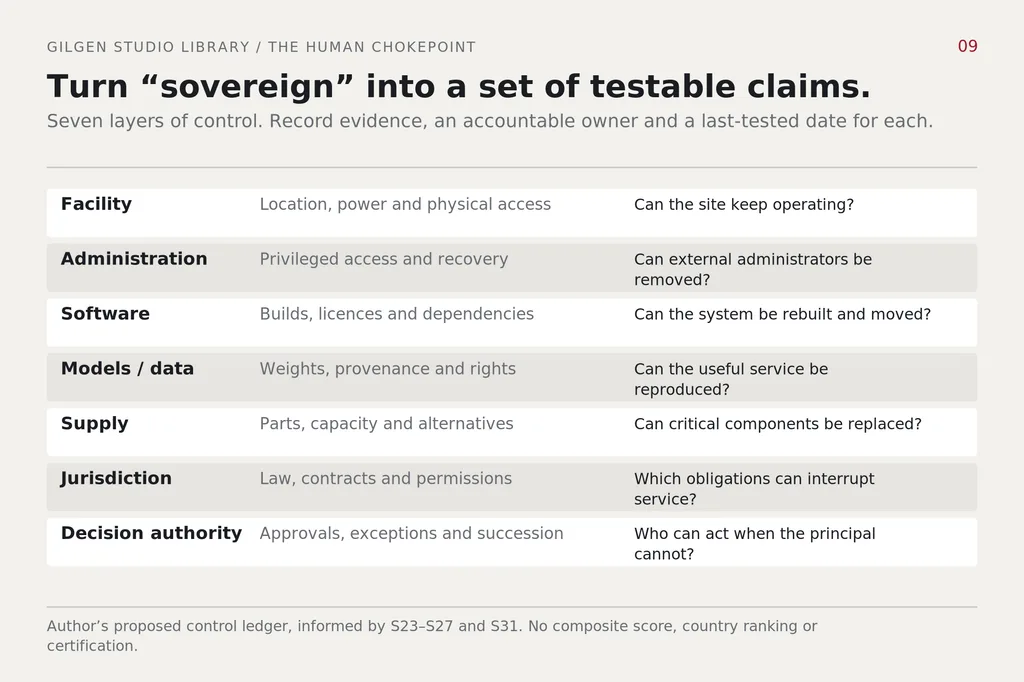
A more useful public account would say what the institution can now do that it could not do before. Can it train or adapt a model? Can it operate without sending sensitive material to an external service? Can it change the application? Can it inspect relevant code? Can it replace a runtime? Can it sustain hardware repairs? Can it continue after a political decision elsewhere removes a source of support?
The answers need not all be yes. They need to be specific.
A sovereignty ledger rather than a national score. Original framework, informed by S23–S27 and S31. No institution has been assigned a measured rating.
NIST’s zero-trust architecture offers a useful, limited analogy. It rejects implicit trust based only on network location or ownership and focuses on explicit authentication and authorisation. The standard is about technical access; it does not prescribe a boardroom constitution. The analogous governance question is whether a person’s status has become an implicit permission to bypass the checks applied to everyone else.[^57]
A chief executive’s approval may be relevant. It should not erase the record of what was approved, the limits of the approval or the possibility of independent review. Likewise, a system’s domestic location may be relevant. It should not erase the question of who can change its configuration or withdraw a dependency.
This is the point at which the sovereignty debate becomes useful to an operator. It stops asking for a label and starts asking for a working demonstration.
## 11 — The founder as a control plane
In computing, a control plane determines how the system is configured and directed. The data plane does the work. The distinction is imperfect when applied to a company, but it identifies a failure mode that an organisation chart can hide.
A chief executive need not administer a production server to influence the decisions that determine its availability. Product commitments, customer exceptions, hiring priorities, government relationships and investment allocations can shape the conditions under which everyone else operates. The executive’s power is not equivalent to root access. It can be more indirect and harder to inventory.
This does not mean the founder should be removed from consequential decisions. It means the organisation should know which decisions depend on personal judgement, which require independent approval and which must remain executable when that person is absent or conflicted.
Consider a customer escalation. In a healthy process, a senior sponsor can ask for review. The review still has an owner, a record, a reasoned decision and any required compliance approval. In an unhealthy process, the sponsor’s name becomes the reason. The difference may not be visible when everything goes well. It becomes visible when someone has to reconstruct why an exception happened.
Or consider an external relationship. A founder may have cultivated trust with a government or a strategic customer over years. That relationship is commercially valuable. But if its operational content exists only in private messages and personal recollection, the company has not fully acquired an institutional capability. It has acquired access that continues to be rented from an individual.
The inquiry at NVIDIA may or may not find failures of this kind. The public record reviewed here does not establish them. They are the kinds of questions an independent examination should be capable of answering.
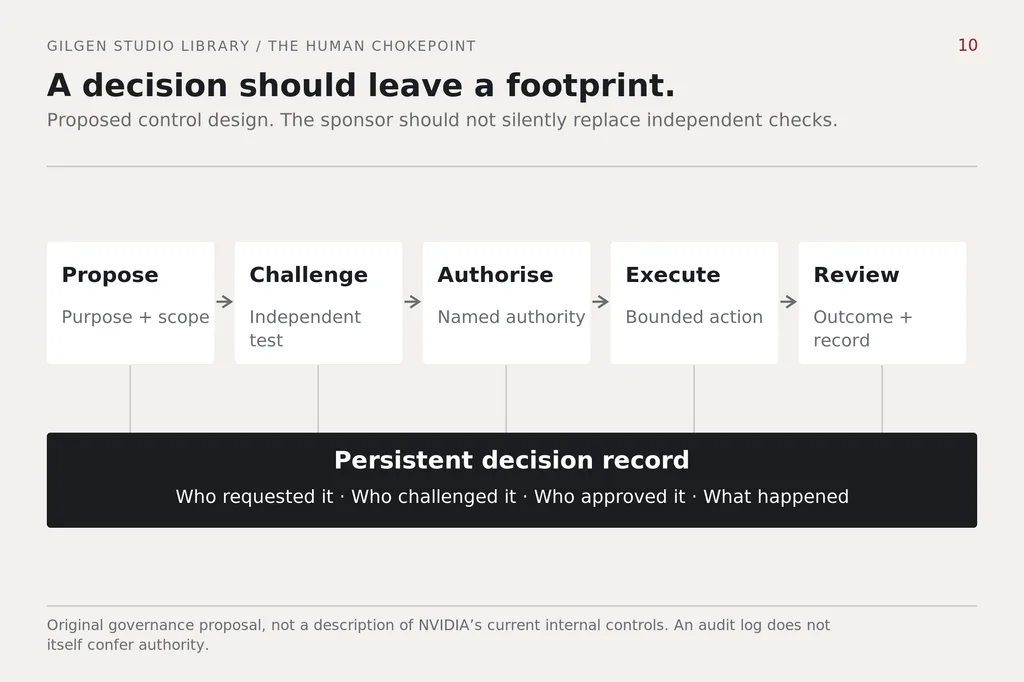
### A decision should leave a footprint
For high-consequence decisions, an institution should be able to identify the proposal, the authority, the evidence available at the time, the objections, the approval and the resulting action. That is not a demand to record every conversation or turn every company into a surveillance apparatus. It is a demand to preserve the decisions that expose other people to risk.
The most important footprint may be an exception. Ordinary transactions can pass through a well-designed control system while exceptional transactions escape it through prestige, urgency or personal sponsorship. A procedure is only as strong as its treatment of the person most able to waive it.
That suggests a practical separation. The person who brings a strategic opportunity should not be the only person who determines that the opportunity is safe. The person whose conduct is being examined should not control the evidence or scope of the inquiry. The person who can authorise a sensitive departure should not be the only person who can discover that it occurred.
These are proposed governance principles, not allegations that NVIDIA lacked them.
The decision footprint. An original operating model. It describes a proposed safeguard, not NVIDIA’s observed internal workflow.
There is a corresponding protection for the executive. A proper record can show that a decision was ordinary, independently reviewed and supported by information available at the time. Without the record, a company may have to defend a legitimate decision through personal assurances after public trust has already deteriorated.
The same logic applies to an independent inquiry. Its credibility depends on access to relevant records, freedom to examine uncomfortable decisions and clarity about what its conclusions do and do not cover. Naming an outside law firm is a meaningful procedural step. It does not allow a reader to assume the investigation’s future scope, completeness or public disclosure.
The board’s eventual account should be read for those boundaries. “No evidence found” can mean a broad inquiry found no evidence, a narrow inquiry did not encounter it, or relevant material was unavailable. The words require context. An honest report states the scope and limits rather than offering a reassuring sentence broad enough to mean several different things.
The human chokepoint is therefore not the presence of a talented founder. It is the absence of institutional alternatives around the founder’s authority.
## 12 — Tuesday, 08:00
*The following is a fictional exercise, not a report about NVIDIA, CSCS, a Swiss authority or any of the author’s clients. All timings are illustrative assumptions, not benchmark results.*
At 08:00 on a Tuesday, a public-service technology team receives two notices. Its principal supplier is suspending a support channel pending a legal review. Separately, the one executive who manages the supplier relationship is unavailable for an indefinite period.
The servers are still running.
This is deliberate. Disaster exercises too often begin with a dramatic outage, allowing everyone to reach for the familiar restoration procedure. Here nothing has broken yet. The team must determine what it can continue to do without the two relationships on which it normally relies.
The service processes documents. It has defined a minimum acceptable mode: sensitive material remains within approved boundaries, urgent cases can still be processed, and slower handling is acceptable for less urgent work. The exercise does not require the alternative to match peak throughput. It requires the alternative to deliver the service that the institution has promised not to lose.
The first inventory is disappointing. The team has model files, but not all build dependencies. It has a backup, but the last restoration test did not include the identity provider. It has a second supplier on a presentation slide, but the production workload has never run there. Two contracts are signed, yet both paths rely on the same external account for an essential deployment step.
None of those facts demonstrates a hostile act. Together, they show that the continuity plan had tested the machines more carefully than the permissions.
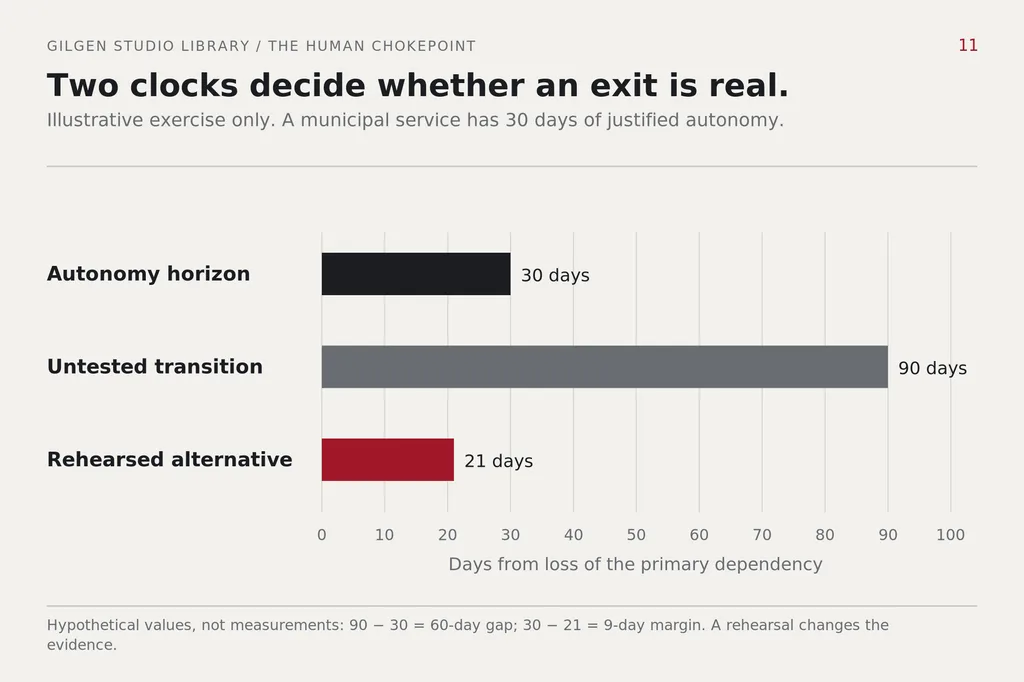
By midday, the team has identified its first useful number: with the approved local stack and available support, it estimates thirty days of acceptable service without the suspended relationship. That estimate is not “the servers will die on day thirty”. It is the period for which the team can justify its operating assumption under the scenario: known dependencies, security obligations, support limits and available capacity.
Its second number is worse. The untested alternative is expected to take ninety days to qualify. The institution has thirty days of justified autonomy and ninety days of transition work. The resulting sixty-day gap is not repaired by ownership of the existing hardware.
After a rehearsal programme, suppose the team reduces the tested transition time to twenty-one days under the same assumptions. It now has a nine-day margin. The figures are invented for this exercise, but the arithmetic is not. The improvement comes from reducing an observable dependency, not from changing the adjective in the procurement document.
Two clocks. Hypothetical scenario: autonomy window 30 days; initial transition 90 days; rehearsed transition 21 days. Initial gap: 60 days. Improved margin: 9 days. These are not measurements of any named system.
This produces a useful operating test:
**For a defined essential workload, the time needed to reach an acceptable alternative should fit inside the time the current arrangement can operate without the dependency being tested.**
The test has to be applied to a scenario, not to “sovereignty” in the abstract. A missing software update, a blocked account, an export restriction, a supplier bankruptcy and the departure of a key administrator affect different dependencies. They should not share one invented number.
Nor should the fastest laboratory migration be presented as an organisational guarantee. Security review, data movement, legal approval, user acceptance, capacity acquisition and staff competence all consume time. If the alternative depends on the same unavailable party, it is not an alternative for that scenario.
The exercise also reveals an often neglected option: reduce the promise. An institution may not be able to sustain frontier-model performance during a disruption, yet may be able to preserve a smaller, well-defined essential service. A measured degraded mode can offer more autonomy than an untested commitment to reproduce everything.
By the end of the exercise, the team has not become independent of the world. It has learned which parts of the world it can temporarily do without, what that costs and who can authorise the transition.
That is a useful kind of sovereignty.
## 13 — A ledger that can survive an apology
The practical output of this volume is a control ledger. Not a score, a badge or a national ranking. A record of the critical decisions and dependencies surrounding a particular service.
For each dependency, the ledger names the required function, the party with authority over it, the evidence for that authority, the mechanism by which access could be altered, the available alternative and the result of the latest test. It also names the person responsible for maintaining the record. An unowned inventory becomes historical fiction surprisingly quickly.
The ledger has to distinguish five verbs: see, decide, operate, stop and replace. A supplier may be able to see telemetry without being authorised to decide how a customer uses its application. An operator may be able to restart a service without being able to replace its hardware. An owner may be able to sell an asset without being able to reproduce the software it runs. A regulator may constrain a transaction without operating the machine.
Those differences are the substance of control. Collapsing them into a single field labelled “owner” makes the resulting document easy to read and difficult to rely on.
The human layer belongs in the same ledger. Which decisions require one named person? Which credentials have no tested recovery path? Which external relationships have no second institutional contact? Which exceptions can be granted without independent challenge? Which records can the subject of an inquiry alter or withhold? The purpose is to protect the service from concentrated authority, not to create a catalogue of employees’ private lives.
A useful review can be surprisingly plain. Choose one important workload. Trace the parties needed to keep it operating. Remove one dependency at a time in a controlled exercise. Record what failed, what still worked and which assumptions proved wrong. Spend money on the gaps that threaten the promised service rather than on a comprehensive diagram no one can validate.
The ledger should also preserve uncertainty. “We do not know who ultimately controls this counterparty” is more useful than inserting a plausible name. “Alternative supplier not tested” is more useful than a green tick beside a contract. “Authority exists but has not been exercised” is more useful than claiming a legal right guarantees operational continuity.
The most expensive entry may be the one labelled “relationship”. It can contain years of personal trust, access to decision-makers and unwritten expectations. Those are not worthless. They are precisely valuable enough to require institutional memory, succession and limits.
This is where the argument returns to the original apology. Even if the independent inquiry finds no espionage, no leakage and no improper commercial treatment, the wider question remains: how much of a critical system’s assurance rests on a person’s reputation, and how much rests on evidence that the system can produce without that person?
A good institution should not need a scandal to ask.
## 14 — The case against the thesis
A volume about chokepoints can become a machine for finding them everywhere. That would be a different kind of failure: a framework so flexible that it explains everything and discriminates between nothing.
The strongest objection is that modern industrial production necessarily depends on expertise and concentration. Customers choose integrated platforms because fragmented alternatives can be slower, more expensive and less reliable. A founder can coordinate a complex system exceptionally well. Attempts to eliminate dependence may destroy the capabilities they are supposed to protect.
That objection is correct as far as it goes. The objective cannot be zero dependence. It is unacceptable dependence under specified conditions. An organisation may rationally accept a supplier concentration because its benefits outweigh the foreseeable costs, provided it knows what it has accepted and has authority to make that trade-off.
A second objection is that the political alternative can be worse. A state-sponsored domestic technology monopoly is not automatically more accountable than a foreign commercial supplier. Moving authority closer does not make it more contestable. A sovereignty programme that concentrates procurement, data and administrative power without oversight can produce domestic vulnerability under a national label.
A third objection concerns timing. The inquiry is unfinished. A systems essay written now risks using an individual as the illustrative villain before the evidence is settled. That is why the argument here must survive the most exculpatory plausible outcome. The acknowledged personal conduct and the existence of the inquiry are documented. The diagnosis of a specific espionage operation is not ours to make.
There is also a limit to generalisation. One case cannot establish the prevalence of executive compromise, the effectiveness of an intelligence service or the security of an entire industry. This volume does not estimate those quantities. It proposes questions and tests that can be applied without knowing them.
Finally, the proposed controls have costs. Independent review can slow a decision. Preserved records require management and privacy safeguards. Alternative platforms need engineering time. Continuity rehearsals consume money that could have delivered features. Pretending those costs do not exist would make sovereignty another form of marketing.
The appropriate response is proportionate design. Put the strongest controls around the decisions and dependencies whose failure would cause the greatest harm. Make ordinary work straightforward. Ensure exceptions are visible. Test the alternative at a scale relevant to the service. Revisit the trade-off as the workload and external environment change.
The title names a risk, not an inevitability. A human being can occupy a powerful position without becoming an ungovernable point of failure. A globally integrated technology can support meaningful local autonomy. A company can investigate its leader without destroying the competence that made the company valuable.
Those are not contradictions. They are the outcomes good institutional design is supposed to make possible.
## Epilogue — The empty chair
The opening image is deliberately an empty chair. It is not a depiction of Huang’s office, a reconstruction of an intelligence meeting or a claim that one person operates every machine. It asks a continuity question without pretending to answer a criminal one.
Remove the person. What still works?
The hardware may keep running. The software may remain available. The teams may know their jobs. But can the institution explain its decisions, exercise its rights, review its exceptions and maintain its relationships without appealing to the missing person’s judgement or reputation?
That is where a system becomes more than the people who built it. Not because people cease to matter, but because their work has been made transferable, reviewable and durable.
The public investigation will develop after this edition. New evidence may substantiate serious allegations, narrow them or undermine them. According to a committee chair, Huang has agreed to brief Congress, and what the briefing yields may remain largely private. A company review may answer questions and leave others open. None of those possibilities permits a writer to prewrite the verdict.
What is already visible is the architecture of the question. Computing capacity is produced by international supply chains, allocated through companies, governed by jurisdictions and directed through human decisions. Control can accumulate at each layer. Possession at one layer does not dissolve authority at the others.
There is no need to turn the affair into a morality play about technology. The more demanding task is to make technology governable by institutions that expect people to be fallible.
Sovereignty is not merely the ability to own the machine. It is the ability to know which decisions remain yours, to preserve those decisions under pressure, and to keep serving the people who depend on them when an important person is no longer available to reassure you.
The machine can be yours while the next decision still belongs to someone else.
## Research and revision note
This edition is based on publicly accessible company statements, government responses, research reports, financial disclosures, technical documentation and attributed news reporting reviewed on 11 November 2026. It is a desk-research synthesis, not an original investigation with interviews, subpoenas, confidential sources or independently obtained shipment-level records. No parties were contacted for this volume; public responses are represented where available. Readers should not confuse the number of source records with the number of independent confirmations.
The strongest direct evidence concerns what Huang, NVIDIA’s board and governments actually said; company-reported financial and technical information; the findings and limitations published by researchers; and historical oversight findings. Those sources have different incentives and evidentiary functions. A corporate statement establishes a corporate position. An official denial establishes a denial. A research sample does not establish a population total. An allegation repeated by several outlets is not several independent discoveries.
Sources S10 and S11 are two presentations of the same C4ADS report, not independent sources. Their period labels differ in parts of the summaries. The companion evidence ledger records this discrepancy. Source S13 was available as a current Reuters summary rather than a complete retrieved article. Source S32 was accessible only through indexed material and is not used to carry a central claim. The large SEC annual-review PDF was text-accessible but exceeded the web screenshot renderer’s size limit; its financial figures were cross-checked against smaller official releases where applicable.
No claim is made that Huang’s marriage will end, that the affair caused a particular policy decision, that all Megaspeed imports were unlawful, that a particular woman’s nationality establishes intelligence affiliation, or that NVIDIA hardware has a secret kill switch. Changes to those propositions require new evidence, not more emphatic prose.
The German and French versions preserve the same facts, uncertainty, labels and source identifiers.
Change note, 12 November 2026. This is edition 2. The section “Update — 12 November 2026” was added after publication. It draws on NVIDIA’s press release and SEC filing of 12 November, attributed news reports of 11 and 12 November, statements by Singapore’s Ministry of Home Affairs and by Megaspeed, and intraday share-price figures labelled with their times. Key takeaway 2, the answers to two questions, one sentence in “Before we enter”, one sentence in section 2 and one sentence in the epilogue were changed to match. The text, figures and sources of the 11 November edition are otherwise unchanged. The update reflects information available at 16:56 CET on 12 November 2026. New source records are S43 to S54.
Change note, 13 November 2026. This is edition 3. The section “Update — 13 November 2026” was added after the section of 12 November. It draws on the closing share price of 12 November, attributed news reports of 12 and 13 November, NVIDIA staff emails as reported by CNBC, statements by the US Justice Department and by Malaysia’s Ministry of Investment, Trade and Industry, a House committee press release, and analyst notes as quoted by CNBC. One sentence in the 12 November section, the answer to one question and one sentence in “Before we enter” were changed to match. The text, figures and sources of editions 1 and 2 are otherwise unchanged. The update reflects information available at 08:48 CET on 13 November 2026. New source records are S55 to S64.
### What would change this edition
A published independent-investigation result, authenticated transaction-level findings, a court decision, a substantive official statement or a correction to a load-bearing source would justify a substantive revision. A new headline that merely repeats an earlier allegation would not. Any revision should preserve a dated change note rather than silently rewrite the historical record.
## Sources
[^1]: [S01] NVIDIA (2026-11-08): A Message to Our Company. [nvidianews.nvidia.com](https://nvidianews.nvidia.com/news/a-message-to-our-company)
[^2]: [S02] NVIDIA (2026-11-08): Statement From NVIDIA Board of Directors. [nvidianews.nvidia.com](https://nvidianews.nvidia.com/news/statement-from-nvidia-board-of-directors)
[^3]: [S09] PRC Ministry of Foreign Affairs (2026-11-10): Regular Press Conference on November 10, 2026. [www.fmprc.gov.cn](https://www.fmprc.gov.cn/eng/xw/fyrbt/202611/t20261110_12056810.html)
[^4]: [S43] NVIDIA (2026-11-12): NVIDIA Announces CEO Transition. [nvidianews.nvidia.com](https://nvidianews.nvidia.com/news/nvidia-announces-ceo-transition)
[^5]: [S44] NVIDIA / SEC (2026-11-12): Form 8-K, Items 5.02 and 9.01 (earliest event 2026-11-11), accession 0001045810-26-000082. [www.sec.gov](https://www.sec.gov/Archives/edgar/data/1045810/000104581026000082/nvda-20261111.htm)
[^6]: [S45] The New York Times / Ryan Mac, Tripp Mickle, Georgia Gee (via Business Standard) (2026-11-11): Huang said to have had relationship with Nvidia exec who reports to him. [www.business-standard.com](https://www.business-standard.com/world-news/huang-said-to-have-had-relationship-with-nvidia-exec-who-reports-to-him-126111200070_1.html)
[^7]: [S46] Reuters / Investing.com (2026-11-12): Nvidia CEO Jensen Huang resigns in big blow to AI boom. [www.investing.com](https://www.investing.com/news/stock-market-news/nvidia-ceo-jensen-huang-to-step-down-in-big-blow-to-ai-boom-5021980)
[^8]: [S47] CNBC (2026-11-11): Nvidia board meeting to decide CEO Jensen Huang's fate stretches into evening. [www.cnbc.com](https://www.cnbc.com/2026/11/11/nvidia-jensen-huang-affair-employee.html)
[^9]: [S50] Reuters / Investing.com (2026-11-11): House Republicans push for Nvidia's Huang to testify, float subpoena over spy allegations. [www.investing.com](https://www.investing.com/news/politics-news/house-republicans-push-for-nvidias-huang-to-testify-float-subpoena-over-spy-allegations-5019993)
[^10]: [S51] House Select Committee on the CCP (2026-11-05): Moolenaar, Mast, and Crawford Seek Briefing from Jensen Huang on Ties to Chinese Intelligence Asset. [chinaselectcommittee.house.gov](https://chinaselectcommittee.house.gov/media/press-releases/moolenaar-mast-and-crawford-seek-briefing-from-jensen-huang-on-ties-to-chinese-intelligence-asset)
[^11]: [S54] NBC News / Jared Perlo, Zara Morris (2026-11-12): Jensen Huang agrees to brief Congress on interactions with alleged spy, lawmaker says. [www.nbcnews.com](https://www.nbcnews.com/tech/tech-news/jensen-huang-agrees-brief-congress-interactions-alleged-spy-lawmaker-s-rcna608990)
[^12]: [S52] CNBC (2026-11-12): Nvidia CEO Jensen Huang resigns: Live updates. [www.cnbc.com](https://www.cnbc.com/2026/11/12/nvidia-jensen-huang-ceo-live-updates.html)
[^13]: [S48] Singapore Ministry of Home Affairs (2026-11-12): Singapore's Investigations into Alice Huang (Huang Le) and Megaspeed International Pte Ltd. [www.mha.gov.sg](https://www.mha.gov.sg/media-room/newsroom/singapore-investigations-into-alice-huang-huang-le-and-megaspeed-international-pte-ltd/)
[^14]: [S49] NBC News / Mithil Aggarwal (2026-11-12): Megaspeed, chip firm at center of Nvidia scandal, pledges to cooperate with U.S. investigation. [www.nbcnews.com](https://www.nbcnews.com/tech/tech-news/megaspeed-statement-nvidia-jensen-huang-alice-us-exports-chips-china-rcna608939)
[^15]: [S53] CoinDesk (2026-11-12): Nvidia shares plunge as much as 14% as Jensen Huang resigns. [www.coindesk.com](https://www.coindesk.com/markets/2026/11/12/nvidia-shares-plunge-10-as-jensen-huang-resigns)
[^16]: [S61] Yahoo Finance (2026-11-12): NVIDIA Corporation (NVDA) Stock Historical Prices & Data. [finance.yahoo.com](https://finance.yahoo.com/quote/NVDA/history/)
[^17]: [S60] CNBC / Ari Levy (2026-11-13): Nvidia stock drops for 6th week, shedding $1.6 trillion in market cap. [www.cnbc.com](https://www.cnbc.com/2026/11/13/nvidia-stock-jensen-affair-ai.html)
[^18]: [S62] CNBC / Katie Tarasov, Megan Cassella (2026-11-12): Here's what Nvidia interim CEO Colette Kress and board chair Harvey Jones wrote to Nvidia employees. [www.cnbc.com](https://www.cnbc.com/2026/11/12/nvidia-kress-jones-employee-emails.html)
[^19]: [S63] CNBC / Dan Mangan (2026-11-12): Nvidia: Ex-prosecutor Joon Kim and Wachtell, Lipton bring big track record to investigation. [www.cnbc.com](https://www.cnbc.com/2026/11/12/nvidia-jensen-huang-joon-kim-wachtell-china-spy.html)
[^20]: [S58] Reuters / CNA (2026-11-12): Former Nvidia CEO Huang had a relationship with a second employee, sources say. [www.channelnewsasia.com](https://www.channelnewsasia.com/business/nvidia-ceo-jensen-huang-third-extramarital-affair-employee-6547376)
[^21]: [S55] Reuters / Investing.com (2026-11-12): US Justice Department has not concluded Alice Huang was Chinese spy, Blanche says. [www.investing.com](https://www.investing.com/news/stock-market-news/us-justice-department-has-not-concluded-alice-huang-was-chinese-spy-blanche-says-5023178)
[^22]: [S56] NBC News / Kyla Guilfoil (2026-11-12): Howard Lutnick agrees to testify as bipartisan pressure grows over Nvidia scandal. [www.nbcnews.com](https://www.nbcnews.com/politics/congress/commerce-secretary-howard-lutnick-testify-pressure-nvidia-scandal-rcna609093)
[^23]: [S57] House Foreign Affairs Committee (Republicans) (2026-11-12): Chairmen Mast, Moolenaar, and Crawford Send Second Request to Jensen Huang and NVIDIA to Brief Congress on the Chinese Intelligence Asset. [foreignaffairs.house.gov](https://foreignaffairs.house.gov/news/press-releases/chairmen-mast-moolenaar-and-crawford-send-second-request-to-jensen-huang-and-nvidia-to-brief-congress-on-the-chinese-intelligence-asset)
[^24]: [S64] Reuters / Investing.com (2026-11-13): China's access to some Nvidia chips in doubt as curbs gain traction in US Congress. [www.investing.com](https://www.investing.com/news/stock-market-news/speaker-johnson-says-congress-developing-consensus-on-limiting-chip-exports-to-china-5022288)
[^25]: [S59] Ministry of Investment, Trade and Industry (Malaysia) (2026-11-13): MITI Statement on Megaspeed International Pte Ltd and Speedmatrix Sdn Bhd. [www.miti.gov.my](https://www.miti.gov.my/miti/resources/Speech/MEDIA_STATEMENT_13112026.pdf)
[^26]: [S25] NVIDIA / Rebellions / SK Telecom (2026-11-08): NVIDIA, Rebellions and SK Telecom Announce Collaboration to Advance Sovereign AI Infrastructure With NVIDIA NVLink Fusion. [nvidianews.nvidia.com](https://nvidianews.nvidia.com/news/nvidia-rebellions-and-sk-telecom-announce-collaboration-to-advance-sovereign-ai-infrastructure-with-nvidia-nvlink-fusion)
[^27]: [S03] NVIDIA (2026-11-10): Statement From the Independent Members of the NVIDIA Board. [nvidianews.nvidia.com](https://nvidianews.nvidia.com/news/statement-from-the-independent-members-of-the-nvidia-board)
[^28]: [S04] Reuters / Investing.com (2026-11-10): Alice Huang, Chinese businesswoman tied to Nvidia CEO, went from finance to chips. [www.investing.com](https://www.investing.com/news/stock-market-news/alice-huang-chinese-businesswoman-tied-to-nvidia-ceo-went-from-finance-to-chips-5014096)
[^29]: [S07] Reuters / Investing.com (2026-11-05): Key Republicans seek briefing from Nvidia CEO over Chinese spy allegations-document. [www.investing.com](https://www.investing.com/news/stock-market-news/key-republicans-seek-briefing-from-nvidia-ceo-over-chinese-spy-allegations-document-5005367)
[^30]: [S33] Reuters / MarketScreener (2026-11-09; updated 2026-11-10): Nvidia, CEO Huang sued over disclosures related to suspected Chinese spy. [www.marketscreener.com](https://www.marketscreener.com/news/nvidia-ceo-huang-sued-over-disclosures-related-to-suspected-chinese-spy-ce785fd3d180f326)
[^31]: [S08] Singapore Ministry of Home Affairs (2026-10-31): Clarification Statement on Wall Street Journal’s Article. [www.mha.gov.sg](https://www.mha.gov.sg/media-room/newsroom/clarification-statement-on-wall-street-journals-article/)
[^32]: [S19] NVIDIA Investor Relations (2024-02-21): Financial Results for Fourth Quarter and Fiscal 2024. [investor.nvidia.com](https://investor.nvidia.com/news/press-release-details/2024/NVIDIA-Announces-Financial-Results-for-Fourth-Quarter-and-Fiscal-2024/default.aspx)
[^33]: [S20] NVIDIA Investor Relations (2025-02-26): Financial Results for Fourth Quarter and Fiscal 2025. [investor.nvidia.com](https://investor.nvidia.com/news/press-release-details/2025/NVIDIA-Announces-Financial-Results-for-Fourth-Quarter-and-Fiscal-2025/default.aspx)
[^34]: [S21] NVIDIA Investor Relations (2026-02-25): Financial Results for Fourth Quarter and Fiscal 2026. [investor.nvidia.com](https://investor.nvidia.com/news/press-release-details/2026/NVIDIA-Announces-Financial-Results-for-Fourth-Quarter-and-Fiscal-2026/)
[^35]: [S22] NVIDIA (2026-08-26): Financial Results for Second Quarter Fiscal 2027. [nvidianews.nvidia.com](https://nvidianews.nvidia.com/news/nvidia-announces-financial-results-for-second-quarter-fiscal-2027)
[^36]: [S18] NVIDIA / SEC (2026): 2026 Annual Review, Proxy Statement and Form 10-K. [www.sec.gov](https://www.sec.gov/Archives/edgar/data/1045810/000104581026000038/a2026-annualxreportxwebxfi.pdf)
[^37]: [S24] NVIDIA (Live documentation; accessed 2026-11-11): CUDA Programming Guide. [docs.nvidia.com](https://docs.nvidia.com/cuda/cuda-programming-guide/)
[^38]: [S05] Reuters / Investing.com (2026-11-10): What we know about Megaspeed, Singapore-based customer of Nvidia. [www.investing.com](https://www.investing.com/news/stock-market-news/factboxwhat-we-know-about-megaspeed-singaporebased-customer-of-nvidia-5014126)
[^39]: [S11] C4ADS / Mishel Kondi (2026-09-09): Covert Compute — full report. [c4ads.org](https://c4ads.org/wp-content/uploads/2026/09/Covert-Compute-C4ADS.pdf)
[^40]: [S39] The Business Times / Chuah Bee Kim (2026-11-10): No Malaysian probe yet into Nvidia customer Megaspeed’s unit; firm earlier cited ministry checks. [www.businesstimes.com.sg](https://www.businesstimes.com.sg/international/asean/no-malaysian-probe-yet-nvidia-customer-megaspeeds-unit-firm-earlier-cited-ministry-checks)
[^41]: [S10] C4ADS / Mishel Kondi (2026-09-09): Covert Compute: How Advanced AI Chips Reach China. [c4ads.org](https://c4ads.org/reports/covert-compute/)
[^42]: [S13] Reuters (2026-11-11): Military-linked Chinese university bought Nvidia H200 chips despite US blacklist, records show. [www.reuters.com](https://www.reuters.com/world/pla-linked-chinese-university-bought-nvidia-h200-chips-despite-us-blacklist-2026-11-11/)
[^43]: [S14] US Department of Justice (2025-12-08): U.S. Authorities Shut Down Major China-Linked AI Tech Smuggling Network. [www.justice.gov](https://www.justice.gov/opa/pr/us-authorities-shut-down-major-china-linked-ai-tech-smuggling-network)
[^44]: [S06] Reuters / MarketScreener (2026-11-10; updated 2026-11-11): Nvidia faces deepening scrutiny over China chip ties, CEO affair. [www.marketscreener.com](https://www.marketscreener.com/news/nvidia-ceo-s-affair-with-alleged-spy-aided-7-5-billion-in-china-chip-shipments-information-reports-ce785edadd88ff20)
[^45]: [S15] US Bureau of Industry and Security (2022-10-07): Commerce Implements New Export Controls on Advanced Computing and Semiconductor Manufacturing Items to the PRC. [media.bis.gov](https://media.bis.gov/node/20292)
[^46]: [S16] US Bureau of Industry and Security (2026-01-13): Department of Commerce Revises License Review Policy for Semiconductors Exported to China. [www.bis.gov](https://www.bis.gov/press-release/department-commerce-revises-license-review-policy-semiconductors-exported-china)
[^47]: [S17] US Bureau of Industry and Security (Live consolidation; accessed 2026-11-11): Export Administration Regulations, Part 742. [media.bis.gov](https://media.bis.gov/regulations/ear/742)
[^48]: [S12] Georgetown CSET / Feldgoise, Miller, Dohmen (2026-09): Tracking AI Chips: Assessing Location Verification as an Export Control Enforcement Tool. [cset.georgetown.edu](https://cset.georgetown.edu/publication/tracking-ai-chips/)
[^49]: [S28] Swiss National Museum / Dominik Landwehr (2020-02-28; modified 2025-12-17): The CX-52 cipher machine and an espionage scandal. [blog.nationalmuseum.ch](https://blog.nationalmuseum.ch/en/2020/02/the-cx-52-cipher-machine-and-an-espionage-scandal/)
[^50]: [S29] Swiss Parliament, GPDel (2020-11-10): Politische Mitverantwortung der Schweizer Behörden für die Aktivitäten der Crypto AG. [www.parlament.ch](https://www.parlament.ch/press-releases/Pages/mm-gpdel-2020-11-10.aspx?lang=1031)
[^51]: [S42] Cyberspace Administration of China (2025-07-31): CAC questions NVIDIA over H20 chip security risks. [www.cac.gov.cn](https://www.cac.gov.cn/2025-07/31/c_1755675743897163.htm)
[^52]: [S41] NVIDIA / David Reber Jr. (2025-08-05): No Backdoors. No Kill Switches. No Spyware.. [blogs.nvidia.com](https://blogs.nvidia.com/blog/no-backdoors-no-kill-switches-no-spyware/)
[^53]: [S23] OECD (2025): Competition in artificial intelligence infrastructure — Market features. [www.oecd.org](https://www.oecd.org/en/publications/competition-in-artificial-intelligence-infrastructure_623d1874-en/full-report/component-6.html)
[^54]: [S30] Henry Farrell / Abraham L. Newman; International Security via Belfer Center (2019): Weaponized Interdependence: How Global Economic Networks Shape State Coercion. [www.belfercenter.org](https://www.belfercenter.org/publication/weaponized-interdependence-how-global-economic-networks-shape-state-coercion)
[^55]: [S26] Swiss National Supercomputing Centre (Live page; accessed 2026-11-11): Alps — system specifications and installation history. [www.cscs.ch](https://www.cscs.ch/computers/alps)
[^56]: [S27] ETH Zurich / Helga Rietz (2026-07-24): Apertus 1.5: Building the next generation of open AI infrastructure. [ai.ethz.ch](https://ai.ethz.ch/news-and-events/ai-center-news/2026/07/apertus-15-building-the-next-generation-of-open-ai-infrastructure.html)
[^57]: [S31] NIST / Rose, Borchert, Mitchell, Connelly (2020-08): Zero Trust Architecture, NIST SP 800-207. [csrc.nist.gov](https://csrc.nist.gov/pubs/sp/800/207/final)
## Connected reading
- [Incident Ownership Without a Principal](https://www.thierry-gilgen-ict.ch/field-notes/incident-ownership-without-a-principal)
- [Access Is Not Authority](https://www.thierry-gilgen-ict.ch/field-notes/access-is-not-authority)
- [The Decision Layer](https://www.thierry-gilgen-ict.ch/field-notes/the-decision-layer)
- [The Sovereignty Gap](https://www.thierry-gilgen-ict.ch/field-notes/the-sovereignty-gap)
- [The GPU Divide](https://www.thierry-gilgen-ict.ch/field-notes/the-gpu-divide)
## Published evidence references
- [A Message to Our Company](https://nvidianews.nvidia.com/news/a-message-to-our-company) — primary, NVIDIA; 2026-11-08; retrieved 2026-11-11
- [Statement From NVIDIA Board of Directors](https://nvidianews.nvidia.com/news/statement-from-nvidia-board-of-directors) — primary, NVIDIA; 2026-11-08; retrieved 2026-11-11
- [Regular Press Conference on November 10, 2026](https://www.fmprc.gov.cn/eng/xw/fyrbt/202611/t20261110_12056810.html) — primary, PRC Ministry of Foreign Affairs; 2026-11-10; retrieved 2026-11-11
- [NVIDIA Announces CEO Transition](https://nvidianews.nvidia.com/news/nvidia-announces-ceo-transition) — primary, NVIDIA; 2026-11-12; retrieved 2026-11-12
- [Form 8-K, Items 5.02 and 9.01 (earliest event 2026-11-11), accession 0001045810-26-000082](https://www.sec.gov/Archives/edgar/data/1045810/000104581026000082/nvda-20261111.htm) — primary, NVIDIA / SEC; 2026-11-12; retrieved 2026-11-12
- [Huang said to have had relationship with Nvidia exec who reports to him](https://www.business-standard.com/world-news/huang-said-to-have-had-relationship-with-nvidia-exec-who-reports-to-him-126111200070_1.html) — secondary, The New York Times / Ryan Mac, Tripp Mickle, Georgia Gee (via Business Standard); 2026-11-11; retrieved 2026-11-12
- [Nvidia CEO Jensen Huang resigns in big blow to AI boom](https://www.investing.com/news/stock-market-news/nvidia-ceo-jensen-huang-to-step-down-in-big-blow-to-ai-boom-5021980) — secondary, Reuters / Investing.com; 2026-11-12; retrieved 2026-11-12
- [Nvidia board meeting to decide CEO Jensen Huang's fate stretches into evening](https://www.cnbc.com/2026/11/11/nvidia-jensen-huang-affair-employee.html) — secondary, CNBC; 2026-11-11; retrieved 2026-11-12
- [House Republicans push for Nvidia's Huang to testify, float subpoena over spy allegations](https://www.investing.com/news/politics-news/house-republicans-push-for-nvidias-huang-to-testify-float-subpoena-over-spy-allegations-5019993) — secondary, Reuters / Investing.com; 2026-11-11; retrieved 2026-11-12
- [Moolenaar, Mast, and Crawford Seek Briefing from Jensen Huang on Ties to Chinese Intelligence Asset](https://chinaselectcommittee.house.gov/media/press-releases/moolenaar-mast-and-crawford-seek-briefing-from-jensen-huang-on-ties-to-chinese-intelligence-asset) — primary, House Select Committee on the CCP; 2026-11-05; retrieved 2026-11-12
- [Jensen Huang agrees to brief Congress on interactions with alleged spy, lawmaker says](https://www.nbcnews.com/tech/tech-news/jensen-huang-agrees-brief-congress-interactions-alleged-spy-lawmaker-s-rcna608990) — secondary, NBC News / Jared Perlo, Zara Morris; 2026-11-12; retrieved 2026-11-12
- [Nvidia CEO Jensen Huang resigns: Live updates](https://www.cnbc.com/2026/11/12/nvidia-jensen-huang-ceo-live-updates.html) — secondary, CNBC; 2026-11-12; retrieved 2026-11-12
- [Singapore's Investigations into Alice Huang (Huang Le) and Megaspeed International Pte Ltd](https://www.mha.gov.sg/media-room/newsroom/singapore-investigations-into-alice-huang-huang-le-and-megaspeed-international-pte-ltd/) — primary, Singapore Ministry of Home Affairs; 2026-11-12; retrieved 2026-11-12
- [Megaspeed, chip firm at center of Nvidia scandal, pledges to cooperate with U.S. investigation](https://www.nbcnews.com/tech/tech-news/megaspeed-statement-nvidia-jensen-huang-alice-us-exports-chips-china-rcna608939) — secondary, NBC News / Mithil Aggarwal; 2026-11-12; retrieved 2026-11-12
- [Nvidia shares plunge as much as 14% as Jensen Huang resigns](https://www.coindesk.com/markets/2026/11/12/nvidia-shares-plunge-10-as-jensen-huang-resigns) — secondary, CoinDesk; 2026-11-12; retrieved 2026-11-12
- [NVIDIA Corporation (NVDA) Stock Historical Prices & Data](https://finance.yahoo.com/quote/NVDA/history/) — secondary, Yahoo Finance; 2026-11-12; retrieved 2026-11-13
- [Nvidia stock drops for 6th week, shedding $1.6 trillion in market cap](https://www.cnbc.com/2026/11/13/nvidia-stock-jensen-affair-ai.html) — secondary, CNBC / Ari Levy; 2026-11-13; retrieved 2026-11-13
- [Here's what Nvidia interim CEO Colette Kress and board chair Harvey Jones wrote to Nvidia employees](https://www.cnbc.com/2026/11/12/nvidia-kress-jones-employee-emails.html) — secondary, CNBC / Katie Tarasov, Megan Cassella; 2026-11-12; retrieved 2026-11-13
- [Nvidia: Ex-prosecutor Joon Kim and Wachtell, Lipton bring big track record to investigation](https://www.cnbc.com/2026/11/12/nvidia-jensen-huang-joon-kim-wachtell-china-spy.html) — secondary, CNBC / Dan Mangan; 2026-11-12; retrieved 2026-11-13
- [Former Nvidia CEO Huang had a relationship with a second employee, sources say](https://www.channelnewsasia.com/business/nvidia-ceo-jensen-huang-third-extramarital-affair-employee-6547376) — secondary, Reuters / CNA; 2026-11-12; retrieved 2026-11-13
- [US Justice Department has not concluded Alice Huang was Chinese spy, Blanche says](https://www.investing.com/news/stock-market-news/us-justice-department-has-not-concluded-alice-huang-was-chinese-spy-blanche-says-5023178) — secondary, Reuters / Investing.com; 2026-11-12; retrieved 2026-11-13
- [Howard Lutnick agrees to testify as bipartisan pressure grows over Nvidia scandal](https://www.nbcnews.com/politics/congress/commerce-secretary-howard-lutnick-testify-pressure-nvidia-scandal-rcna609093) — secondary, NBC News / Kyla Guilfoil; 2026-11-12; retrieved 2026-11-13
- [Chairmen Mast, Moolenaar, and Crawford Send Second Request to Jensen Huang and NVIDIA to Brief Congress on the Chinese Intelligence Asset](https://foreignaffairs.house.gov/news/press-releases/chairmen-mast-moolenaar-and-crawford-send-second-request-to-jensen-huang-and-nvidia-to-brief-congress-on-the-chinese-intelligence-asset) — primary, House Foreign Affairs Committee (Republicans); 2026-11-12; retrieved 2026-11-13
- [China's access to some Nvidia chips in doubt as curbs gain traction in US Congress](https://www.investing.com/news/stock-market-news/speaker-johnson-says-congress-developing-consensus-on-limiting-chip-exports-to-china-5022288) — secondary, Reuters / Investing.com; 2026-11-13; retrieved 2026-11-13
- [MITI Statement on Megaspeed International Pte Ltd and Speedmatrix Sdn Bhd](https://www.miti.gov.my/miti/resources/Speech/MEDIA_STATEMENT_13112026.pdf) — primary, Ministry of Investment, Trade and Industry (Malaysia); 2026-11-13; retrieved 2026-11-13
- [NVIDIA, Rebellions and SK Telecom Announce Collaboration to Advance Sovereign AI Infrastructure With NVIDIA NVLink Fusion](https://nvidianews.nvidia.com/news/nvidia-rebellions-and-sk-telecom-announce-collaboration-to-advance-sovereign-ai-infrastructure-with-nvidia-nvlink-fusion) — primary, NVIDIA / Rebellions / SK Telecom; 2026-11-08; retrieved 2026-11-11
- [Statement From the Independent Members of the NVIDIA Board](https://nvidianews.nvidia.com/news/statement-from-the-independent-members-of-the-nvidia-board) — primary, NVIDIA; 2026-11-10; retrieved 2026-11-11
- [Alice Huang, Chinese businesswoman tied to Nvidia CEO, went from finance to chips](https://www.investing.com/news/stock-market-news/alice-huang-chinese-businesswoman-tied-to-nvidia-ceo-went-from-finance-to-chips-5014096) — secondary, Reuters / Investing.com; 2026-11-10; retrieved 2026-11-11
- [Key Republicans seek briefing from Nvidia CEO over Chinese spy allegations-document](https://www.investing.com/news/stock-market-news/key-republicans-seek-briefing-from-nvidia-ceo-over-chinese-spy-allegations-document-5005367) — secondary, Reuters / Investing.com; 2026-11-05; retrieved 2026-11-11
- [Nvidia, CEO Huang sued over disclosures related to suspected Chinese spy](https://www.marketscreener.com/news/nvidia-ceo-huang-sued-over-disclosures-related-to-suspected-chinese-spy-ce785fd3d180f326) — secondary, Reuters / MarketScreener; 2026-11-09; updated 2026-11-10; retrieved 2026-11-11
- [Clarification Statement on Wall Street Journal’s Article](https://www.mha.gov.sg/media-room/newsroom/clarification-statement-on-wall-street-journals-article/) — primary, Singapore Ministry of Home Affairs; 2026-10-31; retrieved 2026-11-11
- [Financial Results for Fourth Quarter and Fiscal 2024](https://investor.nvidia.com/news/press-release-details/2024/NVIDIA-Announces-Financial-Results-for-Fourth-Quarter-and-Fiscal-2024/default.aspx) — primary, NVIDIA Investor Relations; 2024-02-21; retrieved 2026-11-11
- [Financial Results for Fourth Quarter and Fiscal 2025](https://investor.nvidia.com/news/press-release-details/2025/NVIDIA-Announces-Financial-Results-for-Fourth-Quarter-and-Fiscal-2025/default.aspx) — primary, NVIDIA Investor Relations; 2025-02-26; retrieved 2026-11-11
- [Financial Results for Fourth Quarter and Fiscal 2026](https://investor.nvidia.com/news/press-release-details/2026/NVIDIA-Announces-Financial-Results-for-Fourth-Quarter-and-Fiscal-2026/) — primary, NVIDIA Investor Relations; 2026-02-25; retrieved 2026-11-11
- [Financial Results for Second Quarter Fiscal 2027](https://nvidianews.nvidia.com/news/nvidia-announces-financial-results-for-second-quarter-fiscal-2027) — primary, NVIDIA; 2026-08-26; retrieved 2026-11-11
- [2026 Annual Review, Proxy Statement and Form 10-K](https://www.sec.gov/Archives/edgar/data/1045810/000104581026000038/a2026-annualxreportxwebxfi.pdf) — primary, NVIDIA / SEC; 2026; retrieved 2026-11-11
- [CUDA Programming Guide](https://docs.nvidia.com/cuda/cuda-programming-guide/) — primary, NVIDIA; Live documentation; accessed 2026-11-11; retrieved 2026-11-11
- [What we know about Megaspeed, Singapore-based customer of Nvidia](https://www.investing.com/news/stock-market-news/factboxwhat-we-know-about-megaspeed-singaporebased-customer-of-nvidia-5014126) — secondary, Reuters / Investing.com; 2026-11-10; retrieved 2026-11-11
- [Covert Compute — full report](https://c4ads.org/wp-content/uploads/2026/09/Covert-Compute-C4ADS.pdf) — secondary, C4ADS / Mishel Kondi; 2026-09-09; retrieved 2026-11-11
- [No Malaysian probe yet into Nvidia customer Megaspeed’s unit; firm earlier cited ministry checks](https://www.businesstimes.com.sg/international/asean/no-malaysian-probe-yet-nvidia-customer-megaspeeds-unit-firm-earlier-cited-ministry-checks) — secondary, The Business Times / Chuah Bee Kim; 2026-11-10; retrieved 2026-11-11
- [Covert Compute: How Advanced AI Chips Reach China](https://c4ads.org/reports/covert-compute/) — secondary, C4ADS / Mishel Kondi; 2026-09-09; retrieved 2026-11-11
- [Military-linked Chinese university bought Nvidia H200 chips despite US blacklist, records show](https://www.reuters.com/world/pla-linked-chinese-university-bought-nvidia-h200-chips-despite-us-blacklist-2026-11-11/) — secondary, Reuters; 2026-11-11; retrieved 2026-11-11
- [U.S. Authorities Shut Down Major China-Linked AI Tech Smuggling Network](https://www.justice.gov/opa/pr/us-authorities-shut-down-major-china-linked-ai-tech-smuggling-network) — primary, US Department of Justice; 2025-12-08; retrieved 2026-11-11
- [Nvidia faces deepening scrutiny over China chip ties, CEO affair](https://www.marketscreener.com/news/nvidia-ceo-s-affair-with-alleged-spy-aided-7-5-billion-in-china-chip-shipments-information-reports-ce785edadd88ff20) — secondary, Reuters / MarketScreener; 2026-11-10; updated 2026-11-11; retrieved 2026-11-11
- [Commerce Implements New Export Controls on Advanced Computing and Semiconductor Manufacturing Items to the PRC](https://media.bis.gov/node/20292) — primary, US Bureau of Industry and Security; 2022-10-07; retrieved 2026-11-11
- [Department of Commerce Revises License Review Policy for Semiconductors Exported to China](https://www.bis.gov/press-release/department-commerce-revises-license-review-policy-semiconductors-exported-china) — primary, US Bureau of Industry and Security; 2026-01-13; retrieved 2026-11-11
- [Export Administration Regulations, Part 742](https://media.bis.gov/regulations/ear/742) — primary, US Bureau of Industry and Security; Live consolidation; accessed 2026-11-11; retrieved 2026-11-11
- [Tracking AI Chips: Assessing Location Verification as an Export Control Enforcement Tool](https://cset.georgetown.edu/publication/tracking-ai-chips/) — primary, Georgetown CSET / Feldgoise, Miller, Dohmen; 2026-09; retrieved 2026-11-11
- [The CX-52 cipher machine and an espionage scandal](https://blog.nationalmuseum.ch/en/2020/02/the-cx-52-cipher-machine-and-an-espionage-scandal/) — secondary, Swiss National Museum / Dominik Landwehr; 2020-02-28; modified 2025-12-17; retrieved 2026-11-11
- [Politische Mitverantwortung der Schweizer Behörden für die Aktivitäten der Crypto AG](https://www.parlament.ch/press-releases/Pages/mm-gpdel-2020-11-10.aspx?lang=1031) — primary, Swiss Parliament, GPDel; 2020-11-10; retrieved 2026-11-11
- [CAC questions NVIDIA over H20 chip security risks](https://www.cac.gov.cn/2025-07/31/c_1755675743897163.htm) — primary, Cyberspace Administration of China; 2025-07-31; retrieved 2026-11-11
- [No Backdoors. No Kill Switches. No Spyware.](https://blogs.nvidia.com/blog/no-backdoors-no-kill-switches-no-spyware/) — primary, NVIDIA / David Reber Jr.; 2025-08-05; retrieved 2026-11-11
- [Competition in artificial intelligence infrastructure — Market features](https://www.oecd.org/en/publications/competition-in-artificial-intelligence-infrastructure_623d1874-en/full-report/component-6.html) — secondary, OECD; 2025; retrieved 2026-11-11
- [Weaponized Interdependence: How Global Economic Networks Shape State Coercion](https://www.belfercenter.org/publication/weaponized-interdependence-how-global-economic-networks-shape-state-coercion) — primary, Henry Farrell / Abraham L. Newman; International Security via Belfer Center; 2019; retrieved 2026-11-11
- [Alps — system specifications and installation history](https://www.cscs.ch/computers/alps) — primary, Swiss National Supercomputing Centre; Live page; accessed 2026-11-11; retrieved 2026-11-11
- [Apertus 1.5: Building the next generation of open AI infrastructure](https://ai.ethz.ch/news-and-events/ai-center-news/2026/07/apertus-15-building-the-next-generation-of-open-ai-infrastructure.html) — primary, ETH Zurich / Helga Rietz; 2026-07-24; retrieved 2026-11-11
- [Zero Trust Architecture, NIST SP 800-207](https://csrc.nist.gov/pubs/sp/800/207/final) — primary, NIST / Rose, Borchert, Mitchell, Connelly; 2020-08; retrieved 2026-11-11