# The End of Software Rent
What survives when the cost of building an alternative collapses
Volume 70 · Edition 1 · 2026-10-15
Category: G · Economy & Power (https://www.thierry-gilgen-ict.ch/library/economy-power)
Canonical: https://www.thierry-gilgen-ict.ch/field-notes/the-end-of-software-rent
A software product used to defend its price with a simple argument: you cannot easily build this yourself. That was not the whole truth, but it was often enough. Years of development, specialised people, hosting, updates and a familiar interface made buying the rational choice.
Now a developer can ask an AI assistant to produce, in hours, a tool that once required a team. Sometimes the result is useful. Sometimes it is a convincing screen attached to unreliable machinery. But the question has changed. Customers can increasingly ask not just whether the software works, but why access to it costs so much, forever.
This does not mean software as a service is dead. It means one of its historic sources of pricing power—*the difficulty of producing a substitute*—is becoming less dependable.
What follows is not a prediction that every subscription disappears. It is an argument about the difference between **value that must be delivered again tomorrow** and **rent collected because yesterday’s customer cannot leave**.
## 1. The seductive obituary
In 2026, there is a familiar genre of technology post. One side declares SaaS dead. The other points to a successful company built with inexpensive coding agents and announces that anyone can now build a million-dollar software business. Both confuse the price of writing code with the cost of supplying a dependable service.
Code generation is only one element of ownership. A production service also needs security, updates, user support, identity, data portability, backups, recovery, integrations, quality assurance, incident response and someone accountable when it breaks. Those obligations do not vanish when a model generates a repository.
Nor has subscription software vanished from the economy. Gartner’s November 2024 forecast put worldwide cloud application services (SaaS) spending in 2025 at approximately **$299.1 billion**, up 19.2% on its 2024 forecast. That was a forecast made before the full year, not a measured 2025 outcome; later forecasts may revise the series. Adobe itself reported **$23.77 billion of revenue in FY2025**, up 11%.[^1][^2]
SaaS can keep growing even while some of its pricing structures become harder to defend. That is not a contradiction. In economic transitions, the incumbent can remain commercially successful long after the assumptions behind its old position weaken.
## 2. A customer did not ask to rent twenty fragments
A customer wants to finish a job: publish the video, approve an invoice, onboard an employee, manage a design library. The customer does not necessarily want an identity provider, a collaboration suite, a PDF tool, a reporting portal, a workflow automation platform and five plug-ins with separate invoices.
The SaaS era made sophisticated capabilities accessible without buying servers and employing large internal IT teams. That was genuine progress. Recurring pricing paid for improvements, availability and support. But the same model rewarded fragmentation: one narrow feature, one subscription, one seat-based price, and often an integration charge when the customer’s real workflow crossed a product boundary.
The burden of that fragmentation is not only monetary. There is administrative overhead, procurement, contractual review, credential management, integration risk and dependency risk. A subscription costing €20 can be expensive if the company spends far more keeping it connected to the other nineteen tools.
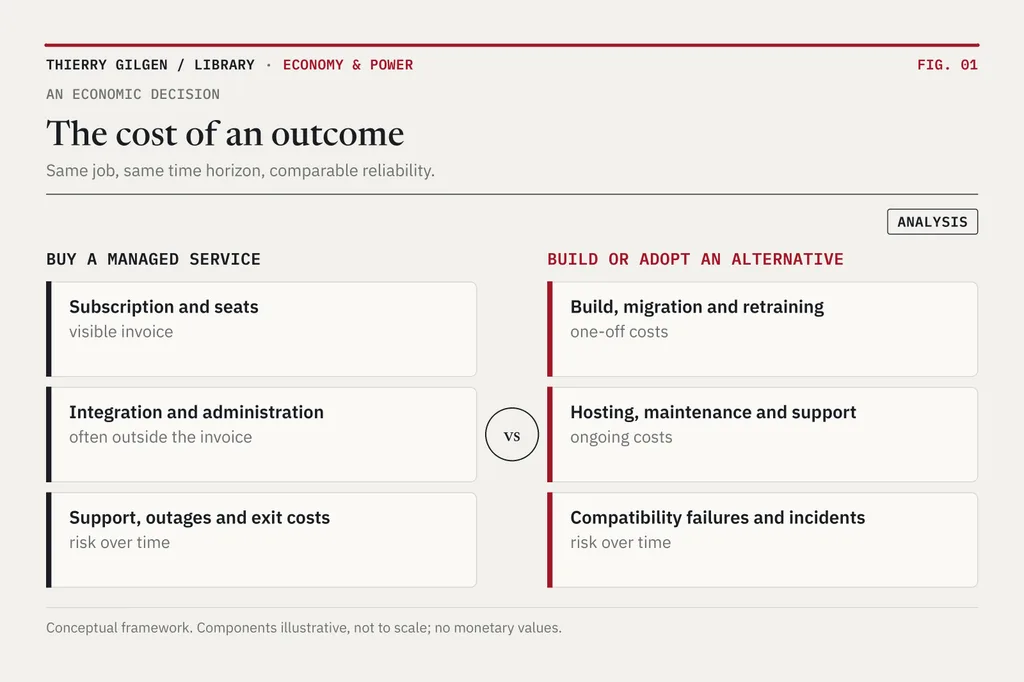
The crucial calculation is not subscription versus no subscription. It is **total cost of obtaining the outcome**, across a realistic operating life.
Figure 1. The relevant decision is not subscription against free download. It is the cost of reliably finishing the same job over time. Components are conceptual, not proportional.
## 3. Three things that are sold under one name
The word SaaS conceals three distinct propositions.
**The tool.** A supplier offers a function: crop an image, generate a chart, store a note, convert a file. A tool can be excellent. But if its core behaviour becomes easy to reproduce, commodity pricing pressure is plausible.
**The operator.** A supplier assumes ongoing responsibility: service uptime, correct calculations, regulatory adaptation, support, safe migrations, interoperability, managed data, maintenance and continuity. Customers may rationally pay indefinitely because the responsibility is itself perpetual.
**The gatekeeper.** A supplier monetises dependency: proprietary hand-offs, non-portable histories, licences difficult to unwind, proprietary ecosystems, a maze of seats and entitlements, or barriers that make leaving more painful than staying. Some of that dependency arises from genuine complexity or beneficial network effects. Some is a commercial design choice.
A business can be all three. No honest analysis should pretend that every expensive software company is merely a gatekeeper. The relevant question is how much of the price is earned by current value, and how much can be demanded because alternatives are hard to reach.
## 4. The two projects that made this argument tangible
In October 2026, two GitHub projects circulated through discussions of software’s future. They illuminate different parts of the story. They should not be presented as one project.
**REA — Reverse Engineer Anything**, published at `github.com/morluto/rea`, is an MIT-licensed toolkit that connects AI agents to reverse-engineering workflows. It supports inspection of software behaviour, JavaScript and Electron artefacts, .NET assemblies and native binaries through tools such as Ghidra, Hopper or IDA, where applicable. Its published example investigations include an older game, a Notion clipboard-bridge trace and another historical binary reconstruction. It does **not** claim to be an automatic Adobe copier. Its own documentation says it does not recover original source code automatically, and its responsible-use policy explicitly rejects unauthorised copying and circumvention.[^3][^4]
**ArtCraft’s Crafting Apps**, at `getartcraft.com/apps` and `github.com/storytold`, are a separate family of AI-assisted, open-source applications written in Rust. The site listed **thirteen** applications in the page snapshot inspected on 14 October: image editing, vector illustration, video, photo management, PDFs, effects, page layout, interface design, word processing, audio, presentations, CAD and spreadsheets. The projects aim at familiar workflows rather than asking customers to relearn every gesture. They are advertised as locally operating, source-visible and callable by agents using CLI/JSON/MCP interfaces.[^5][^6]
The publicly documented development story credits AI coding assistants, particularly Claude, and the developer’s engineering work. **No verified source in this research establishes that REA was the tool ArtCraft used to build its suite.** In fact, a public issue opened in ArtCraft’s own repository on 12 October asks whether the team has considered using REA; it remained open with no replies when checked on 14 October. That is not proof of non-use, but it does establish how premature the alleged connection is. It would be a factual mistake to tell readers that REA recreated Adobe.[^3][^7][^8]
The larger significance is a pairing of capabilities, not a demonstrated causal chain: it is becoming easier to *understand an existing interface* and easier to *build a competing implementation*. The older software company must defend something more substantial than the complexity of its menu system.
## 5. ArtCraft: a startling amount of code is not yet a professional replacement
ArtCraft is worth taking seriously. Its public repositories contain substantive source code, tests, documentation, installers, release processes and detailed gap registers—not merely concept images. PhotoCraft is described as an early-alpha Photoshop-style editor with layers, masks, PSD/PSB handling and automation. FilmCraft targets Premiere-style editing and has its own codec and project infrastructure. Other apps target Lightroom, Illustrator, After Effects, Acrobat and InDesign workflows, with additional productivity categories emerging.[^5][^6][^9]
Open-source creative alternatives long predate AI: GIMP, Krita, Inkscape, Blender and other communities have spent decades proving that serious creative software need not be sold as a proprietary subscription. ArtCraft’s novelty is not the invention of free alternatives; it is the rapid construction of a *coordinated suite* that deliberately reduces retraining costs by using familiar workflows. That distinction matters when discussing who deserves credit for software freedom.
But the claim that it has already rebuilt Adobe’s products into equivalents that are “really good” requires a specific question: **good at which task, on which build, using which files, on which machine?**
In a hands-on test published 10 October, TechRadar’s Steve Paris found PhotoCraft familiar but reported unreliable selections, trouble handling his HEIC images, and problems with PSD save behaviour on his tested machine. FilmCraft could import clips and offered a recognisable interface but exhibited failed trimming interaction, slow responsiveness and unusable audio playback from the test material. That is one review on a particular machine, not proof that subsequent commits failed to fix the issues; it is also stronger evidence of real user experience than stars or screenshots.[^10]
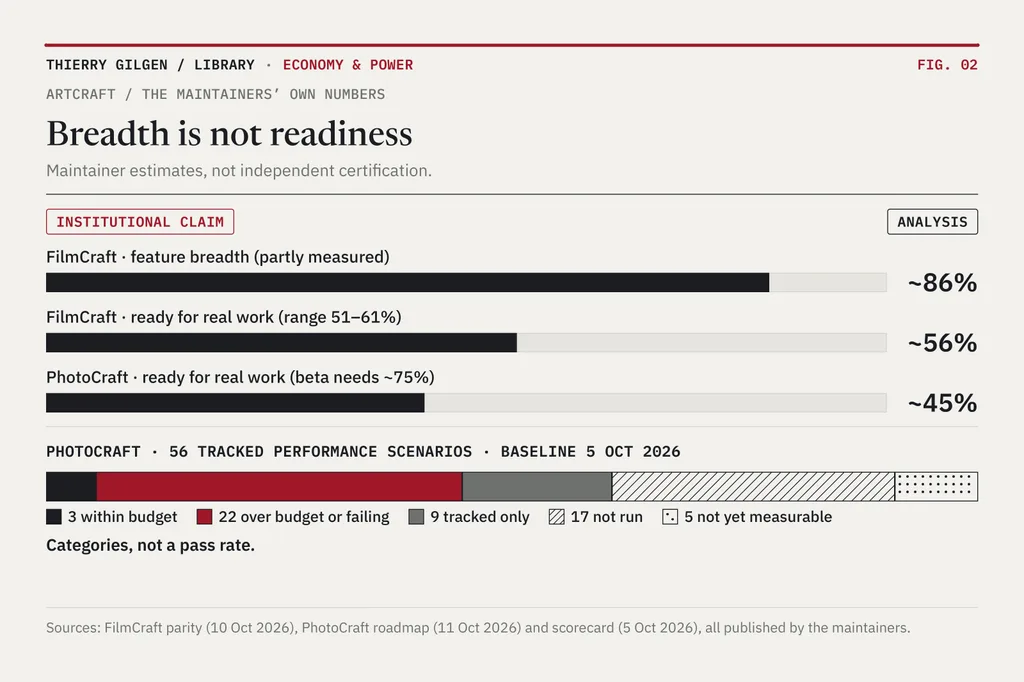
ArtCraft’s own documentation supplies the more revealing evidence. PhotoCraft’s published performance scorecard, based on an October 5 run on an Apple M4 Pro, records **3 of 56 tracked performance scenarios as within budget**, with many scenarios over budget, unrun or not measurable. The document reports a **p95 of 535 ms** for an operation targeting 25 ms, a particularly noticeable discrepancy for interactive editing. Those results are the project’s own benchmark snapshot, not our independent performance test.[^11]
The PhotoCraft gaps ledger updated 13 October calls PSD interoperability and Photoshop acceptance a beta blocker. Its 11 October roadmap separately estimated its own readiness for real work at around **45%**, far short of its stated beta goal near 75%.[^12] Its recorded Photoshop comparison oracles pass approximately **145 of 258** cases in one tracked group; the corpus pass rate depends sharply on which reference set and which operation is measured. The ledger also describes export and round-trip problems. It would be misleading to take a more flattering figure from a marketing-facing README and call it universal Photoshop compatibility.[^13]
FilmCraft’s maintainers present two radically different numbers: around **86% feature breadth**, by their mixed measured-and-estimated method, but only **about 56% readiness for real work**, with an estimated range of 51–61%. They identify missing native `.prproj` import, incomplete hardware support, crash reports, audio reliability issues and a lack of cross-render fidelity comparisons against Premiere. These are self-assessments, not external certifications.[^14][^15]
The honest conclusion is not that ArtCraft is a hoax. It is that **producing a large alternative has become possible faster than validating it as a complete substitute**. That fact should impress us without persuading us to discard quality assurance.
Figure 2. ArtCraft’s own estimates for FilmCraft and PhotoCraft show why feature inventories cannot establish professional interchangeability. PhotoCraft’s 5 October benchmark tracked 56 scenarios with different test statuses; the categories are not an overall pass rate. Sources: FilmCraft parity document, PhotoCraft roadmap and scorecard, published by the maintainers.
## 6. The historical incumbent is not collapsing: Adobe in 2026
Adobe is an unusually useful case because it concentrates a long-running professional ecosystem, a subscription model, file-format expectations and strong user frustration in one company.
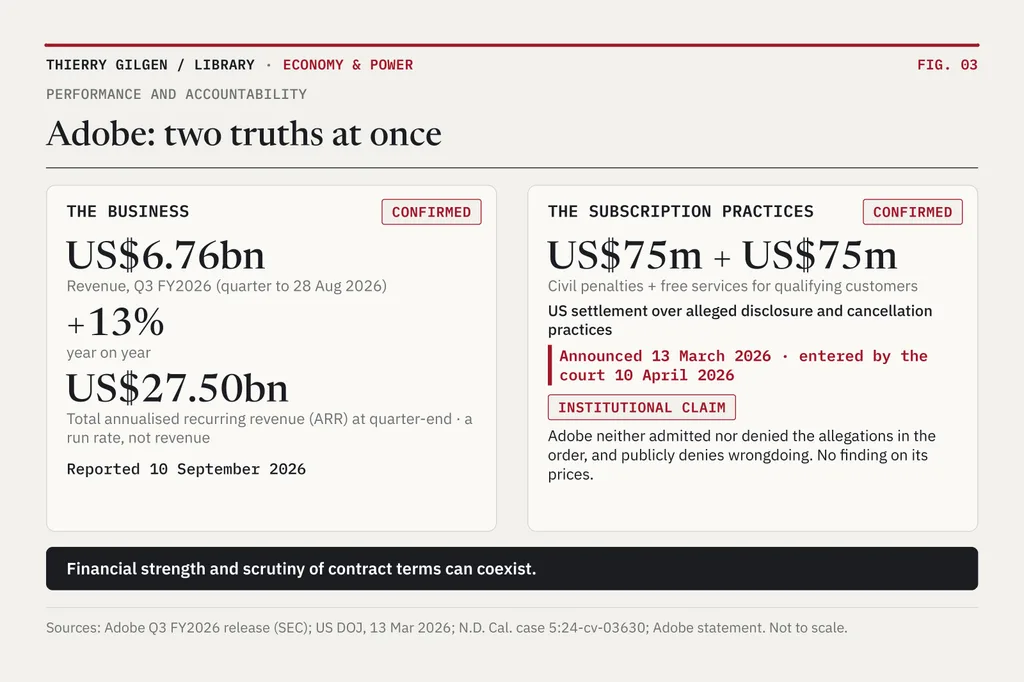
In its September 10, 2026 Q3 earnings release, Adobe reported **$6.76 billion quarterly revenue**, **13% year-on-year growth** and **$27.50 billion in total annualised recurring revenue at quarter-end**. Its consumer/professional group subscription revenues also grew. These results do not describe a dying company. They indicate an incumbent that still delivers software customers pay for, despite competitive pressure and investor worries about future growth.[^16]
The company’s published US individual pricing illustrates the economics that attract criticism. Adobe lists Creative Cloud Standard at **US$54.99/month**, and Creative Cloud Pro at **US$69.99/month**, for **annual commitments billed monthly**, before tax and excluding temporary promotional discounts. The month-to-month Pro price is higher. US list pricing should not be passed off as the user’s Swiss bill. At $69.99 for twelve instalments, Pro represents **$839.88 in advertised monthly charges per contract year**, before any tax or discounts. That is not by itself exploitative: an effective professional may recoup that sum in one job.[^17]
What matters is the balance between value and exit. A professional with years of editable Adobe documents, third-party plug-ins, shared templates, proprietary project files and colleagues on the same stack cannot evaluate a replacement by looking only at the monthly line item. A migration that loses editability, effects, metadata or reliable interchange can consume more time than the subscription saves.
For the supplier, that dependency can be valuable. For the customer, it can be a trap, even when the original decision to subscribe made perfect sense.
## 7. When the subscription model became a legal case
This is not merely an online complaint about a price tag. In June 2024, the US government sued Adobe and two executives over allegations concerning disclosure of early termination fees and difficult cancellation procedures under the Restore Online Shoppers’ Confidence Act. The lawsuit **alleged** wrongdoing; an allegation is not a finding of liability.[^18]
On 13 March 2026, the Department of Justice announced a **proposed $150 million settlement framework**: **$75 million in civil penalties and $75 million in free services for qualifying customers**, alongside provisions addressing disclosures, trial reminders and cancellation. Adobe publicly said it denied wrongdoing and disagreed with the government’s allegations while agreeing to resolve the case. The DOJ announcement described an order subject to entry by the court, and the court entered it on 10 April 2026. In that order Adobe neither admitted nor denied the allegations; reporting should not quietly upgrade it into an adjudicated conviction.[^19][^20]
We should distinguish an important thing: the case concerned marketing, disclosure and cancellation practices. It did not legally establish that Adobe’s software was overpriced, that its subscriptions were invalid, or that all SaaS is abusive.
Yet it shows why freedom to leave is central to the value debate. A subscription can be a reasonable way to pay for ongoing work. It becomes much harder to justify if the subscriber cannot understand the commitment or exit without costly surprises.
Figure 3. Adobe reported Q3 FY2026 revenue of US$6.76bn (+13%) and US$27.50bn in quarter-end ARR. Separately, the US Department of Justice announced a settlement addressing alleged subscription practices — $75m in penalties and $75m in free services — which the court entered on 10 April 2026; Adobe neither admitted nor denied the allegations. Not plotted to scale. Sources: Adobe, US DOJ, court record, Adobe statement.
## 8. A familiar interface, a foreign file, and the real switching bill
The ArtCraft developers made a strategically shrewd choice: familiar panels and shortcuts lower retraining costs. If a designer’s hands already know the operation, learning the alternative may be cheap.
But interface familiarity is not the same as file compatibility, and file compatibility is not the same as operational equivalence. A project can open but lose the adjustment layer that made it editable. A video timeline can import through a neutral exchange format but lose effects, markers or audio metadata. A screenshot can look identical while real-time editing feels unusable.
This is the hidden cost of migration. It is also the heart of the incumbent’s defence: years of tested edge cases, plug-ins, codecs, device integrations, professional conventions and collaboration workflows. A new entrant must cross that distance one broken file and one customer deadline at a time.
A serious alternative should be measured along at least five independent dimensions: **feature presence, behavioural fidelity, file interchange, performance/reliability and ecosystem compatibility**. The public appetite for a replacement is not a measurement of any of them.
The ArtCraft team’s willingness to publish gap documents is notable. Its own beta blockers reveal why a product demonstration and a product business are different achievements. The documents give us unusually concrete evidence for the point that development and operation are not the same cost centre.
## 9. Reverse engineering changes the balance, but legality still matters
REA points to a second change. Historically, suppliers could make it difficult even to understand how a familiar feature worked. Inspection tools and AI assistance reduce that obscurity. If a competitor can reproduce *behaviour*, the original vendor has to rely more heavily on execution, trust, support, interoperability and distribution.
This is not a blanket legal permission to copy software. In the European Union, the Court of Justice ruled in *SAS Institute v World Programming* (2012) that software functionality, programming language and certain data-file formats are not, as such, protected expression under the computer-program copyright regime. The judgment does not waive the protection of original code, graphics, manuals or other protected expression. EU Directive 2009/24/EC includes a **limited** exception for decompilation indispensable to interoperability, with strict conditions.[^21][^22]
In the United States, *Google v Oracle* (2021) held the specific copying of certain Java API declarations to be fair use in its circumstances; it is not a universal licence to clone creative software. Trademarks, visual trade dress, contracts, patents, technical protection measures and jurisdiction-specific rules can still matter.[^23]
REA’s own responsible-use guidance excludes unauthorised reproduction of protected code or assets and DRM circumvention. ArtCraft describes its applications as independent clean-room projects. That description is a developer claim, not an independent legal clearance; auditing provenance would require more than reading the front page of a repository.[^4][^6]
The case therefore supports a narrower, important proposition: **greater reproducibility of software behaviour can discipline an incumbent’s pricing power, provided alternatives are actually interoperable and lawful.**
## 10. AI makes writing cheaper. Evidence may become more expensive.
There is no single honest multiplier for AI-assisted development. A 2025 field experiment across three workplaces involving 4,867 developers found a combined 26.08% increase in completed tasks for developers with a coding assistant. A different randomised study by METR of 16 experienced open-source maintainers doing 246 tasks in familiar repositories found AI tools from early 2025 associated with **19% longer completion time**. The experiments studied different tasks, developers, systems and periods. Neither result can be used as a universal forecast for the other.[^24][^25]
The practical distinction: an agent can produce code faster than the team can establish that it meets every obligation. The ArtCraft story is evidence of astonishing *output*. The same project’s performance and file-compatibility documents are evidence of the remaining *verification debt*.
The economic change may be asymmetric. The cost of generating a plausible interface falls first. The cost of proving that it can be trusted with a critical project falls more slowly. A company that has always earned its subscription through dependable operation retains a reason to exist. A company charging primarily for a thin wrapper around a simple function faces a more immediate problem.
## 11. A second revolution: the right to leave
Artificial intelligence is not the only force changing the market. Europe’s Data Act introduces obligations intended to reduce barriers to switching among data processing services. The European Commission explains that customers should be able to export data using common machine-readable formats and that covered switching charges will be prohibited from **12 January 2027**. Scope, technical exceptions and implementation details matter; the Data Act should not be described as magically making every app interchangeable.[^26]
The policy direction is notable: the regulator is addressing something the market alone has often failed to resolve. Competition is limited not only when newcomers cannot build alternatives, but when customers cannot take their own work to them.
A customer cannot exercise genuine choice while their history remains hostage. And a vendor cannot credibly claim it is retained for its value when leaving has been made deliberately punitive.
## 12. The next gatekeepers may sit one layer lower
It would be easy to write a triumphant ending: the old gates fall, developers rebuild every tool, customers become free.
But AI does not abolish dependency. It changes its location. New applications may depend on proprietary coding agents, foundation-model providers, GPU and cloud infrastructure, distribution platforms, hosted identity, payment systems and data feeds. The software used to escape one subscription may carry new recurring costs behind the scenes.
There is also an uncomfortable open-source reality. A free download has a price to maintain. Who tests the next operating-system release? Who fixes a document-corruption bug? Who signs and distributes safe binaries? Who responds when a collaborator can’t finish an urgent delivery? A community can provide these things, but somebody must do the work.
So the argument must apply equally to new companies. An AI-native vendor is not morally superior because its original code cost less. It still needs to earn the customer’s trust, explain its pricing, respect their data and let them leave.
## 13. What software companies should sell now
A defensible subscription starts with a customer’s outcome and continues to earn its place.
For straightforward tools, this may mean a low recurring fee, a one-time purchase, open-source software with optional support, or usage-based pricing. For complicated and regulated workflows, it may mean a managed service, clear service commitments, expert upkeep, integrations, evidence trails and reliable human escalation. Seat counts are not always good proxies for value when automated systems perform the work; outcomes, usage, capacity and responsibility may be more intelligible units.
None of those models guarantees fairness. Usage pricing can create unpredictability. Outcome pricing can misattribute causality. Support subscriptions can become protection money if interoperability is intentionally blocked. The test is not the billing vocabulary; it is whether a customer can see what is being delivered.
The useful question for a vendor is: **If customers could migrate tomorrow with their files, histories and integrations intact, how many would still choose us—and why?**
That question does not threaten good software. It helps identify it.
## 14. What ArtCraft has already changed
As of 14 October 2026, ArtCraft has not established that professional creators can replace the entire Adobe Creative Cloud suite without loss. On available evidence, that would be an exaggeration.
What it has established is more interesting: the effort needed to produce serious-looking, materially functional challengers is falling, and challengers can publish not only screenshots but working binaries, transparent issues and detailed tests in an exceptionally compressed timescale.
Adobe’s financial results show that customers still pay for mature tools. The ArtCraft gap registers show why. The settlement over subscription disclosure shows that value and commercial conduct are separate questions. REA shows that a competing developer’s ability to understand incumbent behaviour is improving. All four facts can be true at once.
The contest will not be decided by whose application looks most like Photoshop in a screenshot. It will be decided by whether the alternative can carry a real user’s work safely, whether the original continues to justify its bill, and whether the user remains free to choose.
**SaaS is not dead. But the right to collect a subscription merely because a customer has nowhere else to go is becoming less secure.**
That is a change worth welcoming—not because software will be free, but because software may once again have to earn its price.
## Method and limitations
This piece combines primary documents (GitHub repositories and maintainers’ own benchmarks, Adobe pricing and SEC-hosted earnings releases, US DOJ/Adobe settlement announcements, EU legislation and court judgments), third-party hands-on testing, and published studies of developer productivity. GitHub stars, commit counts, estimated parity percentages and claims of clean-room construction are **not** independent quality or legal certifications. ArtCraft is updating rapidly: repository claims and an external review from days earlier can diverge, and must be dated. No local binary was installed or subjected to an independent benchmark in preparing this research. Dollar prices are US list prices for the specified individual plans, not Swiss quotes. This article expresses an economic interpretation, not a securities recommendation or legal opinion. Full references appear in the Sources.
## Sources
[^1]: Gartner, 19 November 2024. [Gartner Forecasts Worldwide Public Cloud End-User Spending to Total $723 Billion in 2025](https://www.gartner.com/en/newsroom/press-releases/2024-11-19-gartner-forecasts-worldwide-public-cloud-end-user-spending-to-total-723-billion-dollars-in-2025). Market forecast for SaaS spending in 2025; not realised spending, and later forecasts may revise it.
[^2]: Adobe, 10 December 2025, SEC Exhibit 99.1. [Adobe Reports Record Q4 and FY2025 Revenue](https://www.sec.gov/Archives/edgar/data/796343/000079634325000135/adbeex991q425.htm). Company-reported results; revenue says nothing about how much is value and how much is dependency.
[^3]: morluto, GitHub, checked 14 October 2026. [REA: Reverse Engineer Anything](https://github.com/morluto/rea). MIT licence. The project’s own description of an inspection toolkit; it does not show use on any particular product.
[^4]: morluto, GitHub, checked 14 October 2026. [REA responsible-use disclaimer](https://github.com/morluto/rea/blob/main/DISCLAIMER.md). A project policy, not a legal opinion or a guarantee of how every user behaves.
[^5]: ArtCraft, checked 14 October 2026. [Crafting Apps](https://getartcraft.com/apps). Thirteen apps listed on 14 October, three marked early alpha and ten in development; the count has changed during the story.
[^6]: storytold, GitHub, checked 14 October 2026. [PhotoCraft repository and README](https://github.com/storytold/photocraft). Developer claims, including clean-room construction; not independently audited.
[^7]: Creative Bloq, 8 October 2026. [Someone just rebuilt Adobe Creative Cloud with AI, then gave it away for free](https://www.creativebloq.com/design/design-software/someone-just-rebuilt-adobe-creative-cloud-with-ai-then-gave-it-away-for-free). Press report crediting the developer and AI coding tools, Claude among them; it does not mention REA.
[^8]: storytold/artcraft, GitHub issue 2223, opened 12 October 2026. [Have you considered using REA (Reverse Engineer Anything) as a development tool?](https://github.com/storytold/artcraft/issues/2223). Open with no comments when checked on 14 October 2026. An unanswered question proves neither use nor non-use.
[^9]: storytold, GitHub, checked 14 October 2026. [FilmCraft repository and README](https://github.com/storytold/filmcraft). Developer documentation; a feature list is not functional fidelity.
[^10]: Steve Paris, TechRadar, 10 October 2026. [One dev is recreating 7 Adobe apps in Rust for free, so I tested it out](https://www.techradar.com/pro/one-dev-is-recreating-7-adobe-apps-in-rust-for-free-so-i-tested-it-out). Independent hands-on review; one reviewer, one machine, one build.
[^11]: storytold, GitHub, baseline 5 October 2026. [PhotoCraft performance and interoperability scorecard](https://github.com/storytold/photocraft/blob/main/docs/scorecard.md). Of 56 tracked performance scenarios: 3 within budget, 22 over budget or failing, 9 tracked only, 17 not run, 5 not yet measurable. The maintainers’ own benchmark on an Apple M4 Pro, not an independent test and not a pass rate.
[^12]: storytold, GitHub, updated 11 October 2026. [PhotoCraft roadmap](https://github.com/storytold/photocraft/blob/main/docs/roadmap.md). Stage alpha; ready for real work about 45%, beta threshold about 75%. A maintainer estimate, not a measured score.
[^13]: storytold, GitHub, updated 13 October 2026. [Where PhotoCraft falls short of Photoshop](https://github.com/storytold/photocraft/blob/main/docs/gaps.md). Gaps ledger: PSD fidelity and Photoshop acceptance block beta; Photoshop-oracle floor 145 of 258. Several test corpora; no single compatibility percentage applies.
[^14]: storytold, GitHub, updated 10 October 2026. [FilmCraft parity with Adobe Premiere Pro](https://github.com/storytold/filmcraft/blob/main/docs/target-app-parity.md). Feature breadth about 86%, partly measured; ready for real work about 56% (range 51–61%). Maintainer estimates, not third-party certification.
[^15]: storytold, GitHub, checked 14 October 2026. [FilmCraft outstanding gaps against Premiere](https://github.com/storytold/filmcraft/blob/main/docs/gaps.md). Premiere’s own project files cannot be opened; audio, hardware and render-comparison gaps. A backlog that changes quickly.
[^16]: Adobe, 10 September 2026, SEC Exhibit 99.1. [Adobe Reports Record Q3 Results](https://www.sec.gov/Archives/edgar/data/796343/000079634326000147/adbeex991q326.htm). Quarterly revenue is income earned in the quarter; total ARR is an annualised run rate at quarter-end. The two are not interchangeable.
[^17]: Adobe Help, last updated 12 February 2026, checked 14 October 2026. [Changes to Creative Cloud for individuals plans](https://helpx.adobe.com/account/individual/subscriptions-and-plans/plan-types-and-eligibility/changes-to-individual-plan.html). US prices for an annual contract billed monthly, before tax; month-to-month is higher. Not Swiss prices.
[^18]: US Federal Trade Commission. [Adobe, Inc., U.S. v.](https://www.ftc.gov/legal-library/browse/cases-proceedings/222-3055-adobe-inc-us-v); [press release, June 2024](https://www.ftc.gov/news-events/news/press-releases/2024/06/ftc-takes-action-against-adobe-executives-hiding-fees-preventing-consumers-easily-cancelling). Complaint filed by the Department of Justice on referral from the FTC. Allegations, not findings.
[^19]: US Department of Justice, 13 March 2026. [Adobe Agrees to $150 Million Settlement and Injunction to Resolve Alleged Violations of the Restore Online Shoppers’ Confidence Act](https://www.justice.gov/opa/pr/adobe-agrees-150-million-settlement-and-injunction-resolve-alleged-violations-restore-online); US District Court, Northern District of California, case 5:24-cv-03630, [stipulated order, entered 10 April 2026](https://www.govinfo.gov/content/pkg/USCOURTS-cand-5_24-cv-03630/pdf/USCOURTS-cand-5_24-cv-03630-2.pdf) and [final judgment, 10 April 2026](https://www.govinfo.gov/content/pkg/USCOURTS-cand-5_24-cv-03630/pdf/USCOURTS-cand-5_24-cv-03630-3.pdf). Adobe neither admitted nor denied the allegations; a settlement, not an adjudicated finding of liability.
[^20]: Adobe Newsroom, 13 March 2026. [Adobe Statement Regarding the Department of Justice Settlement](https://news.adobe.com/news/2026/03/adobe-statement). The company’s position: it disagrees with the claims and denies wrongdoing.
[^21]: Court of Justice of the European Union, 2 May 2012, case C-406/10. [SAS Institute Inc. v World Programming Ltd](https://eur-lex.europa.eu/legal-content/EN/TXT/?uri=CELEX%3A62010CA0406). Functionality, programming language and data-file formats are not protected as such; other protection can still apply.
[^22]: European Union, 23 April 2009. [Directive 2009/24/EC on the legal protection of computer programs](https://eur-lex.europa.eu/legal-content/en/TXT/?uri=CELEX%3A32009L0024). Article 6: a limited decompilation exception for interoperability, under strict conditions. Not legal advice.
[^23]: Supreme Court of the United States, 5 April 2021, via Cornell LII. [Google LLC v. Oracle America, Inc.](https://www.law.cornell.edu/supremecourt/text/18-956). Fair use on a specific record; not a general licence to copy application code, assets or brands.
[^24]: Kevin Zheyuan Cui, Mert Demirer, Sonia Jaffe, Leon Musolff, Sida Peng and Tobias Salz, Microsoft Research, 2025. [The Effects of Generative AI on High-Skilled Work: Evidence from Three Field Experiments with Software Developers](https://www.microsoft.com/en-us/research/publication/the-effects-of-generative-ai-on-high-skilled-work-evidence-from-three-field-experiments-with-software-developers/). Completed tasks in three workplaces; not a measure of product delivery, safety or maintenance.
[^25]: METR (Joel Becker, Nate Rush, Elizabeth Barnes and David Rein), July 2025. [Measuring the Impact of Early-2025 AI on Experienced Open-Source Developer Productivity](https://metr.org/Early_2025_AI_Experienced_OS_Devs_Study-paper.pdf). Small randomised study in familiar repositories; specific to its tasks and period.
[^26]: European Commission, checked 14 October 2026. [Data Act explained](https://digital-strategy.ec.europa.eu/en/factpages/data-act-explained). The Data Act applies since 12 September 2025; switching charges for data processing services end on 12 January 2027. Scope and exceptions apply; it does not make every application interchangeable.
## Connected reading
- [The Exit Test](https://www.thierry-gilgen-ict.ch/field-notes/the-exit-test)
- [Open Is Not Sovereign](https://www.thierry-gilgen-ict.ch/field-notes/open-is-not-sovereign)
- [Inherited Trust Is Not a Product](https://www.thierry-gilgen-ict.ch/field-notes/inherited-trust-is-not-a-product)
- [The Work Between the Prompts](https://www.thierry-gilgen-ict.ch/field-notes/the-work-between-the-prompts)